Weekly Markets Monitor: Calm interrupted
Weekly Markets Monitor
Highlights
- Last week was a rollercoaster of highs and lows. Israel and Hamas agreed a peace plan, while US-China trade tensions re-escalated. The US government shutdown continued, political stability concerns grew in France and Japan, and Chinese Golden Week holiday spending showed mixed signals.
- Global equity markets closed the week lower after Friday's sell-off, with bond yields, the US dollar, and oil prices also falling.
- Gold broke through US$4,000 last week – here’s our blog on it, notching a 45th new high for the year and taking the y-t-d return to 52%. Silver and platinum have forged ahead to new highs as well. Gold’s rampant performance has probably raised concerns about its near-term capacity to act as a hedge. It was put to the test on Friday, when renewed tariff tensions jolted markets and sent equities and cryptocurrencies tumbling. Although merely an intraday move, gold did what gold often does best – protect investor portfolios (COTW).
Chart of the week - Gold just doing its goldy thing
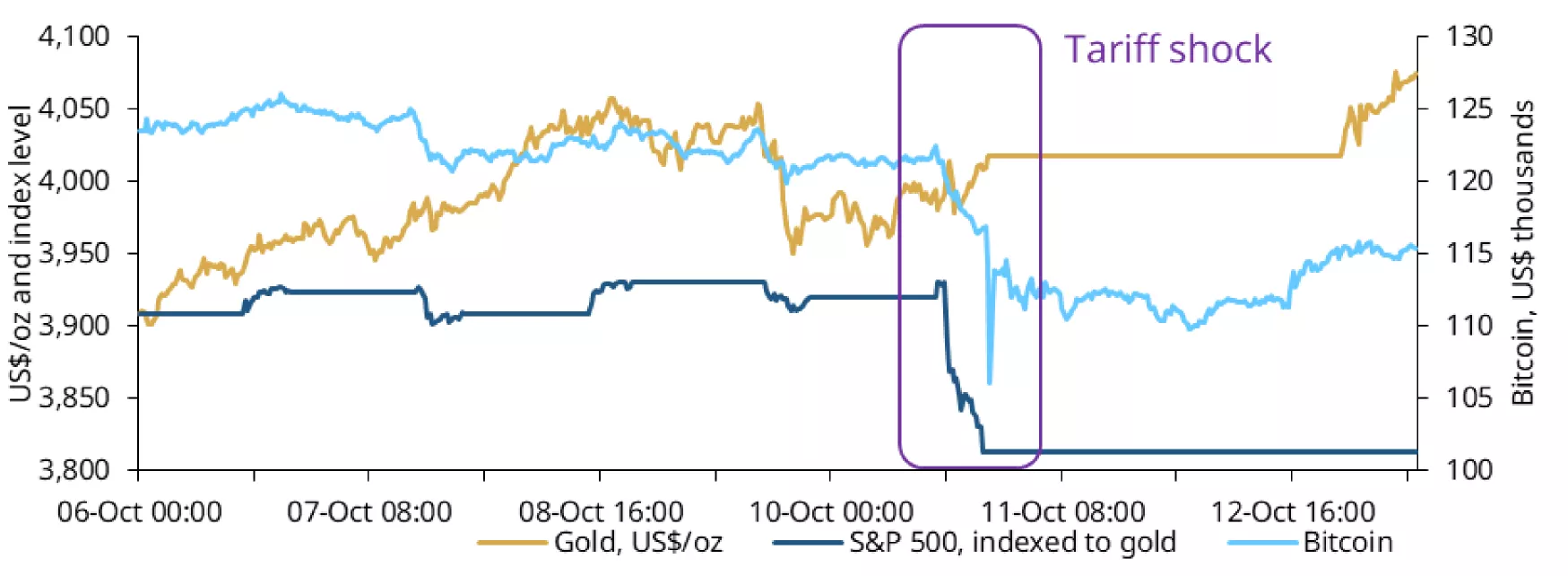
Data to 12 October 2025.
Source: Bloomberg, World Gold Council
Disclaimer
Important information and disclaimers
© 2025 World Gold Council. All rights reserved. World Gold Council and the Circle device are trademarks of the World Gold Council or its affiliates.
All references to LBMA Gold Price are used with the permission of ICE Benchmark Administration Limited and have been provided for informational purposes only. ICE Benchmark Administration Limited accepts no liability or responsibility for the accuracy of the prices or the underlying product to which the prices may be referenced. Other content is the intellectual property of the respective third party and all rights are reserved to them.
Reproduction or redistribution of any of this information is expressly prohibited without the prior written consent of World Gold Council or the appropriate copyright owners, except as specifically provided below. Information and statistics are copyright © and/or other intellectual property of the World Gold Council or its affiliates or third-party providers identified herein. All rights of the respective owners are reserved.
The use of the statistics in this information is permitted for the purposes of review and commentary (including media commentary) in line with fair industry practice, subject to the following two pre-conditions: (i) only limited extracts of data or analysis be used; and (ii) any and all use of these statistics is accompanied by a citation to World Gold Council and, where appropriate, to Metals Focus or other identified copyright owners as their source. World Gold Council is affiliated with Metals Focus.
The World Gold Council and its affiliates do not guarantee the accuracy or completeness of any information nor accept responsibility for any losses or damages arising directly or indirectly from the use of this information.
This information is for educational purposes only and by receiving this information, you agree with its intended purpose. Nothing contained herein is intended to constitute a recommendation, investment advice, or offer for the purchase or sale of gold, any gold-related products or services or any other products, services, securities or financial instruments (collectively, “Services”). This information does not take into account any investment objectives, financial situation or particular needs of any particular person.
Diversification does not guarantee any investment returns and does not eliminate the risk of loss. Past performance is not necessarily indicative of future results. The resulting performance of any investment outcomes that can be generated through allocation to gold are hypothetical in nature, may not reflect actual investment results and are not guarantees of future results. The World Gold Council and its affiliates do not guarantee or warranty any calculations and models used in any hypothetical portfolios or any outcomes resulting from any such use. Investors should discuss their individual circumstances with their appropriate investment professionals before making any decision regarding any Services or investments.
This information may contain forward-looking statements, such as statements which use the words “believes”, “expects”, “may”, or “suggests”, or similar terminology, which are based on current expectations and are subject to change. Forward-looking statements involve a number of risks and uncertainties. There can be no assurance that any forward-looking statements will be achieved. World Gold Council and its affiliates assume no responsibility for updating any forward-looking statements.
Information regarding QaurumSM and the Gold Valuation Framework
Note that the resulting performance of various investment outcomes that can be generated through use of Qaurum, the Gold Valuation Framework and other information are hypothetical in nature, may not reflect actual investment results and are not guarantees of future results. Neither World Gold Council (including its affiliates) nor Oxford Economics provides any warranty or guarantee regarding the functionality of the tool, including without limitation any projections, estimates or calculations.
Get updates in your inbox
Make sure you are subscribed
Get email updates
China gold market update: Wholesale demand rebounded
Ray Jia
Head of Research (Asia Pacific, ex-India) and Deputy Head of Trade Engagement (China) World Gold CouncilHighlights
- Gold continues to shine. The LBMA Gold Price PM in USD and the Shanghai Benchmark Gold Price PM (SHAUPM) in RMB both soared by 12% last month, extending y-t-d gains to levels unseen for decades
- Gold withdrawals from the Shanghai Gold Exchange (SGE) reached 118t in September, 33t higher m/m and 4t higher y/y; Q3 ended with a total withdrawal of 297t, 9t lower y/y
- Chinese gold ETFs saw inflows in September (RMB4.5bn, US$622mn), narrowing their Q3 losses, and gold futures activity on the Shanghai Futures Exchange (SHFE) improved notably
- The People’s Bank of China (PBoC) reported its 11th consecutive monthly gold purchase, adding 1.2t in September and pushing the Q3 total to 5t.
Looking ahead
- After re-stocking in September, gold jewellery retailers will likely dial back their replenishment in October, following seasonal trends. Furthermore, the gold price rally may continue to weigh on gold jewellery consumption, adding to retailer caution.
- Investment demand for gold may be buoyed by the attractive gold price rally, particularly when the local equity momentum took a hit amid flaring US-China tension.
Chart 1: The SHAUPM saw its strongest Q1~Q3 performance since its launch in 2016
Cumulative return of the SHAUPM in RMB between Q1 and Q3*
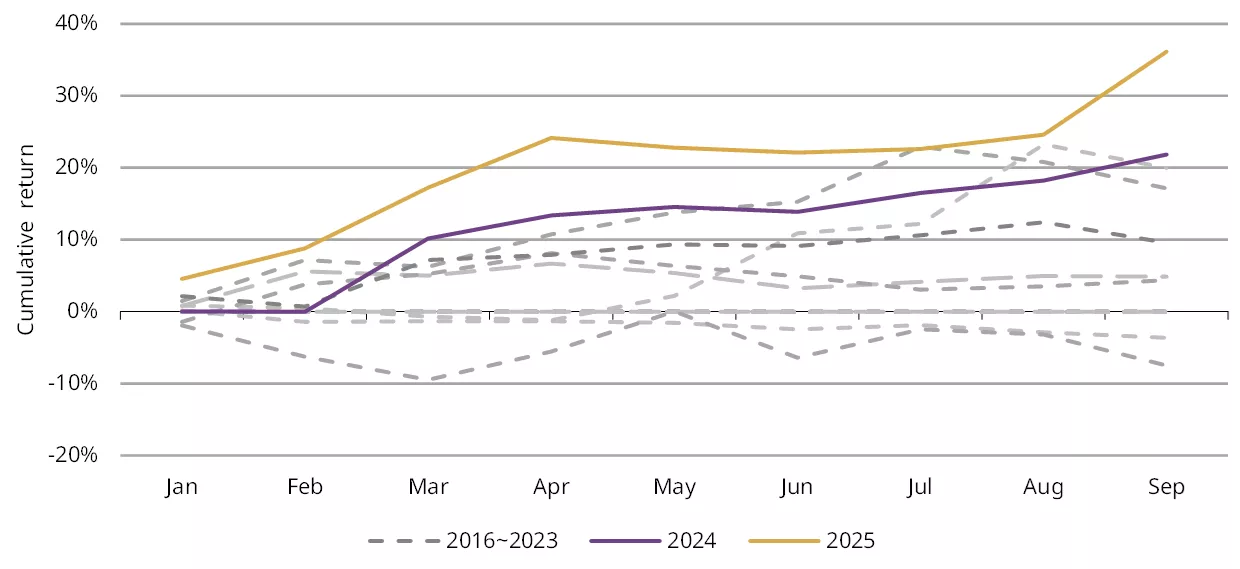
*Data based on SHAUPM monthly returns between May 2016 and September 2025 as the SHAUPM was launched on 25 April 2016. The dotted grey lines represent cumulative returns between 2017 and 2023.
Source: Shanghai Gold Exchange, World Gold Council
Another record-shattering month
Gold’s strength continued in September. The LBMA Gold Price PM recorded its largest monthly increase since January 2012 and its strongest quarterly performance since Q1 2016. But more notably, the SHAUPM registered its strongest month on record and its second strongest quarter ever with a 14% gain—just behind Q1 2025’s 18% surge.
Having reached record highs 36 times during the first three quarters of 2025, the SHAUPM’s y-t-d return extended to 36%, to date the best year on record (Chart 1). The LBMA Gold Price PM jumped 43% between January and September, the best y-t-d performance since 1979. Gold’s relatively weaker return in China was mainly due to a 4% appreciation in the RMB against the dollar during the period.
It is also worth noting that the gold price has carried its bullish momentum into October, with the LBMA Gold Price PM breaching the US$4,000/oz threshold for the first time ever on 8 October and the SHAUPM surging nearly 5% during the month’s first trading day.1
Wholesale demand ended Q3 with an improving September
Wholesale gold demand saw a 33t m/m rebound in September, reaching 118t; 4t higher y/y (Chart 2). Nonetheless, it remained 33% below the long-term average. Our interactions with market participants inform us that as the gold price resumed its uptrend, bar and coin sales improved during the month, supporting wholesale demand. But some investors took the opportunity to book profits by selling their holdings.
September usually brings a seasonal uplift from manufacturers’ new product launches and retailers’ pre-Golden Week holiday restocking. Yet this year, soaring gold prices and doubts about future sales have tempered retailers' restocking enthusiasm.
Chart 2: Wholesale gold demand improved in September
Monthly gold withdrawals from the SGE*
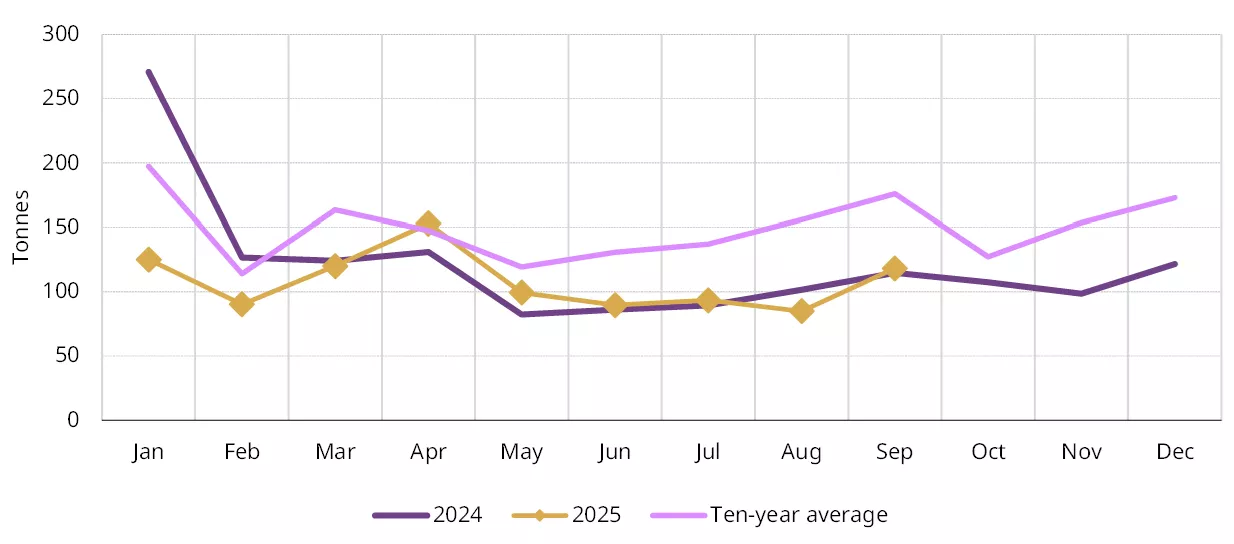
*The 10-year average is based on data between 2015 and 2024.
Source: Shanghai Gold Exchange, World Gold Council
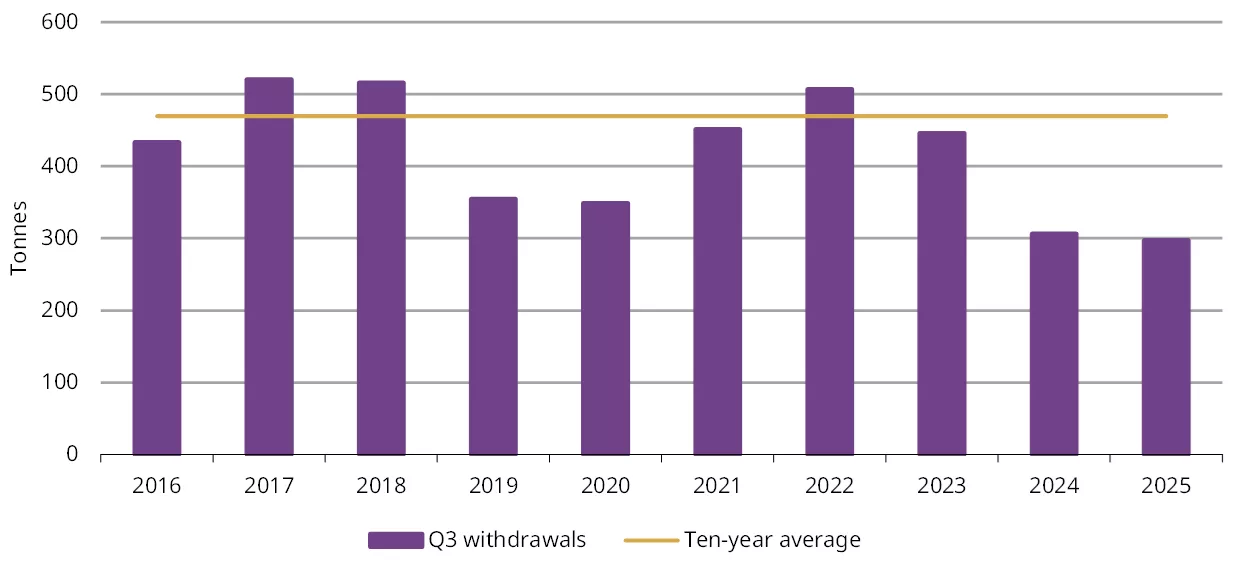
During the first three quarters of 2025 wholesale gold demand reached 297t, a mild 3% y/y fall and 37% below the ten-year average (Chart 3). In this quarter, weakness in the gold jewellery sector outpaced investment strength. For details on gold demand changes in Q3 and our outlook, please stay tuned for our Gold Demand Trends report, which will be released on 30 October.
Chart 3: Gold withdrawals from the SGE remained weak in Q3
Q3 gold withdrawals from the SGE*
*The 10-year average is based on data between 2015 and 2024.
Source: Shanghai Gold Exchange, World Gold Council
Early Q3 Chinese gold ETF losses partially reversed by a positive September
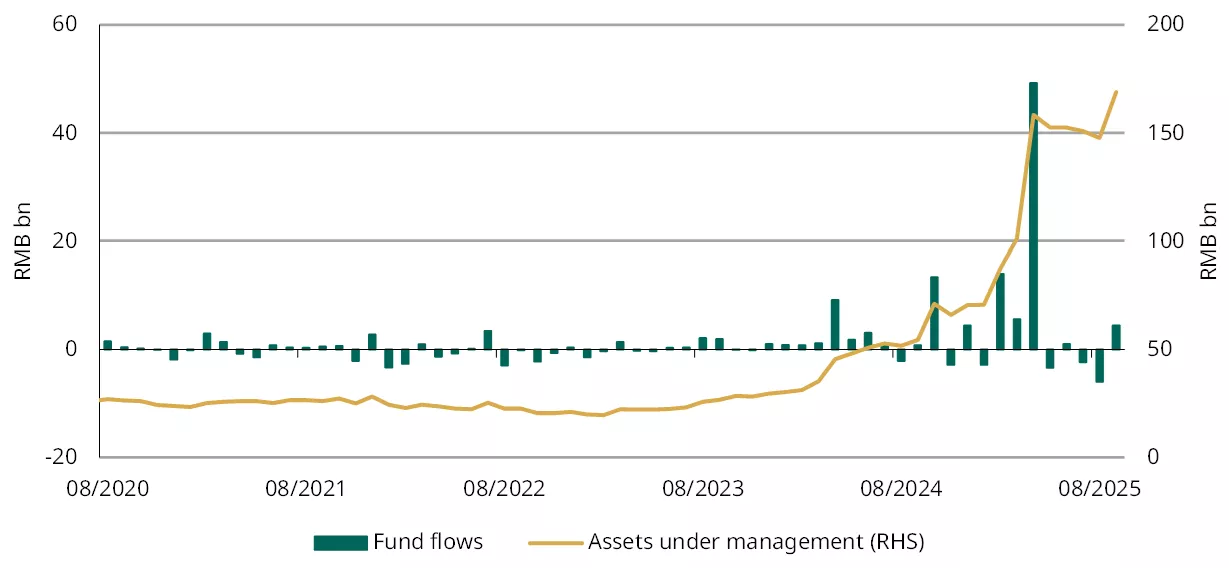
Chinese gold ETFs finally saw inflows in September, following two consecutive monthly losses (Chart 4). Attracted by the strong gold price performance, Chinese investors bought RMB4.5bn (US$622mn) of local gold ETFs. September’s inflows and the surging price lifted Chinese gold ETFs’ total AUM to another month-end peak of RMB169bn (US$22bn), with holdings rebounding by 4.9t to 194t.
Chart 4: Chinese gold ETFs saw inflows in September
Monthly Chinese gold ETF flows and month-end AUM*
*Data to 30 September 2025.
Source: Company filings, World Gold Council
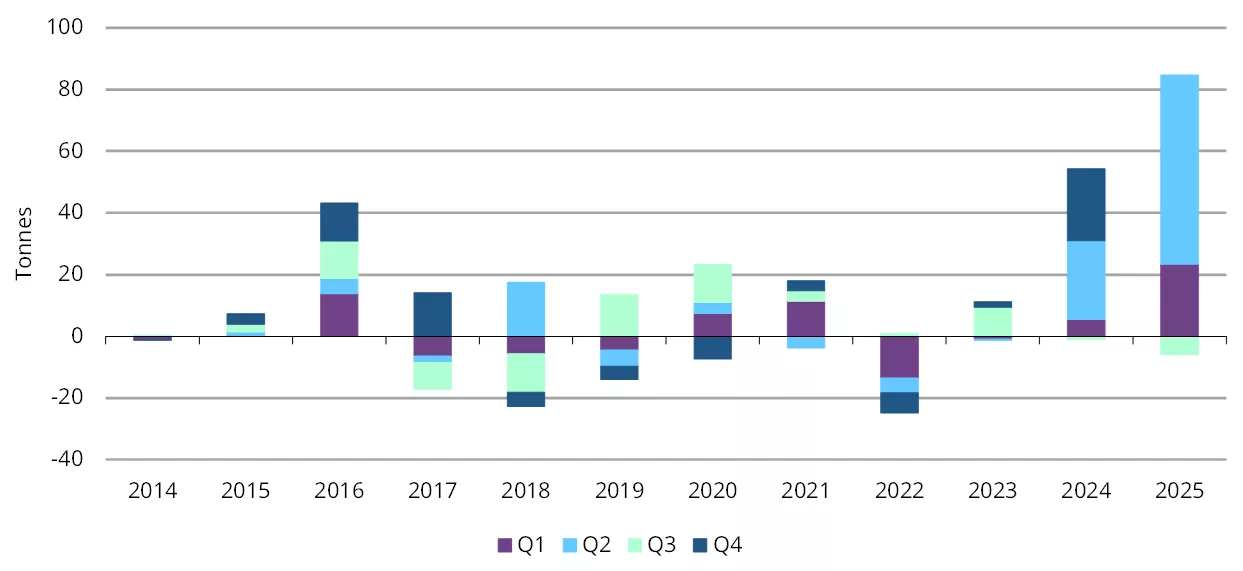
But September’s inflows were not sufficient to reverse earlier losses, resulting in Q3 net outflows of RMB3.8bn (US$537mn) (Chart 5) and collective holdings reduced by 5.8t during the period. As previously noted, Chinese investor risk appetite improved as the need for safe-haven assets declined: July and August saw better growth expectations on the back of strong Q2 economic data and a reducing US-China tariff risk. This sentiment was reflected in the strong CSI300 Stock Index rally, which surged 18% during Q3, the strongest quarter since Q1 2019. Meanwhile, rising government bond yields – as the market priced in fewer rate cuts by the PBoC – increased opportunity costs of holding gold.
Nonetheless, helped by various uncertainties, the strong price performance, a lack of alternative investment options, and encouragement from the central bank’s non-stop gold buying, Chinese gold ETF inflows during the first three quarters remain the largest ever. In fact, the cumulative inflows of RMB59bn (US$8.2bn, 79t) between Q1 and Q3 have surpassed all previous annual records (Chart 5).
Chart 5: Q3 outflows have little impact on y-t-d strength
Quarterly gold ETF tonnage demand*
*As of September 2025.
Source: Company filings, World Gold Council
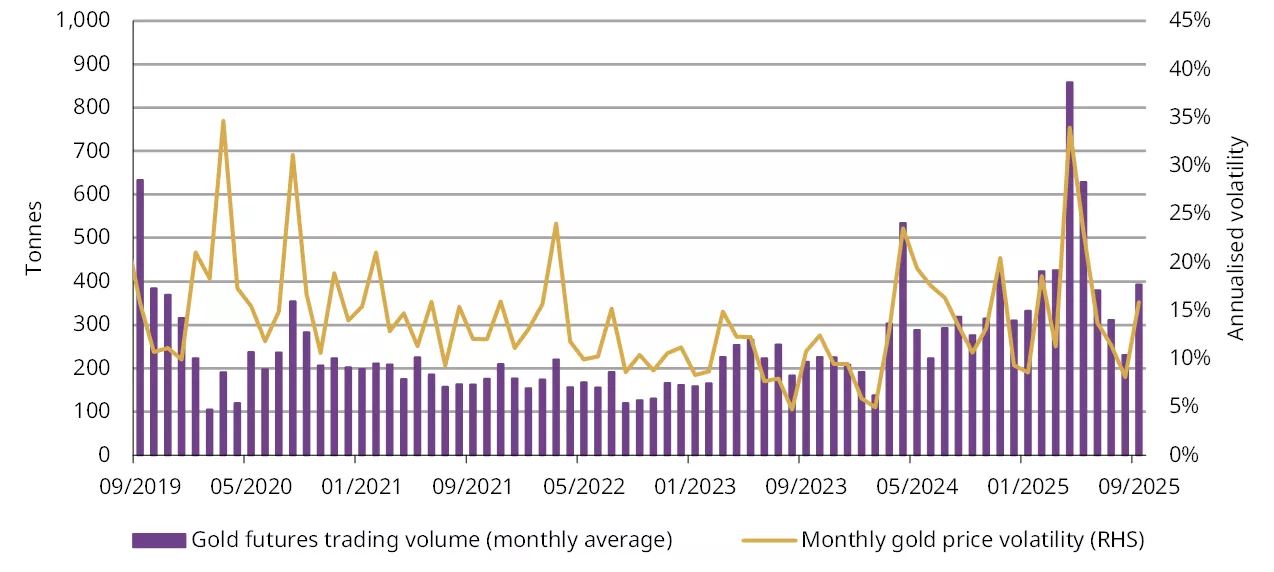
Gold futures investor activity also improved (Chart 6). The average trading volumes of gold futures at the SHFE jumped 70% m/m to 394t/day in September; 82% higher than the five-year average. The strong gold price performance and rising volatility attracted attention from tactical investors. Yet Q3 volumes fell 49% q/q to 312t/day despite the gold price rally proving stronger than the previous quarter – Q2 gold price volatility climbed to the highest in decades, a key factor luring interest from futures traders.
Chart 6: Trading volumes of gold futures rebounded in September
Daily average trading volumes of SHFE gold futures and monthly gold price volatility*
*As of 30 September 2025. The monthly gold price volatility is based on daily gold price change in the active SHFE gold futures.
Source: Shanghai Futures Exchange, World Gold Council
The PBoC reported its 11th consecutive monthly gold purchase
In September the PBoC announced a 1.2t gold purchase, its 11th non-stop addition. By the end of Q3 China’s official gold holdings stood at 2,303t, 7.7% of total foreign reserves.
China’s gold reserves increased by 5t, a slower pace than in previous quarters (Chart 7). This is perhaps not surprising: as the gold price surges central banks may dial back the amount of gold buying for tactical reasons. Yet judging from the PBoC’s four-quarter non-stop gold purchases, we believe gold remains a key strategic asset to central banks looking to diversify assets in a fragmented and uncertain world.
Chart 7: Four quarters of non-stop PBoC gold purchasing announcements
Reported official gold holdings and the quarterly average LBMA Gold Price PM*
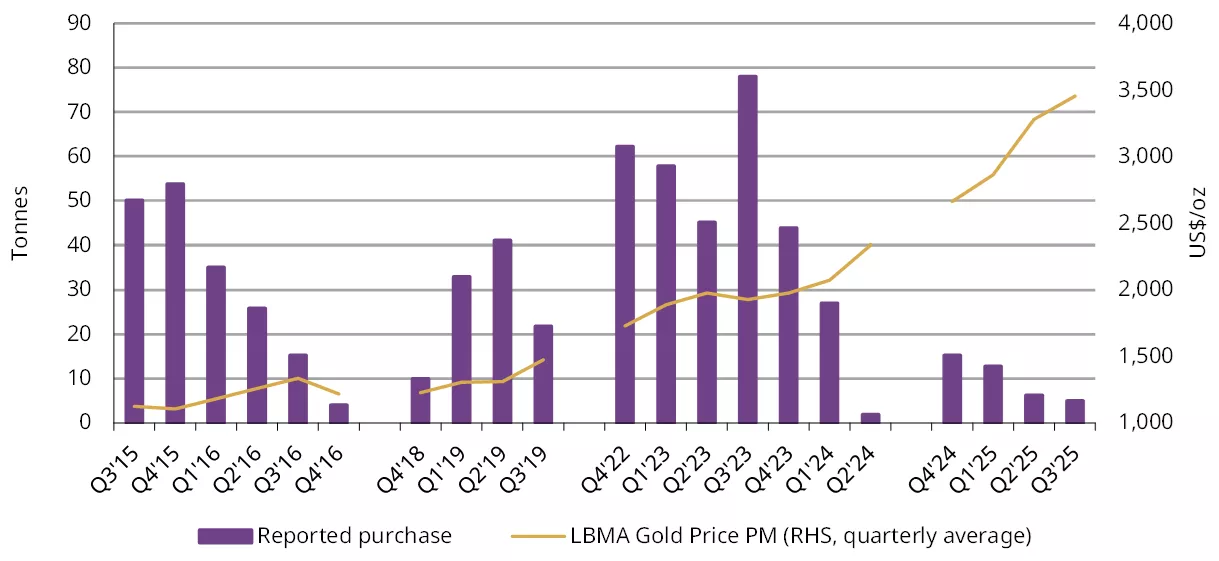
*As of September 2025. The gaps indicate quarters where the PBoC did not announce gold purchases.
Source: State Administration of Foreign Exchange, World Gold Council
Imports stable in August
China imported a net 87t of gold in August, based on the latest information, a mild 2t m/m fall (Chart 8). Imports remained broadly stable as the average local gold price premium fell only slightly in the month (US$7.6/oz in August vs US$8/oz in July); the upcoming peak season for gold also limited the m/m weakness.
Chart 8: August gold imports remained relatively stable
Net 7108 gold imports under various regimes*
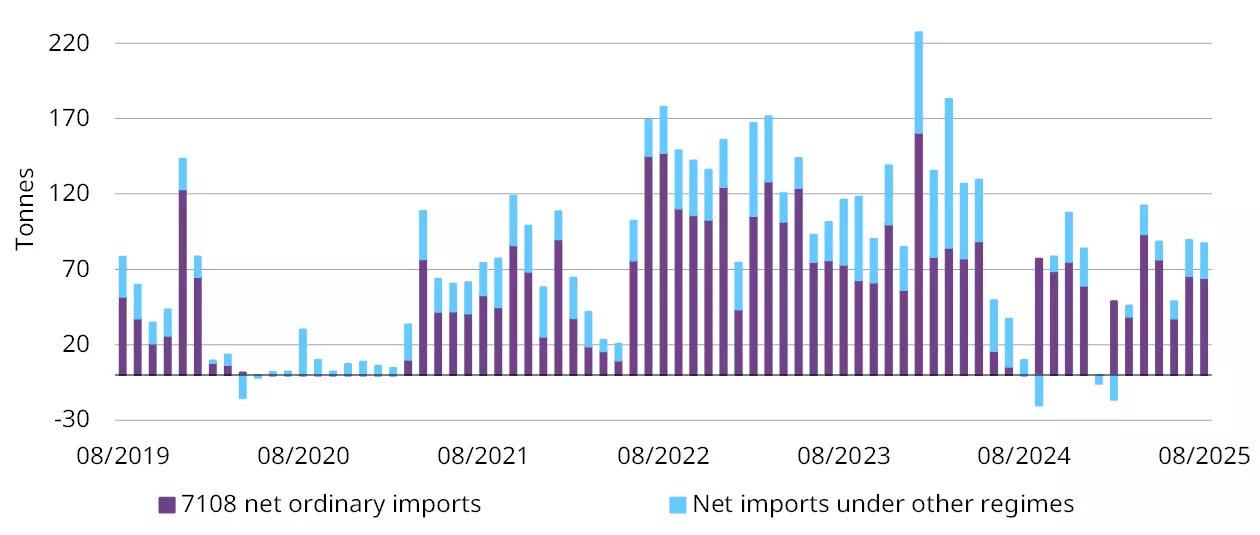
*Based on the latest data available. Data to August 2025.
Source: China Customs, World Gold Council
Footnotes:
1Chinese markets were closed between 1 and 8 October due to the National Day Holiday and the Mid-Autumn Day.
Disclaimer
Important information and disclaimers
© 2025 World Gold Council. All rights reserved. World Gold Council and the Circle device are trademarks of the World Gold Council or its affiliates.
All references to LBMA Gold Price are used with the permission of ICE Benchmark Administration Limited and have been provided for informational purposes only. ICE Benchmark Administration Limited accepts no liability or responsibility for the accuracy of the prices or the underlying product to which the prices may be referenced. Other content is the intellectual property of the respective third party and all rights are reserved to them.
Reproduction or redistribution of any of this information is expressly prohibited without the prior written consent of World Gold Council or the appropriate copyright owners, except as specifically provided below. Information and statistics are copyright © and/or other intellectual property of the World Gold Council or its affiliates or third-party providers identified herein. All rights of the respective owners are reserved.
The use of the statistics in this information is permitted for the purposes of review and commentary (including media commentary) in line with fair industry practice, subject to the following two pre-conditions: (i) only limited extracts of data or analysis be used; and (ii) any and all use of these statistics is accompanied by a citation to World Gold Council and, where appropriate, to Metals Focus or other identified copyright owners as their source. World Gold Council is affiliated with Metals Focus.
The World Gold Council and its affiliates do not guarantee the accuracy or completeness of any information nor accept responsibility for any losses or damages arising directly or indirectly from the use of this information.
This information is for educational purposes only and by receiving this information, you agree with its intended purpose. Nothing contained herein is intended to constitute a recommendation, investment advice, or offer for the purchase or sale of gold, any gold-related products or services or any other products, services, securities or financial instruments (collectively, “Services”). This information does not take into account any investment objectives, financial situation or particular needs of any particular person.
Diversification does not guarantee any investment returns and does not eliminate the risk of loss. Past performance is not necessarily indicative of future results. The resulting performance of any investment outcomes that can be generated through allocation to gold are hypothetical in nature, may not reflect actual investment results and are not guarantees of future results. The World Gold Council and its affiliates do not guarantee or warranty any calculations and models used in any hypothetical portfolios or any outcomes resulting from any such use. Investors should discuss their individual circumstances with their appropriate investment professionals before making any decision regarding any Services or investments.
This information may contain forward-looking statements, such as statements which use the words “believes”, “expects”, “may”, or “suggests”, or similar terminology, which are based on current expectations and are subject to change. Forward-looking statements involve a number of risks and uncertainties. There can be no assurance that any forward-looking statements will be achieved. World Gold Council and its affiliates assume no responsibility for updating any forward-looking statements.
Information regarding QaurumSM and the Gold Valuation Framework
Note that the resulting performance of various investment outcomes that can be generated through use of Qaurum, the Gold Valuation Framework and other information are hypothetical in nature, may not reflect actual investment results and are not guarantees of future results. Neither World Gold Council (including its affiliates) nor Oxford Economics provides any warranty or guarantee regarding the functionality of the tool, including without limitation any projections, estimates or calculations.
India gold market update: Festive shine
Kavita Chacko
Research Head, India World Gold CouncilHighlights
- Gold price rally intensifies and domestic premium climbs
- The festive season starts strongly, powered by investment demand and jewellery sales
- September sees record inflows into gold ETFs and the momentum carries forward
- Listed jewellers report strong quarterly revenue gains despite the high gold price and base effect
- Gold imports hit a 10-month high in August, supported by seasonal buying and investment demand.
Looking ahead
- Expectations for a strong festive season remain high across the gold trade, driven by continued demand for investment products and wedding jewellery, despite challenges in the broader jewellery market amidst a rising gold price.
- Increased disposable income for consumers – following GST cuts and the prevailing low inflation environment1 – may give gold a boost.
Fresh record for gold
Gold continues its extraordinary price rally, having reached 48 all-time highs this year.2 Geopolitical tensions, strong investment demand, dollar weakness, financial market risk and expectations of dovish Fed policy lifted international prices by 11.6% in September and by an additional 7.9% in the first two weeks of October, pushing past the US$4,000/oz milestone. Notably, the surge from $3,500 to $4,000 occurred in just 36 days, a stark contrast to the previous $500/oz increments, which took over three years on average. International gold prices have surged by 58% y-t-d, marking the largest increase in 45 years. Domestically, gold prices have mirrored this upward trend, rising 66% y-t-d, with gains further amplified by weakness in the Indian rupee.
Chart 1: The gold rally continues in both international and domestic markets
End of month LBMA Price PM and MCX domestic spot price levels and m/m changes *
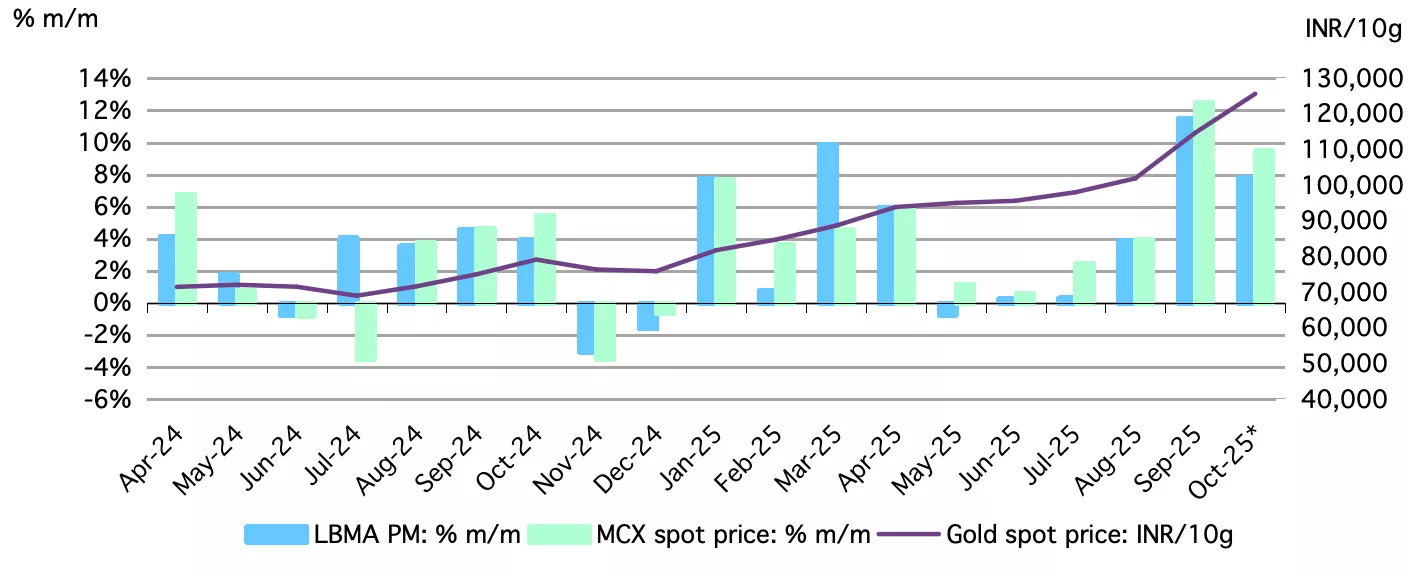
*Based on the LBMA Gold Price PM in USD and MCX spot gold price as of 15 October 2025.
Source: Bloomberg, World Gold Council
Since mid-September domestic gold prices have been trading at a sustained premium over international prices (Chart 2). As of mid-October the premium has risen to US$25/oz,3 marking the highest level since July 2024 when the customs duty cut boosted the spread. This move is indicative of the domestic demand conditions detailed below.
Chart 2: The domestic gold price premium has climbed as the festive season kicked off
NCDEX gold premium/discount relative to the international price*
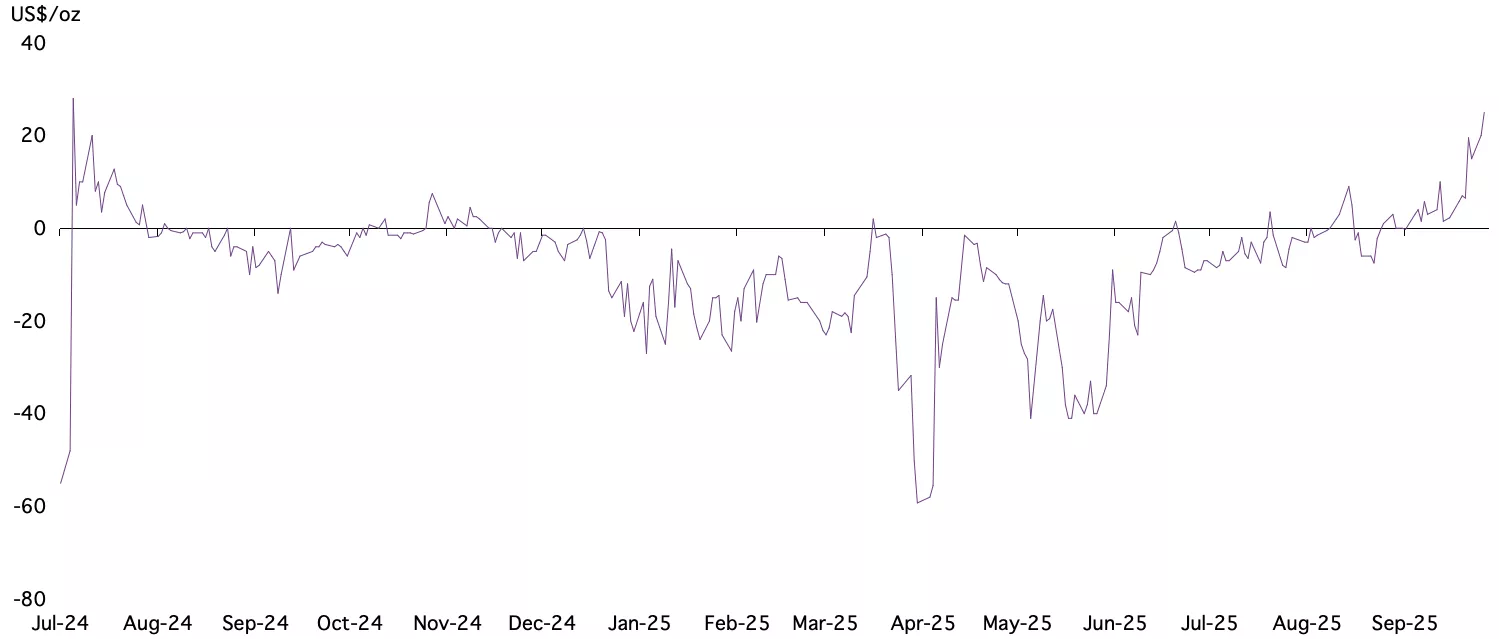
*As of 14 October 2025.
Source: NCDEX, World Gold Council
Record prices fuel festive sales and investment interest
The festive season has begun on a positive note, with market feedback and anecdotal evidence indicating healthy demand for both physical investment products and jewellery. The record rally in the gold price has drawn investor attention and fuelled sustained interest in physical gold. As a result, the share of investment demand within overall domestic gold consumption is on the rise.4 Despite the pressure on gold jewellery consumption due to high prices and affordability, there has been a recent sales uptick, predominantly concentrated around wedding-related purchases and aligning with the wedding season. High prices are prompting consumers to opt for lighter-weight, lower-carat pieces, affecting overall retail volumes. While retailers’ revenues may benefit from a boost in jewellery sales, overall volume demand is bound to decline due to affordability constraints from high gold prices.
Retailer feedback highlights varying demand trends across store types. Large chain stores are witnessing a preference for lighter, lower-carat jewellery, while high-end independent stores catering to wedding customers are experiencing strong sales with minimal impact on volume. In contrast, smaller stores are struggling as footfall declines and sales fall.
Strong quarter for listed jewellers amid gold price surge
Despite the high base effect – caused by the July 2024 customs duty cut – and the current record-high gold prices (up ~43% y/y), listed jewellery retailers delivered a strong performance in the July-September quarter, with revenue growth ranging from 6.5% to 63%, according to their quarterly business updates.5
The early onset of the festive season (September vs. October last year) and strong wedding demand helped to partially offset the impact of last year’s high base. Targeted marketing campaigns, promotional initiatives, and customer-centric purchase schemes – such as old gold exchange offers, lightweight options and curated product launches – further supported consumer momentum. Retailers reported a notable uptick in demand for lighter, lower-carat jewellery as consumers adapted to higher prices. Meanwhile old gold exchange programs remained a significant sales driver across retailers.
Retail expansion also stayed strong, with leading players adding between five and 34 new stores during the quarter, including franchise and international formats, underscoring the sector's continued shift toward organised retail. Digital and e-commerce channels also saw significant traction, with some retailers reporting a y/y doubling of online revenue.
These large retailers remain upbeat about the current quarter, which is traditionally the strongest as it is driven by key festivals and peak wedding season demand.
ETFs: unprecedented inflows
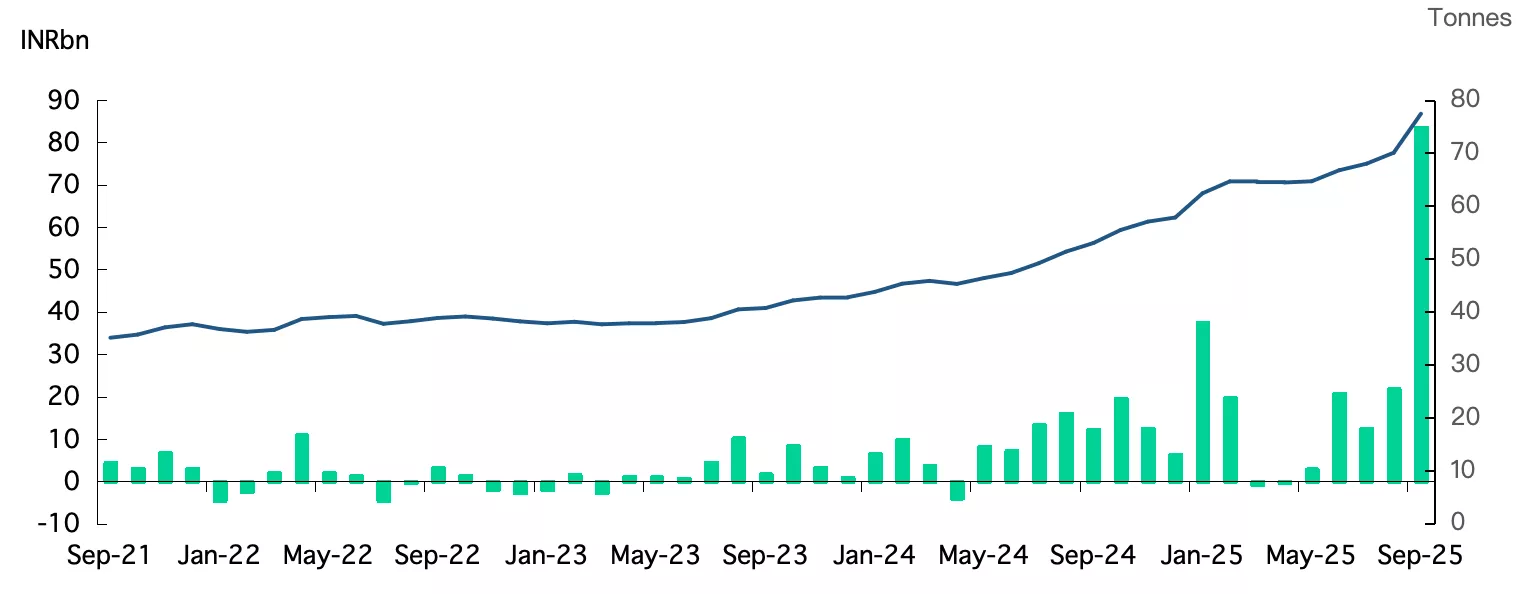
Mirroring the global trend, Indian gold ETFs witnessed their largest-ever monthly net inflows in September, totalling INR83.6bn (US$947mn), a 282% increase m/m. Gold demand increased by 7.4t, closely aligned with our earlier estimate6 and marking the strongest month on record. The sustained and unprecedented gold price rally has captured investor interest, likely fuelling the surge in inflows; persistent safe-haven demand has also contributed. As per AMFI data,7 assets under management (AUM) in gold ETFs reached an all-time high of INR901.4bn (US$10.2bn), while cumulative holdings rose to 77.4t, a tenth of which was added in September alone.
Investor participation surged as well, with a record 629 thousand new accounts (folios) added in September. This took the total number of active folios to 8.66mn, a 33% increase since the start of the year.
Early data through October 10th indicates that this momentum is continuing, with strong net inflows of INR52.81bn(US$589mn) during this period.8
Investor profiles reveal notable differences in terms of AUM share and numbers of accounts. As per AMFI, retail investors accounted for 97% of total folios as of end-June 2025 but only 8% of AUM, reflecting their smaller average ticket size. In contrast, corporates and high-net-worth individuals (HNIs) held a much larger share – 61% and 31% of AUM, respectively – indicating significantly higher investment per account. While the corporate share of total folios remained steady at 0.2%, HNIs showed rising participation, with their share of folios increasing from 1.4% in June 2024 to 3% by June 2025. This suggests growing interest in gold ETFs from affluent investors, possibly driven by portfolio diversification strategies.
Chart 3: Indian gold ETF holdings rise on record inflows
Monthly gold ETF flows in INRbn, and total holdings in tonnes*
*As of end September 2025.
Source: AMFI, ICRA Analytics, CMIE, World Gold Council
Modest addition to RBI reserves
In September 2025, based on our estimates using the RBI’s weekly data, the central bank added 0.2t to its gold reserves, bringing its total holdings to 880.2t. While the RBI's gold purchases in 2025 have been relatively muted – just 4t were added during the first nine months compared to 50t in the same period last year – the share of gold in India's foreign exchange reserves has increased significantly, rising from 9% to 14% over this period, largely driven by valuation gains from the rising gold price.
Gold imports rise sharply on seasonal and investment demand
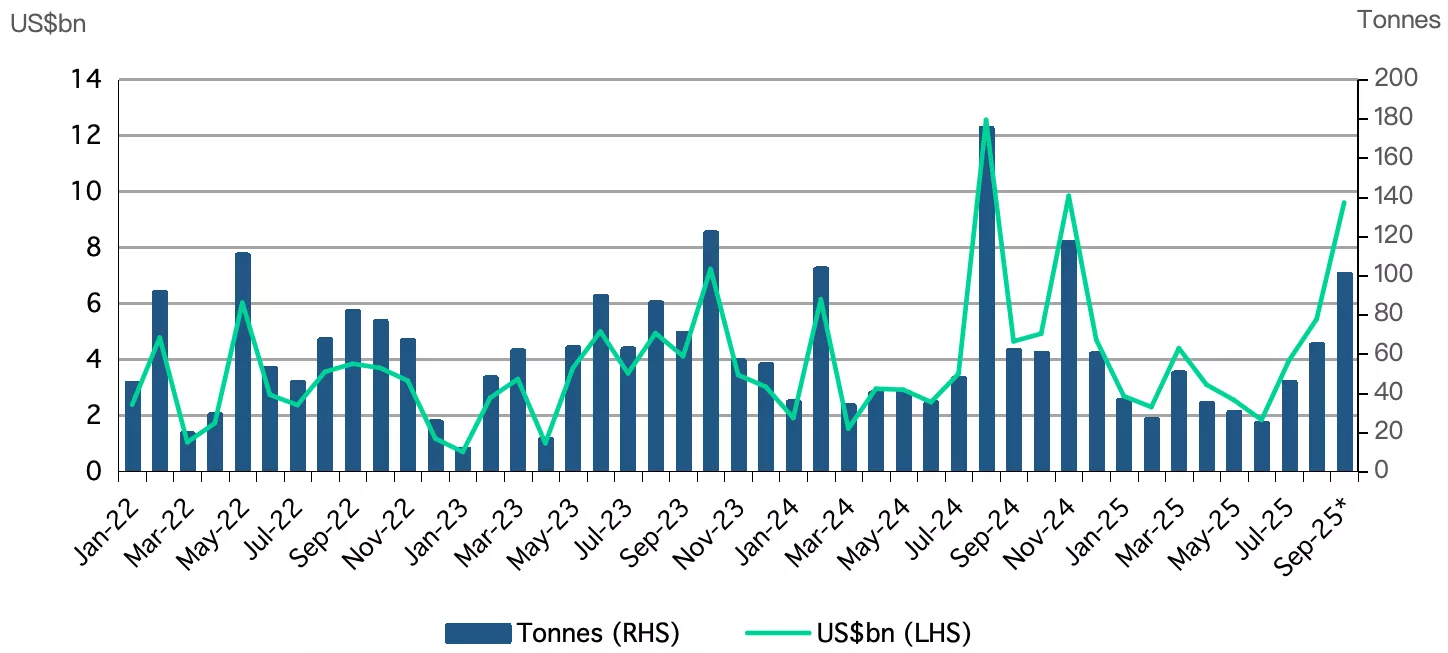
India's gold imports surged to a ten-month high in September. Imports totalled US$9.16bn, marking a 77% m/m increase. The surge reflects seasonal buying ahead of the festival season, supported by robust investment demand. In volume terms, we estimate imports to be in the range of 100-104t, up from 65t in August.
Chart 4: Gold imports have been steadily rising
Monthly gold imports in tonnes and US$bn*
*Includes World Gold Council estimates.
Source: Ministry of Commerce and Industry, CMIE, World Gold Council
Footnotes:
1Retail inflation slips to over 8-year low of 1.54% in September, NDTV, 14 October 2015.
2Based on LBMA Gold Price PM as of 15 October 2025.
3As of 14 October 2025.
4The share of bar and coin demand in India’s gold consumption (including jewellery and bars & coins) has increased from 29% in Q2’24 to 34% in Q2’25, Gold Demand Trends: Q2 2025, World Gold Council.
5Quarterly update – Titan Company, Kalyan Jewellers, PNG Jewellers, PC Jewellers Limited, Senco Gold Limited.
6WGC’s preliminary estimate, based on partial data, indicated net fund inflows of US$903mn and demand of 7.3t.
7As per the Association of Mutual Funds of India (AMFI) September 2025 report.
8Based on World Gold Council’s estimates of fund-wise net inflows from 1st to 10th October.
Disclaimer
Important information and disclaimers
© 2025 World Gold Council. All rights reserved. World Gold Council and the Circle device are trademarks of the World Gold Council or its affiliates.
All references to LBMA Gold Price are used with the permission of ICE Benchmark Administration Limited and have been provided for informational purposes only. ICE Benchmark Administration Limited accepts no liability or responsibility for the accuracy of the prices or the underlying product to which the prices may be referenced. Other content is the intellectual property of the respective third party and all rights are reserved to them.
Reproduction or redistribution of any of this information is expressly prohibited without the prior written consent of World Gold Council or the appropriate copyright owners, except as specifically provided below. Information and statistics are copyright © and/or other intellectual property of the World Gold Council or its affiliates or third-party providers identified herein. All rights of the respective owners are reserved.
The use of the statistics in this information is permitted for the purposes of review and commentary (including media commentary) in line with fair industry practice, subject to the following two pre-conditions: (i) only limited extracts of data or analysis be used; and (ii) any and all use of these statistics is accompanied by a citation to World Gold Council and, where appropriate, to Metals Focus or other identified copyright owners as their source. World Gold Council is affiliated with Metals Focus.
The World Gold Council and its affiliates do not guarantee the accuracy or completeness of any information nor accept responsibility for any losses or damages arising directly or indirectly from the use of this information.
This information is for educational purposes only and by receiving this information, you agree with its intended purpose. Nothing contained herein is intended to constitute a recommendation, investment advice, or offer for the purchase or sale of gold, any gold-related products or services or any other products, services, securities or financial instruments (collectively, “Services”). This information does not take into account any investment objectives, financial situation or particular needs of any particular person.
Diversification does not guarantee any investment returns and does not eliminate the risk of loss. Past performance is not necessarily indicative of future results. The resulting performance of any investment outcomes that can be generated through allocation to gold are hypothetical in nature, may not reflect actual investment results and are not guarantees of future results. The World Gold Council and its affiliates do not guarantee or warranty any calculations and models used in any hypothetical portfolios or any outcomes resulting from any such use. Investors should discuss their individual circumstances with their appropriate investment professionals before making any decision regarding any Services or investments.
This information may contain forward-looking statements, such as statements which use the words “believes”, “expects”, “may”, or “suggests”, or similar terminology, which are based on current expectations and are subject to change. Forward-looking statements involve a number of risks and uncertainties. There can be no assurance that any forward-looking statements will be achieved. World Gold Council and its affiliates assume no responsibility for updating any forward-looking statements.
Information regarding QaurumSM and the Gold Valuation Framework
Note that the resulting performance of various investment outcomes that can be generated through use of Qaurum, the Gold Valuation Framework and other information are hypothetical in nature, may not reflect actual investment results and are not guarantees of future results. Neither World Gold Council (including its affiliates) nor Oxford Economics provides any warranty or guarantee regarding the functionality of the tool, including without limitation any projections, estimates or calculations.
Weekly Markets Monitor: Gravity dismissed
Weekly Markets Monitor
Highlights
- Last week presented a mixed global macro picture. US-China trade tensions eased. The US government shutdown continued. Concerns over regional banks and private credit ‘cockroaches’ emerged, yet major US banks reported strong earnings. In Europe, the UK saw a mild economic rebound and French political uncertainty eased. In Asia, China’s Q3 growth slowed, while Indian inflation cooled.
- Global equity markets felt some midweek turbulence: US stocks gained, while major European and Asian indices declined. US Treasury yields fell, the dollar weakened, and oil prices continued their downward trajectory.
- A brief stumble on Friday aside, gold stayed strong as equities shrugged off US credit worries. Uncertainty and rate-cut bets continue to draw in new investment, even if the rally feels stretched. We maintain that gold remains strategically under owned (C.O.T.W) with scope for further upside supported by constructive fundamentals and elevated global liquidity.
Chart of the week - They say gold is expensive…
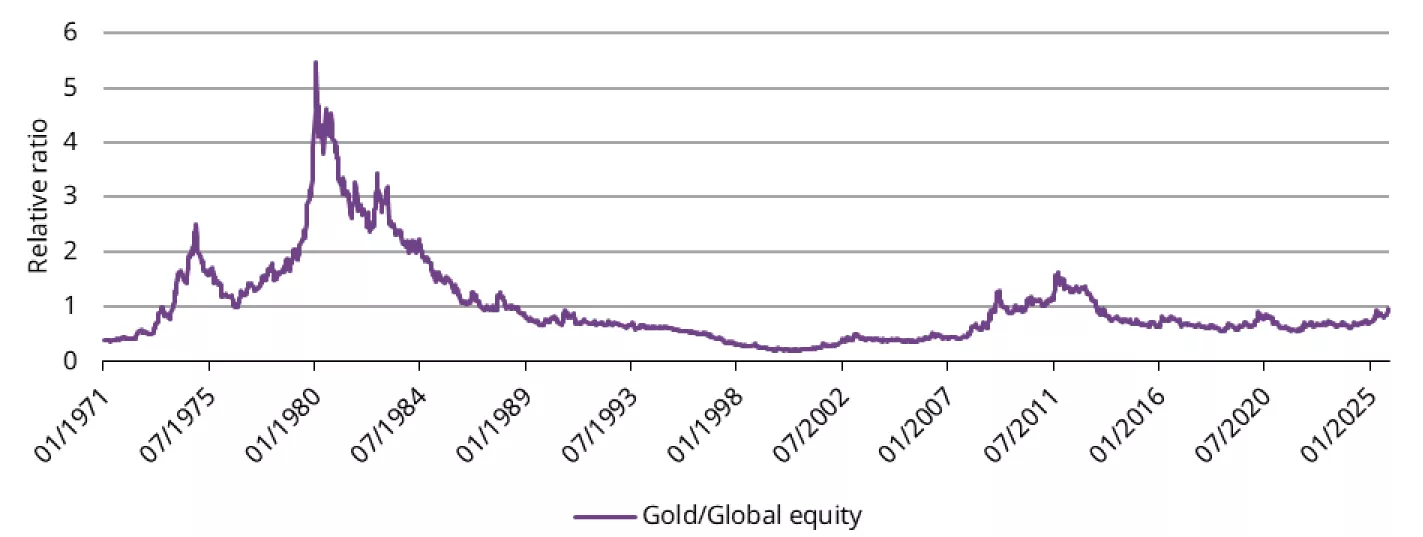
Weekly data between 1 January 1971 and 17 October 2025 based on weekly average LBMA Gold Price PM and MSCI World Index.
Source: ICE Benchmark Administration, Bloomberg, World Gold Council
Disclaimer
Important information and disclaimers
© 2025 World Gold Council. All rights reserved. World Gold Council and the Circle device are trademarks of the World Gold Council or its affiliates.
All references to LBMA Gold Price are used with the permission of ICE Benchmark Administration Limited and have been provided for informational purposes only. ICE Benchmark Administration Limited accepts no liability or responsibility for the accuracy of the prices or the underlying product to which the prices may be referenced. Other content is the intellectual property of the respective third party and all rights are reserved to them.
Reproduction or redistribution of any of this information is expressly prohibited without the prior written consent of World Gold Council or the appropriate copyright owners, except as specifically provided below. Information and statistics are copyright © and/or other intellectual property of the World Gold Council or its affiliates or third-party providers identified herein. All rights of the respective owners are reserved.
The use of the statistics in this information is permitted for the purposes of review and commentary (including media commentary) in line with fair industry practice, subject to the following two pre-conditions: (i) only limited extracts of data or analysis be used; and (ii) any and all use of these statistics is accompanied by a citation to World Gold Council and, where appropriate, to Metals Focus or other identified copyright owners as their source. World Gold Council is affiliated with Metals Focus.
The World Gold Council and its affiliates do not guarantee the accuracy or completeness of any information nor accept responsibility for any losses or damages arising directly or indirectly from the use of this information.
This information is for educational purposes only and by receiving this information, you agree with its intended purpose. Nothing contained herein is intended to constitute a recommendation, investment advice, or offer for the purchase or sale of gold, any gold-related products or services or any other products, services, securities or financial instruments (collectively, “Services”). This information does not take into account any investment objectives, financial situation or particular needs of any particular person.
Diversification does not guarantee any investment returns and does not eliminate the risk of loss. Past performance is not necessarily indicative of future results. The resulting performance of any investment outcomes that can be generated through allocation to gold are hypothetical in nature, may not reflect actual investment results and are not guarantees of future results. The World Gold Council and its affiliates do not guarantee or warranty any calculations and models used in any hypothetical portfolios or any outcomes resulting from any such use. Investors should discuss their individual circumstances with their appropriate investment professionals before making any decision regarding any Services or investments.
This information may contain forward-looking statements, such as statements which use the words “believes”, “expects”, “may”, or “suggests”, or similar terminology, which are based on current expectations and are subject to change. Forward-looking statements involve a number of risks and uncertainties. There can be no assurance that any forward-looking statements will be achieved. World Gold Council and its affiliates assume no responsibility for updating any forward-looking statements.
Information regarding QaurumSM and the Gold Valuation Framework
Note that the resulting performance of various investment outcomes that can be generated through use of Qaurum, the Gold Valuation Framework and other information are hypothetical in nature, may not reflect actual investment results and are not guarantees of future results. Neither World Gold Council (including its affiliates) nor Oxford Economics provides any warranty or guarantee regarding the functionality of the tool, including without limitation any projections, estimates or calculations.
Get updates in your inbox
Get email updates
Weekly Markets Monitor: The Easing Glow
Weekly Markets Monitor
Highlights
- Last week, global economic updates reflected both momentum and headwinds. US inflation eased and business activity strengthened, Eurozone and India saw manufacturing gains, while China and Japan reported uneven growth. Meanwhile, US imposed sanctions on Russian oil, threatened Canada with additional tariffs, and Japan plans a stimulus package.
- Global stock markets rose for the week, with US benchmark indices hitting new records. Treasury yields and the US$ were largely unchanged, and oil prices retreated after earlier gains.
- Gold may finally take a breather with volatility spiking higher and momentum turning lower. Risk-on sentiment could also dent gold’s prospects this week. Markets are salivating at the prospect of Big Tech earnings which, if they validate the AI hype, could foster a strong risk-on response. Investor sentiment could be helped along by thawing US-China trade tensions and the Fed’s anticipated cut this week. US data has been sparse due to the lockdown, but CPI and consumer sentiment prints (very weak!) probably ensure that this cut is sown on (COTW).
Chart of the Week: Cut confirmed?
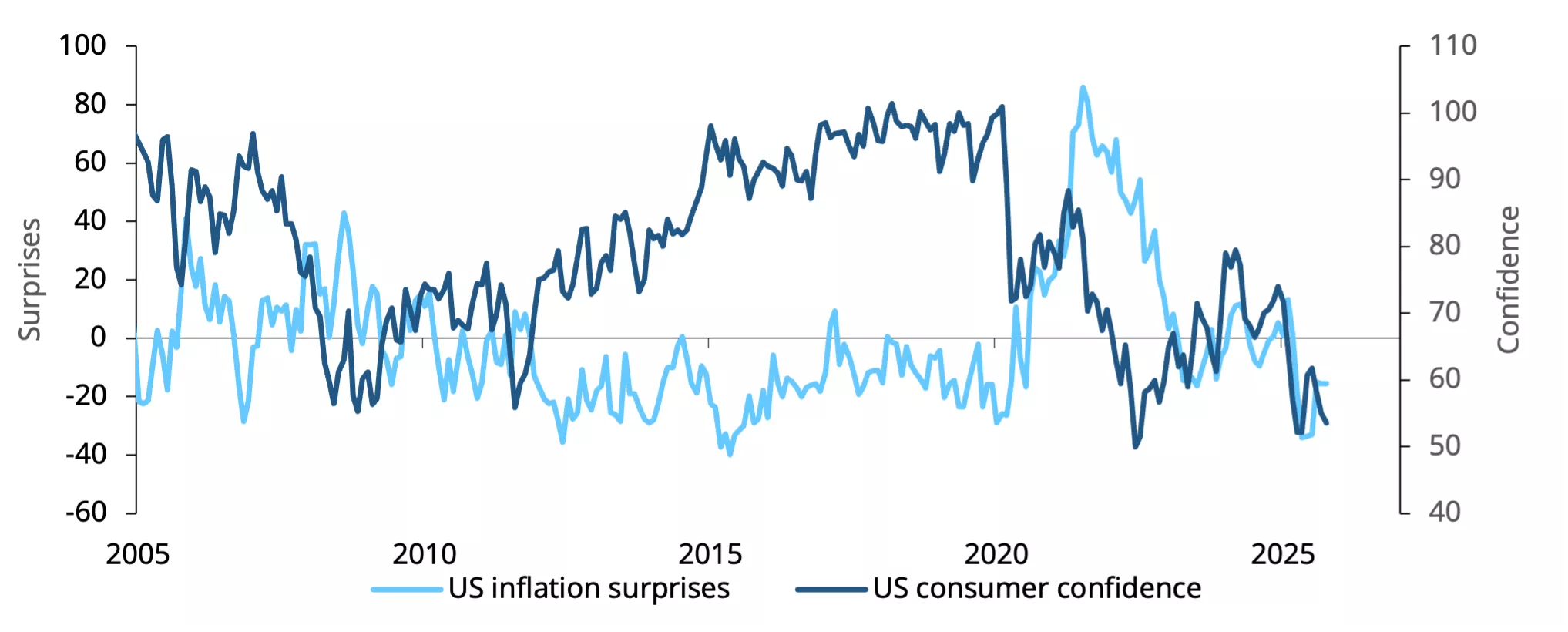
Data to 24 October 2025. Source: Bloomberg, World Gold Council
Disclaimer
Important information and disclaimers
© 2025 World Gold Council. All rights reserved. World Gold Council and the Circle device are trademarks of the World Gold Council or its affiliates.
All references to LBMA Gold Price are used with the permission of ICE Benchmark Administration Limited and have been provided for informational purposes only. ICE Benchmark Administration Limited accepts no liability or responsibility for the accuracy of the prices or the underlying product to which the prices may be referenced. Other content is the intellectual property of the respective third party and all rights are reserved to them.
Reproduction or redistribution of any of this information is expressly prohibited without the prior written consent of World Gold Council or the appropriate copyright owners, except as specifically provided below. Information and statistics are copyright © and/or other intellectual property of the World Gold Council or its affiliates or third-party providers identified herein. All rights of the respective owners are reserved.
The use of the statistics in this information is permitted for the purposes of review and commentary (including media commentary) in line with fair industry practice, subject to the following two pre-conditions: (i) only limited extracts of data or analysis be used; and (ii) any and all use of these statistics is accompanied by a citation to World Gold Council and, where appropriate, to Metals Focus or other identified copyright owners as their source. World Gold Council is affiliated with Metals Focus.
The World Gold Council and its affiliates do not guarantee the accuracy or completeness of any information nor accept responsibility for any losses or damages arising directly or indirectly from the use of this information.
This information is for educational purposes only and by receiving this information, you agree with its intended purpose. Nothing contained herein is intended to constitute a recommendation, investment advice, or offer for the purchase or sale of gold, any gold-related products or services or any other products, services, securities or financial instruments (collectively, “Services”). This information does not take into account any investment objectives, financial situation or particular needs of any particular person.
Diversification does not guarantee any investment returns and does not eliminate the risk of loss. Past performance is not necessarily indicative of future results. The resulting performance of any investment outcomes that can be generated through allocation to gold are hypothetical in nature, may not reflect actual investment results and are not guarantees of future results. The World Gold Council and its affiliates do not guarantee or warranty any calculations and models used in any hypothetical portfolios or any outcomes resulting from any such use. Investors should discuss their individual circumstances with their appropriate investment professionals before making any decision regarding any Services or investments.
This information may contain forward-looking statements, such as statements which use the words “believes”, “expects”, “may”, or “suggests”, or similar terminology, which are based on current expectations and are subject to change. Forward-looking statements involve a number of risks and uncertainties. There can be no assurance that any forward-looking statements will be achieved. World Gold Council and its affiliates assume no responsibility for updating any forward-looking statements.
Information regarding QaurumSM and the Gold Valuation Framework
Note that the resulting performance of various investment outcomes that can be generated through use of Qaurum, the Gold Valuation Framework and other information are hypothetical in nature, may not reflect actual investment results and are not guarantees of future results. Neither World Gold Council (including its affiliates) nor Oxford Economics provides any warranty or guarantee regarding the functionality of the tool, including without limitation any projections, estimates or calculations.
Get updates in your inbox
Get email updates
Weekly Markets Monitor: Deadlock and democrats
Weekly Markets Monitor
Highlights
- Last week saw a thaw in US-China relations with a temporary trade agreement, alongside divergent central bank actions. While the Fed and Bank of Canada lowered rates, the ECB and BoJ held steady. On the economy front, Eurozone growth surprised on the upside, China’s factory activity continued to decline and India maintained its growth momentum.
- Major global equity markets ended the week mixed, while US Treasury yields, the US Dollar, and oil prices all rose.
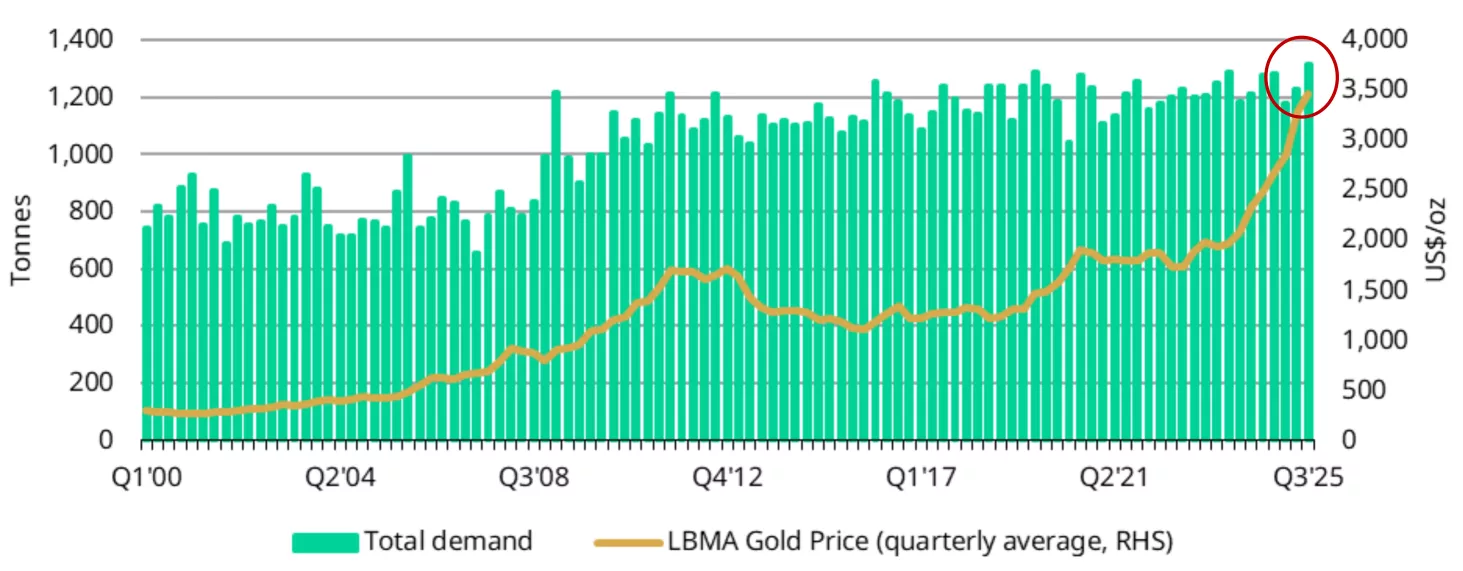
- Global gold demand, including OTC, reached 1,313t in Q3, 3% higher y/y. Both the quarterly average gold price and demand hit their highest on record, with gold investment strength more than offsetting fabrication weakness.
- This week, Democrats in US gubernational elections look to be steaming ahead. The government shutdown remains mired in deadlock between the parties. Betting markets see little chance of a resolution this week. Data will be thin.
Chart of the Week: Forging ahead
Data to 30 September 2025.
Source: Metals Focus, ICE Benchmark Administration,, World Gold Council
Disclaimer
Important information and disclaimers
© 2025 World Gold Council. All rights reserved. World Gold Council and the Circle device are trademarks of the World Gold Council or its affiliates.
All references to LBMA Gold Price are used with the permission of ICE Benchmark Administration Limited and have been provided for informational purposes only. ICE Benchmark Administration Limited accepts no liability or responsibility for the accuracy of the prices or the underlying product to which the prices may be referenced. Other content is the intellectual property of the respective third party and all rights are reserved to them.
Reproduction or redistribution of any of this information is expressly prohibited without the prior written consent of World Gold Council or the appropriate copyright owners, except as specifically provided below. Information and statistics are copyright © and/or other intellectual property of the World Gold Council or its affiliates or third-party providers identified herein. All rights of the respective owners are reserved.
The use of the statistics in this information is permitted for the purposes of review and commentary (including media commentary) in line with fair industry practice, subject to the following two pre-conditions: (i) only limited extracts of data or analysis be used; and (ii) any and all use of these statistics is accompanied by a citation to World Gold Council and, where appropriate, to Metals Focus or other identified copyright owners as their source. World Gold Council is affiliated with Metals Focus.
The World Gold Council and its affiliates do not guarantee the accuracy or completeness of any information nor accept responsibility for any losses or damages arising directly or indirectly from the use of this information.
This information is for educational purposes only and by receiving this information, you agree with its intended purpose. Nothing contained herein is intended to constitute a recommendation, investment advice, or offer for the purchase or sale of gold, any gold-related products or services or any other products, services, securities or financial instruments (collectively, “Services”). This information does not take into account any investment objectives, financial situation or particular needs of any particular person.
Diversification does not guarantee any investment returns and does not eliminate the risk of loss. Past performance is not necessarily indicative of future results. The resulting performance of any investment outcomes that can be generated through allocation to gold are hypothetical in nature, may not reflect actual investment results and are not guarantees of future results. The World Gold Council and its affiliates do not guarantee or warranty any calculations and models used in any hypothetical portfolios or any outcomes resulting from any such use. Investors should discuss their individual circumstances with their appropriate investment professionals before making any decision regarding any Services or investments.
This information may contain forward-looking statements, such as statements which use the words “believes”, “expects”, “may”, or “suggests”, or similar terminology, which are based on current expectations and are subject to change. Forward-looking statements involve a number of risks and uncertainties. There can be no assurance that any forward-looking statements will be achieved. World Gold Council and its affiliates assume no responsibility for updating any forward-looking statements.
Information regarding QaurumSM and the Gold Valuation Framework
Note that the resulting performance of various investment outcomes that can be generated through use of Qaurum, the Gold Valuation Framework and other information are hypothetical in nature, may not reflect actual investment results and are not guarantees of future results. Neither World Gold Council (including its affiliates) nor Oxford Economics provides any warranty or guarantee regarding the functionality of the tool, including without limitation any projections, estimates or calculations.
Get updates in your inbox
Get email updates
You asked, we answered: What are the implications of the VAT reform in China?
Ray Jia
Head of Research (Asia Pacific, ex-India) and Deputy Head of Trade Engagement (China) World Gold CouncilSummary
- The Ministry of Finance and State Taxation Administration of China recently announced changes to the gold market value-added tax (VAT) policies, effective from 1 November 2025 to 31 December 2027
- Members who buy and sell gold directly on the Shanghai Gold Exchange (SGE) – the so-called “first-tier” supply – remain VAT free, however, members withdrawing gold are now subject to different policies depending on their purpose: investment or non-investment
- Members withdrawing physical gold and re-selling with investment purposes are not impacted as they are still subject to the current VAT charge (at 13%) on the value-added part1, while those with non-investment purposes now face higher costs when they re-distribute
- Clients who are registered with SGE members – also referred to as SGE clients – also face increased tax obligations when they withdraw gold from the SGE.
Impact
- With higher costs, gold jewellery demand in China may face some headwinds; however, it may can also be an additional catalyst for innovation amidst a competitive landscape
- Bar and coin demand is not directly impacted by the policy, but we may see greater concentration of gold buying through SGE members
- In certain instances, some consumers may choose to shift their gold jewellery purchases to investment products to take advantage of the lower tax burden
- Interestingly, the tax increase would widen the differential between the purchase price of a jewellery piece (which will include VAT) and its buy-back price (which excludes VAT); this could in turn have a dimming effect on jewellery recycling
Overview of the gold market tax reform
The Ministry of Finance and State Taxation Administration of China recently issued a few changes in the Chinese gold market tax policies, effective from 1 November 2025 to 31 December 2027. The changes are mainly related to the VAT system that is specific to the gold market. Last time there was a change in VAT that affected the gold market was back in April 2019, when VAT was lowered from 16% to 13% across the board.
The news came shortly after changes to taxation on platinum and diamonds2, which also came into effect on 1 November. But the recent VAT policy change affecting the gold market is different.
What’s the change? A VAT system varied by purpose
To understand the changes, we need to take a step back and review the VAT policy in place until 31st October.
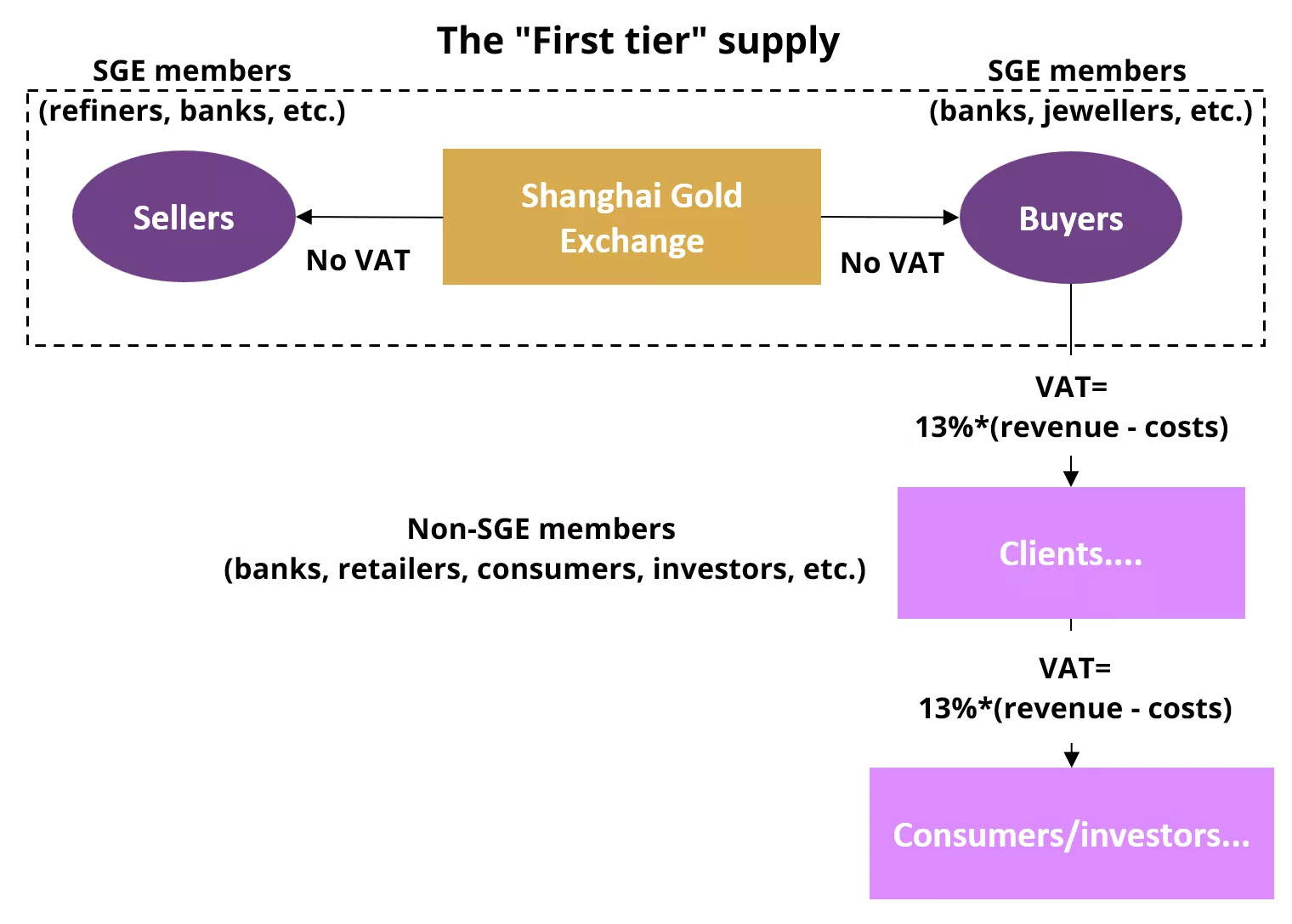
VAT is a circulation tax, meaning it is usually levied on the “value-added” part, or gross margin, at each point in the process of manufacturing, distributing and re-selling (Figure 1). We can break this down tier by tier:
- First tier: when SGE members/clients buy gold at the SGE from sellers, both the SGE and the purchasing members are basically exempt from VAT via the “immediate levy and refund” policy3
- Second tier: when SGE members/clients withdraw gold – to make it into branded investment products, or jewellery items – and re-sell, they pay VAT (at 13%) only on the value-added part (revenue minus costs), which is passed on to their clients
- Third tier or further: when retailers buy these products from SGE members/clients and sell to consumers, they also pay VAT only on their value-added part, which they pass on to their customers.
The value-added part described for the second and third (and beyond) above is usually much smaller for investment products, which have low labour charges, than for jewellery products, where mark-up is determined by craftsmanship.
Figure 1: An illustration of the previous VAT policy in China’s gold market
Source: Shanghai Gold Exchange, World Gold Council
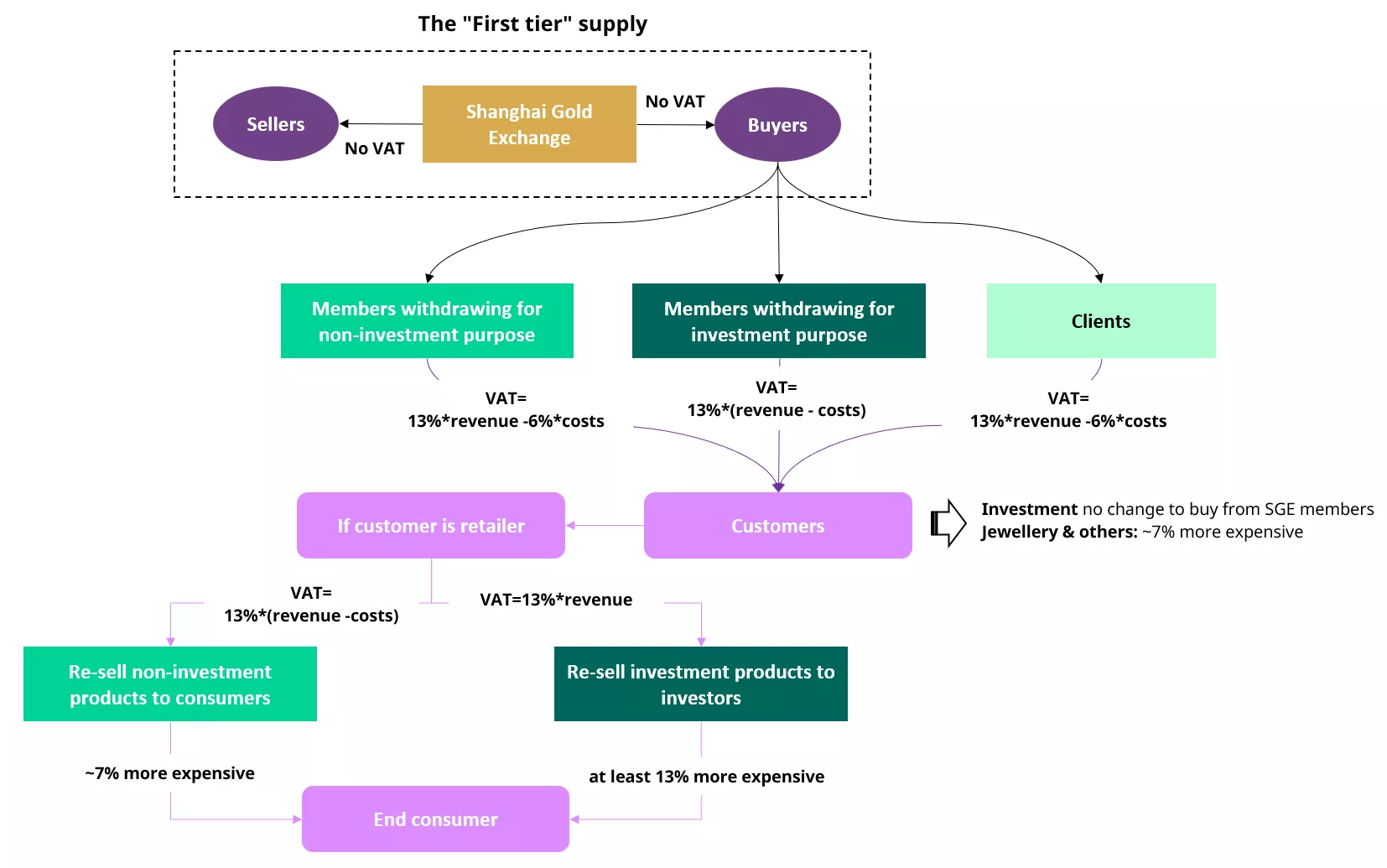
But now it is different. While SGE members that buy and sell gold on SGE in the “first tier” are still VAT exempt, the VAT treatment for members withdrawing gold is different, depending on their purposes. It is perhaps easier if we use hypothetical examples to explain the mechanics, illustrated in Figure 2.
SGE members who withdraw gold for investment purposes:
The VAT treatment of SGE members who withdraw gold and re-sell it for investment purposes hasn’t changed. For example, if Bank A withdraws 1,000 yuan worth of gold from the SGE, which represents its cost, refines it into a branded bar and resells it at 1,050 yuan, which represents the sales price before VAT. In this case the applicable VAT is 13%* (1,050/1.13) – 13%* (1,000/1.13) = 5.8 yuan, raising the sale price after VAT to 1,055.8 yuan.4 This has not changed under the new tax reforms.
However, the input VAT tax deduction ends there. Here is what happens if Bank A sells the same product to a Client at the same price, and the Client sells this to a consumer at 1,100 yuan:
The Client’s tax burden is now 13% * (1,100/1.13) – 0 = 127 yuan, pushing the total sale price after VAT to 1,227 yuan. The new tax rule stipulates that SGE members cannot issue a special VAT invoice when they re-sell their investment products to any client, leaving the client with no “cost credit” to deduct. In this situation, the consumer will most likely choose to buy the same investment product directly form Bank A, which is a SGE member, as it would be cheaper.
SGE members who withdraw gold for non-investment purposes:
SGE members who withdraw gold for non-investment purposes can now only deduct their sales VAT (at 13%) by 6% of their costs, instead of 13% previously. And the SGE issues only ordinary invoices instead of special VAT invoices to these members. For example, let’s assume that Jeweller B withdraws 1,000 yuan worth of gold from the SGE and plans to re-sell the jewellery product made from that SGE gold bar at 1,100 yuan:
- Before: Jeweller B’s VAT burden is 13% * (1,000/1.13) – 13% * (1,100/1.13) = 12 yuan, meaning the final sale price to its client after VAT will be 1,112 yuan
- After: Jeweller B’s VAT burden is now 13% * (1,000/1.13) – 6% * 1,100 = 55 yuan, raising the sale price after VAT to 1,155 yuan, which is 4% more expensive than the previous price of 1,112 yuan
Suppose B’s client, Retailer C, plans to sell the same product for a hypothetical additional 20% profit, at 1,386 yuan (cost at 1,155 yuan), then the total VAT burden passed on to the end consumer will be 13%* (1,155* 1.2/1.13) – 13% * (1,155/1.13) = 27 yuan, meaning that the end consumer in this hypothetical example would pay 1,413 yuan for the product. In general, consumers will now likely pay more for their gold jewellery as the tax is usually passed down from the seller.
Note that for illustrative purposes, we have only considered VAT in the above examples and have excluded all other taxes, such as stamp duty, city construction tax, education tax, etc.
SGE non-member clients who withdraw gold:
SGE non-member clients who open accounts via SGE members, are treated the same as SGE members who withdraw gold for non-investment purposes. They will need to sell their products at higher prices as they can only deduct their VAT at 6% of costs, rather than 13% as previously.
Figure 2: A stylised illustration of the new VAT policy’s impact on China’s gold market
Source: Shanghai Gold Exchange, World Gold Council
What’s the impact: pain or gain?
It is obvious from the above analysis that the new VAT policy will impact investment demand and jewellery consumption differently. In the investment sector:
- Bar and coin investors won’t see any change as long as they buy gold investment products directly from SGE members
- In addition, there is no impact on the buying and/or selling of gold ETFs and gold accumulation plans (GAP)
- However, the dominance of SGE members in China’s investment sector is likely to increase due to their VAT advantages compare to industry participants further down the chain, as shown in Figure 2
- Gold bar sales may further pick up: while various risks, expectations of lower yields, and anticipation of further gold price strength could provide continued support for investment, gold jewellery consumers may be tempted to buy gold bars and send to jewellery shops or craftsmen for processing in order to avoid the additional VAT on direct gold jewellery purchase
But the implication is different for gold jewellery consumption:
- Gold jewellery products will likely be more expensive as they now reflect the additional tax passed to consumers
- Due to its negative correlation with the gold price, China’s gold jewellery demand is likely to face headwinds. Our annual gold jewellery demand model shows that, keeping other factors constant, for every 1% increase in the gold price, demand could be reduced, in tonnage terms, by 0.7% in the same year
- Yet looking at the dynamic correlation between changes in Chinese gold jewellery demand and the gold price we found that as the price increases, the elasticity of demand reduces, suggesting that demand may become less sensitive to further cost rises as the gold price has already surged to its record high
- The ongoing consolidation of gold jewellery retailers may accelerate, potentially persuading jewellers to further shift their focus from price competition to innovative design and craftmanship in order to attract consumers
- Gold jewellery sales performance may diverge between mainland China, Hong Kong SAR and Macau SAR as the latter two are not impacted by the new VAT policy changes and could, therefore, offer cheaper prices.
Conclusion
The new VAT policy will have implications across China’s gold market, particularly in the jewellery sector. Based on our recent field trip in Shenzhen, China’s gold jewellery manufacturing and wholesale hub, we observed:
- Gold jewellery prices at manufacturers and wholesalers’ showrooms in Shenzhen have already increased, reflecting their additional VAT burdens; meanwhile, retail prices at jewellery retailer shops across the country have also risen since 3 November
- Higher costs have weighed on retailers’ restocking activities further: tepid National Day Holiday sales and a later-than-usual 2026 Chinese New Year’s holiday, a traditional gold jewellery sales boost, have already dashed their replenishment enthusiasm in Q4
- Activities of “buying bars from SGE members and sending for gold jewellery re-making” might begin to intensify.
Meanwhile, gold investment products sold via SGE members’ channels, i.e. major commercial banks and direct sales stores of gold jewellery brands who are also SGE members, are not impacted. But non-member clients such as small regional banks, independent jewellery shops and franchises of major gold jewellery brands, have already raised their gold bar prices by around 13%.
Gold jewellery recycling activity is also likely to be impacted. Retail prices have climbed while recycling prices have remained close to the SGE benchmark (usually marginally lower than SGE prices), leading to a widening price gap and a perceived loss for consumers, which may suppress household recycling interest.
Looking ahead, we expect this VAT adjustment to have a more pronounced effect on China’s gold jewellery industry by raising costs for consumers. It also reinforces an existing challenge for jewellers: how to attract buyers in a high-gold-price environment. As we have noted in the past, contributions from Hard Pure gold jewellery products as well as pure gold + other materials have risen due to their better affordability and innovative designs. We believe this could continue to help retail jewellers’ sales and profits in the future.
With the real estate sector weakening, growth uncertainty remaining, yields potentially declining and household willingness to save hovering around the record high, we see continued strength in China’s gold investment demand.
Footnotes
1See: Value Added Tax in China - China Guide | Doing Business in China
2See: China withdraws tax exemptions on platinum and diamonds.
3This is a tax benefit where sellers and buyers – SGE members – are allowed to pay VAT first then get the refund.
4Note that for illustrative purposes, we have only considered VAT in all examples here and have excluded all other taxes, such as stamp duty, city construction tax, education tax, etc.
Disclaimer
Important information and disclaimers
© 2025 World Gold Council. All rights reserved. World Gold Council and the Circle device are trademarks of the World Gold Council or its affiliates.
All references to LBMA Gold Price are used with the permission of ICE Benchmark Administration Limited and have been provided for informational purposes only. ICE Benchmark Administration Limited accepts no liability or responsibility for the accuracy of the prices or the underlying product to which the prices may be referenced. Other content is the intellectual property of the respective third party and all rights are reserved to them.
Reproduction or redistribution of any of this information is expressly prohibited without the prior written consent of World Gold Council or the appropriate copyright owners, except as specifically provided below. Information and statistics are copyright © and/or other intellectual property of the World Gold Council or its affiliates or third-party providers identified herein. All rights of the respective owners are reserved.
The use of the statistics in this information is permitted for the purposes of review and commentary (including media commentary) in line with fair industry practice, subject to the following two pre-conditions: (i) only limited extracts of data or analysis be used; and (ii) any and all use of these statistics is accompanied by a citation to World Gold Council and, where appropriate, to Metals Focus or other identified copyright owners as their source. World Gold Council is affiliated with Metals Focus.
The World Gold Council and its affiliates do not guarantee the accuracy or completeness of any information nor accept responsibility for any losses or damages arising directly or indirectly from the use of this information.
This information is for educational purposes only and by receiving this information, you agree with its intended purpose. Nothing contained herein is intended to constitute a recommendation, investment advice, or offer for the purchase or sale of gold, any gold-related products or services or any other products, services, securities or financial instruments (collectively, “Services”). This information does not take into account any investment objectives, financial situation or particular needs of any particular person.
Diversification does not guarantee any investment returns and does not eliminate the risk of loss. Past performance is not necessarily indicative of future results. The resulting performance of any investment outcomes that can be generated through allocation to gold are hypothetical in nature, may not reflect actual investment results and are not guarantees of future results. The World Gold Council and its affiliates do not guarantee or warranty any calculations and models used in any hypothetical portfolios or any outcomes resulting from any such use. Investors should discuss their individual circumstances with their appropriate investment professionals before making any decision regarding any Services or investments.
This information may contain forward-looking statements, such as statements which use the words “believes”, “expects”, “may”, or “suggests”, or similar terminology, which are based on current expectations and are subject to change. Forward-looking statements involve a number of risks and uncertainties. There can be no assurance that any forward-looking statements will be achieved. World Gold Council and its affiliates assume no responsibility for updating any forward-looking statements.
Information regarding QaurumSM and the Gold Valuation Framework
Note that the resulting performance of various investment outcomes that can be generated through use of Qaurum, the Gold Valuation Framework and other information are hypothetical in nature, may not reflect actual investment results and are not guarantees of future results. Neither World Gold Council (including its affiliates) nor Oxford Economics provides any warranty or guarantee regarding the functionality of the tool, including without limitation any projections, estimates or calculations.
Weekly Markets Monitor: Open the spigots
Weekly Markets Monitor
Highlights
- Last week’s economic updates highlighted uneven global momentum. US consumer sentiment dipped close to record lows, and European central banks kept rates steady. China’s exports fell and Japan’s manufacturing slowed, whereas India’s manufacturing gained pace.
- Major global equities mostly closed lower, dragged down by tech stocks, while benchmark Treasury yields remained flat and both the dollar and oil weakened.
- A firming US dollar has added to recent headwinds for gold, helped by tightening liquidity in funding markets (COTW). But the Fed may already be stepping in to ease these pressures. In parallel, an end to the US government shutdown is in sight after a key senate vote over the weekend. These two actions could open the liquidity spigot. Add a hint of tariff dividend to boost depressed sentiment and risk assets could gather momentum into year end. Gold might not benefit from improved sentiment, but liquidity and a resumption of a dollar down trend could help.
Chart of the Week: Dollar bounce concluded?

Data to 8 November 2025. Source: Bloomberg, World Gold Council
Disclaimer
Important information and disclaimers
© 2025 World Gold Council. All rights reserved. World Gold Council and the Circle device are trademarks of the World Gold Council or its affiliates.
All references to LBMA Gold Price are used with the permission of ICE Benchmark Administration Limited and have been provided for informational purposes only. ICE Benchmark Administration Limited accepts no liability or responsibility for the accuracy of the prices or the underlying product to which the prices may be referenced. Other content is the intellectual property of the respective third party and all rights are reserved to them.
Reproduction or redistribution of any of this information is expressly prohibited without the prior written consent of World Gold Council or the appropriate copyright owners, except as specifically provided below. Information and statistics are copyright © and/or other intellectual property of the World Gold Council or its affiliates or third-party providers identified herein. All rights of the respective owners are reserved.
The use of the statistics in this information is permitted for the purposes of review and commentary (including media commentary) in line with fair industry practice, subject to the following two pre-conditions: (i) only limited extracts of data or analysis be used; and (ii) any and all use of these statistics is accompanied by a citation to World Gold Council and, where appropriate, to Metals Focus or other identified copyright owners as their source. World Gold Council is affiliated with Metals Focus.
The World Gold Council and its affiliates do not guarantee the accuracy or completeness of any information nor accept responsibility for any losses or damages arising directly or indirectly from the use of this information.
This information is for educational purposes only and by receiving this information, you agree with its intended purpose. Nothing contained herein is intended to constitute a recommendation, investment advice, or offer for the purchase or sale of gold, any gold-related products or services or any other products, services, securities or financial instruments (collectively, “Services”). This information does not take into account any investment objectives, financial situation or particular needs of any particular person.
Diversification does not guarantee any investment returns and does not eliminate the risk of loss. Past performance is not necessarily indicative of future results. The resulting performance of any investment outcomes that can be generated through allocation to gold are hypothetical in nature, may not reflect actual investment results and are not guarantees of future results. The World Gold Council and its affiliates do not guarantee or warranty any calculations and models used in any hypothetical portfolios or any outcomes resulting from any such use. Investors should discuss their individual circumstances with their appropriate investment professionals before making any decision regarding any Services or investments.
This information may contain forward-looking statements, such as statements which use the words “believes”, “expects”, “may”, or “suggests”, or similar terminology, which are based on current expectations and are subject to change. Forward-looking statements involve a number of risks and uncertainties. There can be no assurance that any forward-looking statements will be achieved. World Gold Council and its affiliates assume no responsibility for updating any forward-looking statements.
Information regarding QaurumSM and the Gold Valuation Framework
Note that the resulting performance of various investment outcomes that can be generated through use of Qaurum, the Gold Valuation Framework and other information are hypothetical in nature, may not reflect actual investment results and are not guarantees of future results. Neither World Gold Council (including its affiliates) nor Oxford Economics provides any warranty or guarantee regarding the functionality of the tool, including without limitation any projections, estimates or calculations.