• Goldhub
  • Research
  • Central Banks

  • Latest issue

    Central Banks


    Central banks show little sign of buyer fatigue in February

    Krishan Gopaul

    Senior Analyst, EMEA World Gold Council


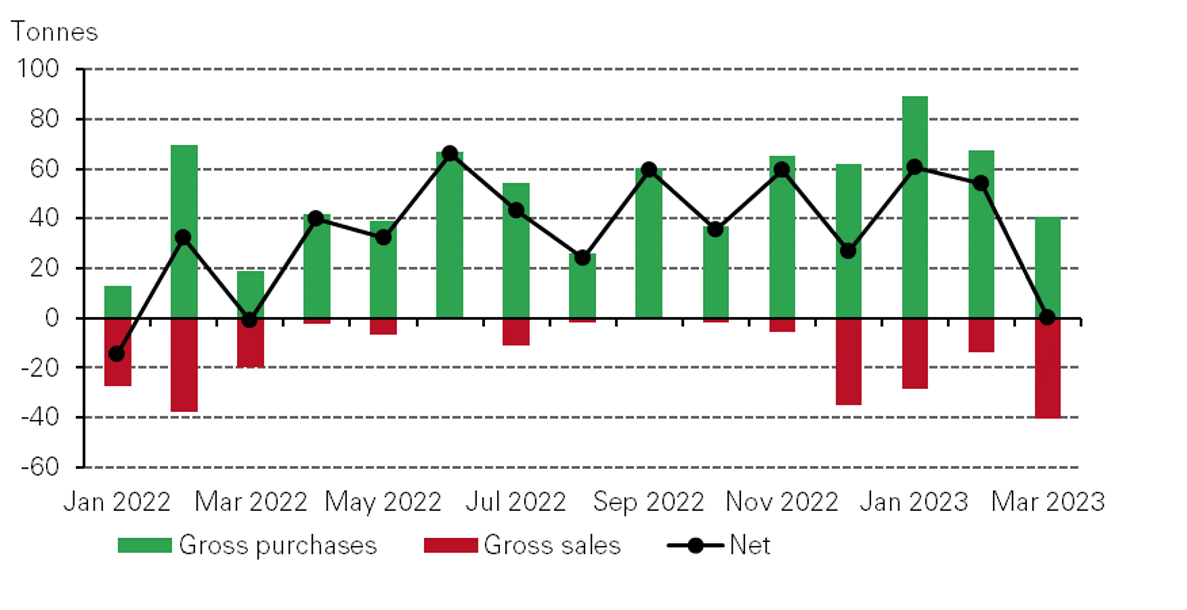
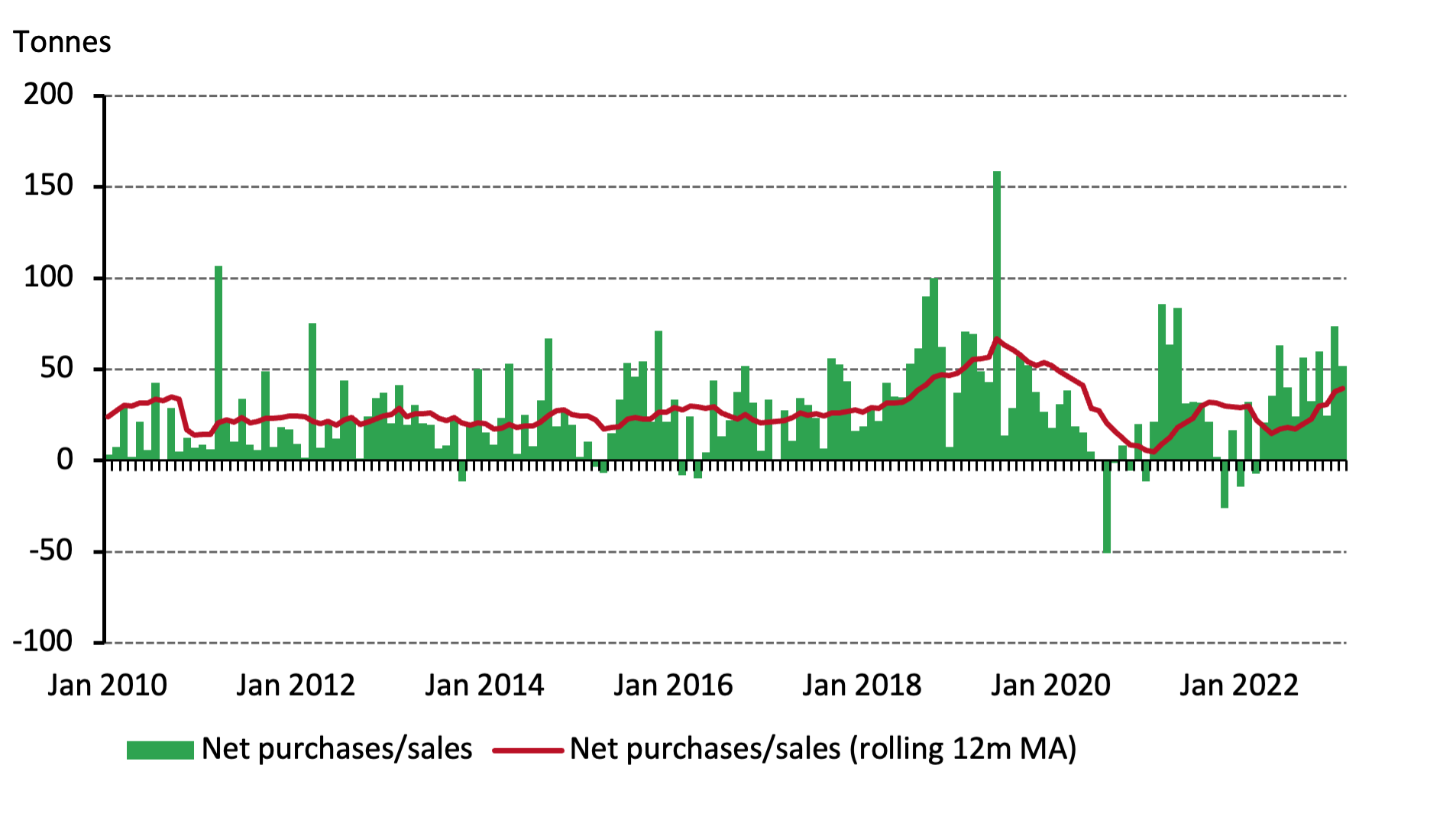
    Central bank gold buying momentum showed no signs of stalling in February. Reported global gold reserves  rose by 52t during the month –  the eleventh consecutive month of net purchases – following January's 74t. 1 This excludes updated data for Russia (more on that below ), but still maintains the upward trend (based on the 12-month moving average) since June 2022. 


    Central banks maintain momentum in gold *

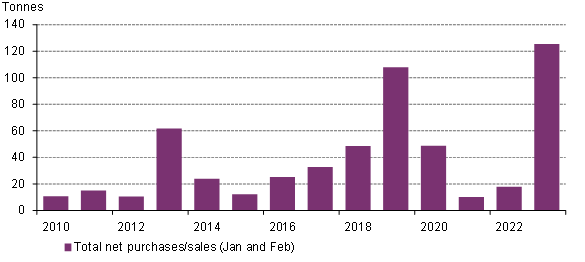
    On a y-t-d basis, central banks have reported net purchases of 125t. This is the strongest start to a year back to at least 2010 – when central banks became net buyers on an annual basis.


    Central bank demand in 2023 has had the strongest start since at least 2010*

    One of the more significant updates for February came from the Central Bank of Russia, which  published its gold reserves for the first time in over a year. 2 It reported gold holdings of 2,330t at the end of February 2023, 31t more than at the end of January 2022 when it last reported . However, no indication was given on the exact timing of the gold purchases over this period so we have assigned the reported change to February until more information is available.3  Based on the new information, gold reserves now account for 24% of Russia’s international reserves.

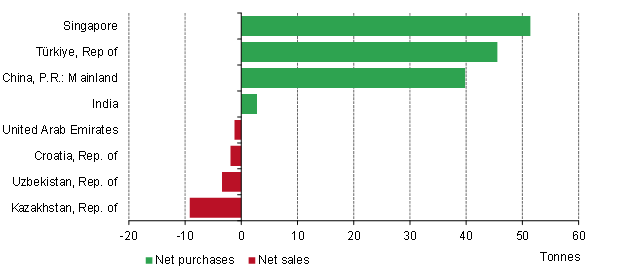
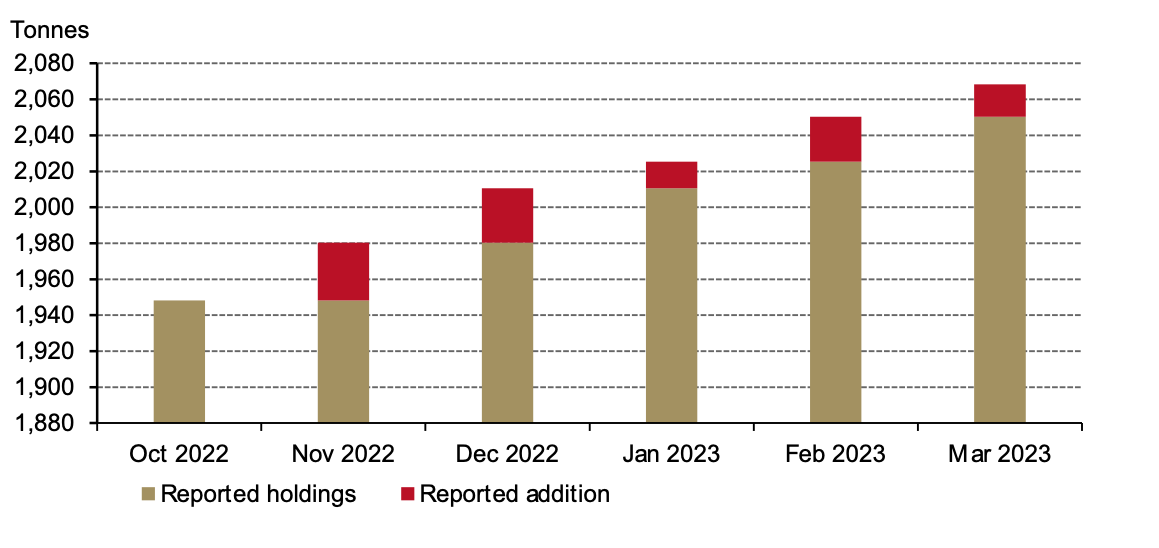
    The People’s Bank of China reported its gold reserves rose by 25t during the month, to 2,050t. This was the largest single purchase in February, and is the fourth consecutive month in which China’s gold reserves have risen, growing by 102t over that period. The Central Bank of Türkiye also continued its recent buying spree – now 15  consecutive months – adding over 22t. Its official gold reserves (central bank and Treasury holdings) are now 587t, 33% of its international reserves.4

    The Central Bank of Uzbekistan added 8t to its gold reserves, following three consecutive months of sales. Its official gold reserves now stand at 393t (67% of total reserves). The Monetary Authority of Singapore increased its gold reserves by nearly 7t, lifting them to 205t and over 51 tonnes higher than at the end of 2022. The Reserve Bank of India (RBI) resumed buying in February, having kept its powder dry in January. It added a modest 3t to lift its gold reserves to 790t. However, a recent recovery in the RBI’s FX reserves means gold’s share of total reserves has fallen marginally to 8%.

    The National Bank of Kazakhstan was the sole notable net seller during the month. Its official gold reserves fell by 13t, to 342t – their lowest level since October 2018. Since 2021, monthly net sales from Kazakhstan have increased in magnitude and frequency, but it is not uncommon for central banks that purchase gold from domestic sources to be frequent sellers of gold.


    Year-to-date, purchases have heavily outweighed sales*

    We’ll be revisiting all central bank gold demand for Q1 in our upcoming Gold Demand Trends report, due for publication at the start of May.5

    Footnotes

    1Based on IMF data supplemented with data from respective central banks where available and not reported through the IMF at the time of publication. Figures may be revised in our next monthly update should more data become available. Please see footnote 5 for more information of the differences between this dataset and the central bank dataset used in Gold Demand Trends.

    2www.cbr.ru/eng/press/pr/?file=638151009240212004ENG_STAT.htm

    3We will update our monthly changes dataset if/when more information on the timing of purchases is made available.

    4Türkiye official sector gold reserves are the sum of central bank-owned gold and Treasury gold holdings. This is equivalent to gross gold reserves less all gold held at the central bank in relation to commercial sector gold policies (such as the Reserve Option Mechanism (ROM), collateral, deposits and swaps). For information on this methodology, see: https://www.gold.org/download/file/16208/Central-bank-stats-methodology-technical-adjustments.pdf

    5We publish two  series of central bank gold activity, which are drawn from different sources. Central bank demand reported in Gold Demand Trends is primarily sourced from Metals Focus, whose proprietary estimates of official sector activity incorporate the IMF data. The monthly time series of central bank holdings reported on goldhub.com uses IMF IFS statistics supplemented with data directly from central bank websites where needed and available. Both data sets are subject to revision as new information is made available and/or to accommodate late or updated data reported by official institutions to the IMF. IMF IFS data is reported with a two-month lag and most institutions report on a regular basis, although some will report with a – sometimes significant – delay. Metals Focus sometimes has insight into these transactions before they are reported and will incorporate these into their data, which will therefore not require a revision.

    Global central bank gold reserves remained flat in March

    Krishan Gopaul

    Senior Analyst, EMEA World Gold Council


    •    According to the IMF, 1 reported global central bank gold reserves remained virtually unchanged in March.
    •    Available data shows purchases almost perfectly offset sales, resulting in a net increase of 0.2 tonnes.


    Central bank gold reserves virtually unchanged in March based on reported IMF data*

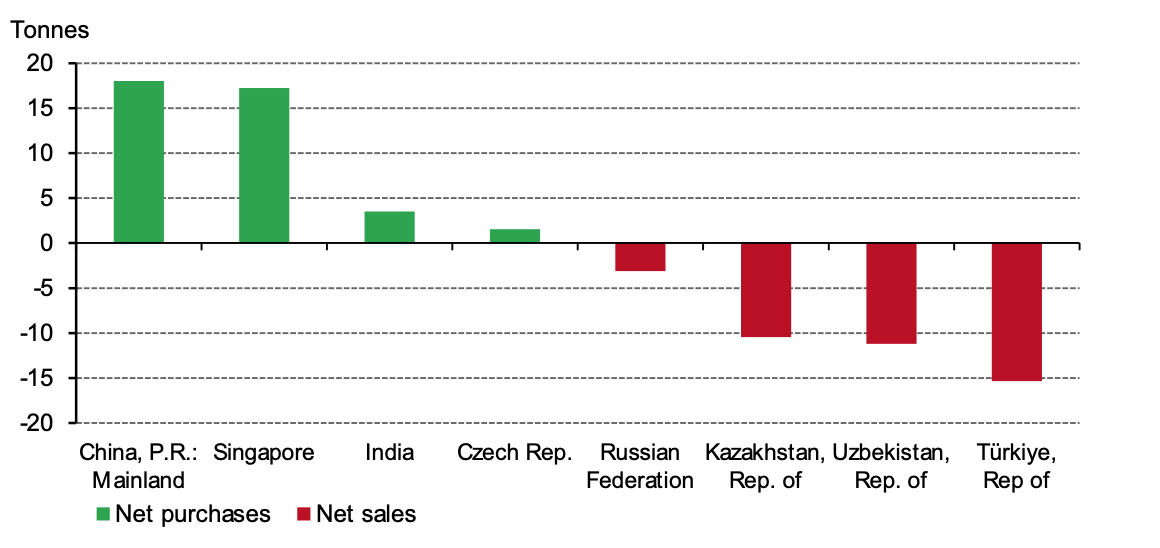
    China reported its fifth consecutive increase to its gold reserves, adding 18 tonnes in March.


    Reported PBoC gold reserves have now increased for five consecutive months*

    Singapore followed with a reported increase of 17t, bringing its total reserves to 222t – 45% higher than at the end of 2022. In addition, India and the Czech Republic reported a more modest 4- and 2-tonne increase, respectively.

    Reported sales of gold in March were driven primarily by Türkiye (15 tonnes), 2 Uzbekistan (11 tonnes) and Kazakhstan (10 tonnes). Türkiye sold the gold into the domestic market following a temporary partial ban on gold bullion imports. Further, it is not uncommon for central banks that purchase gold from domestic sources, such as Uzbekistan and Kazakhstan, to be frequent sellers of gold.


    China and Singapore purchases helped offset heavy sales from Türkiye, Uzbekistan and Kazakhstan in March*

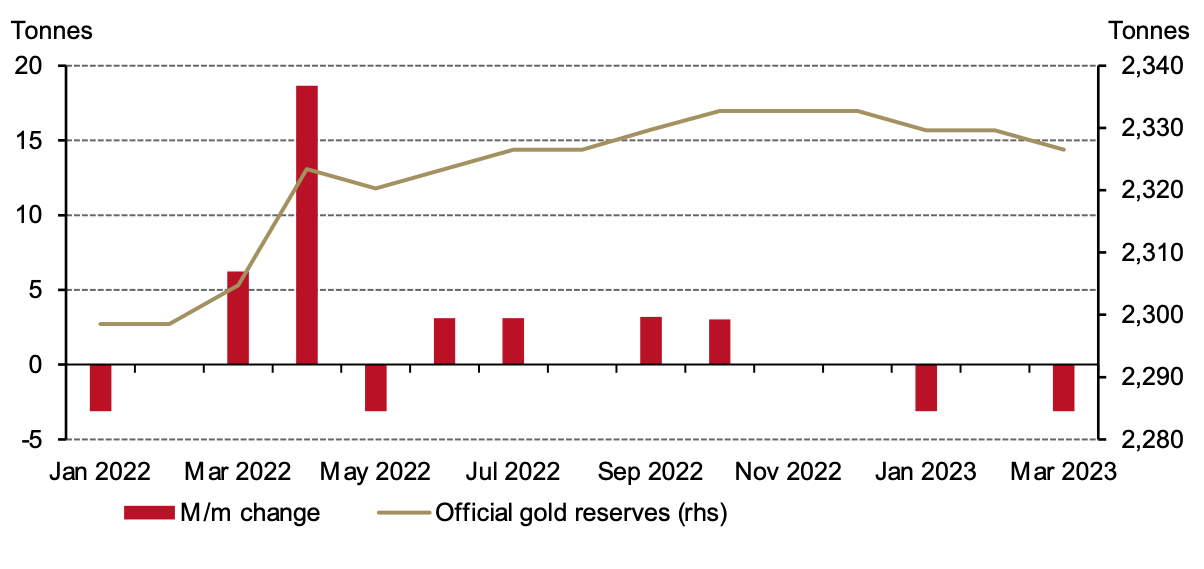
    Russia also showed a 3 tonne fall in official gold reserves in March after submitting previously unreported information dating back to February 2022.

    Stay tuned for our Gold Demand Trends Q1 report, to be published on 5 May, which will contain more detailed information on gold demand by central banks and other official institutions.3


    Monthly changes in Central Bank of Russia gold reserves*

    Footnotes

    1Based on IMF IFS data and supplemented with data from respective central banks where available and not reported through the IMF at the time of publication. IMF IFS data is reported with a two-month lag, and while most institutions report on a regular basis, some may report with a – sometimes significant – delay. Figures may be subsequently revised as more data becomes available. The data used here informs but is distinct from the central bank demand estimates we report in Gold Demand Trends. Please see footnote 3 for more information.

    2Türkiye official sector gold reserves are the sum of central bank-owned gold and Treasury gold holdings. This is equivalent to gross gold reserves less all gold held at the central bank in relation to commercial sector gold policies (such as the Reserve Option Mechanism (ROM), collateral, deposits and swaps). For information on this methodology, see: Central Banks Methodology Note

    3For purposes of Gold Demand Trends, central bank demand is defined as net purchases (i.e. gross purchases less gross sales) by central banks and other official sector institutions, including supra national entities such as the IMF and sovereign wealth funds where applicable. Our central bank demand data is sourced from Metals Focus, whose proprietary estimates of official sector activity incorporate various sources, including IMF IFS reports, international trade data, and others. As such, IMF IFS data is a subset of what is included in Gold Demand Trends. Both data sets are subject to revision as new information is made available and/or to accommodate late or updated data reported by official institutions. 

    Central bank demand flipped negative in April amid Turkish selling

    Krishan Gopaul

    Senior Analyst, EMEA World Gold Council


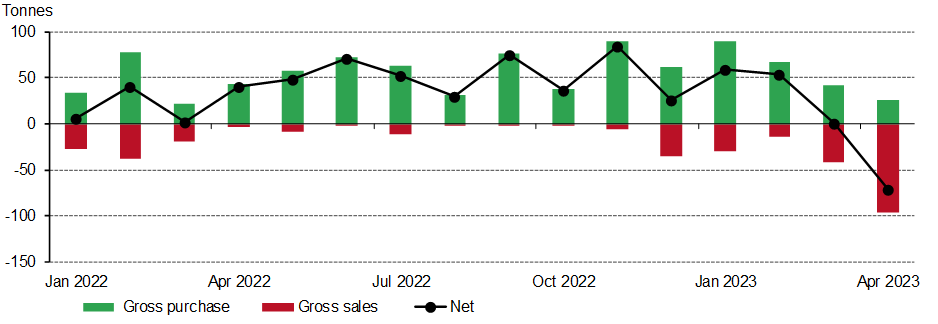
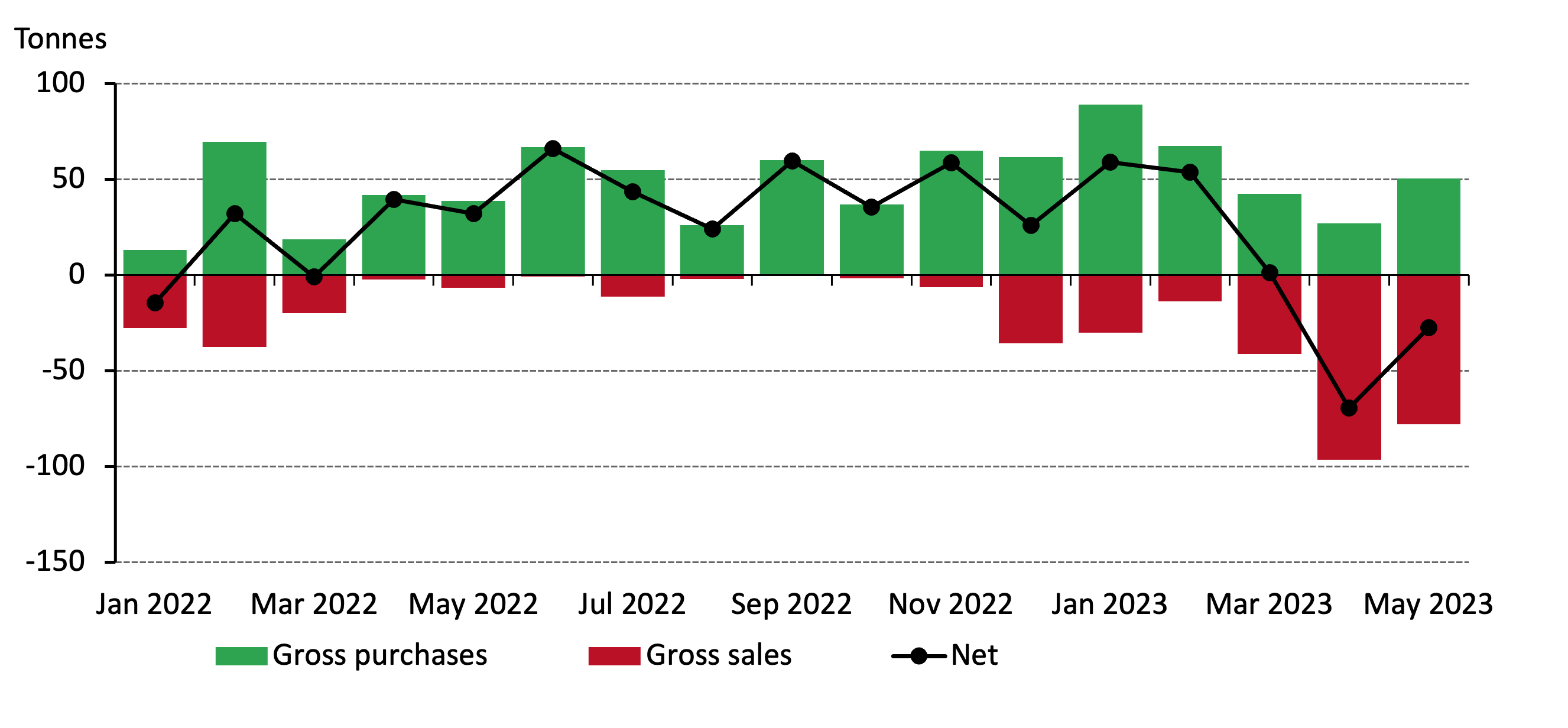
    • Global official gold reserves dropped by 71 tonnes (t) in April (Chart 1), according to our monthly analysis sourced primarily from the IMF1
    • This was the first net decrease in reported gold holdings for over a year (March 2022: -1t).


    Chart 1: Global central bank gold reserves fell in April*

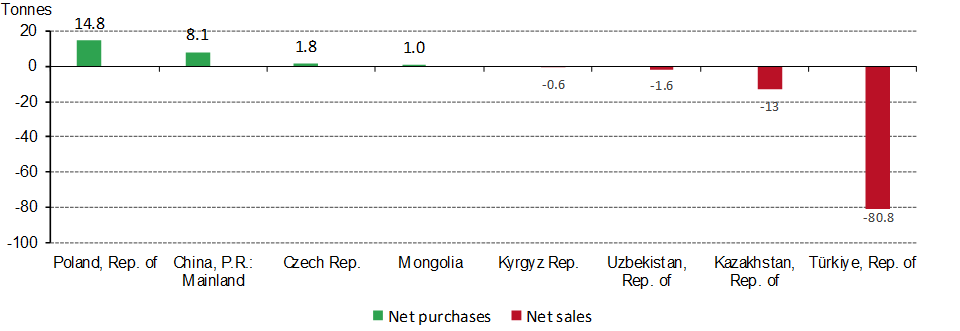
    This may, on the face of it, seem like a remarkable about turn from central banks, which were a source of very strong gold demand in Q1.2 But the country-level data reveals that, far from a sudden wave of central bank selling, the drop in reserves was primarily due to Türkiye (Chart 2).

    The Central Bank of Türkiye reported a decline in its official gold reserves of 81t, reducing its total gold reserves to 491t.3 Our analysis, based on published data and in-market conversations, indicates that this was a specific response to local dynamics rather than a change to their long-term gold policy: the gold was sold into Türkiye's domestic market to satisfy very strong bar, coin and jewellery demand following a temporary partial ban on gold bullion imports.4  It remains to be seen if this selling will continue and, if so, at what pace.

    The other notable – albeit smaller – sellers during April were three banks who regularly buy gold from domestic production. Frequent buying and selling are not uncommon for central banks which buy gold from domestic sources. The National Bank of Kazakhstan reduced its official gold reserves by 13t to 319t, the third consecutive monthly sale in excess of 10t. Nonetheless, gold still represents 54% of total Kazakh reserves. The Central Bank of Uzbekistan sold for the second consecutive month, although substantially lower than in March. Its official gold reserves fell by 2t during the month, to 380t (69% of total reserves). The National Bank of the Kyrgyz Republic also sold 0.6t during the month.

    Purchases were comparatively smaller this month. Four central banks reported an increase in their gold reserves. The largest purchase came from Poland -  the Narodowy Bank Polski’s gold holdings rose by 15t to 243t, accounting for 9% of total reserves by the end of April.5 The People’s Bank of China continued its recent run of buying – now six consecutive months – lifting its gold reserves by 8t to 2,076t (4% of total reserves). The Czech National Bank (2t) and the Central Bank of Mongolia (1t) were the other reported buyers.


    Chart 2: Türkiye’s April sale eclipsed all other activity during the month*

    Despite sizable net selling from central banks in April, we maintain our expectation for central banks to remain net gold purchasers in 2023, as we discussed in our most recent Gold Demand Trends (GDT). Our view is also supported by findings from our latest Central Bank Gold Reserves survey, which shows reserves managers remain broadly positive towards gold. It’s also worth noting that the Central Bank of Iraq recently announced a 2.5t purchase in May and signalled more to come.6 Due to its timing, though, this purchase will be reflected in next month’s central banks' activity summary.

    Of course, further selling could challenge the outlook which we will update, based on all available information, in our next GDT.

    Footnotes

    1Based on monthly IMF IFS data and supplemented with data from respective central banks where available and not reported through the IMF at the time of publication. IMF IFS data is reported with a two-month lag, and while most institutions report on a regular basis, some may report with a – sometimes significant – delay. Figures may be subsequently revised as more data becomes available. The data used here informs but is distinct from the central bank demand estimates we report in Gold Demand Trends. Please see footnote 3 for more information.

    2For purposes of Gold Demand Trends, central bank demand is defined as net purchases (i.e. gross purchases less gross sales) by central banks and other official sector institutions, including supra national entities such as the IMF and sovereign wealth funds where applicable. Our quarterly central bank demand data is sourced from Metals Focus, whose proprietary estimates of official sector activity incorporate various sources, including IMF IFS reports, international trade data, and others. As such, IMF IFS data is a subset of what is included in Gold Demand Trends. Both data sets are subject to revision as new information is made available and/or to accommodate late or updated data reported by official institutions.

    3Türkiye official sector gold reserves are the sum of central bank-owned gold and Treasury gold holdings. This is equivalent to gross gold reserves less all gold held at the central bank in relation to commercial sector gold policies (such as the Reserve Option Mechanism (ROM), collateral, deposits and swaps). For information on this methodology, click here.

    4For more, see: Turkey to suspend some gold imports after earthquake -Bloomberg News | Reuters

    5For more, see: Official reserve assets | NBP

    6Iraq Boosts Gold Reserves by 2% in Single Day in Gradual Buildup, Bloomberg, 29 May 2023.

    Central banks remained net sellers in May but picture improves

    Krishan Gopaul

    Senior Analyst, EMEA World Gold Council


    • Central banks remained net sellers in May; global official gold reserves fell 27t1
    • Monthly net total was again impacted by significant offloading from Türkiye
    • Excluding Türkiye’s sales, the positive trend in central bank buying continued


    Central banks as a whole reported net sales in May: global official gold reserves fell by 27t, less than half the 69t of net sales seen in April. 


    Central banks remained net sellers in May, although at half the level of April*

    The Central Bank of Türkiye was again the largest seller in May, offloading 63t of gold.2 Since March, the central bank has sold nearly 160t, equivalent to its cumulative purchases over the preceding 12 months. As noted previously, these sales are a response to local market dynamics (very strong gold demand and a temporary partial ban on gold bullion imports) rather than a change to their long-term gold policy.

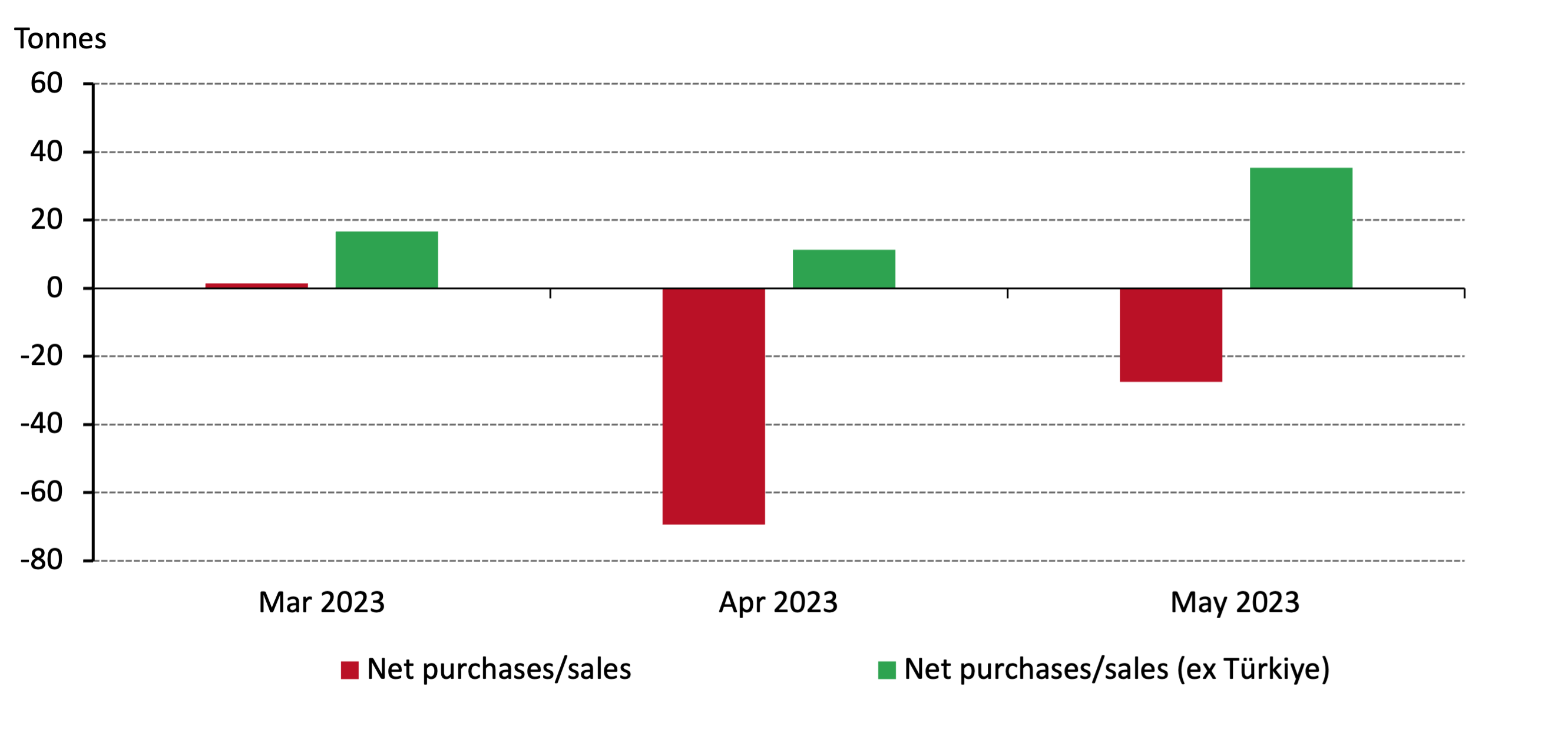
    The chart below illustrates the impact of Türkiye’s sales on the net total: excluding them shows that central banks globally would have been net purchasers over the last three months.


    Excluding Türkiye’s sales, the trend in central bank buying is still in place*

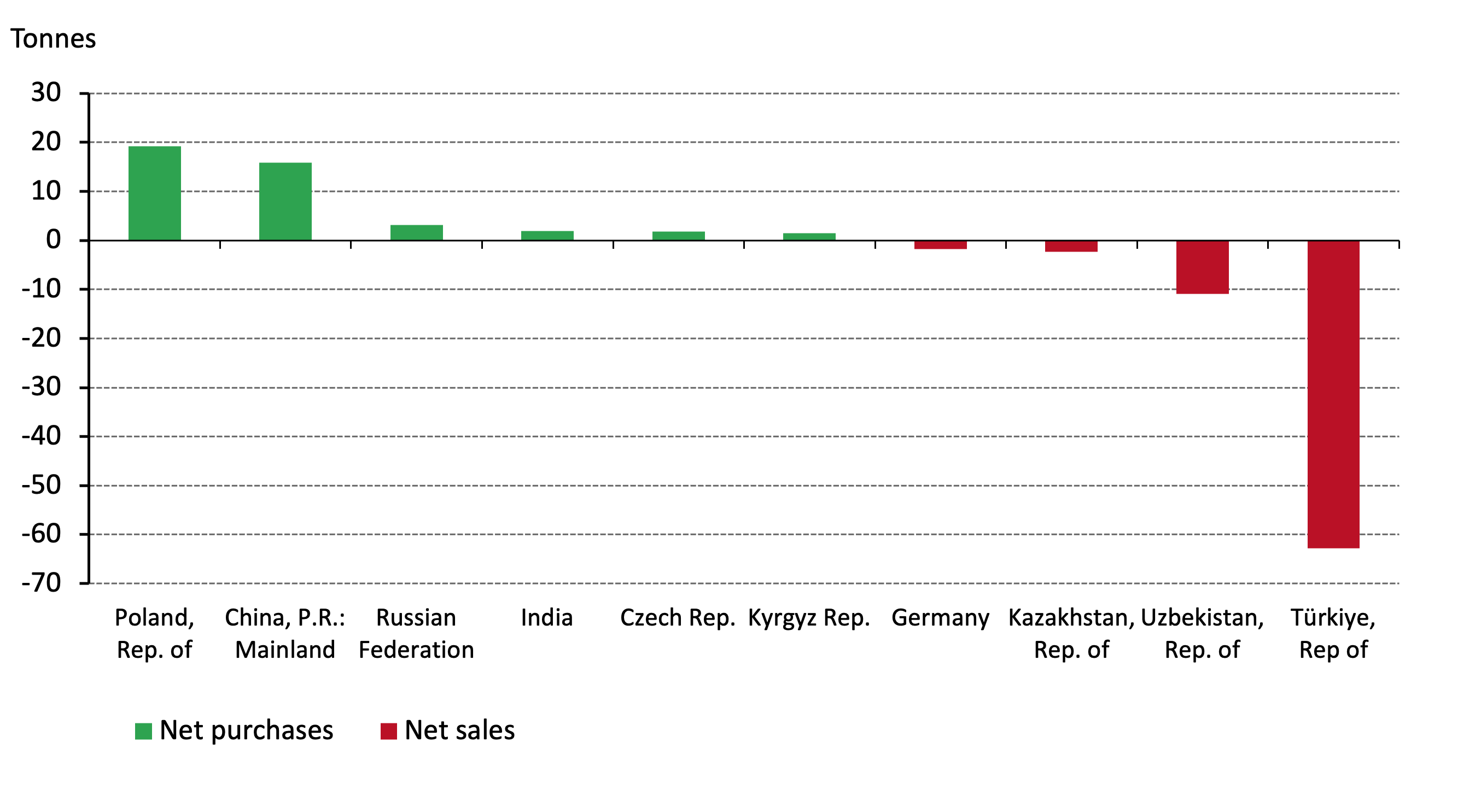
    Aside from Türkiye, the Central Bank of Uzbekistan (11t), the National Bank of Kazakhstan (2t) and Germany (2t) were the other significant sellers during the month. Selling by banks who buy gold from domestic production – such as Uzbekistan and Kazakhstan is not uncommon, while Germany’s sale is likely related to its coin-minting programme.

    Eight central banks increased their official gold reserves in May, led by Poland. The National Bank of Poland added 19t during the month, lifting its gold reserves to 263t. The People’s Bank of China reported buying 16t in May, its seventh consecutive month of purchases. Its gold reserves now stand at 2,092t. The central banks of Singapore (4t), Russia (3t), India (2t), the Czech Republic (2t) and the Kyrgyz Republic (2t) were the other notable buyers.

    As noted in last month’s blog, the Central Bank of Iraq boosted its gold reserves by just over 2 tonnes in May, lifting its gold reserves to 133 tonnes. According to the central bank: “the purchase came with the aim of increasing its holdings of gold in light of the economic and political conditions that the world is witnessing.”3


    Key central bank purchases and sales in May by country*

    In other news, Russia’s National Wealth Fund has reduced its gold holdings by 37t since the start of the year. There is little publicly-available information around this activity, but suggestions are that the sales of gold (and yuan) have been used to finance the budget deficit.

    Commentary for central bank gold demand in Q2 2023 will be available in our next Gold Demand Trends report, which will be released at the start of August.4

    Footnotes

    1Based on monthly IMF IFS data and supplemented with data from respective central banks where available and not reported through the IMF at the time of publication. IMF IFS data is reported with a two-month lag, and while most institutions report on a regular basis, some may report with a – sometimes significant – delay. Figures may be subsequently revised as more data becomes available. The data used here informs but is distinct from the central bank demand estimates we report in Gold Demand Trends. Please see footnote 3 for more information.

    2Türkiye official sector gold reserves are the sum of central bank-owned gold and Treasury gold holdings. This is equivalent to gross gold reserves less all gold held at the central bank in relation to commercial sector gold policies (such as the Reserve Option Mechanism (ROM), collateral, deposits and swaps). For information on this methodology, click here.

    3https://cbi.iq/news/view/2347

    4For purposes of Gold Demand Trends, central bank demand is defined as net purchases (i.e. gross purchases less gross sales) by central banks and other official sector institutions, including supra national entities such as the IMF and sovereign wealth funds where applicable. Our quarterly central bank demand data is sourced from Metals Focus, whose proprietary estimates of official sector activity incorporate various sources, including IMF IFS reports, international trade data, and others. As such, IMF IFS data is a subset of what is included in Gold Demand Trends. Both data sets are subject to revision as new information is made available and/or to accommodate late or updated data reported by official institutions.

    Central banks return to net buying in June

    Krishan Gopaul

    Senior Analyst, EMEA World Gold Council


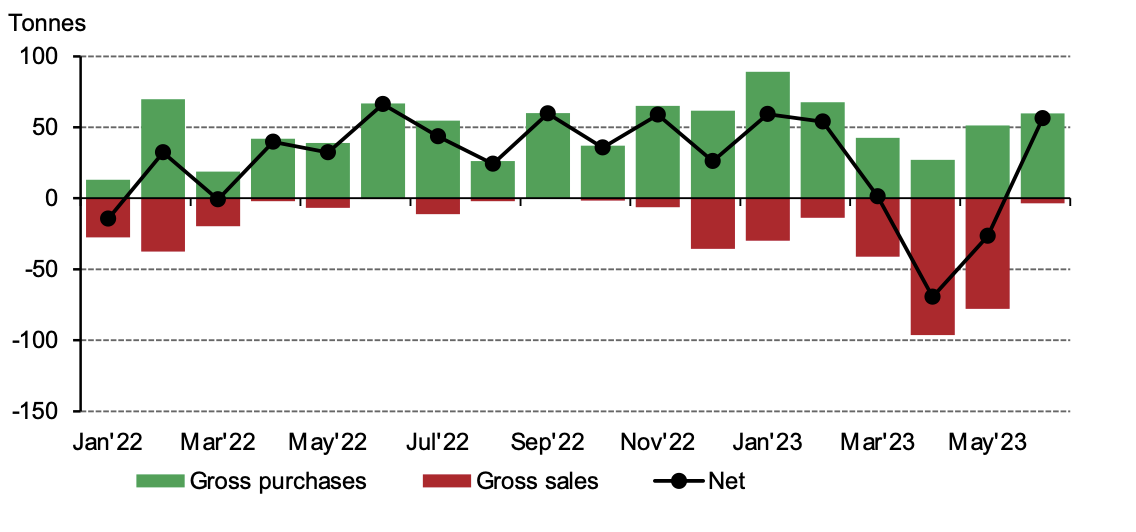
    • Central banks bought a net 55t of gold in June following three straight months of selling
    • The Central Bank of Türkiye's return to net buying in June helped the trend in central bank demand remain steadfast


    Following three months of net sales, central banks reported net buying again in June* 

    Reported net purchases from central banks totalled 55t, the first month of sizeable global net buying since February.1 

    As in recent months, activity from the Central Bank of Türkiye (CBRT) was pivotal to the global total.2 Having been a significant net seller between March and May in order to meet local demand, it swung back to net buying in June, adding 11t to its official reserves.3 The CBRT’s total gold reserves stood at 440t at the end of June (29% of total reserves).

    The bank’s activity underlined and clarified the continuing trend in central bank gold demand. Six central banks added gold during the month, with only two notable sellers. Among the buyers, the People’s Bank of China was the largest. It added 21t to its gold reserves during June, the eighth consecutive month of purchases. Since it began reporting increases in November 2022, gold reserves have grown by 165t (+8%), of which 103t has been bought in 2023, making it the largest buyer y-t-d.

    The National Bank of Poland (NBP) was another large purchaser in June, increasing its gold reserves by 14t. This is the third consecutive month of buying from the bank, which last year indicated that it planned to add 100t to its gold reserves.4 The NBP has added 48t y-t-d, pushing its total gold holdings to 277t. Uzbekistan (8t), the Czech Republic (3t), Qatar (2t) and India (1t) were the other notable buyers in June.

    At the time of writing, Kazakhstan and Singapore were the only significant (one tonne or more) sellers in June. Kazakhstan’s official gold reserves fell by 3t to 314t (56% of total reserves), with the bank indicating that more selling will likely occur before the end of the year.5 More frequent buying and selling from banks that obtain gold from domestic sources, such as Kazakhstan, is not uncommon. The Monetary Authority of Singapore reduced its gold reserves by 1t during the month.

    To read more about central bank gold demand in H1 as a whole, please see our latest Gold Demand Trends report.6 

    Footnotes

    1Based on monthly IMF IFS data and supplemented with data from respective central banks where available and not reported through the IMF at the time of publication. IMF IFS data is reported with a two-month lag, and while most institutions report on a regular basis, some may report with a – sometimes significant – delay. Figures may be subsequently revised as more data becomes available. The data used here informs but is distinct from the central bank demand estimates we report in Gold Demand Trends. Please see footnote 3 for more information.

    2Türkiye official sector gold reserves are the sum of central bank-owned gold and Treasury gold holdings. This is equivalent to gross gold reserves less all gold held at the central bank in relation to commercial sector gold policies (such as the Reserve Option Mechanism (ROM), collateral, deposits and swaps). For information on this methodology, click here.

    3For more, see: Turkey to suspend some gold imports after earthquake -Bloomberg News | Reuters

    4biznes.interia.pl/gospodarka/news-adam-glapinski-prezes-nbp-bede-namawiac-rpp-do-kolejnej-podw,nId,5823037

    5www.bloomberg.com/news/articles/2023-07-31/one-big-gold-seller-among-central-banks-has-even-more-to-offload

    6For purposes of Gold Demand Trends, central bank demand is defined as net purchases (i.e. gross purchases less gross sales) by central banks and other official sector institutions, including supra national entities such as the IMF and sovereign wealth funds where applicable. Our quarterly central bank demand data is sourced from Metals Focus, whose proprietary estimates of official sector activity incorporate various sources, including IMF IFS reports, international trade data, and others. As such, IMF IFS data is a subset of what is included in Gold Demand Trends. Both data sets are subject to revision as new information is made available and/or to accommodate late or updated data reported by official institutions.

    Central bank gold buying remains hot in July

    Krishan Gopaul

    Senior Analyst, EMEA World Gold Council


    • Central banks added 55t to global gold reserves in July
    • China and Poland both added around 23t, while Turkey was again among the buyers
    • Selling was limited but volumes were still notable


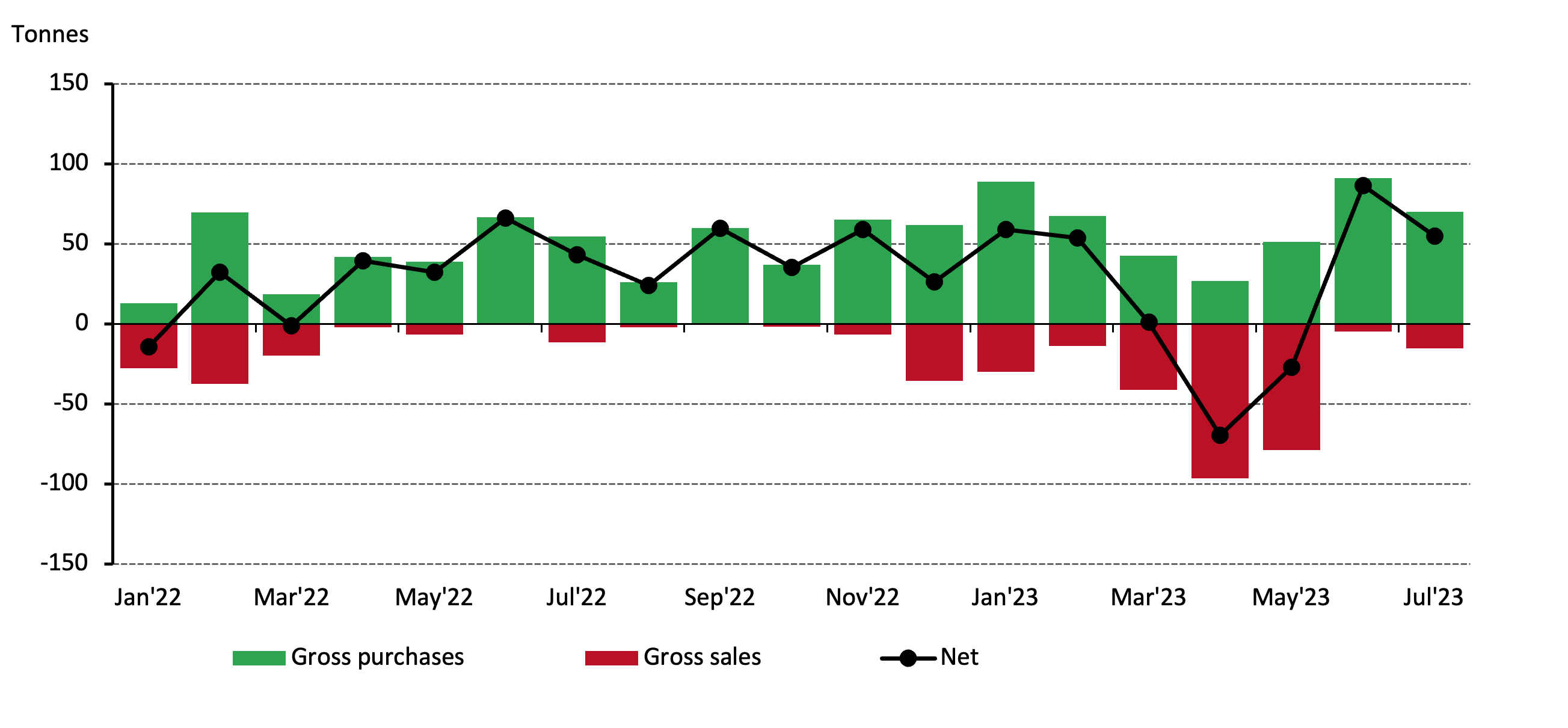
    Having reported a return to net buying in June, the latest data shows global central banks continued to add to their gold reserves in July. Central banks reported healthy net purchases of 55t during the month.1 Despite the month-on-month slowdown – owing to the late reporting of a 30t purchase by the Central Bank of Libya in June – the latest data does seem to support our view that the longer-term buying trend remains in place.


    Central banks remained net buyers in July*

    Looking at the detailed activity during July, two things are notable: 1) relatively few banks altered their gold holdings in July, and 2) many that did buy/sell did so sizeably.

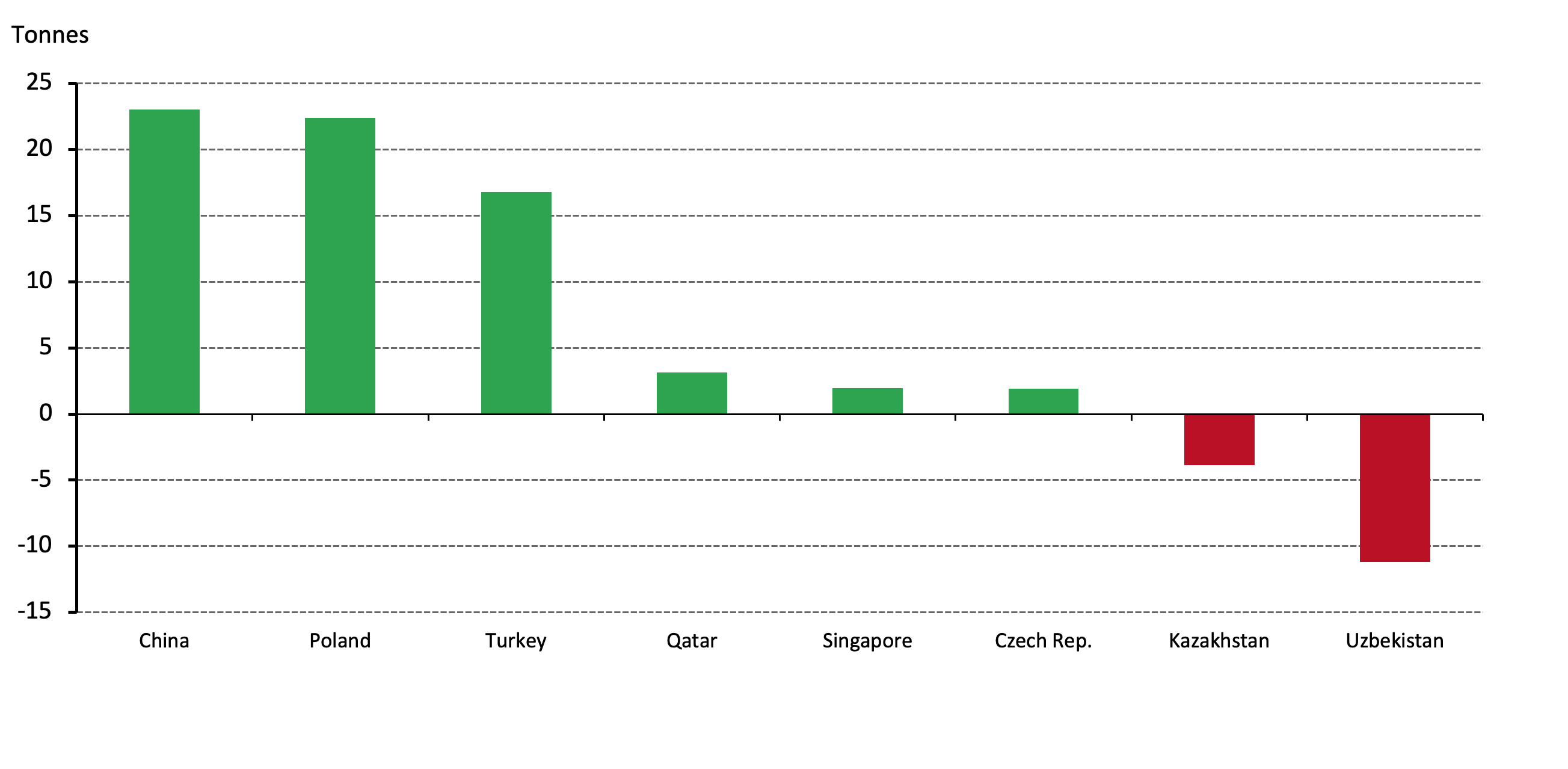
    The People’s Bank of China (PBoC) was once again the largest buyer, adding 23t during the month and cementing its place as the largest buyer year-to-date (126t). Since it began regularly reporting gold buying in November, the PBoC has bought a net 188t, lifting its total gold reserves to 2,136t (4% of total reserves). The National Bank of Poland (NBP) was a close second, increasing its gold reserves by 22t during July, boosting its total gold holdings to 299t. This is the fourth consecutive month of net buying, with purchases over this period totalling 71t – just 29t shy of the NBP’s stated aim of increasing its gold reserves by 100t.2

    The Central Bank of Turkey was again among the buyers in July.3 Having flipped back to net purchases in June (11t), it added a further 17t in July. However, on a year-to-date basis the central bank remains a net seller (85t) owing to the heavy selling between March and May. Gold import quotas were reinstated in early August so it remains to be seen whether this will lead to renewed selling from the central bank should local gold demand remain elevated.4 Qatar (3t), Singapore (2t) and the Czech Republic (2t) also bought gold during the month.

    In early August, it was also reported that Russia would recommence the buying of foreign currency and gold.5 However, scant information was available on the size or timing of any future gold purchases so we just need to watch the monthly data.


    Buying and selling was limited in July, but volumes were sizeable*

    There were fewer sales than purchases in July, but volumes were still meaningful. The Central Bank of Uzbekistan (11t) and the National Bank of Kazakhstan (4t) were the two noteworthy and familiar sellers in the month. Further sales from central banks should not be discounted, especially from those that buy from domestic sources, such as the two above. In fact, the National Bank of Kazakhstan has been upfront on its plans to further reduce its gold reserves by the end of the year.6

    Following the release of our latest Gold Demand Trends report, it’s undeniable that strength of central bank gold demand remains headline news. After recent heavy selling – largely from Turkey – monthly net purchases have re-established themselves in June and July. As such, we think this is a sector gold observers should continue to pay attention to.

    Footnotes

    1Based on monthly IMF IFS data and supplemented with data from respective central banks where available and not reported through the IMF at the time of publication. IMF IFS data is reported with a two-month lag, and while most institutions report on a regular basis, some may report with a – sometimes significant – delay. Figures may be subsequently revised as more data becomes available. The data used here informs but is distinct from the central bank demand estimates we report in Gold Demand Trends. Please see footnote 3 for more information.

    2biznes.interia.pl/gospodarka/news-adam-glapinski-prezes-nbp-bede-namawiac-rpp-do-kolejnej-podw,nId,5823037

    3Turkey’s official sector gold reserves are the sum of central bank-owned gold and Treasury gold holdings. This is equivalent to gross gold reserves less all gold held at the central bank in relation to commercial sector gold policies (such as the Reserve Option Mechanism (ROM), collateral, deposits and swaps). For information on this methodology, click here.

    4www.reuters.com/world/middle-east/turkey-plans-gold-import-quota-cut-ca-deficit-source-2023-08-07

    5www.bloomberg.com/news/articles/2023-08-03/russia-to-restart-buying-currency-gold-as-energy-income-revives

    6www.bloomberg.com/news/articles/2023-07-31/one-big-gold-seller-among-central-banks-has-even-more-to-offload?

    Central bank demand still sizzling in August

    Krishan Gopaul

    Senior Analyst, EMEA World Gold Council


    • Central banks reported adding 77t of gold to global reserves in August
    • China, Poland and Turkey were again buyers; no notable sales during the month
    • As we head into Q4, central banks remain on course for a strong annual total.

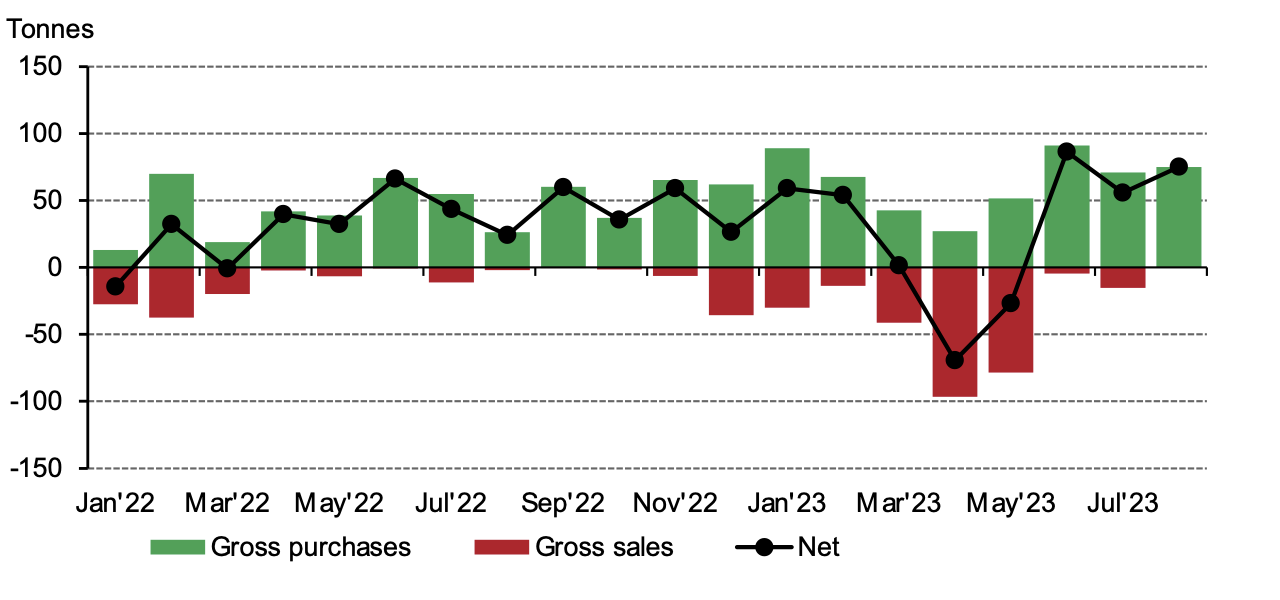
    Central banks collectively increased their gold reserves in August for the third consecutive month. They added – based on the reported data at the time of writing – 77t to global official reserves during the month, a 38% up-tick from July’s buying.1 Over the last three months, their combined net buying has totalled 219t, comfortably outweighing the combined net sales from April and May (96t). 
     

    Central banks post another month of strong gold buying in August*

    This recent buying suggests that we have now firmly moved past the net selling we saw in April and May, which was primarily driven by heavy, non-strategic selling from Turkey. We are therefore confident that the long-term trend of healthy central bank demand remains in place.

    Buying, however, continues to be sizeable but limited to a small number of banks. The People’s Bank of China once again led the pack, adding a further 29t during the month. This brings its y-t-d net purchases to 155t, and its total buying since last November – when it began regularly reporting purchases – to 217t. As a result, gold holdings climbed to 2,165t at the end of August, accounting for just over 4% of total reserves.

    The National Bank of Poland (NBP) also remained a significant buyer during the month. The NBP bought a further 18t, bringing its y-t-d net buying to 88t and a step closer to its previously stated 100t buying target.2  Its gold reserves now amount to 314t (11% of total reserves). Meanwhile, the Central Bank of Turkey added 15t to its gold reserves in August as it continues to rebuild its reserves following the sales mentioned above.3  

    The Central Bank of Uzbekistan (9t), the Reserve Bank of India (2t), the Czech National Bank (2t), Singapore (2t) and National Bank of the Kyrgyz Republic (1t), were the other buyers in the month. The Central Bank of Russia also reported a 3t increase in its gold reserves in August, taking its gold reserves back to where they started the year at 2,333 tonnes.

    While reported sales were virtually non-existent in the month, Bloomberg reported claims that the Central Bank of Bolivia had “monetised” 17t of its gold reserves between May and August. This follows new legislation in May enabling the central bank to utilise its gold reserves.4 If confirmed, this would represent a 40% decline in its gold reserves (tonnage terms). Until confirmed, however, there is ambiguity in the use of “monetise” as this could mean several things, including, for example, outright sales or swap agreements. Currently, data on gold reserves at the Central Bank of Bolivia is not available after April, so we await more information.


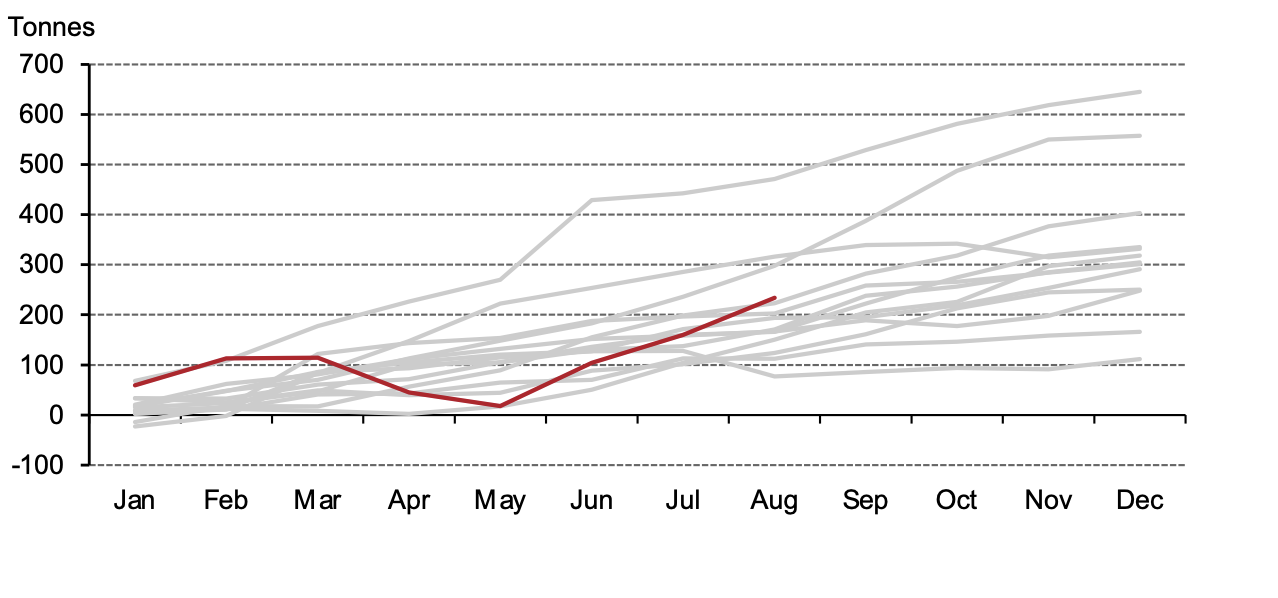
    Cumulative reported central bank demand by year since 2010 (red line: YTD 2023)*

    Suffice to say, central bank buying remains healthy. Even accounting for the net sales earlier in the year, the pace of buying so far this year suggests that we are on course for another strong annual total. We’ll cover overall central bank demand for Q3 and y-t-d in our next Gold Demand Trends report, which will be published at the end of October.

    Footnotes

    1Based on monthly IMF IFS data and supplemented with data from respective central banks where available and not reported through the IMF at the time of publication. IMF IFS data is reported with a two-month lag, and while most institutions report on a regular basis, some may report with a – sometimes significant – delay. Figures may be subsequently revised as more data becomes available. The data used here informs but is distinct from the central bank demand estimates we report in Gold Demand Trends. Please see footnote 3 for more information.

    2www.biznes.interia.pl/gospodarka/news-adam-glapinski-prezes-nbp-bede-namawiac-rpp-do-kolejnej-podw,nId,5823037

    3Turkey’s official sector gold reserves are the sum of central bank-owned gold and Treasury gold holdings. This is equivalent to gross gold reserves less all gold held at the central bank in relation to commercial sector gold policies (such as the Reserve Option Mechanism (ROM), collateral, deposits and swaps). For information on this methodology, click here.

    4www.bloomberg.com/news/articles/2023-05-05/bolivian-senate-approves-general-terms-of-bill-to-monetize-gold
    Central banks bought 77t in September

    Krishan Gopaul

    Senior Analyst, EMEA World Gold Council


    Download PDF

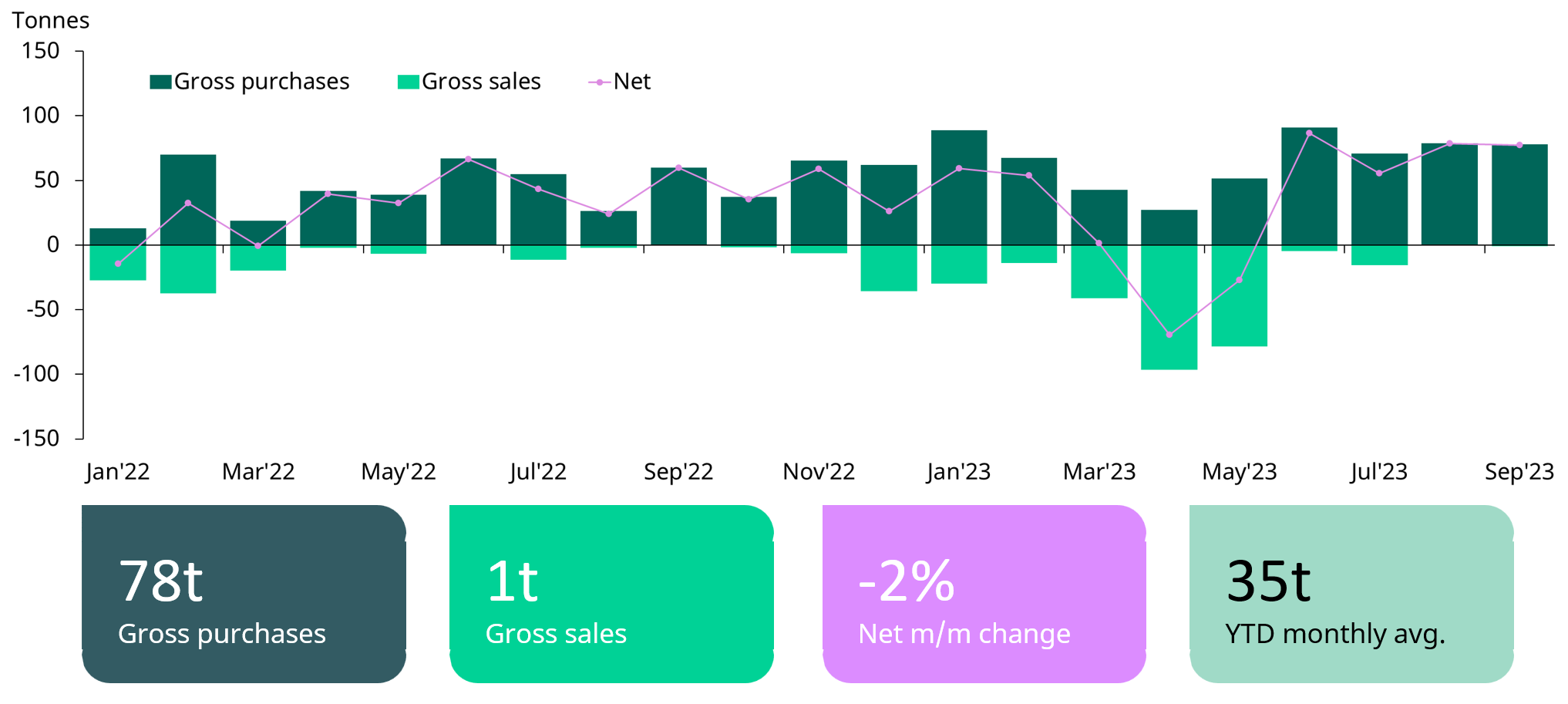
    • Reported global central bank gold reserves, via the IMF and publicly available sources, rose by a net 77t in September
    • Gross sales (1t) were dwarfed by gross purchases (78t), highlighting the strength of buying

    Change by country

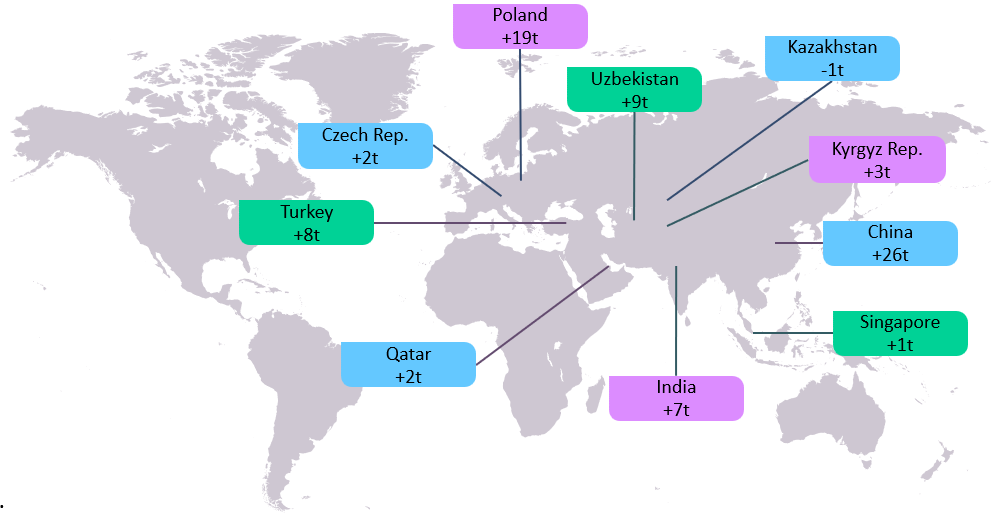
    Central bank purchases in September 2023 were dominated by banks who have been regular buyers so far this year.

    Major buyers were all from emerging markets. The People’s Bank of China added the most gold during the month (26t), followed by the National Bank of Poland and the Central Bank of Uzbekistan.

    Changes year-to-date

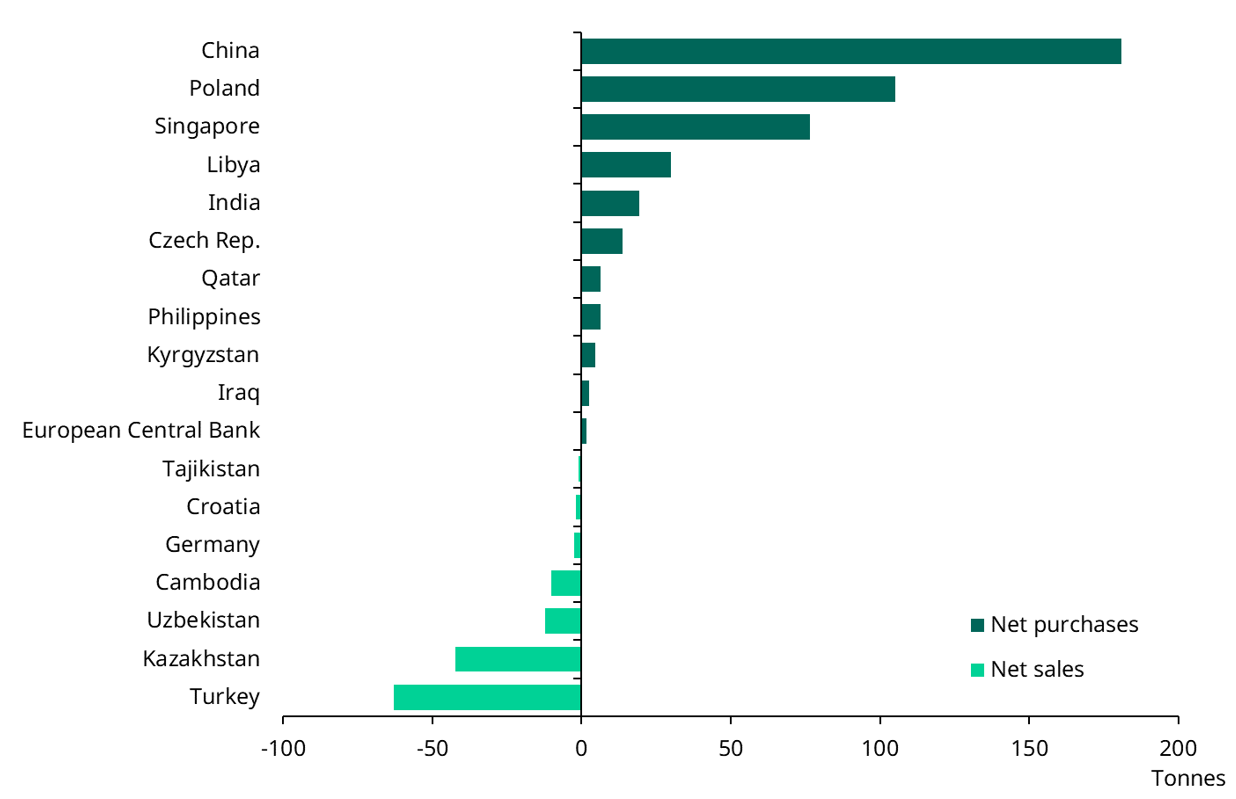
    The People’s Bank of China remains the largest gold purchaser in 2023.

    Emerging market banks have been the driving force on both the purchases and sales side.

    The Monetary Authority of Singapore remains the sole developed market bank adding gold to its reserves (the ECB addition was related to Croatia joining the eurozone in January).


    Latest research

    Looking for insight and analysis on gold? Our team of experts produce market-leading research and macroeconomic commentary on gold.