Central Bank Gold Statistics: Central banks make positive headlines on gold
3 September, 2026
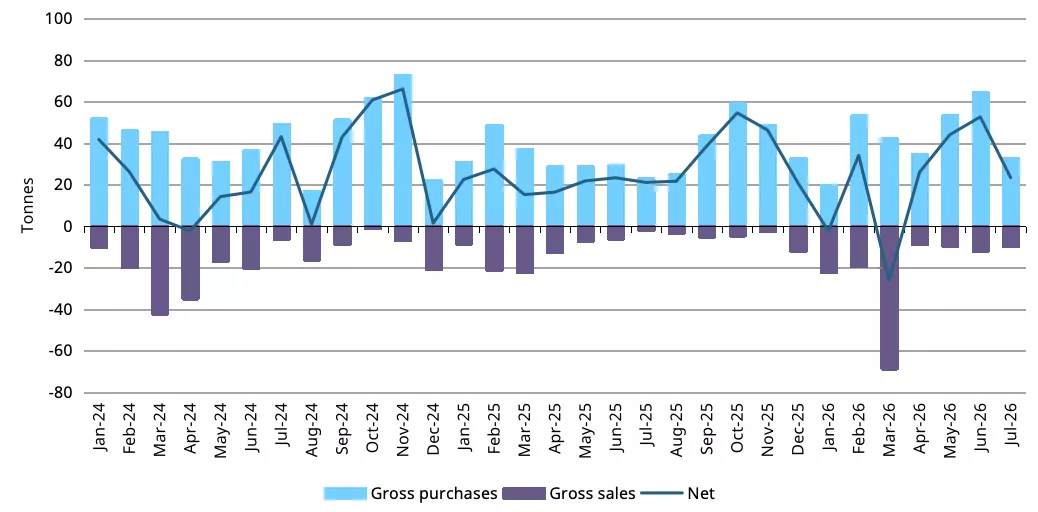
Central banks continued their gold accumulation in July with net buying reported at 23t. Emerging markets have also continued to accumulate gold this month with China (20t) and Poland (8t) taking the lead (Chart 1). Notably, activity from the People’s Bank of China (PBoC) has picked up pace in recent months, with double-digit monthly purchases of gold since May 2026. Russia was the top net seller this month, posting sales of 6t, followed by Turkey, Jordan and Uzbekistan at 1t each. On a y-t-d basis, central banks reported purchases have totalled around 130t of gold. This compares to a reported ~160t which was purchased over the same period last year.
Chart 1: Central banks remain positive in July with net buying of 23t
Monthly reported central bank activity, tonnes*
*Data to 31 July 2026, where available.
Source: IMF, respective central banks, World Gold Council
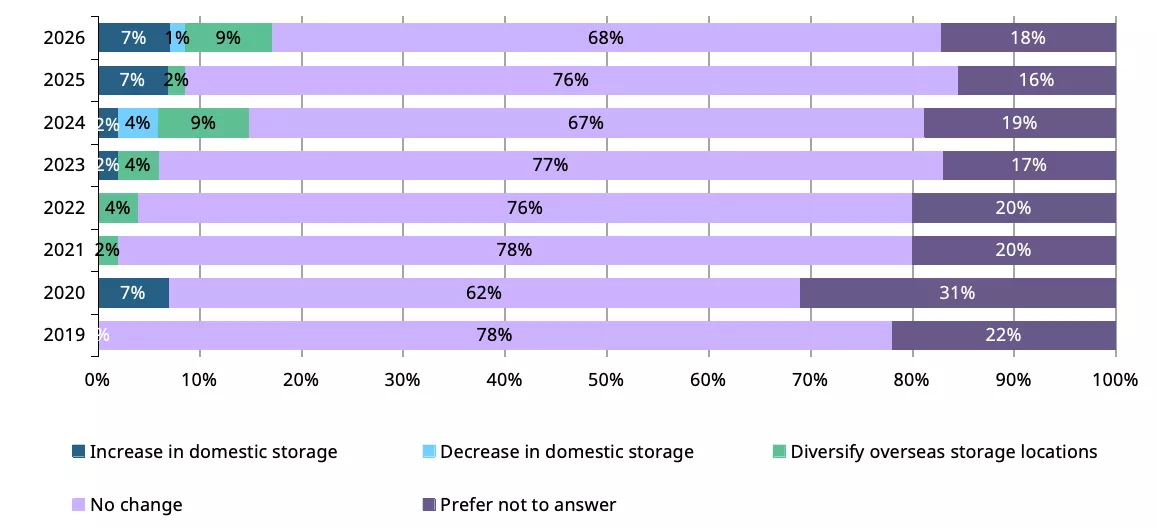
Chart 2: Diversifying storage locations in the next 12 months
How, if at all, do you intend to change your custody arrangements over the next 12 months?
2026 base: All central banks (68); advanced economy (16); EMDE (52). Totals may not sum due to rounding.
Source: IMF, respective central banks, World Gold Council
Significant reported activity in July and y-t-d:
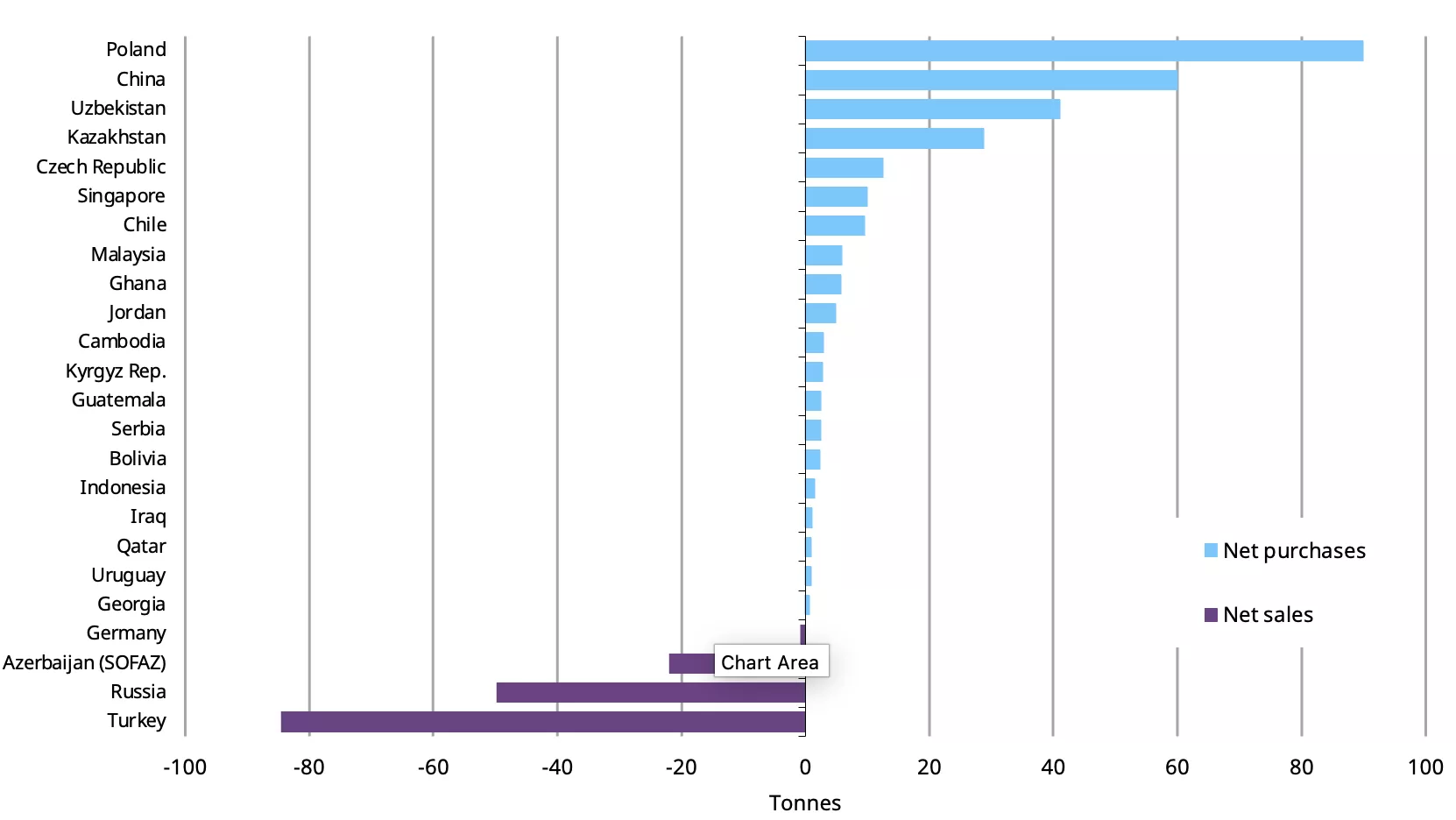
- The National Bank of Poland continued its gold accumulation streak, with 8t purchased this month. Poland tops the scoreboard when it comes to y-t-d gold purchases, buying 90t so far this year. The country has accumulated 640t of gold – against its target of 700t – or approximately 28% of its total reserves.
- In its 21st consecutive month of buying the PBoC added 20t to its gold reserves in July. China has added 60t to its gold reserves y-t-d, second only to Poland. China’s official gold reserves now stand at 8% of total reserves, or around 2,366t, and is the sixth largest reported gold holder globally.
- The Central Bank of Uzbekistan sold 1t this month; its y-t-d gold purchases stand at 40t. The central bank hit the news recently as Governor Timur Ishmetov looked to engage with American money managers. Ishmetov said that while “gold has turned out to be the best investment so far”, the central bank is looking at potential sales of gold at “favourable prices” as part of its overall reserve management plan. Uzbekistan’s gold now stands at 87% of total reserves, or about 431t.
- The Czech National Bank also bought 2t of gold this month in its 41st consecutive month of net buying. The central bank has bought 12t y-t-d, bringing its gold holdings to 6% of its total reserves, or 84t.
- The National Bank of Kazakhstan (NBK), Bank Negara Malaysia (BNM) and the Central Bank of Bolivia (CBB) each bought 1t of gold this month. On a y-t-d basis the NBK has accumulated 29t of gold and is one of the top five gold accumulators globally. Kazakhstan’s gold holdings stand at 75% of its total reserves. Both the BNM and the CBB are relatively new entrants to the gold market, with y-t-d gold holdings at 6t and 2t respectively.
- The Central Bank of Russia continued its net sales in July, offloading a further 6t of gold. Russia has sold 50t of gold y-t-d, lowering its total gold holdings to 2,277t.
- The Central Bank of the Republic of Turkey sold 1t of gold this month, bringing its total sales so far this year to 85t.
Chart 3: Year-to-date central bank gold activity
Reported central bank net purchases and sales, tonnes*
*Data to 31 July 2026, where available.
Note: The Bulgarian National Bank's transfer of 2t to the European Central Bank as part of its adoption of the euro is excluded from the chart. Azerbaijan (SOFAZ) represents the gold reserves of the State Oil Fund of Azerbaijan (SOFAZ).
Source: IMF, respective central banks, World Gold Council
Central banks continue to report positive headlines
The Bank of Korea (BOK) added to central bank headlines by announcing an official gold allocation after 13 years. The allocation, made via gold-backed ETFs, is estimated at US$250mn or approximately 2t. The BOK also announced plans to purchase domestically refined gold in order to diversify its reserves and hedge against risks related to inflation and geopolitics.
The Venezuelan government requested repatriation of around US$4bn of its gold reserves from the Bank of England. The move comes about as Venezuela looks to rebuild infrastructure post the 2026 earthquake. Since 2018, Venezuela has been blocked from accessing its gold reserves as the UK government declined to recognise the country’s socialist government. This type of activity in the sector is noted in our 2026 Central Banks Gold Reserves Survey, which records a pickup in central banks looking to increase domestic storage and diversify overseas storage locations (Chart 2).
The Bank of Namibia has ramped up its gold accumulation ambition: its target is to increase gold reserves from 1% to 3% by the end of March 2027, according to a statement by the bank’s deputy governor earlier this month.1 The bank signed a gold purchase agreement in March this year with QKR Namibia Navachab, a local mining company, to help build up its gold reserves.2
Footnotes
1Bloomberg.
2Bank of Namibia inches towards local gold reserves, Namibia Business Review, March 2026.
Disclaimer
Important information and disclaimers
© 2026 World Gold Council. All rights reserved. World Gold Council and the Circle device are trademarks of the World Gold Council or its affiliates.
All references to LBMA Gold Price are used with the permission of ICE Benchmark Administration Limited and have been provided for informational purposes only. ICE Benchmark Administration Limited accepts no liability or responsibility for the accuracy of the prices or the underlying product to which the prices may be referenced. Other content is the intellectual property of the respective third party and all rights are reserved to them.
Reproduction or redistribution of any of this information is expressly prohibited without the prior written consent of World Gold Council or the appropriate copyright owners, except as specifically provided below. Information and statistics are copyright © and/or other intellectual property of the World Gold Council or its affiliates or third-party providers identified herein. All rights of the respective owners are reserved.
The use of the statistics in this information is permitted for the purposes of review and commentary (including media commentary) in line with fair industry practice, subject to the following two pre-conditions: (i) only limited extracts of data or analysis be used; and (ii) any and all use of these statistics is accompanied by a citation to World Gold Council and, where appropriate, to Metals Focus or other identified copyright owners as their source. World Gold Council is affiliated with Metals Focus.
The World Gold Council and its affiliates do not guarantee the accuracy or completeness of any information nor accept responsibility for any losses or damages arising directly or indirectly from the use of this information.
This information is for educational purposes only and by receiving this information, you agree with its intended purpose. Nothing contained herein is intended to constitute a recommendation, investment advice, or offer for the purchase or sale of gold, any gold-related products or services or any other products, services, securities or financial instruments (collectively, “Services”). This information does not take into account any investment objectives, financial situation or particular needs of any particular person.
Diversification does not guarantee any investment returns and does not eliminate the risk of loss. Past performance is not necessarily indicative of future results. The resulting performance of any investment outcomes that can be generated through allocation to gold are hypothetical in nature, may not reflect actual investment results and are not guarantees of future results. The World Gold Council and its affiliates do not guarantee or warranty any calculations and models used in any hypothetical portfolios or any outcomes resulting from any such use. Investors should discuss their individual circumstances with their appropriate investment professionals before making any decision regarding any Services or investments.
This information may contain forward-looking statements, such as statements which use the words “believes”, “expects”, “may”, or “suggests”, or similar terminology, which are based on current expectations and are subject to change. Forward-looking statements involve a number of risks and uncertainties. There can be no assurance that any forward-looking statements will be achieved. World Gold Council and its affiliates assume no responsibility for updating any forward-looking statements.
Information regarding the LBMA Gold Price
The LBMA Gold Price is used by the World Gold Council with permission under license by ICE Benchmark Administration Limited and is subject to the restrictions set forth here (www.gold.org/terms-and-conditions).
Information regarding QaurumSM and the Gold Valuation Framework
Note that the resulting performance of various investment outcomes that can be generated through use of Qaurum, the Gold Valuation Framework and other information are hypothetical in nature, may not reflect actual investment results and are not guarantees of future results. Neither World Gold Council (including its affiliates) nor Oxford Economics provides any warranty or guarantee regarding the functionality of the tool, including without limitation any projections, estimates or calculations.
Information from ICRA Analytics Limited
All information obtained from ICRA Analytics Limited contained in this document is subject to the disclaimer set forth here (www.icraanalytics.com/terms-of-use/disclaimer).