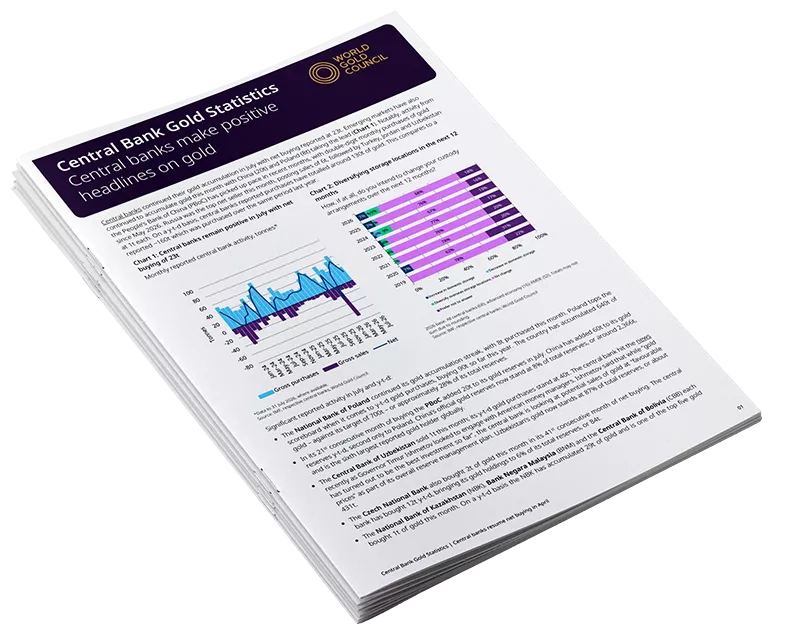
Central Bank Gold Statistics: Central banks stay the course on gold in February
Marissa Salim
Senior Research Lead, APAC World Gold CouncilFebruary Highlights1
- February buying: Central banks bought a net 27t in February, with activity driven by Poland (20t), a marked rebound after a lull in January. Uzbekistan entered its fifth consecutive month of net buying (8t), followed by Kazakhstan (8t), Czech Republic (2t), Malaysia (2t), China (1t) and Cambodia (1t). Net sellers this month were Turkey (8t) and Russia (6t)
Notable takeaways
- Poland was the primary buyer for the month with net recorded buying at 20t, this is its highest purchase since February 2025, which was 29t.
- Track record of net buying maintained across some central banks with Czech Republic reporting its 36th consecutive month of net buying. China is on its 16th consecutive month of net purchases, followed by Uzbekistan tallying five consecutive months.
- A growing number of African central banks have been reported to turn to gold as a strategic diversification tool, to boost reserves and manage risks to the economy in international financial markets.
Central banks remain firm on gold accumulation in February, having bought a net 27t. This was a rebound from the lull we saw in January, and in line with the monthly average of 26t reported in 2025. Just two months into the year, central banks have bought 31t, a pace much slower than the same period last year (50t).
Chart 1: Central banks buying firm up in February
Monthly reported central banks activity, tonnes*
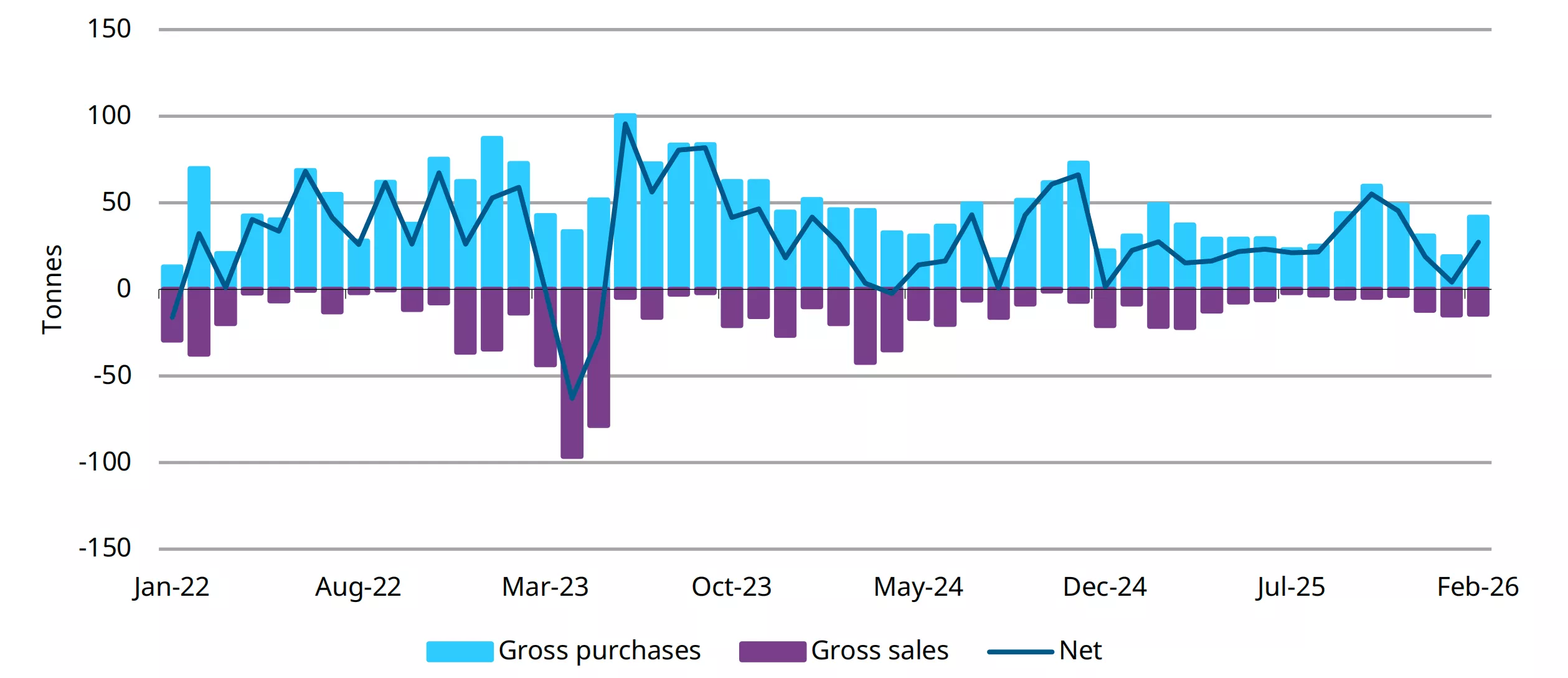
*Data to 28 February 2026, where available.
Source: IMF, respective central banks, World Gold Council
Reported activity in February was concentrated in:
- The National Bank of Poland drove much of this month’s buying activity, having bought 20t. This brings its total gold reserves to 570t, lifting its share of total reserves to 31%. The bank has set a target of 700t of gold, as announced by its Governor Adam Glapiński. In a recent development, Governor Glapiński had also proposed generating US$13bn through potential sale of gold reserves to finance defense spending, with the intention to “generate profits and to then buy it back”. Details on this proposal, though, remain unclear.
- Central Bank of Uzbekistan bought 8t of gold this month, lifting its gold reserves to 407t or 88% of its total reserves. Y-t-d, Uzbekistan bought 16t so far this year.
- National Bank of Kazakhstan added 8t to its gold reserves during the month, bringing its y-t-d net purchases to 7t. This also lifted its total gold holdings to 348t – the highest level of since January 2023.
- Bank Negara Malaysia’s renewed interest continued into February, its second month of net purchases, adding 2t during the month. Y-t-d net purchases total a modest 5t. Czech National Bank’s modest but consistent net purchases brings its gold reserves to 75t ot 7% of total reserves. A similar story for the People’s Bank of China, its 16th consecutive month of buying saw gold reserves grow to 2,308t or 10% of its total reserves.
- Turkey (8t) and Russia (6t) saw the biggest declines in gold reserves in February. In Turkey’s case, the reduction appeared to be reflective of a decline in Treasury holdings, rather than central bank reserves based on our calculations. In March, however, the central bank was highly active, with our estimates indicating it utilised around 50t of its gold reserves for liquidity purposes and FX operations.2 Governor Fatih Karahan noted that: “a significant part of these transactions are in the nature of gold-currency swap futures. In other words, when it matures, the gold in question will return to our reserves.”3
Chart 2: Year-to-date central bank gold activity
Central bank net purchases and sales, tonnes*
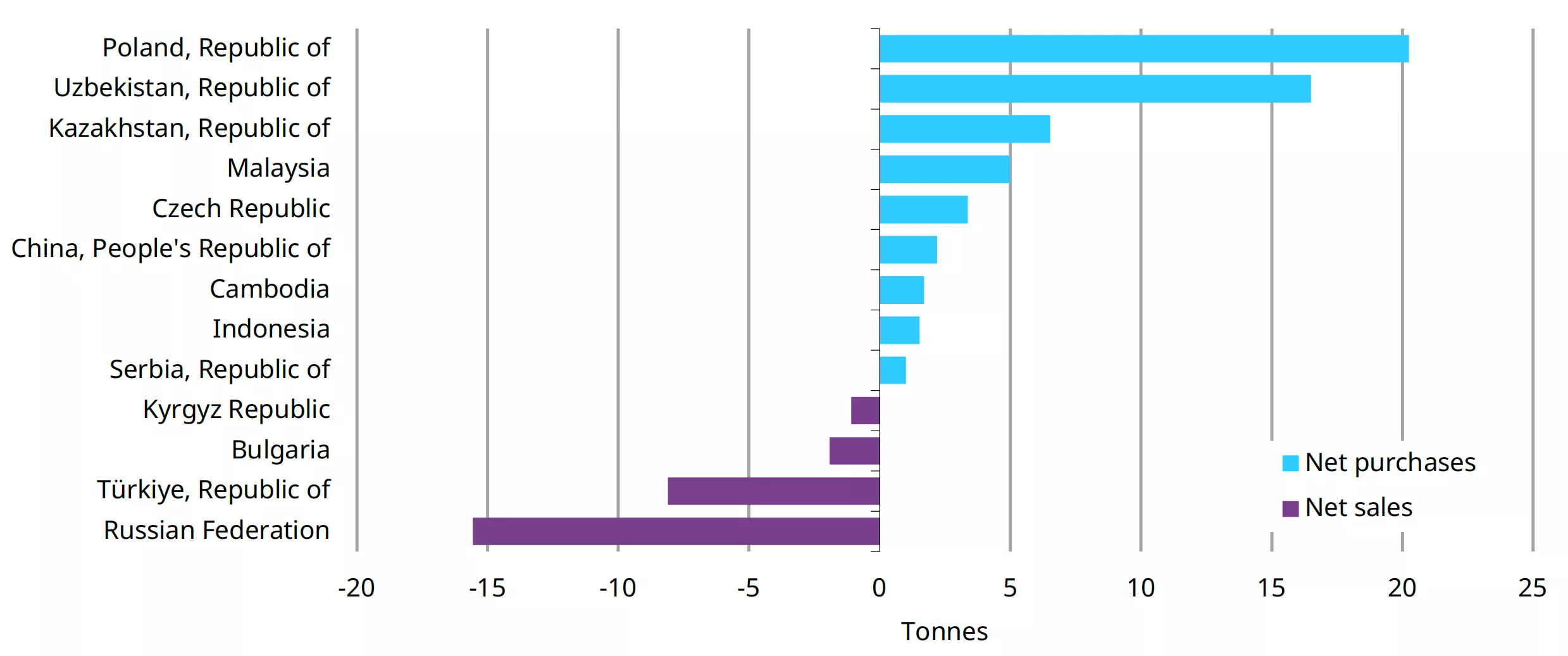
*Data to 28 February 2026, where available.
Source: IMF, respective central banks, World Gold Council
African central banks look towards gold for diversification
The Bank of Uganda launched its domestic gold buying programme two years ago, with active buying commencing in March 2026. The bank aims to purchase at least 100kg of gold between March and June this year from artisanal, medium and large-scale domestic producers. The move is aimed to bolster reserves and cushion the economy from risks in international financial markets. Uganda is not alone in this shift. Kenya's central bank Governor Kamau Thugge signalled similar intentions at a news conference in early February, which alludes to a broader trend of African central banks turning to gold as a strategic diversification tool.
Conclusion
February seems to indicate a rebound in central bank buying after a quiet January, highlighting commitment to gold’s role in reserves. At the same time, central banks may be prudently price sensitive in their accumulation. Poland's contribution this month highlights continued appetite from established buyers, with persistent buying streaks from Czech Republic, China and Uzbekistan signalling sustained demand. New entrants from Southeast Asian and African central banks suggest that the emerging market story continues.
Footnotes
1Please note that this blog post was updated on 7 April 2026 to include the February purchase by the National Bank of Kazakhstan.
2Based on data to 20 March 2026.
3Statements from CBRT Governor Karahan on gold-based transactions, Bloomberg HT, March 2026.
Disclaimer
Important information and disclaimers
© 2026 World Gold Council. All rights reserved. World Gold Council and the Circle device are trademarks of the World Gold Council or its affiliates.
All references to LBMA Gold Price are used with the permission of ICE Benchmark Administration Limited and have been provided for informational purposes only. ICE Benchmark Administration Limited accepts no liability or responsibility for the accuracy of the prices or the underlying product to which the prices may be referenced. Other content is the intellectual property of the respective third party and all rights are reserved to them.
Reproduction or redistribution of any of this information is expressly prohibited without the prior written consent of World Gold Council or the appropriate copyright owners, except as specifically provided below. Information and statistics are copyright © and/or other intellectual property of the World Gold Council or its affiliates or third-party providers identified herein. All rights of the respective owners are reserved.
The use of the statistics in this information is permitted for the purposes of review and commentary (including media commentary) in line with fair industry practice, subject to the following two pre-conditions: (i) only limited extracts of data or analysis be used; and (ii) any and all use of these statistics is accompanied by a citation to World Gold Council and, where appropriate, to Metals Focus or other identified copyright owners as their source. World Gold Council is affiliated with Metals Focus.
The World Gold Council and its affiliates do not guarantee the accuracy or completeness of any information nor accept responsibility for any losses or damages arising directly or indirectly from the use of this information.
This information is for educational purposes only and by receiving this information, you agree with its intended purpose. Nothing contained herein is intended to constitute a recommendation, investment advice, or offer for the purchase or sale of gold, any gold-related products or services or any other products, services, securities or financial instruments (collectively, “Services”). This information does not take into account any investment objectives, financial situation or particular needs of any particular person.
Diversification does not guarantee any investment returns and does not eliminate the risk of loss. Past performance is not necessarily indicative of future results. The resulting performance of any investment outcomes that can be generated through allocation to gold are hypothetical in nature, may not reflect actual investment results and are not guarantees of future results. The World Gold Council and its affiliates do not guarantee or warranty any calculations and models used in any hypothetical portfolios or any outcomes resulting from any such use. Investors should discuss their individual circumstances with their appropriate investment professionals before making any decision regarding any Services or investments.
This information may contain forward-looking statements, such as statements which use the words “believes”, “expects”, “may”, or “suggests”, or similar terminology, which are based on current expectations and are subject to change. Forward-looking statements involve a number of risks and uncertainties. There can be no assurance that any forward-looking statements will be achieved. World Gold Council and its affiliates assume no responsibility for updating any forward-looking statements.
Information regarding the LBMA Gold Price
The LBMA Gold Price is used by the World Gold Council with permission under license by ICE Benchmark Administration Limited and is subject to the restrictions set forth here (www.gold.org/terms-and-conditions).
Information regarding QaurumSM and the Gold Valuation Framework
Note that the resulting performance of various investment outcomes that can be generated through use of Qaurum, the Gold Valuation Framework and other information are hypothetical in nature, may not reflect actual investment results and are not guarantees of future results. Neither World Gold Council (including its affiliates) nor Oxford Economics provides any warranty or guarantee regarding the functionality of the tool, including without limitation any projections, estimates or calculations.
Information from ICRA Analytics Limited
All information obtained from ICRA Analytics Limited contained in this document is subject to the disclaimer set forth here (www.icraanalytics.com/terms-of-use/disclaimer).
Central bank gold statistics: March 2026
Marissa Salim
Senior Research Lead, APAC World Gold Council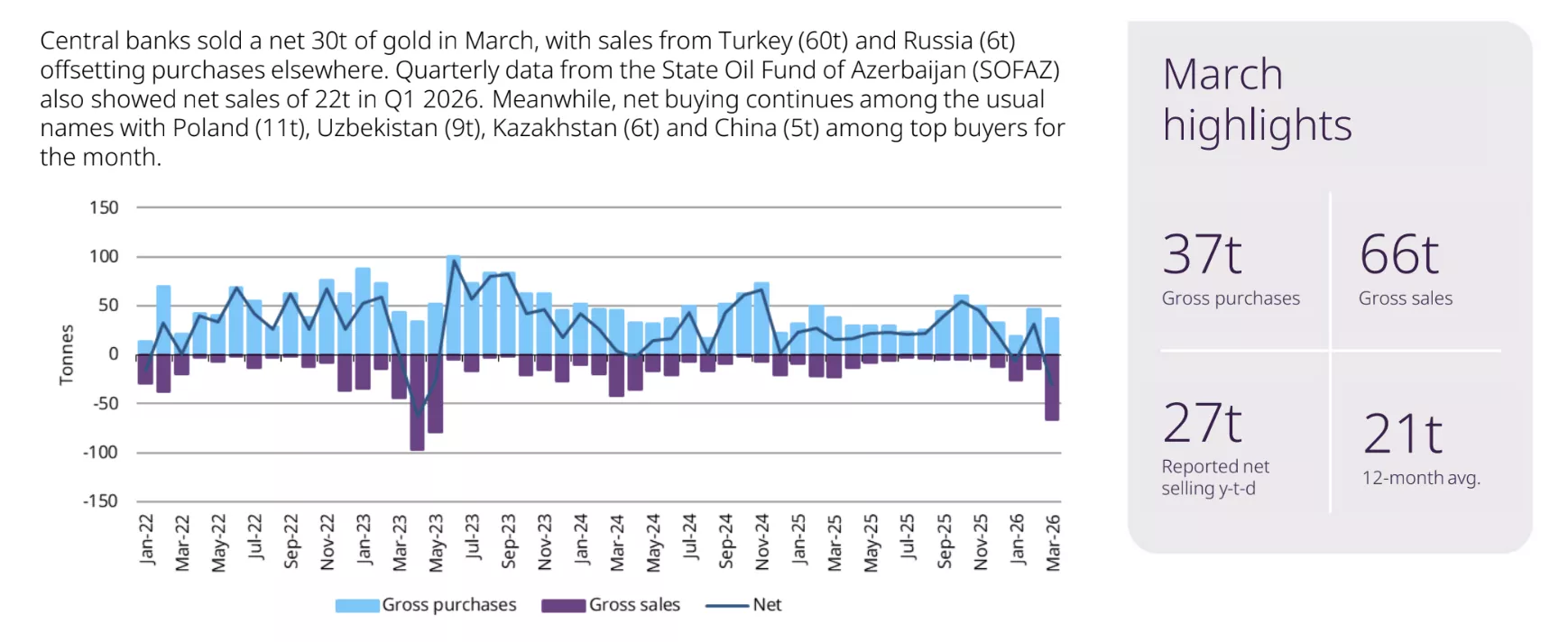
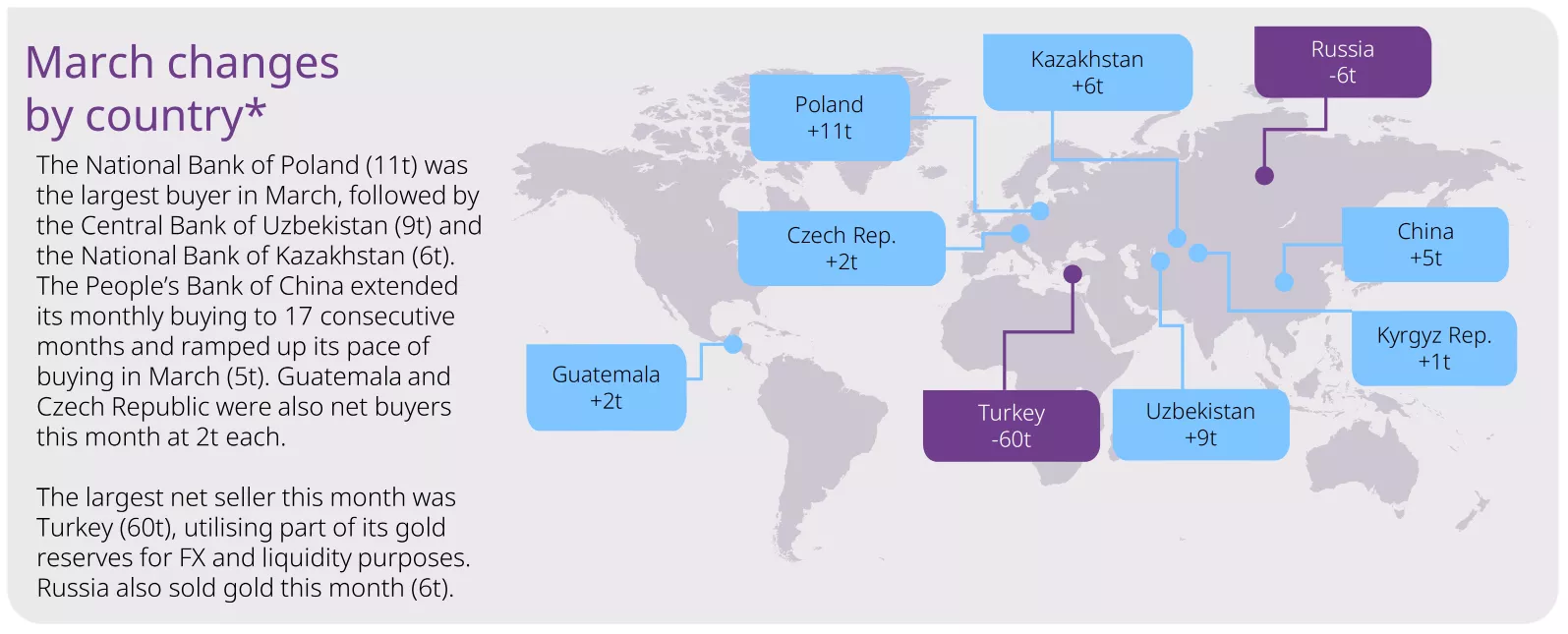
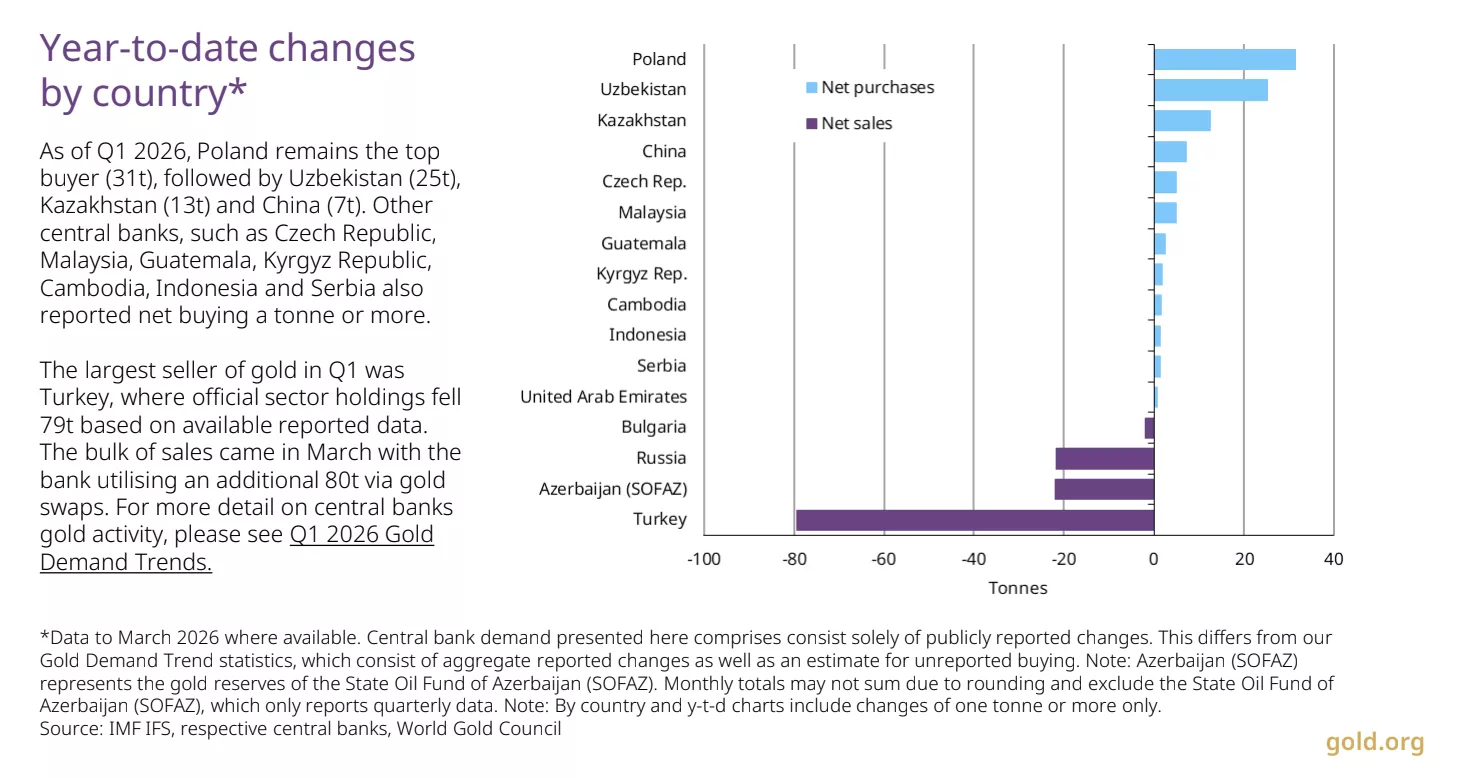
Disclaimer
Important information and disclaimers
© 2026 World Gold Council. All rights reserved. World Gold Council and the Circle device are trademarks of the World Gold Council or its affiliates.
All references to LBMA Gold Price are used with the permission of ICE Benchmark Administration Limited and have been provided for informational purposes only. ICE Benchmark Administration Limited accepts no liability or responsibility for the accuracy of the prices or the underlying product to which the prices may be referenced. Other content is the intellectual property of the respective third party and all rights are reserved to them.
Reproduction or redistribution of any of this information is expressly prohibited without the prior written consent of World Gold Council or the appropriate copyright owners, except as specifically provided below. Information and statistics are copyright © and/or other intellectual property of the World Gold Council or its affiliates or third-party providers identified herein. All rights of the respective owners are reserved.
The use of the statistics in this information is permitted for the purposes of review and commentary (including media commentary) in line with fair industry practice, subject to the following two pre-conditions: (i) only limited extracts of data or analysis be used; and (ii) any and all use of these statistics is accompanied by a citation to World Gold Council and, where appropriate, to Metals Focus or other identified copyright owners as their source. World Gold Council is affiliated with Metals Focus.
The World Gold Council and its affiliates do not guarantee the accuracy or completeness of any information nor accept responsibility for any losses or damages arising directly or indirectly from the use of this information.
This information is for educational purposes only and by receiving this information, you agree with its intended purpose. Nothing contained herein is intended to constitute a recommendation, investment advice, or offer for the purchase or sale of gold, any gold-related products or services or any other products, services, securities or financial instruments (collectively, “Services”). This information does not take into account any investment objectives, financial situation or particular needs of any particular person.
Diversification does not guarantee any investment returns and does not eliminate the risk of loss. Past performance is not necessarily indicative of future results. The resulting performance of any investment outcomes that can be generated through allocation to gold are hypothetical in nature, may not reflect actual investment results and are not guarantees of future results. The World Gold Council and its affiliates do not guarantee or warranty any calculations and models used in any hypothetical portfolios or any outcomes resulting from any such use. Investors should discuss their individual circumstances with their appropriate investment professionals before making any decision regarding any Services or investments.
This information may contain forward-looking statements, such as statements which use the words “believes”, “expects”, “may”, or “suggests”, or similar terminology, which are based on current expectations and are subject to change. Forward-looking statements involve a number of risks and uncertainties. There can be no assurance that any forward-looking statements will be achieved. World Gold Council and its affiliates assume no responsibility for updating any forward-looking statements.
Information regarding the LBMA Gold Price
The LBMA Gold Price is used by the World Gold Council with permission under license by ICE Benchmark Administration Limited and is subject to the restrictions set forth here (www.gold.org/terms-and-conditions).
Information regarding QaurumSM and the Gold Valuation Framework
Note that the resulting performance of various investment outcomes that can be generated through use of Qaurum, the Gold Valuation Framework and other information are hypothetical in nature, may not reflect actual investment results and are not guarantees of future results. Neither World Gold Council (including its affiliates) nor Oxford Economics provides any warranty or guarantee regarding the functionality of the tool, including without limitation any projections, estimates or calculations.
Information from ICRA Analytics Limited
All information obtained from ICRA Analytics Limited contained in this document is subject to the disclaimer set forth here (www.icraanalytics.com/terms-of-use/disclaimer).
Central bank gold statistics: Central banks resume net buying in April
Marissa Salim
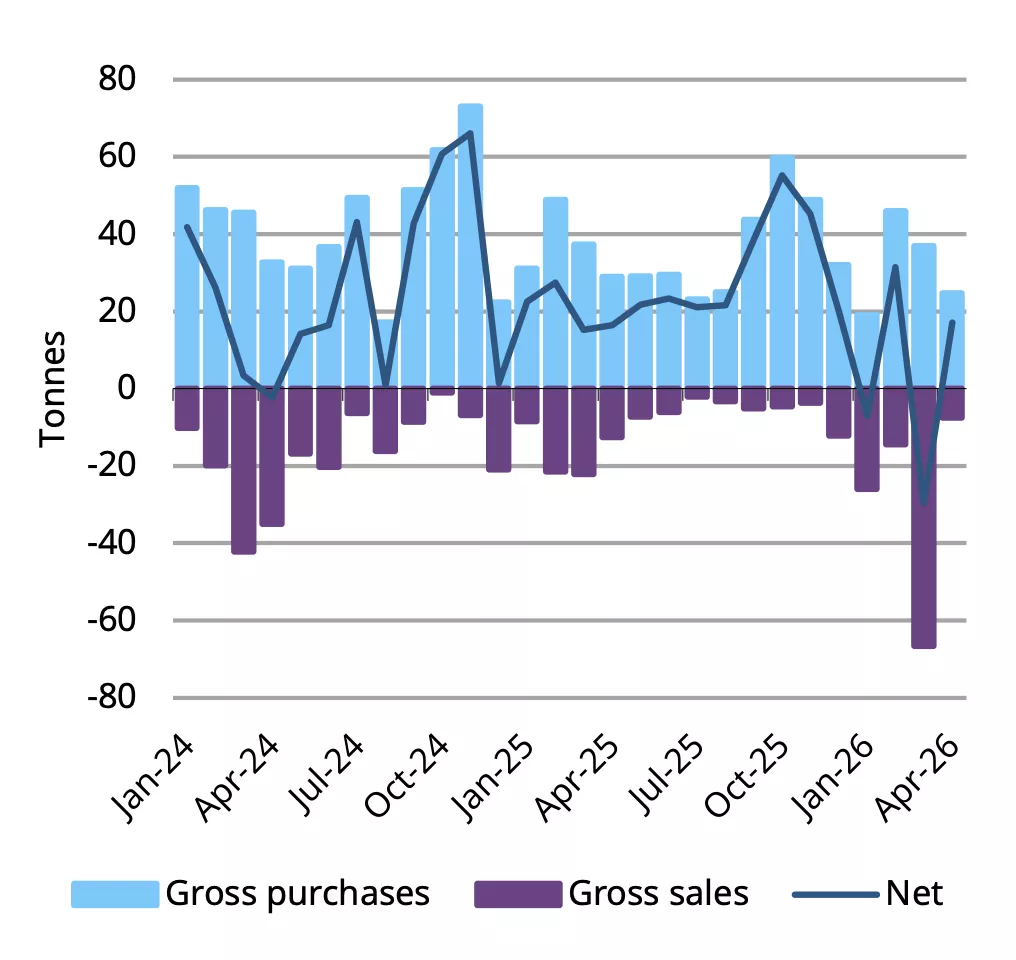
Senior Research Lead, APAC World Gold CouncilCentral banks resumed net gold purchases in April, having bought 19t. This was a rebound from the sizeable net sales reported in March (Chart 1).
Chart 1: Central banks resume gold purchases in April
Monthly reported central bank activity, tonnes*
*Data to 29 May 2026, where available.
Source: IMF, respective central banks, World Gold Council
Poland remained the top buyer in the month (14t), while China intensified its pace of purchases: it’s 8t net purchase is the highest since December 2024 and extends its current buying run to 18 consecutive months. The Czech Republic shows similar consistency in purchases, having bought 3t in April, its 38th consecutive monthly purchase. Meanwhile, Russia continues its sales streak this month (6t), with y-t-d sales of 22t.
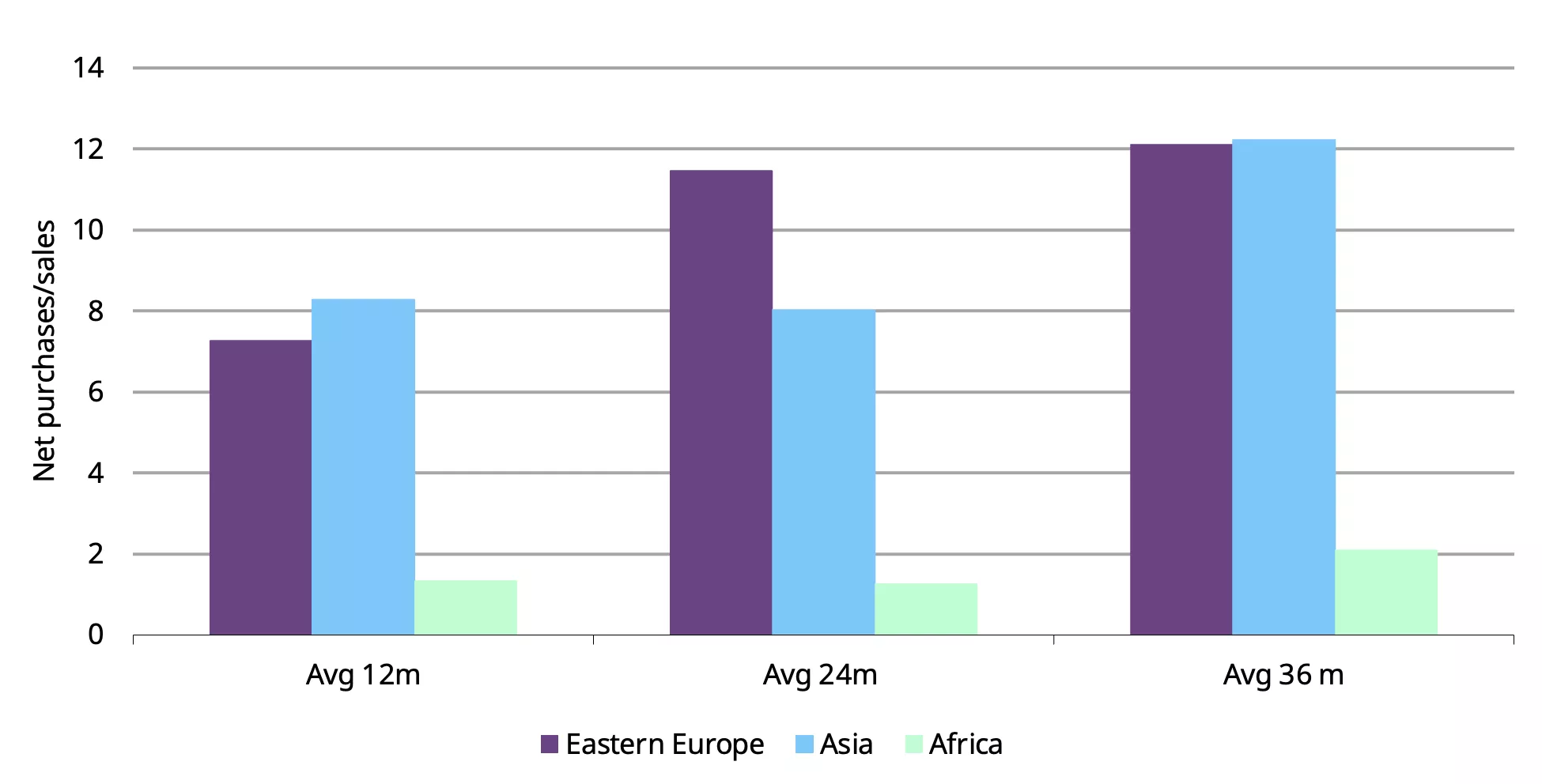
Chart 2: Emerging markets central bank activity driven by Eastern Europe and Asia
Average 12, 24 and 36-month net purchases/sales by region*
*Data to 29 May 2026, where available.
Source: IMF, respective central banks, World Gold Council
Reported activity in April and y-t-d was concentrated in:
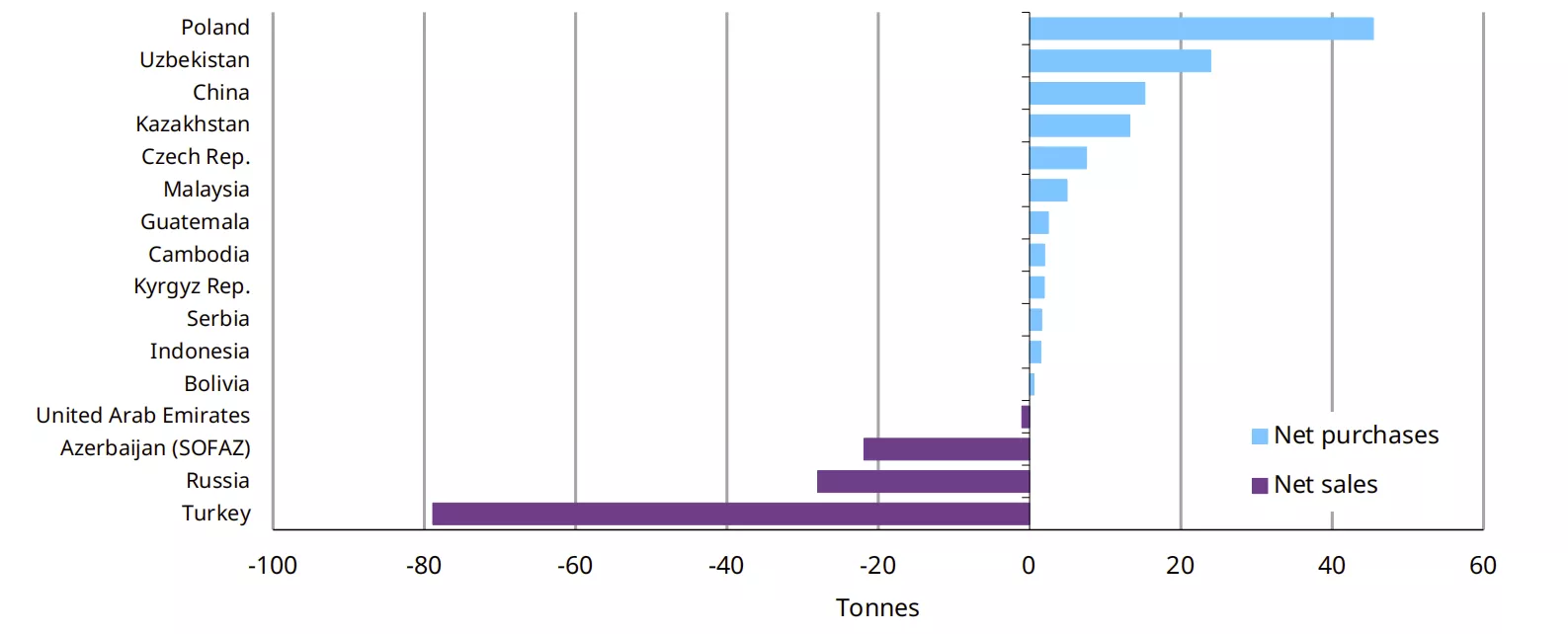
- National Bank of Poland drove much of April’s buying activity, having bought 14t. This brings Poland’s y-t-d gold purchases to 45t with its gold reserves at 595t or about 30% of its total reserves.
- People’s Bank of China added 8t to its gold reserves during the month, highest since December 2024. Official gold reserves now stand at 9% of total reserves or around 2,322t. China has been consistently purchasing gold over 18 consecutive months.
- Czech National Bank’s modest but consistent 3t net purchases in April brings its gold reserves to 79t or 6% of its total reserves.
- Meanwhile, Central Bank of Uzbekistan sold 1t this month, though on a y-t-d basis, it remains a net purchaser (24t) and is second only to Poland. Uzbekistan’s reserves make up 88% of its total reserves or around 414t.
- Central Bank of Russia continued its recent streak of net sales for the fourth month with reported April net sales of 6t.
- March’s top seller, Central Bank of the Republic of Turkey reported virtually flat gold reserves in April, with weekly data showing that short-term gold/USD swaps matured in April, leaving only longer-term (1-3 month) gold/USD swaps outstanding. More on Turkey’s recent reserve management operations can be found in our recently published Gold Demand Trends Q1 2026.
- Eastern European and Asian central banks continue to dominate gold purchases with consistent purchases. Over the past 36 months, both regions have purchased 12t and 11t per month on average collectively. Global central banks activity shows average net purchases of 29t over the same period (Chart 2).
Chart 3: Year-to-date central bank gold activity1
Central bank net purchases and sales, tonnes*
*Data to 29 May 2026, where available.
Source: IMF, respective central banks, World Gold Council
Central Bank Gold Reserves Survey 2026
Our ninth Central Bank Gold Reserves Survey 2026 will be released in June and will provide the latest insights into the central banking community’s strategic views on gold as a reserve asset.
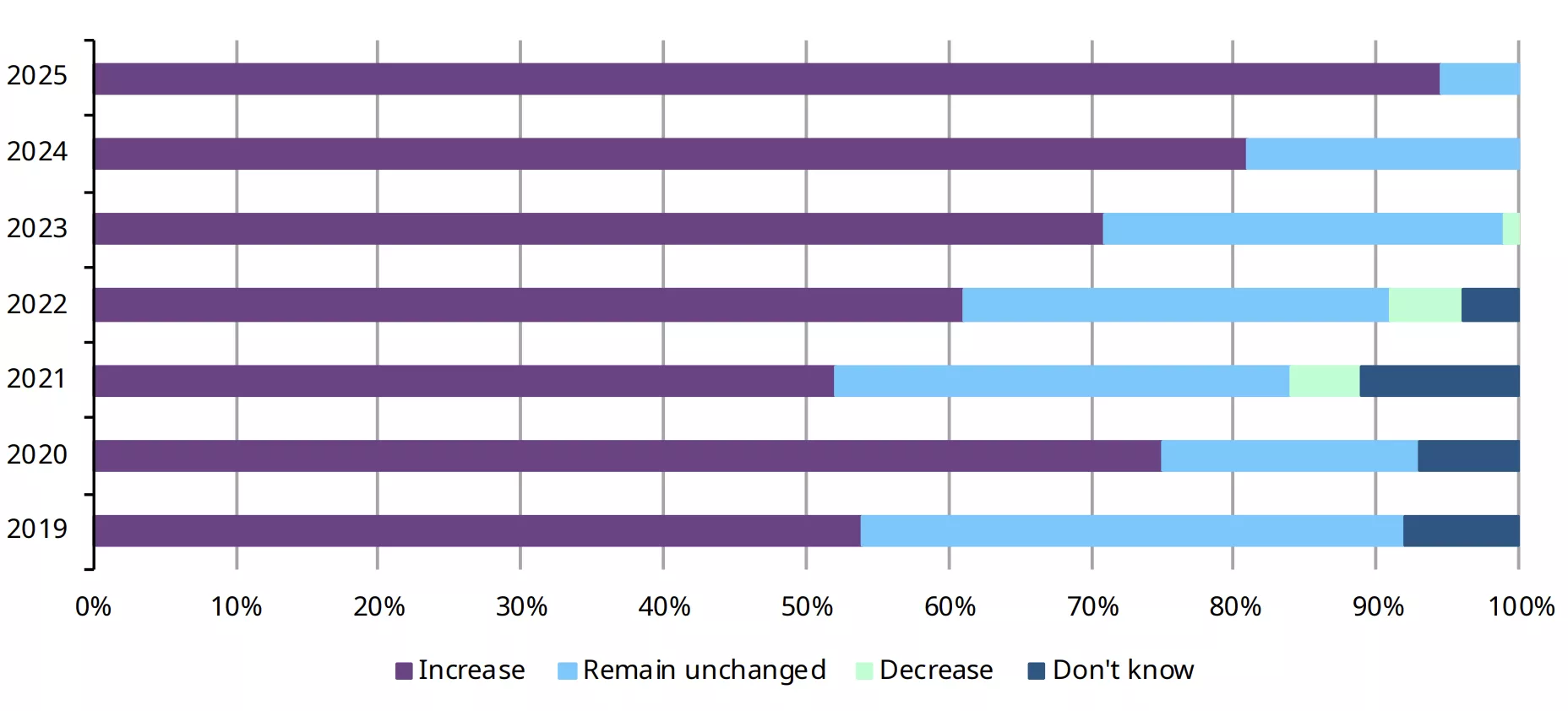
In our survey in 2025, central banks held favourable expectations on gold with 95% of respondents indicating that global central bank gold reserves will increase over the next 12 months, this is compared to 81% of respondents indicating the same in our 2024 survey. 43% of respondents believe that their own gold reserves will also increase over the same period in 2025, compared to 29% of respondents in our survey in 2024.
Chart 4: The majority of central banks that participated in our 2025 survey expected gold reserves to increase over the following 12 months
Percentage of respondents answering the question: how do you expect central bank gold reserves to change over the next 12 months?*
Source: YouGov, World Gold Council. *2025 base: all central banks (73), advanced economy (15), EMDE (58) 2024 base: all central banks (69), advanced economy (24), EMDE (45)
1This blog post was updated on 12 June 2026 to correct an error in Chart 3.
Disclaimer
Important information and disclaimers
© 2026 World Gold Council. All rights reserved. World Gold Council and the Circle device are trademarks of the World Gold Council or its affiliates.
All references to LBMA Gold Price are used with the permission of ICE Benchmark Administration Limited and have been provided for informational purposes only. ICE Benchmark Administration Limited accepts no liability or responsibility for the accuracy of the prices or the underlying product to which the prices may be referenced. Other content is the intellectual property of the respective third party and all rights are reserved to them.
Reproduction or redistribution of any of this information is expressly prohibited without the prior written consent of World Gold Council or the appropriate copyright owners, except as specifically provided below. Information and statistics are copyright © and/or other intellectual property of the World Gold Council or its affiliates or third-party providers identified herein. All rights of the respective owners are reserved.
The use of the statistics in this information is permitted for the purposes of review and commentary (including media commentary) in line with fair industry practice, subject to the following two pre-conditions: (i) only limited extracts of data or analysis be used; and (ii) any and all use of these statistics is accompanied by a citation to World Gold Council and, where appropriate, to Metals Focus or other identified copyright owners as their source. World Gold Council is affiliated with Metals Focus.
The World Gold Council and its affiliates do not guarantee the accuracy or completeness of any information nor accept responsibility for any losses or damages arising directly or indirectly from the use of this information.
This information is for educational purposes only and by receiving this information, you agree with its intended purpose. Nothing contained herein is intended to constitute a recommendation, investment advice, or offer for the purchase or sale of gold, any gold-related products or services or any other products, services, securities or financial instruments (collectively, “Services”). This information does not take into account any investment objectives, financial situation or particular needs of any particular person.
Diversification does not guarantee any investment returns and does not eliminate the risk of loss. Past performance is not necessarily indicative of future results. The resulting performance of any investment outcomes that can be generated through allocation to gold are hypothetical in nature, may not reflect actual investment results and are not guarantees of future results. The World Gold Council and its affiliates do not guarantee or warranty any calculations and models used in any hypothetical portfolios or any outcomes resulting from any such use. Investors should discuss their individual circumstances with their appropriate investment professionals before making any decision regarding any Services or investments.
This information may contain forward-looking statements, such as statements which use the words “believes”, “expects”, “may”, or “suggests”, or similar terminology, which are based on current expectations and are subject to change. Forward-looking statements involve a number of risks and uncertainties. There can be no assurance that any forward-looking statements will be achieved. World Gold Council and its affiliates assume no responsibility for updating any forward-looking statements.
Information regarding the LBMA Gold Price
The LBMA Gold Price is used by the World Gold Council with permission under license by ICE Benchmark Administration Limited and is subject to the restrictions set forth here (www.gold.org/terms-and-conditions).
Information regarding QaurumSM and the Gold Valuation Framework
Note that the resulting performance of various investment outcomes that can be generated through use of Qaurum, the Gold Valuation Framework and other information are hypothetical in nature, may not reflect actual investment results and are not guarantees of future results. Neither World Gold Council (including its affiliates) nor Oxford Economics provides any warranty or guarantee regarding the functionality of the tool, including without limitation any projections, estimates or calculations.
Information from ICRA Analytics Limited
All information obtained from ICRA Analytics Limited contained in this document is subject to the disclaimer set forth here (www.icraanalytics.com/terms-of-use/disclaimer).
Central bank gold statistics: Central banks remain committed to gold
Marissa Salim
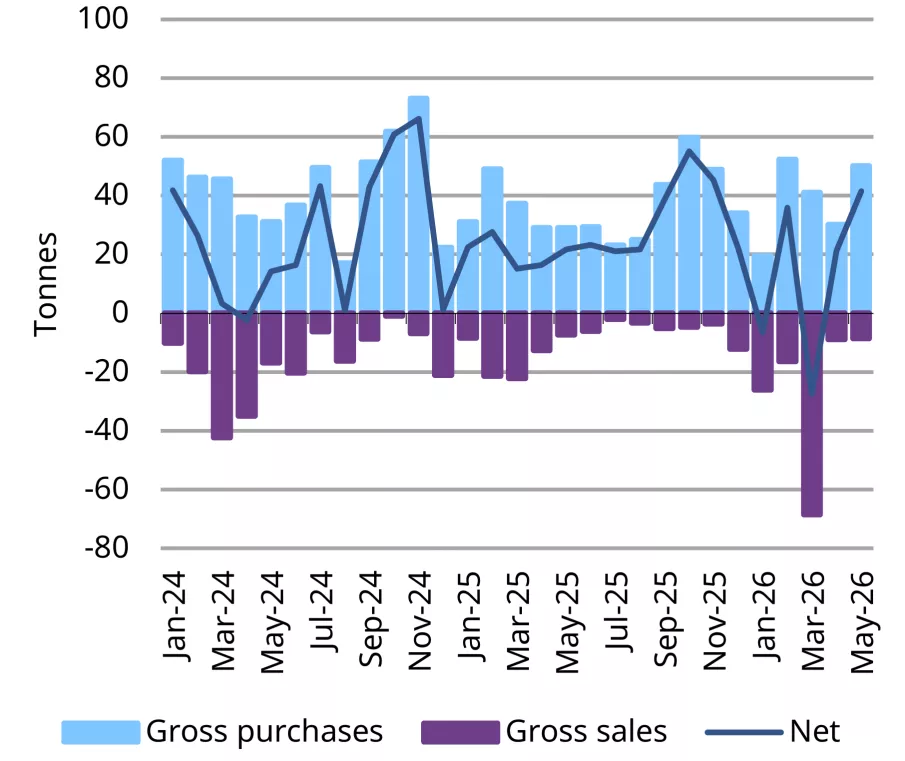
Senior Research Lead, APAC World Gold CouncilCentral banks were back in buying mode in May – and with a little more spring in their step. Based on the latest reported data, official gold reserves increased by a net 41t during the month, with purchases once again concentrated among a familiar cast of buyers (Chart 1).
Chart 1: Central banks stay on course in May buying a net 41t of gold
Monthly reported central bank activity, tonnes*
*Data to 30 June 2026, where available.
Source: IMF, respective central banks, World Gold Council
Much of the activity was driven by Poland (18t) and China (10t), with Uzbekistan and Kazakhstan also continuing their monthly net gold buying activity. Singapore also rejoined the list of buyers, reporting a net purchase of 4t, its first monthly net purchase since September 2025. Meanwhile, net sellers for the month were Turkey (3t) and Russia (6t) with y-t-d sales of 81t and 34t respectively.
Year-to-date, Poland has accumulated 64t of gold, followed by Uzbekistan and China at 33t and 25t respectively. Kazakhstan, a close fourth, has accumulated 20t y-t-d.
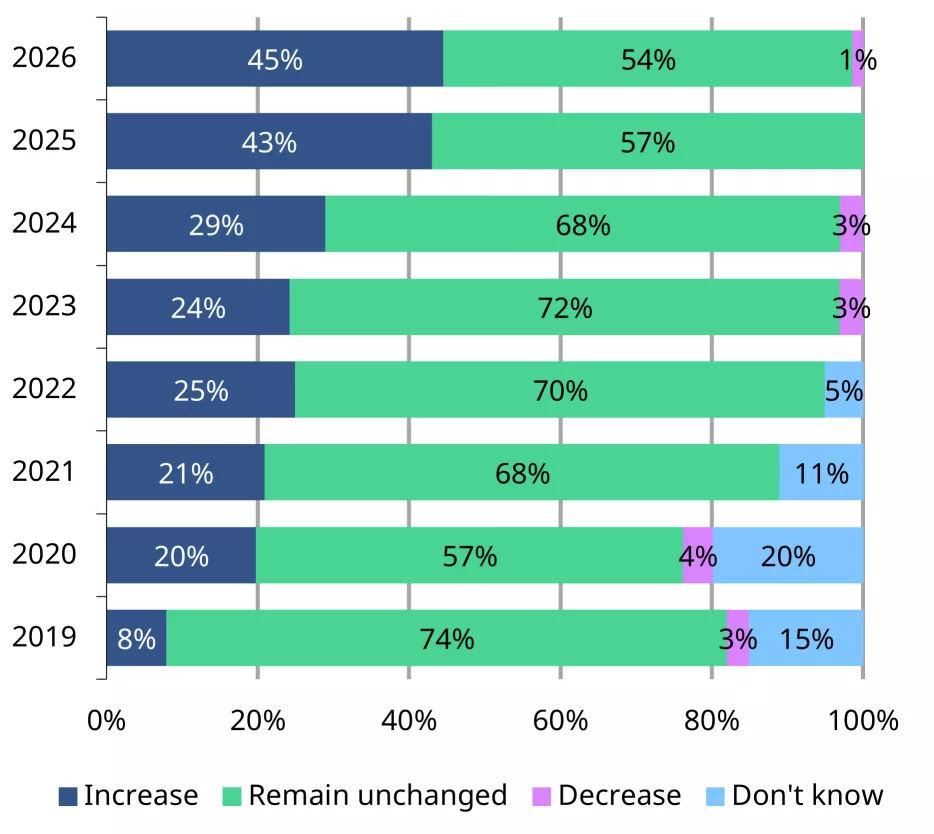
Despite the recent developments, central bankers remained positive on the role of gold in their reserves. As published in our ninth Central Bank Gold Reserves Survey 2026, 89% of central bankers expect global gold reserves to increase in the next 12 months. Meanwhile, a record high 45% of central bankers expect their own institution’s gold reserves to increase over the next 12 months (Chart 2).
Chart 2: A record high number of central bankers expect their gold reserves to increase
How do you expect your institution's gold reserves to change over the next 12 months?
2026 base: All central banks (74); advanced economy (17); EMDE (57). “Don’t knowʺ was removed as an option in 2023.
Source: IMF, respective central banks, World Gold Council
The most significant reported activity in May and y-t-d:
- The National Bank of Poland continued its net buying trajectory, having accumulated 18t in the month. Y-t-d, Poland leads its peers, with May being its fourth consecutive month of double-digit net buying (64t) and its highest monthly accumulation since February. Poland now holds 614t of gold in its reserves, inching closer to its 700t target
- In its 20th consecutive month of net buying, the People’s Bank of China added 10t to its gold reserves – the highest monthly addition since December 2024. Y-t-d, China has added 25t to its gold reserves and is among the top three accumulators so far this year. China’s official gold reserves now stand at 9% of total reserves or around 2,331t
- The Central Bank of Uzbekistan accumulated 9t in May, with y-t-d gold purchases standing at 33t, second only to Poland. Uzbekistan’s gold reserves now stands at 87% of its total reserves.
- The National Bank of Kazakhstan bought 7t in the month; y-t-d it has bought a net 20t. Kazakhstan’s official gold reserves stand at 361t or 78% of its total reserves
- The Monetary Authority of Singapore purchased 4t of gold this month, its first monthly net purchase since September 2025. This brings Singapore’s total gold holdings to 197t. Separately, the MAS is looking to establish central bank gold vaulting services October 2026, in line with the country’s plans to establish a gold hub in the city state.1
- The Czech National Bank and the Central Bank of Jordan also bought gold this month at 2t and 1t, respectively, bringing the former’s consistent run of net gold purchases to 39 months
- The Central Bank of Russia continued its streak of net selling this month, offloading 6t of gold. Y-t-d, Russia has sold 34t of gold, lowering its total gold holdings to 2,292t.
- The Central Bank of the Republic of Turkey sold 3t of gold this month, offloading 81t of gold so far on a y-t-d basis.
Chart 3: Year-to-date central bank gold activity
Central bank net purchases and sales, tonnes*
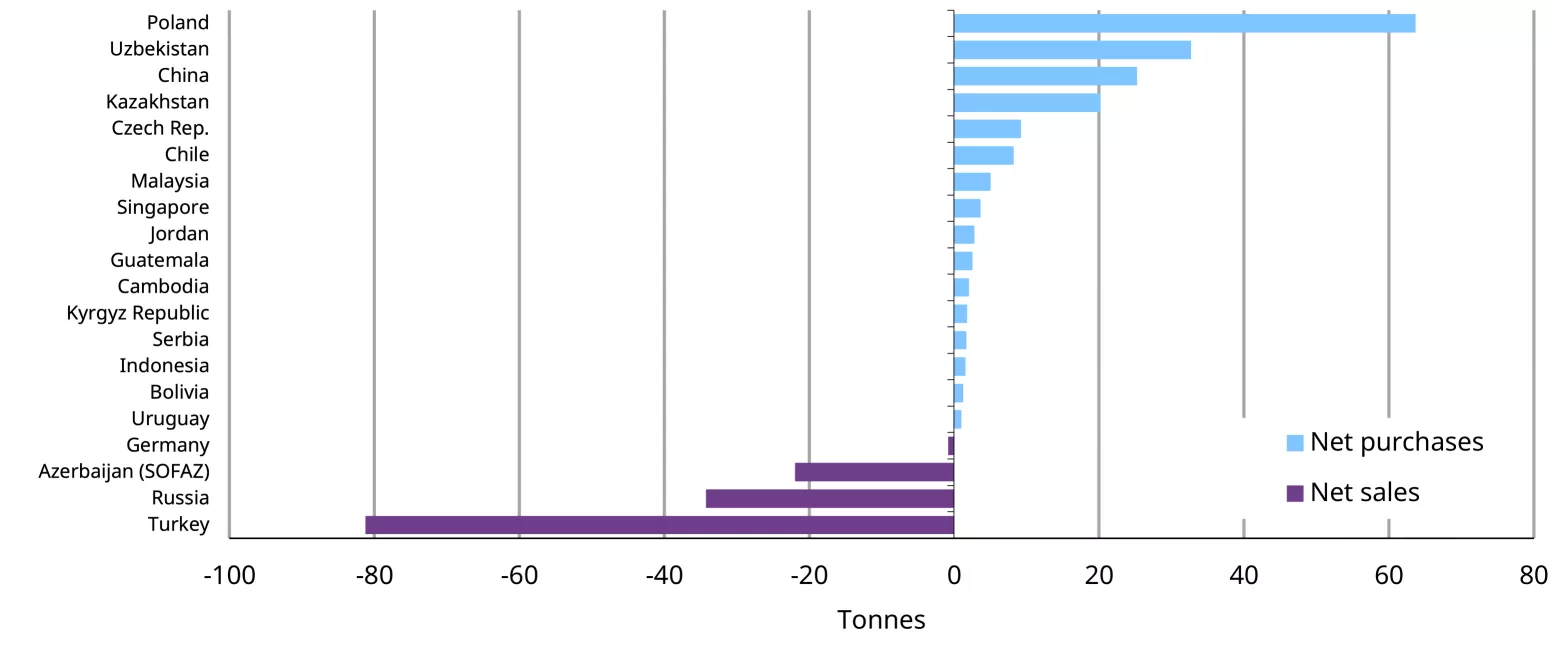
*Data to 30 June 2026, where available. Note: The Bulgarian National Bank's transfer of 2t to the European Central Bank as part of its adoption of the euro is excluded from the chart.
Source: IMF, respective central banks, World Gold Council
The Bank of Korea readies allocation to gold ETF
The Bank of Korea has reportedly2 completed preparations to invest in overseas gold-backed ETFs as part of its strategy of foreign currency asset diversification, although due to its confidentiality policy there has been no indication as to whether the allocation has been made. According to the report, gold-backed ETFs were the instrument of choice due to their high liquidity and lower storage costs. The bank currently holds 104t of gold in its reserves – about 3% of its total reserves – a figure that is relatively low compared to its emerging market peers. Gaining exposure to gold via ETFs is fairly uncommon amongst central banks: only 4% of survey respondents indicated that they purchase gold via gold-backed ETFs (Chart 4).
Chart 4: OTC market remains dominant way central banks accumulate gold
How do you purchase gold? (Please select all that apply)
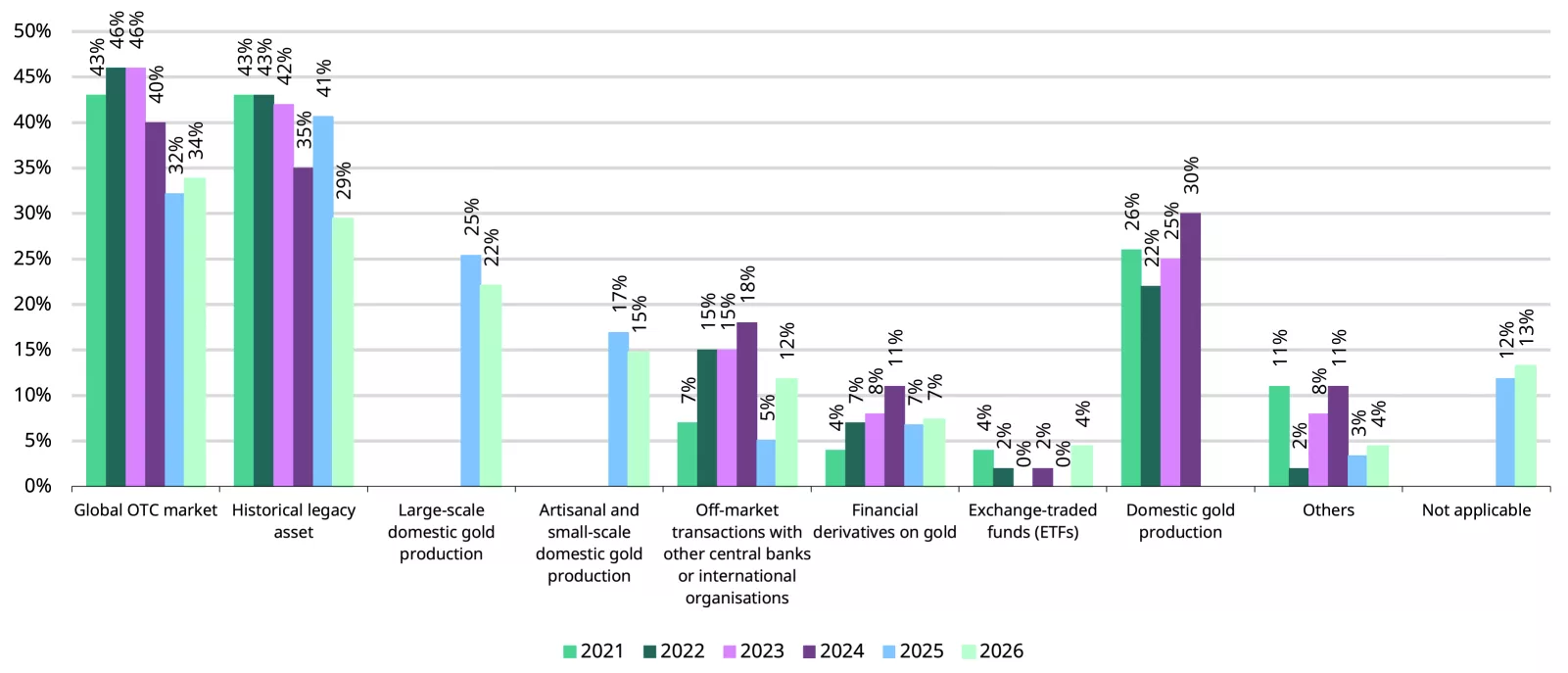
2026 base: All central banks (68); Advanced economy (16); EMDE (52).
Source: YouGov, World Gold Council
Gold gains traction within Latin American central banks
Over the course of 2026, our analysis has picked up new gold buying activity within Latin American central banks. Chile has accumulated around 8t of gold y-t-d, followed by Guatemala (2t), and Bolivia and Uruguay at 1t each. While this region has seen some geopolitical heat recently, it is too early to tell if this trend will gain traction or broaden out to match other Latin American peers (Chart 5).
Chart 5: Latin American central banks have shown greater interest in gold
Gold net buying/selling activity in Latin America since January 2022
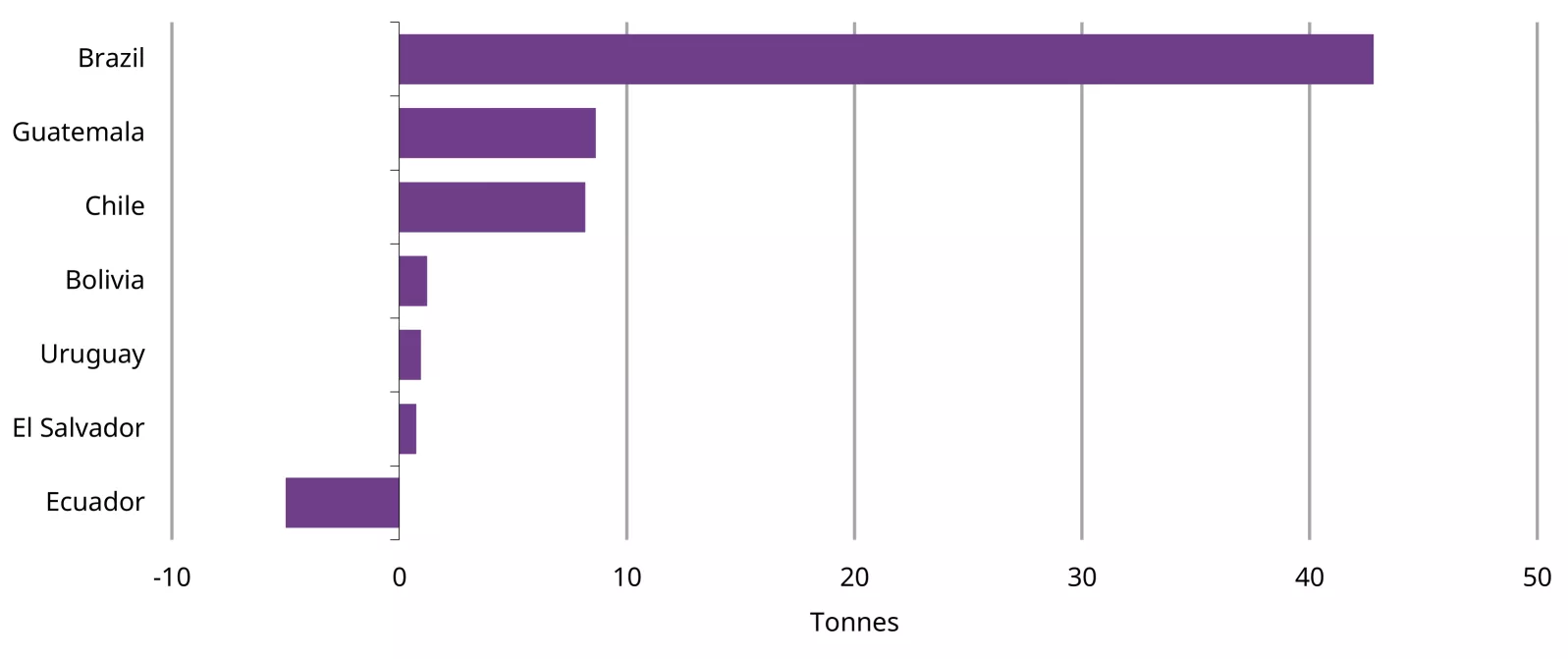
*Data to 31 May 2026 where available.
Source: IMF, respective central banks, World Gold Council
Footnotes
1Singapore to establish OTC gold clearing system, introduce central bank gold-vaulting services | Reuters
2Bank of Korea, which has stopped buying gold for 13 years, completes account opening for gold ETF investment, Herald Economy
Disclaimer
Important information and disclaimers
© 2026 World Gold Council. All rights reserved. World Gold Council and the Circle device are trademarks of the World Gold Council or its affiliates.
All references to LBMA Gold Price are used with the permission of ICE Benchmark Administration Limited and have been provided for informational purposes only. ICE Benchmark Administration Limited accepts no liability or responsibility for the accuracy of the prices or the underlying product to which the prices may be referenced. Other content is the intellectual property of the respective third party and all rights are reserved to them.
Reproduction or redistribution of any of this information is expressly prohibited without the prior written consent of World Gold Council or the appropriate copyright owners, except as specifically provided below. Information and statistics are copyright © and/or other intellectual property of the World Gold Council or its affiliates or third-party providers identified herein. All rights of the respective owners are reserved.
The use of the statistics in this information is permitted for the purposes of review and commentary (including media commentary) in line with fair industry practice, subject to the following two pre-conditions: (i) only limited extracts of data or analysis be used; and (ii) any and all use of these statistics is accompanied by a citation to World Gold Council and, where appropriate, to Metals Focus or other identified copyright owners as their source. World Gold Council is affiliated with Metals Focus.
The World Gold Council and its affiliates do not guarantee the accuracy or completeness of any information nor accept responsibility for any losses or damages arising directly or indirectly from the use of this information.
This information is for educational purposes only and by receiving this information, you agree with its intended purpose. Nothing contained herein is intended to constitute a recommendation, investment advice, or offer for the purchase or sale of gold, any gold-related products or services or any other products, services, securities or financial instruments (collectively, “Services”). This information does not take into account any investment objectives, financial situation or particular needs of any particular person.
Diversification does not guarantee any investment returns and does not eliminate the risk of loss. Past performance is not necessarily indicative of future results. The resulting performance of any investment outcomes that can be generated through allocation to gold are hypothetical in nature, may not reflect actual investment results and are not guarantees of future results. The World Gold Council and its affiliates do not guarantee or warranty any calculations and models used in any hypothetical portfolios or any outcomes resulting from any such use. Investors should discuss their individual circumstances with their appropriate investment professionals before making any decision regarding any Services or investments.
This information may contain forward-looking statements, such as statements which use the words “believes”, “expects”, “may”, or “suggests”, or similar terminology, which are based on current expectations and are subject to change. Forward-looking statements involve a number of risks and uncertainties. There can be no assurance that any forward-looking statements will be achieved. World Gold Council and its affiliates assume no responsibility for updating any forward-looking statements.
Information regarding the LBMA Gold Price
The LBMA Gold Price is used by the World Gold Council with permission under license by ICE Benchmark Administration Limited and is subject to the restrictions set forth here (www.gold.org/terms-and-conditions).
Information regarding QaurumSM and the Gold Valuation Framework
Note that the resulting performance of various investment outcomes that can be generated through use of Qaurum, the Gold Valuation Framework and other information are hypothetical in nature, may not reflect actual investment results and are not guarantees of future results. Neither World Gold Council (including its affiliates) nor Oxford Economics provides any warranty or guarantee regarding the functionality of the tool, including without limitation any projections, estimates or calculations.
Information from ICRA Analytics Limited
All information obtained from ICRA Analytics Limited contained in this document is subject to the disclaimer set forth here (www.icraanalytics.com/terms-of-use/disclaimer).
Central bank gold statistics: June 2026
Marissa Salim
Senior Research Lead, APAC World Gold Council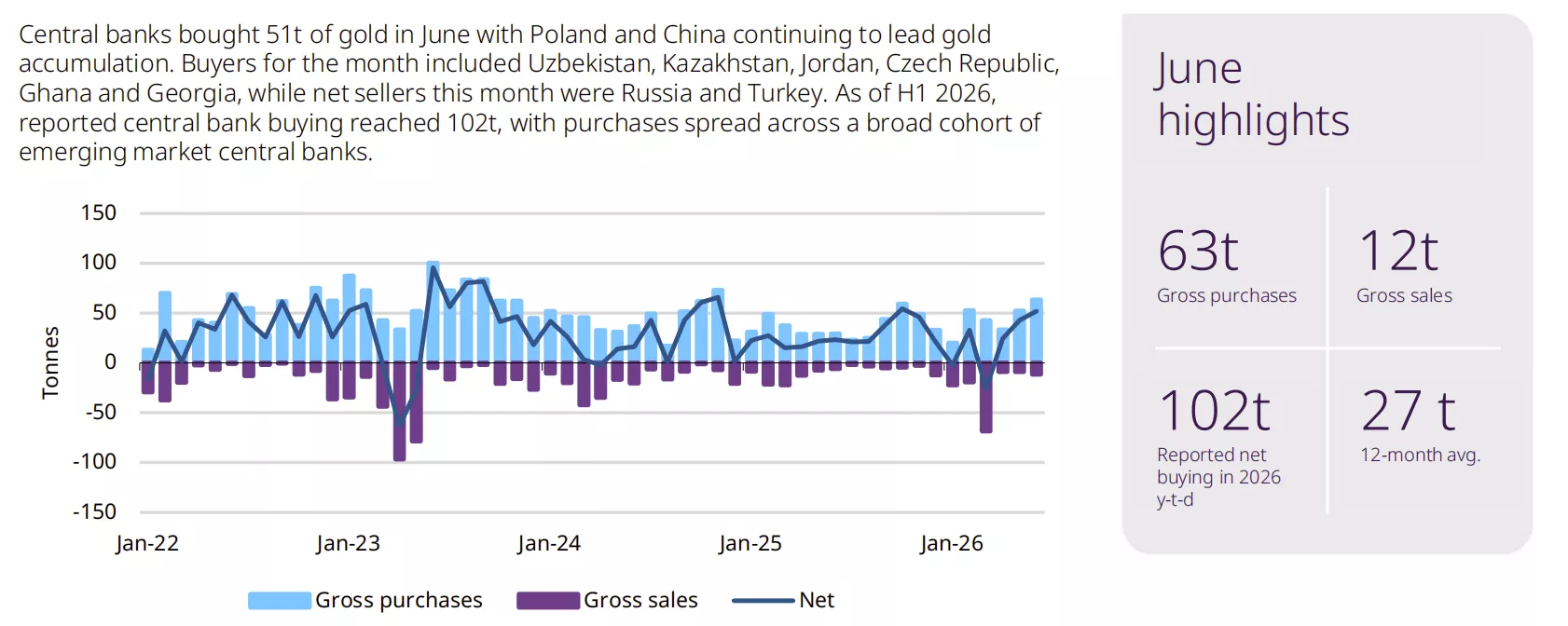
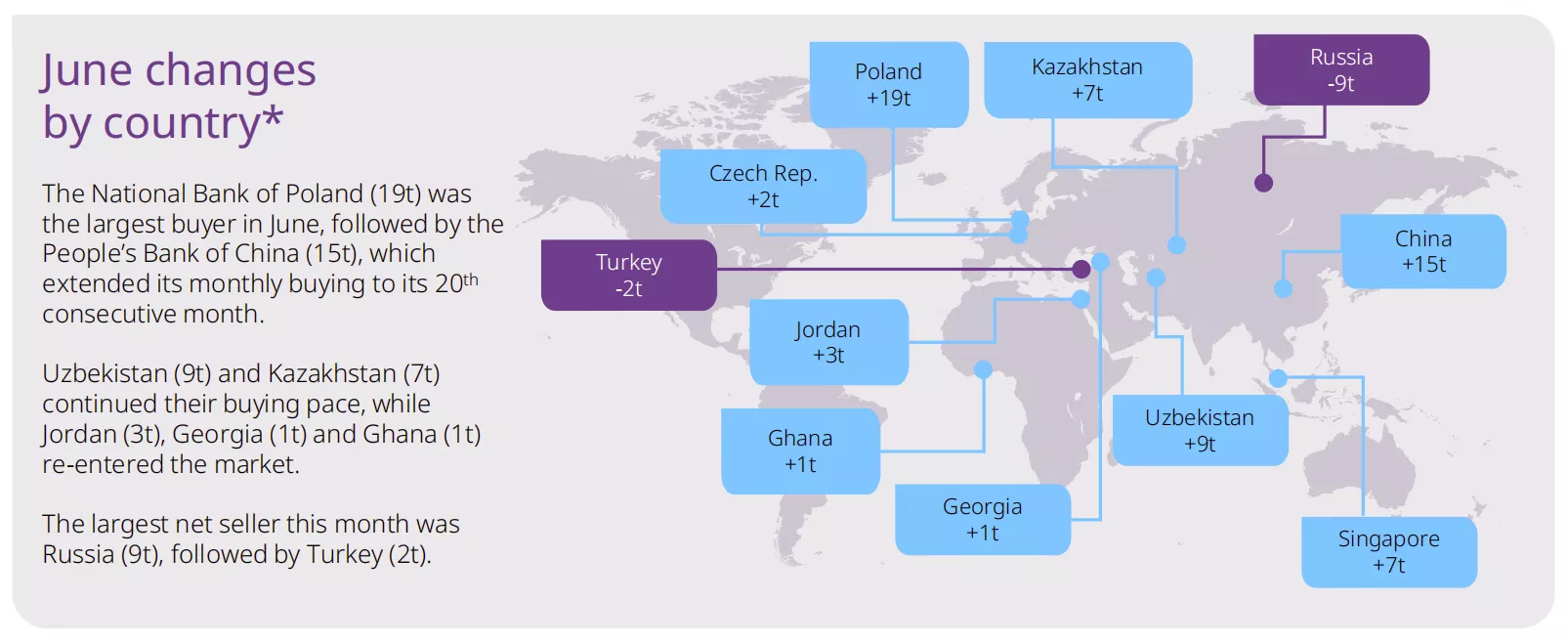
Year-to-date changes by country*
As of H1 2026, Poland remains the top buyer (82t), followed by Uzbekistan (41t), China (40t) and Kazakhstan (27t). Other major net buyers include Czech Republic (11t), Singapore (10t), Chile (8t), Jordan (6t) and Ghana (6t). Other smaller buyers are diversified within the emerging markets.
Turkey remains the largest y-t-d seller (83t) with most of its selling activity concentrated in Q1. Sales in Q2 were a modest 4t with reduction in swaps recorded at the end of June. Russia also sold gold, with 44t net sales y-t-d. See more detail on central banks gold activity in our Q2 2026 Gold Demand Trends.
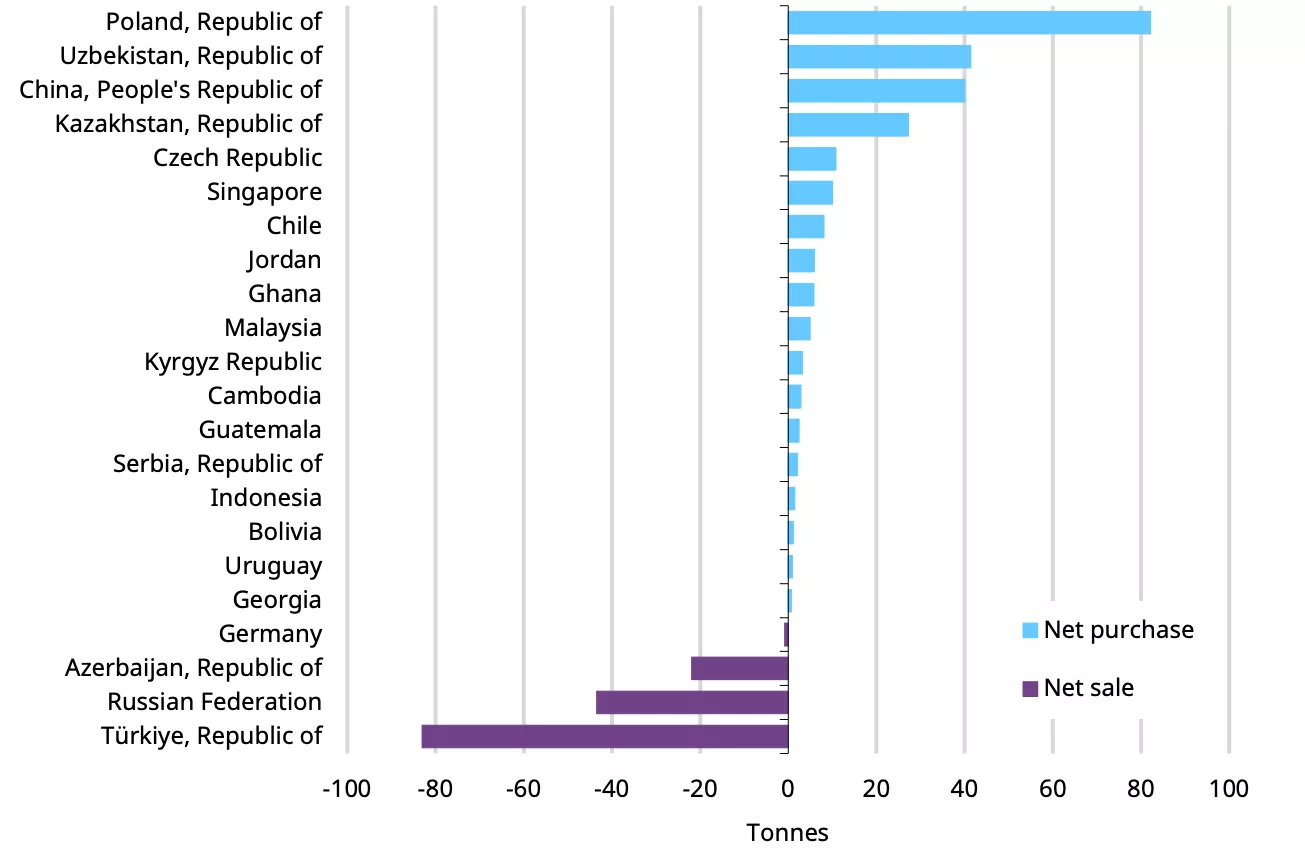
*Data to June 2026 where available. Central bank demand presented here comprises consist solely of publicly reported changes. This differs from our Gold Demand Trend statistics, which consist of aggregate reported changes as well as an estimate for unreported buying. Note: Azerbaijan (SOFAZ) represents the gold reserves of the State Oil Fund of Azerbaijan (SOFAZ). Monthly totals may not sum due to rounding and exclude the State Oil Fund of Azerbaijan (SOFAZ), which only reports quarterly data. Note: By country and y-t-d charts include changes of one tonne or more only.
Source: IMF IFS, respective central banks, World Gold Council
Disclaimer
Important information and disclaimers
© 2026 World Gold Council. All rights reserved. World Gold Council and the Circle device are trademarks of the World Gold Council or its affiliates.
All references to LBMA Gold Price are used with the permission of ICE Benchmark Administration Limited and have been provided for informational purposes only. ICE Benchmark Administration Limited accepts no liability or responsibility for the accuracy of the prices or the underlying product to which the prices may be referenced. Other content is the intellectual property of the respective third party and all rights are reserved to them.
Reproduction or redistribution of any of this information is expressly prohibited without the prior written consent of World Gold Council or the appropriate copyright owners, except as specifically provided below. Information and statistics are copyright © and/or other intellectual property of the World Gold Council or its affiliates or third-party providers identified herein. All rights of the respective owners are reserved.
The use of the statistics in this information is permitted for the purposes of review and commentary (including media commentary) in line with fair industry practice, subject to the following two pre-conditions: (i) only limited extracts of data or analysis be used; and (ii) any and all use of these statistics is accompanied by a citation to World Gold Council and, where appropriate, to Metals Focus or other identified copyright owners as their source. World Gold Council is affiliated with Metals Focus.
The World Gold Council and its affiliates do not guarantee the accuracy or completeness of any information nor accept responsibility for any losses or damages arising directly or indirectly from the use of this information.
This information is for educational purposes only and by receiving this information, you agree with its intended purpose. Nothing contained herein is intended to constitute a recommendation, investment advice, or offer for the purchase or sale of gold, any gold-related products or services or any other products, services, securities or financial instruments (collectively, “Services”). This information does not take into account any investment objectives, financial situation or particular needs of any particular person.
Diversification does not guarantee any investment returns and does not eliminate the risk of loss. Past performance is not necessarily indicative of future results. The resulting performance of any investment outcomes that can be generated through allocation to gold are hypothetical in nature, may not reflect actual investment results and are not guarantees of future results. The World Gold Council and its affiliates do not guarantee or warranty any calculations and models used in any hypothetical portfolios or any outcomes resulting from any such use. Investors should discuss their individual circumstances with their appropriate investment professionals before making any decision regarding any Services or investments.
This information may contain forward-looking statements, such as statements which use the words “believes”, “expects”, “may”, or “suggests”, or similar terminology, which are based on current expectations and are subject to change. Forward-looking statements involve a number of risks and uncertainties. There can be no assurance that any forward-looking statements will be achieved. World Gold Council and its affiliates assume no responsibility for updating any forward-looking statements.
Information regarding the LBMA Gold Price
The LBMA Gold Price is used by the World Gold Council with permission under license by ICE Benchmark Administration Limited and is subject to the restrictions set forth here (www.gold.org/terms-and-conditions).
Information regarding QaurumSM and the Gold Valuation Framework
Note that the resulting performance of various investment outcomes that can be generated through use of Qaurum, the Gold Valuation Framework and other information are hypothetical in nature, may not reflect actual investment results and are not guarantees of future results. Neither World Gold Council (including its affiliates) nor Oxford Economics provides any warranty or guarantee regarding the functionality of the tool, including without limitation any projections, estimates or calculations.
Information from ICRA Analytics Limited
All information obtained from ICRA Analytics Limited contained in this document is subject to the disclaimer set forth here (www.icraanalytics.com/terms-of-use/disclaimer).
You asked, we answered: Markets may not buy the buybacks
Johan Palmberg
Senior Quantitative Analyst World Gold CouncilIn response to a relentless rise in longer-term bond yields, the US Treasury announced that they were increasing their ‘buybacks’ of longer-term Treasuries to stem the rise.1 Yields dropped, as did the dollar and gold rallied 3% (Chart 1). This is not yield-curve control (YCC) but it might be a step in that direction, as Mohamed El-Erian remarked following the announcement.2 Here’s our take on what it means.
Chart 1: Yields, dollar and gold react to US Treasury buyback announcement
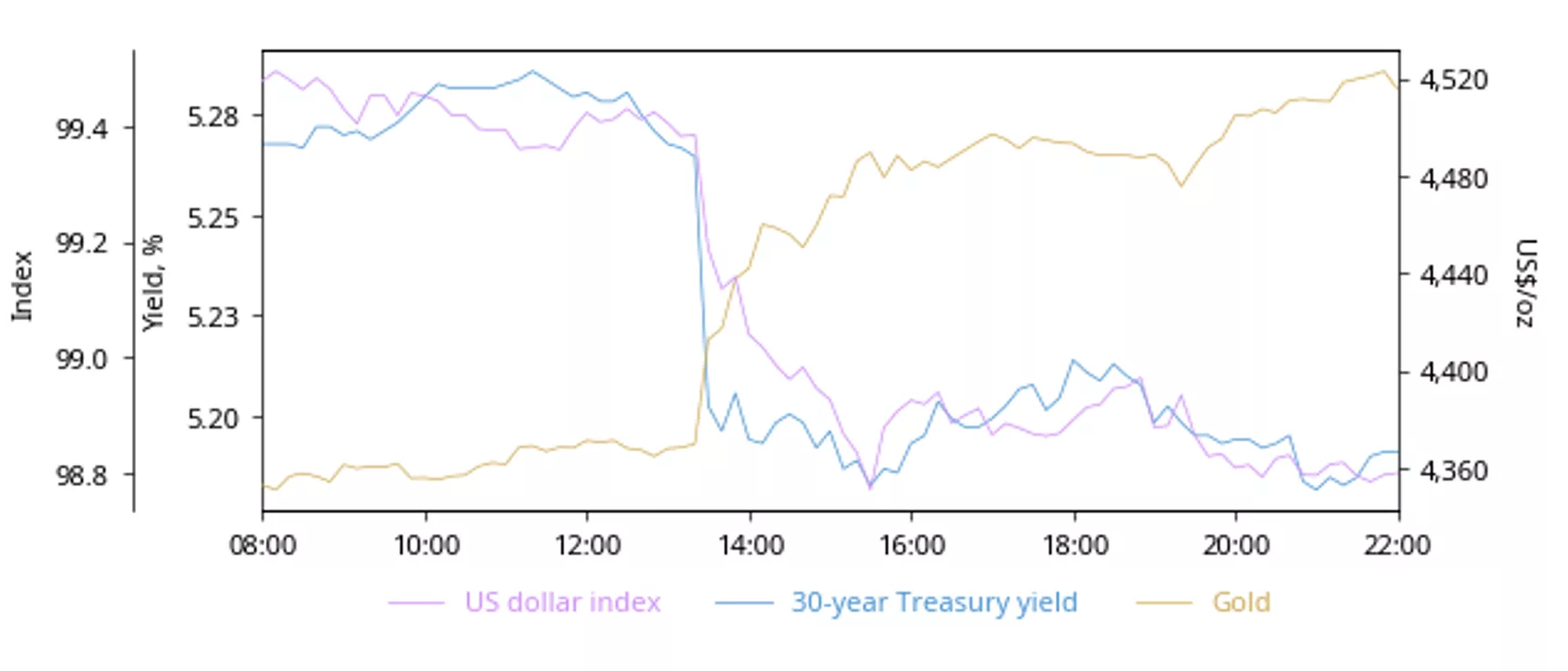
* Intraday reaction to Treasury buyback announcement on 19 August 2026.
Source: Bloomberg, World Gold Council
Who’s going to buy our bonds?
While Treasury yields ultimately reflect expectations for growth, inflation and monetary policy, investors are paying increasing attention to the balance between a growing supply of government debt and the willingness of different buyer groups to absorb it.
On the supply side, issuance continues to grow: persistent fiscal deficits require ever larger amounts of borrowing, alongside an expanding debt stock that also needs refinancing.3,4
On the demand side, some traditional buyers appear more skittish. Foreign official institutions continue to diversify reserves, foreign private investors face attractive yields elsewhere and official ones are diversifying US dollar exposure. Banks remain balance-sheet constrained5, and corporate borrowing linked to AI and data-centre investment is competing for investor capital (Chart 2). Plus, a growing share of Treasury demand has come from highly price-sensitive private-sector investors, including hedge funds.6
Chart 2: Treasury issuance rising sharply but AI-related issuance competing for capital
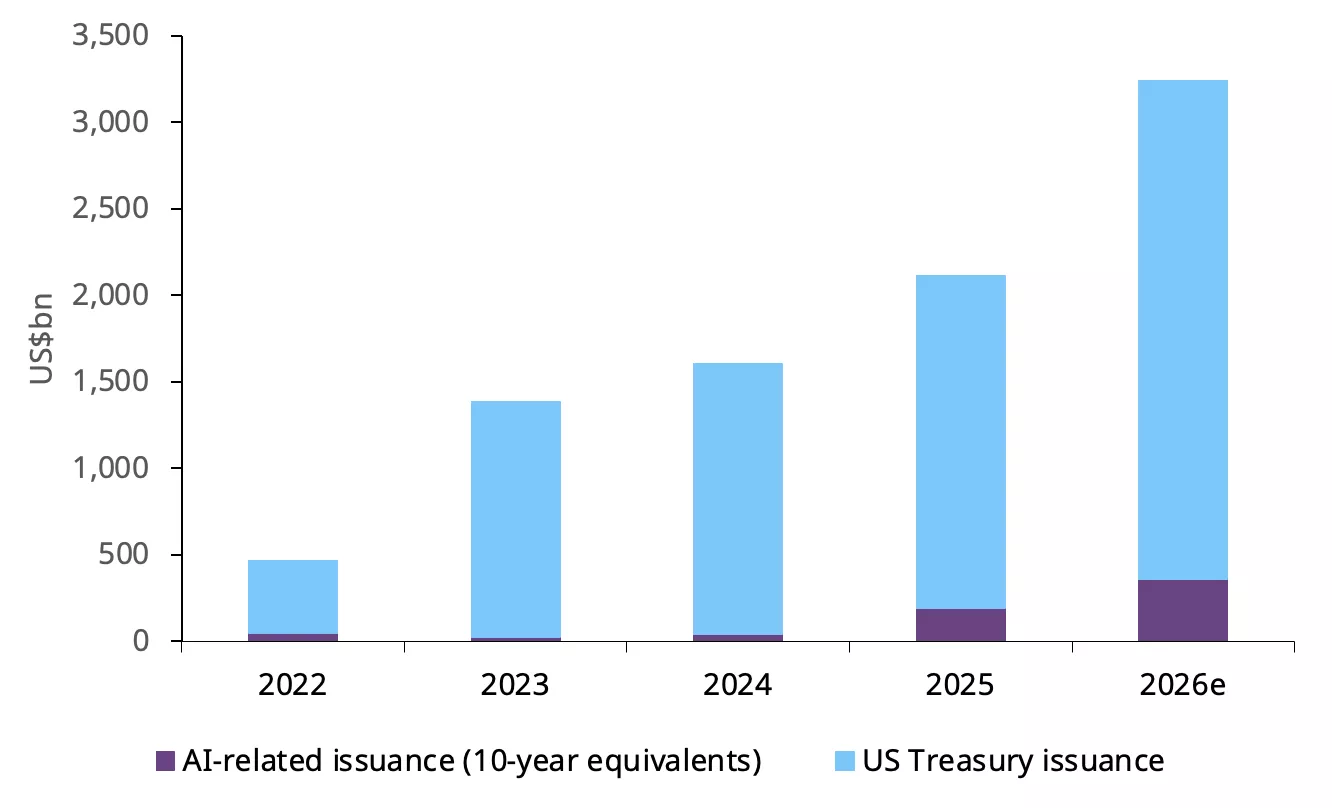
*AI issuance sourced from Dallas Fed How AI debt financing impacts duration supply and interest rates - Dallasfed.org. Treasury issuance sourced from SIFMA
Source: Bloomberg, Dallas Fed, SIFMA, World Gold Council
In this environment - and against a backdrop of elevated inflation, concerns around the trajectory of public debt and the independence of policymakers - investors are demanding greater compensation to hold long-dated Treasuries. The recent yield rise suggests that investors no longer assume Treasury supply will be absorbed effortlessly. Instead, the balance between supply and demand has become an increasingly important determinant of pricing.
Policymakers’ options are limited
The Treasury’s increased use of buybacks highlights a willingness by policymakers to intervene at the margin without resorting to more overt forms of support such as QE.
There are softer options including reconfiguring the enhanced Supplementary Leverage Ratio ( eSLR)7, discouraging sales of Treasuries – as we saw during the yen intervention8 in early August – as well as stablecoin promotion. But these measures probably just paper over the cracks.
Fed support via a new round of QE is unlikely, because it carries significant credibility baggage. Why deploy an extraordinary balance-sheet tool to manage the long end of the curve, that the Fed Chair has been vocally opposed to9, when rate hikes could, in principle, achieve a similar outcome by tempering the inflation outlook and containing term premia? Alas, rate hikes may not be palatable ahead of the Midterms. An alternative might be yield curve control (YCC), where the Fed rather than the Treasury, would intervene directly to cap yields.
Why YCC might be tabled, unofficially
YCC may be more than just an academic concept. It was tabled by the Fed in 2020 in response to COVID.10 It was used in the 1940s in the US and was initially successful. Japan and Australia also deployed YCC in the last decade.11 For those two countries it was meant to prevent yields from falling below desired levels as well as influence the shape of the curve. In today's US context, the goal would be to cap yield rises, as it did in the 1940s.
Unlike QE, YCC doesn't necessarily require a large expansion of the Fed's balance sheet. QE is about quantity. It creates a visible balance-sheet expansion and helped underpin one of the defining post-GFC narratives for gold. YCC could conceivably be implemented sporadically, with a much smaller balance-sheet footprint. It could even be sold as a measure to improve market functioning rather than macroeconomic stimulus. Just because it walks like a duck and quacks like a duck, doesn't mean it's a duck. It's monetary policy's version of plausible deniability.
What it might mean for gold
As with everything, the impact on gold is unsurprisingly not a one-way street. Aside from the fact that US monetary policy is only one of many drivers of global gold prices, even for Western investors, YCC wouldn't automatically translate into a bullish outcome for gold. But our view is that the positives would likely outweigh the negatives and likely invite substantial interest in gold:
- Pressure on the US dollar. A weaker dollar would probably be the most immediate channel through which YCC would benefit gold. We caught a glimpse of that during the buyback announcement on 19 August. In our view the expensive US dollar is already facing pressure from several corners and YCC, much like the buyback program, could increasingly force the adjustment through the currency rather than the bond market12
- Financial repression, another fancy term for keeping yields at bay, would usher in a tug of war between policymakers and the market. A Treasury market that clears at an administratively influenced price brings uncertainty because investors don’t know where yields would settle absent intervention. As we've seen with interventions elsewhere, most notably Japan, markets can be relentless. It doesn't require aggressive short sellers, perhaps not even outright sellers, just an absence of buyers. And it’s perhaps not just low yields that would attract investors to gold, but that yields are being kept low because letting them clear at market prices are a policy concern
- Lower real rates. YCC would likely make it harder for nominal yields to keep up with rising inflation expectations. If policymakers succeed in capping yields with elevated inflation, investors face lower real returns on government bonds. The inverse relationship between gold and real yields would likely become stronger as a result.
But of course, YCC could work, if investors viewed the policy as credible and temporary. It would remove concerns about market dysfunction and probably compress term premia and improve sentiment. And oddly, that could see gold weaker even in the face of lower bond yields. But the US experience in the 1940s suggests that such arrangements can become difficult to maintain. During that episode, YCC eventually unravelled, colliding with rising inflation and concerns over Fed independence. Sound familiar?
Unfortunately, we don’t have a counterfactual for how gold would have performed then, as it wasn’t freely available to buy and sell, like other hard metals such as silver and copper. And gold mining companies were an imperfect proxy: they captured some of the monetary demand for gold but margins were simultaneously squeezed by rising costs.
But our experience over the last few years suggests that the debt mountain concern – in the US and elsewhere - remains one of the pillars of gold demand and any attempts to manage that burden not involving a reduction of debt or deficits are likely to continue favouring gold.
Footnotes
1US Treasury to boost long-term bond purchases in bid to steady market
3The Budget and Economic Outlook: 2026 to 2036 | Congressional Budget Office
4Federal Debt Management: Treasury Is Meeting Borrowing Needs but the Deteriorating Fiscal Outlook Poses Risks | U.S. GAO
5Treasury Market Resiliency and Large Banks’ Balance Sheet Constraints - Bank Policy Institute
6The Fed - Decomposing Hedge Funds’ U.S. Treasury Exposures
7Bank Capital Requirements and Treasury Market Resiliency
8US Treasury undertakes historic intervention in yen market
9Shrinking the Fed’s Balance Sheet Is Easier Said Than Done | Stanford Graduate School of Business
10Minutes of the Federal Open Market Committee June 9-10, 2020
Disclaimer
Important information and disclaimers
© 2026 World Gold Council. All rights reserved. World Gold Council and the Circle device are trademarks of the World Gold Council or its affiliates.
All references to LBMA Gold Price are used with the permission of ICE Benchmark Administration Limited and have been provided for informational purposes only. ICE Benchmark Administration Limited accepts no liability or responsibility for the accuracy of the prices or the underlying product to which the prices may be referenced. Other content is the intellectual property of the respective third party and all rights are reserved to them.
Reproduction or redistribution of any of this information is expressly prohibited without the prior written consent of World Gold Council or the appropriate copyright owners, except as specifically provided below. Information and statistics are copyright © and/or other intellectual property of the World Gold Council or its affiliates or third-party providers identified herein. All rights of the respective owners are reserved.
The use of the statistics in this information is permitted for the purposes of review and commentary (including media commentary) in line with fair industry practice, subject to the following two pre-conditions: (i) only limited extracts of data or analysis be used; and (ii) any and all use of these statistics is accompanied by a citation to World Gold Council and, where appropriate, to Metals Focus or other identified copyright owners as their source. World Gold Council is affiliated with Metals Focus.
The World Gold Council and its affiliates do not guarantee the accuracy or completeness of any information nor accept responsibility for any losses or damages arising directly or indirectly from the use of this information.
This information is for educational purposes only and by receiving this information, you agree with its intended purpose. Nothing contained herein is intended to constitute a recommendation, investment advice, or offer for the purchase or sale of gold, any gold-related products or services or any other products, services, securities or financial instruments (collectively, “Services”). This information does not take into account any investment objectives, financial situation or particular needs of any particular person.
Diversification does not guarantee any investment returns and does not eliminate the risk of loss. Past performance is not necessarily indicative of future results. The resulting performance of any investment outcomes that can be generated through allocation to gold are hypothetical in nature, may not reflect actual investment results and are not guarantees of future results. The World Gold Council and its affiliates do not guarantee or warranty any calculations and models used in any hypothetical portfolios or any outcomes resulting from any such use. Investors should discuss their individual circumstances with their appropriate investment professionals before making any decision regarding any Services or investments.
This information may contain forward-looking statements, such as statements which use the words “believes”, “expects”, “may”, or “suggests”, or similar terminology, which are based on current expectations and are subject to change. Forward-looking statements involve a number of risks and uncertainties. There can be no assurance that any forward-looking statements will be achieved. World Gold Council and its affiliates assume no responsibility for updating any forward-looking statements.
Information regarding the LBMA Gold Price
The LBMA Gold Price is used by the World Gold Council with permission under license by ICE Benchmark Administration Limited and is subject to the restrictions set forth here (www.gold.org/terms-and-conditions).
Information regarding QaurumSM and the Gold Valuation Framework
Note that the resulting performance of various investment outcomes that can be generated through use of Qaurum, the Gold Valuation Framework and other information are hypothetical in nature, may not reflect actual investment results and are not guarantees of future results. Neither World Gold Council (including its affiliates) nor Oxford Economics provides any warranty or guarantee regarding the functionality of the tool, including without limitation any projections, estimates or calculations.
Information from ICRA Analytics Limited
All information obtained from ICRA Analytics Limited contained in this document is subject to the disclaimer set forth here (www.icraanalytics.com/terms-of-use/disclaimer).
Central Bank Gold Statistics: Central banks make positive headlines on gold
Marissa Salim
Senior Research Lead, APAC World Gold CouncilCentral banks continued their gold accumulation in July with net buying reported at 23t. Emerging markets have also continued to accumulate gold this month with China (20t) and Poland (8t) taking the lead (Chart 1). Notably, activity from the People’s Bank of China (PBoC) has picked up pace in recent months, with double-digit monthly purchases of gold since May 2026. Russia was the top net seller this month, posting sales of 6t, followed by Turkey, Jordan and Uzbekistan at 1t each. On a y-t-d basis, central banks reported purchases have totalled around 130t of gold. This compares to a reported ~160t which was purchased over the same period last year.
Chart 1: Central banks remain positive in July with net buying of 23t
Monthly reported central bank activity, tonnes*
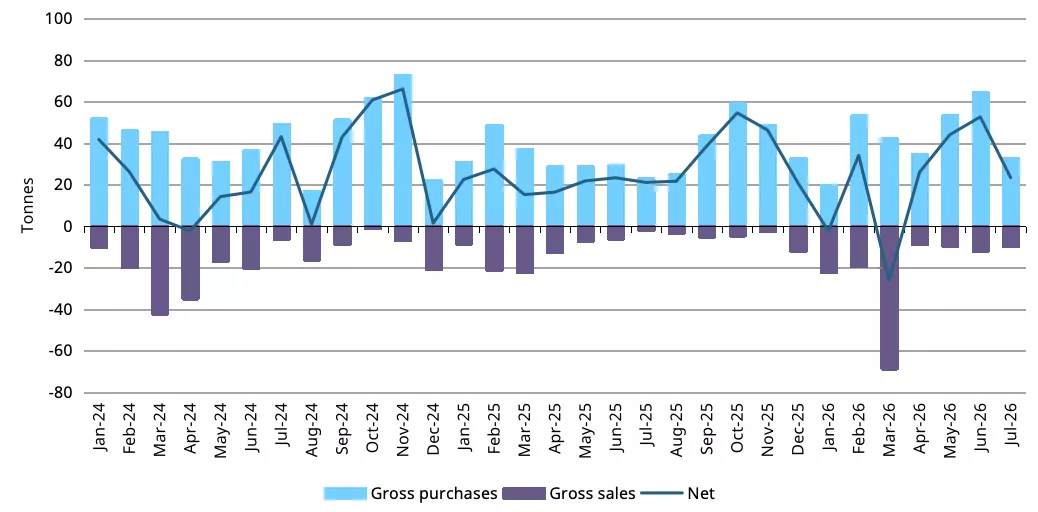
*Data to 31 July 2026, where available.
Source: IMF, respective central banks, World Gold Council
Chart 2: Diversifying storage locations in the next 12 months
How, if at all, do you intend to change your custody arrangements over the next 12 months?
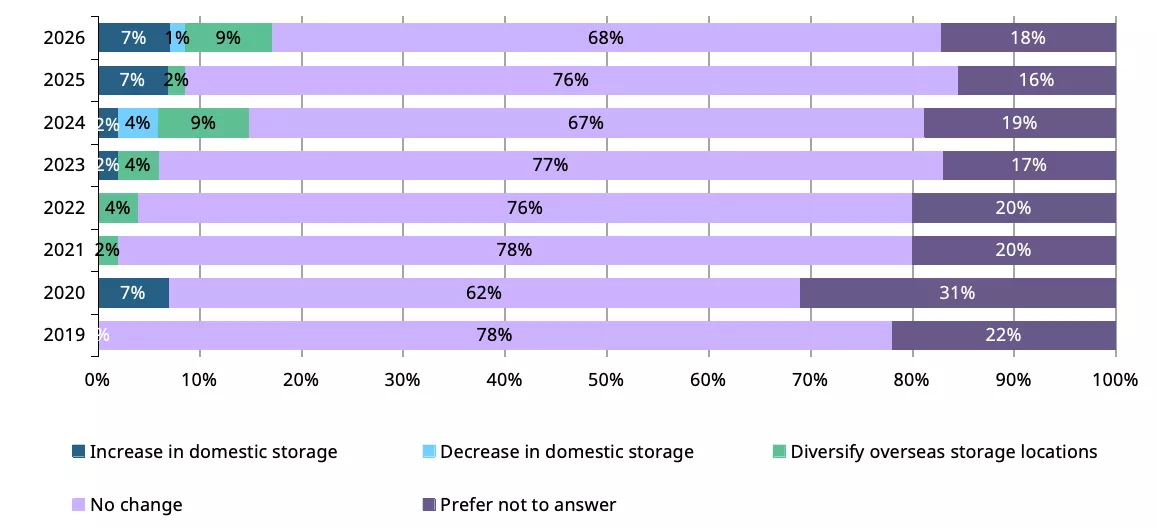
2026 base: All central banks (68); advanced economy (16); EMDE (52). Totals may not sum due to rounding.
Source: IMF, respective central banks, World Gold Council
Significant reported activity in July and y-t-d:
- The National Bank of Poland continued its gold accumulation streak, with 8t purchased this month. Poland tops the scoreboard when it comes to y-t-d gold purchases, buying 90t so far this year. The country has accumulated 640t of gold – against its target of 700t – or approximately 28% of its total reserves.
- In its 21st consecutive month of buying the PBoC added 20t to its gold reserves in July. China has added 60t to its gold reserves y-t-d, second only to Poland. China’s official gold reserves now stand at 8% of total reserves, or around 2,366t, and is the sixth largest reported gold holder globally.
- The Central Bank of Uzbekistan sold 1t this month; its y-t-d gold purchases stand at 40t. The central bank hit the news recently as Governor Timur Ishmetov looked to engage with American money managers. Ishmetov said that while “gold has turned out to be the best investment so far”, the central bank is looking at potential sales of gold at “favourable prices” as part of its overall reserve management plan. Uzbekistan’s gold now stands at 87% of total reserves, or about 431t.
- The Czech National Bank also bought 2t of gold this month in its 41st consecutive month of net buying. The central bank has bought 12t y-t-d, bringing its gold holdings to 6% of its total reserves, or 84t.
- The National Bank of Kazakhstan (NBK), Bank Negara Malaysia (BNM) and the Central Bank of Bolivia (CBB) each bought 1t of gold this month. On a y-t-d basis the NBK has accumulated 29t of gold and is one of the top five gold accumulators globally. Kazakhstan’s gold holdings stand at 75% of its total reserves. Both the BNM and the CBB are relatively new entrants to the gold market, with y-t-d gold holdings at 6t and 2t respectively.
- The Central Bank of Russia continued its net sales in July, offloading a further 6t of gold. Russia has sold 50t of gold y-t-d, lowering its total gold holdings to 2,277t.
- The Central Bank of the Republic of Turkey sold 1t of gold this month, bringing its total sales so far this year to 85t.
Chart 3: Year-to-date central bank gold activity
Reported central bank net purchases and sales, tonnes*
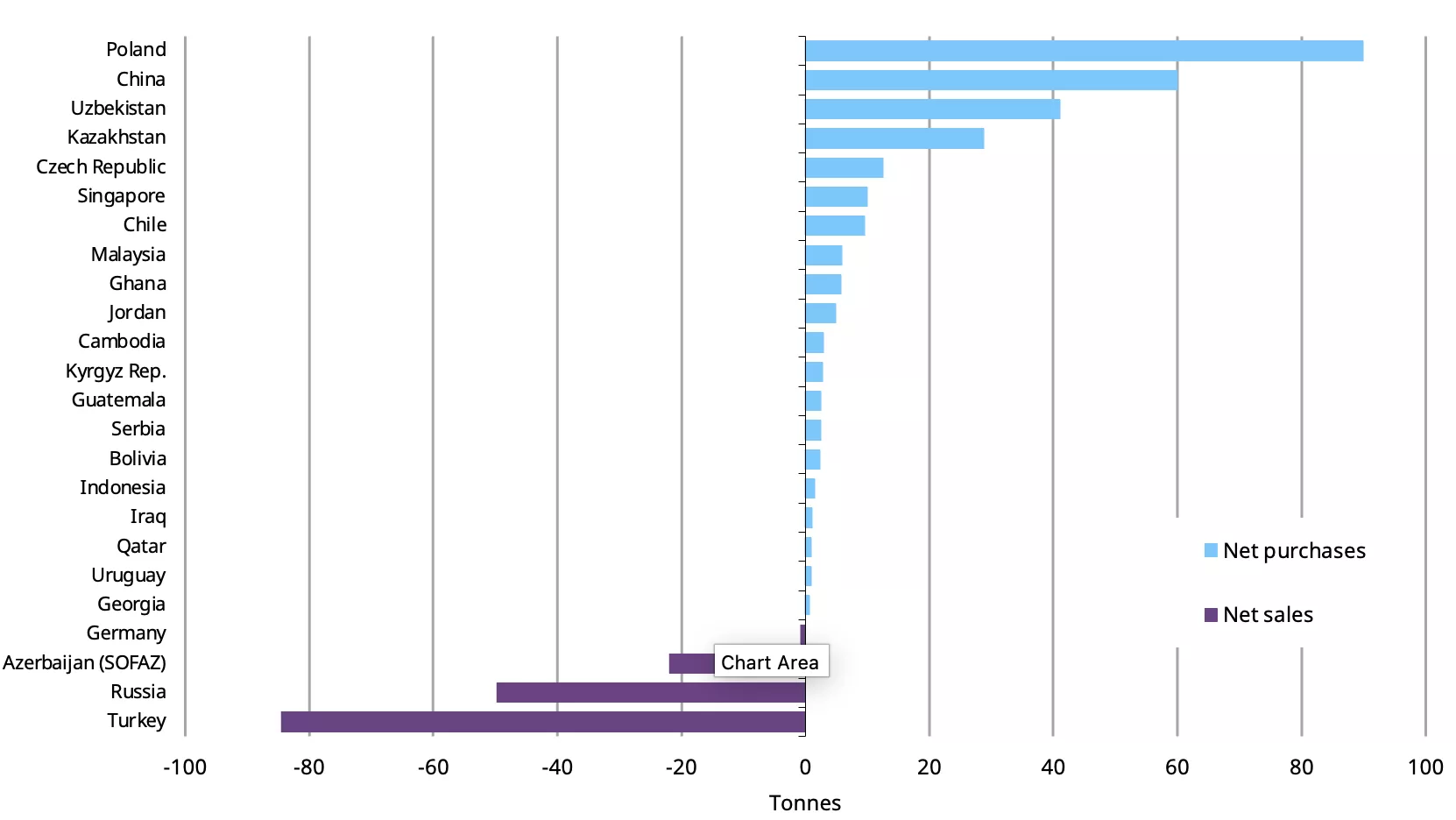
*Data to 31 July 2026, where available.
Note: The Bulgarian National Bank's transfer of 2t to the European Central Bank as part of its adoption of the euro is excluded from the chart. Azerbaijan (SOFAZ) represents the gold reserves of the State Oil Fund of Azerbaijan (SOFAZ).
Source: IMF, respective central banks, World Gold Council
Central banks continue to report positive headlines
The Bank of Korea (BOK) added to central bank headlines by announcing an official gold allocation after 13 years. The allocation, made via gold-backed ETFs, is estimated at US$250mn or approximately 2t. The BOK also announced plans to purchase domestically refined gold in order to diversify its reserves and hedge against risks related to inflation and geopolitics.
The Venezuelan government requested repatriation of around US$4bn of its gold reserves from the Bank of England. The move comes about as Venezuela looks to rebuild infrastructure post the 2026 earthquake. Since 2018, Venezuela has been blocked from accessing its gold reserves as the UK government declined to recognise the country’s socialist government. This type of activity in the sector is noted in our 2026 Central Banks Gold Reserves Survey, which records a pickup in central banks looking to increase domestic storage and diversify overseas storage locations (Chart 2).
The Bank of Namibia has ramped up its gold accumulation ambition: its target is to increase gold reserves from 1% to 3% by the end of March 2027, according to a statement by the bank’s deputy governor earlier this month.1 The bank signed a gold purchase agreement in March this year with QKR Namibia Navachab, a local mining company, to help build up its gold reserves.2
Footnotes
1Bloomberg.
2Bank of Namibia inches towards local gold reserves, Namibia Business Review, March 2026.
Disclaimer
Important information and disclaimers
© 2026 World Gold Council. All rights reserved. World Gold Council and the Circle device are trademarks of the World Gold Council or its affiliates.
All references to LBMA Gold Price are used with the permission of ICE Benchmark Administration Limited and have been provided for informational purposes only. ICE Benchmark Administration Limited accepts no liability or responsibility for the accuracy of the prices or the underlying product to which the prices may be referenced. Other content is the intellectual property of the respective third party and all rights are reserved to them.
Reproduction or redistribution of any of this information is expressly prohibited without the prior written consent of World Gold Council or the appropriate copyright owners, except as specifically provided below. Information and statistics are copyright © and/or other intellectual property of the World Gold Council or its affiliates or third-party providers identified herein. All rights of the respective owners are reserved.
The use of the statistics in this information is permitted for the purposes of review and commentary (including media commentary) in line with fair industry practice, subject to the following two pre-conditions: (i) only limited extracts of data or analysis be used; and (ii) any and all use of these statistics is accompanied by a citation to World Gold Council and, where appropriate, to Metals Focus or other identified copyright owners as their source. World Gold Council is affiliated with Metals Focus.
The World Gold Council and its affiliates do not guarantee the accuracy or completeness of any information nor accept responsibility for any losses or damages arising directly or indirectly from the use of this information.
This information is for educational purposes only and by receiving this information, you agree with its intended purpose. Nothing contained herein is intended to constitute a recommendation, investment advice, or offer for the purchase or sale of gold, any gold-related products or services or any other products, services, securities or financial instruments (collectively, “Services”). This information does not take into account any investment objectives, financial situation or particular needs of any particular person.
Diversification does not guarantee any investment returns and does not eliminate the risk of loss. Past performance is not necessarily indicative of future results. The resulting performance of any investment outcomes that can be generated through allocation to gold are hypothetical in nature, may not reflect actual investment results and are not guarantees of future results. The World Gold Council and its affiliates do not guarantee or warranty any calculations and models used in any hypothetical portfolios or any outcomes resulting from any such use. Investors should discuss their individual circumstances with their appropriate investment professionals before making any decision regarding any Services or investments.
This information may contain forward-looking statements, such as statements which use the words “believes”, “expects”, “may”, or “suggests”, or similar terminology, which are based on current expectations and are subject to change. Forward-looking statements involve a number of risks and uncertainties. There can be no assurance that any forward-looking statements will be achieved. World Gold Council and its affiliates assume no responsibility for updating any forward-looking statements.
Information regarding the LBMA Gold Price
The LBMA Gold Price is used by the World Gold Council with permission under license by ICE Benchmark Administration Limited and is subject to the restrictions set forth here (www.gold.org/terms-and-conditions).
Information regarding QaurumSM and the Gold Valuation Framework
Note that the resulting performance of various investment outcomes that can be generated through use of Qaurum, the Gold Valuation Framework and other information are hypothetical in nature, may not reflect actual investment results and are not guarantees of future results. Neither World Gold Council (including its affiliates) nor Oxford Economics provides any warranty or guarantee regarding the functionality of the tool, including without limitation any projections, estimates or calculations.
Information from ICRA Analytics Limited
All information obtained from ICRA Analytics Limited contained in this document is subject to the disclaimer set forth here (www.icraanalytics.com/terms-of-use/disclaimer).
You asked, we answered: Why are central banks moving their gold reserves
Krishan Gopaul
Senior Analyst, EMEA World Gold CouncilGold on the move
On 2 September, De Nederlandsche Bank (DNB) announced that it had transferred approximately 86t of gold from New York and Ottawa to London.1 The operation, conducted between March and August 2026, was designed to improve the liquidity and tradability of DNB’s gold reserves and strengthen its preparedness for severe crises.
At first glance, the decision might look like another example of a central bank bringing its gold closer to home. It is more revealing than that. London’s share of Dutch gold reserves rose from 18.1% to 32.1%, surpassing domestic holdings of 30.8% and making London, rather than the Netherlands, the largest single storage location for Dutch gold. The shares held in New York and Ottawa fell to 18.5% each, from 31.3% and 19.7%, respectively.
The mechanics were equally significant. Around 59t was sold in New York and replaced with internationally tradable gold in London. More than 27t of gold was physically transported from North America to DNB’s facility in Zeist, while a similar quantity moved from Zeist to London. This was therefore a strategic reallocation of reserve locations, not simply 86t of bullion being flown across the Atlantic.
The announcement nevertheless highlights a broader shift in central bank thinking on where gold reserves should be stored to balance security, accessibility and liquidity.
From repatriation to location strategy
Gold repatriation is not new.2 In 2000, Germany transferred around 930t from London to Frankfurt, with the Bundesbank subsequently confirming that the gold had been inspected and that some bars were to be recast to meet Good Delivery standard.3 But the issue became much more prominent after the global financial crisis.
Venezuela returned 160t from foreign institutions in 2011–12.4 Germany followed with a second programme, transferring 674t from New York and Paris to Frankfurt between 2013 and 2017.5 The Netherlands moved 122.5t from New York to Amsterdam in 2014,6 while Austria moved 90t from London between 2015 and 2018.7 Later in the decade, Türkiye changed the overseas custody location of part of its gold, while Hungary and Poland moved physical reserves into domestic storage.
The range of countries reviewing or changing their gold storage arrangements has broadened since then. Serbia reportedly returned around 13t between 2021 and 2022.8 India has progressively increased domestic gold holdings since 2022, with the pace of relocation accelerating sharply after March 2023.9 France also changed the geographical distribution of its gold exposure in 2025–26, selling 129t held in New York and acquiring an equivalent quantity of replacement gold in Europe. The Banque de France did not describe the operation as a physical relocation.10
Chart 1: Selected central bank repatriations, strategic relocations and uncompleted proposals since 2000
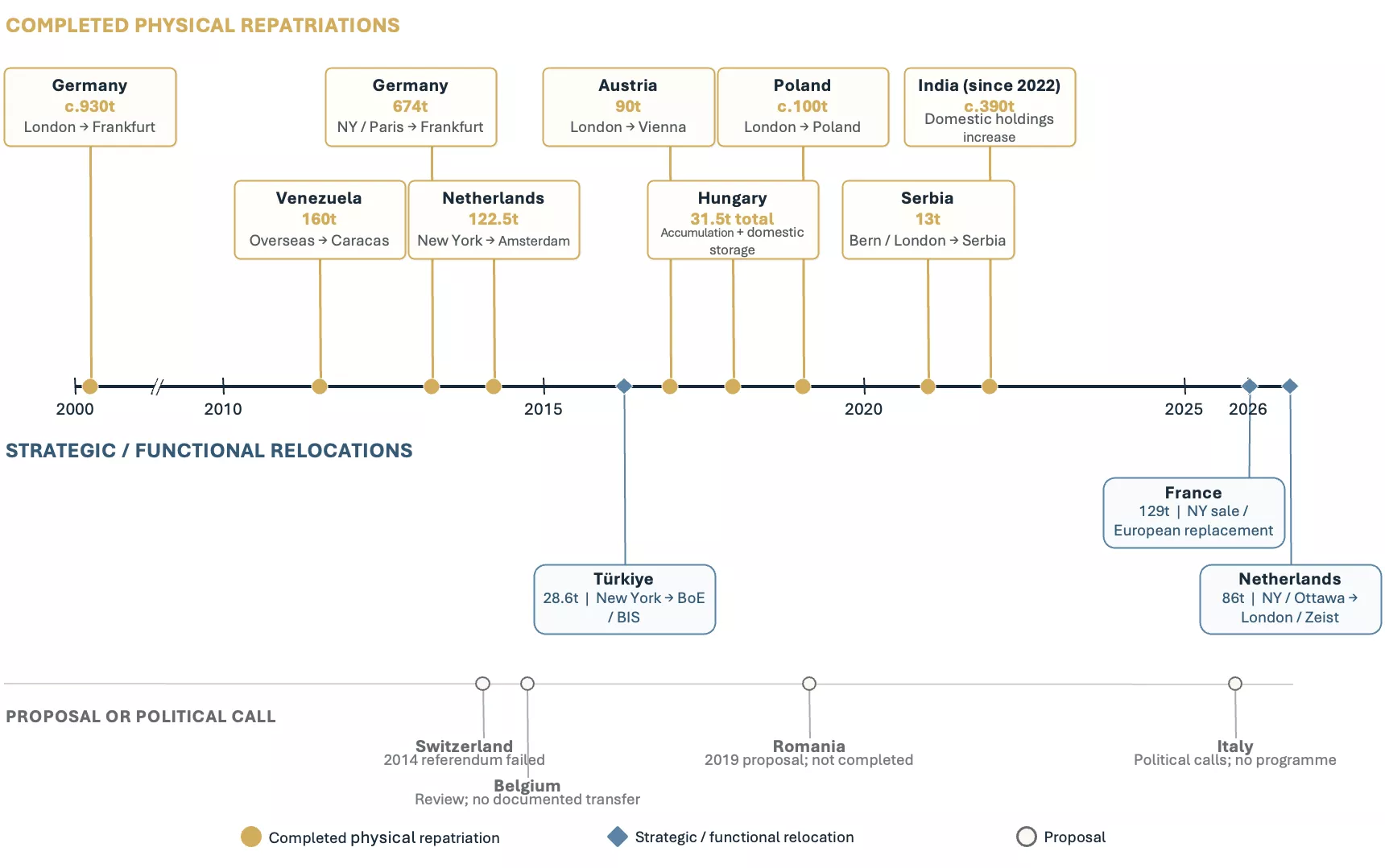
Dates reflect the announcement or broad programme period. Routes are simplified. Changes in custody position do not always prove physical shipment.
Source: World Gold Council analysis of central bank disclosures and cited public sources
Three waves, but no single motivation
One way to interpret the post-2000 history is through three broad, overlapping waves:
- The first wave reflected an early reassessment of reserve location arrangements. Germany’s transfer of around 930t from London to Frankfurt in 2000 showed that the geographical distribution of official gold was already being reconsidered well before repatriation became a prominent geopolitical issue.
- In the second wave, from roughly 2011 to 2019, questions of national control and public confidence became more visible. Venezuela presented its decision in terms of greater national control.11 Elsewhere, central banks generally pursued more balanced strategies. Germany wanted half of its reserves in Frankfurt, while Austria also ultimately held half of its gold reserves domestically but retained substantial holdings in London and Switzerland to preserve access to international markets; Poland combined domestic repatriation with a major expansion of its gold reserves.
- The third wave is more complex. Heightened geopolitical uncertainty has increased attention on jurisdiction, access during a crisis and exposure to overseas financial infrastructure.12 Yet recent operations by France and DNB show that the answer does not necessarily lie in domestic storage alone. Central banks are increasingly optimising across three considerations: custody risk, physical accessibility and market liquidity.
DNB’s decision captures this evolution particularly well. In 2014, it moved gold from New York to Amsterdam to increase the proportion held domestically. In 2026, it moved gold from North America predominantly to London to make it more readily deployable. These decisions point in different geographical directions, but share the same objective: resilience through a more purposeful distribution of reserves.
Chart 2: Where do you currently vault your gold reserves? (Please select all that apply)
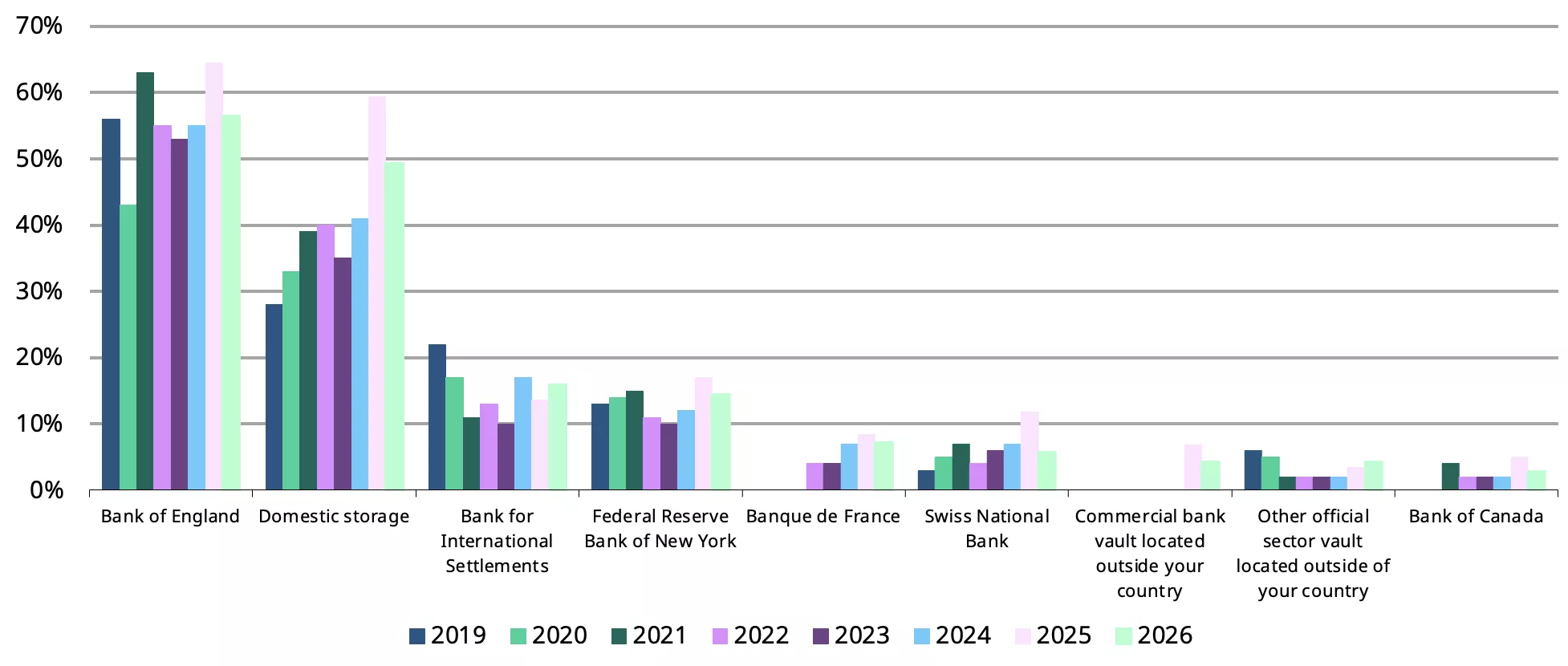
2026 base: All central banks who hold gold (69); advanced economy (16); EMDE (53). Note: Respondents were able to select all options that applied.
Source: World Gold Council, YouGov
What central banks themselves are saying
Our 2026 Central Bank Gold Reserves Survey reinforces this interpretation. The Bank of England remains the most commonly cited vaulting location, used by 57% of respondents, while 49% reported holding at least some gold domestically.
Over the preceding 12 months, 9% of respondents had increased domestic storage, but 10% had diversified their overseas storage locations. Looking ahead, 7% planned to increase domestic storage and 9% expected to diversify further overseas. The latter figure rose from just 2% in the previous survey.
Chart 3: How, if at all, have your custody arrangements changed over the past 12 months?
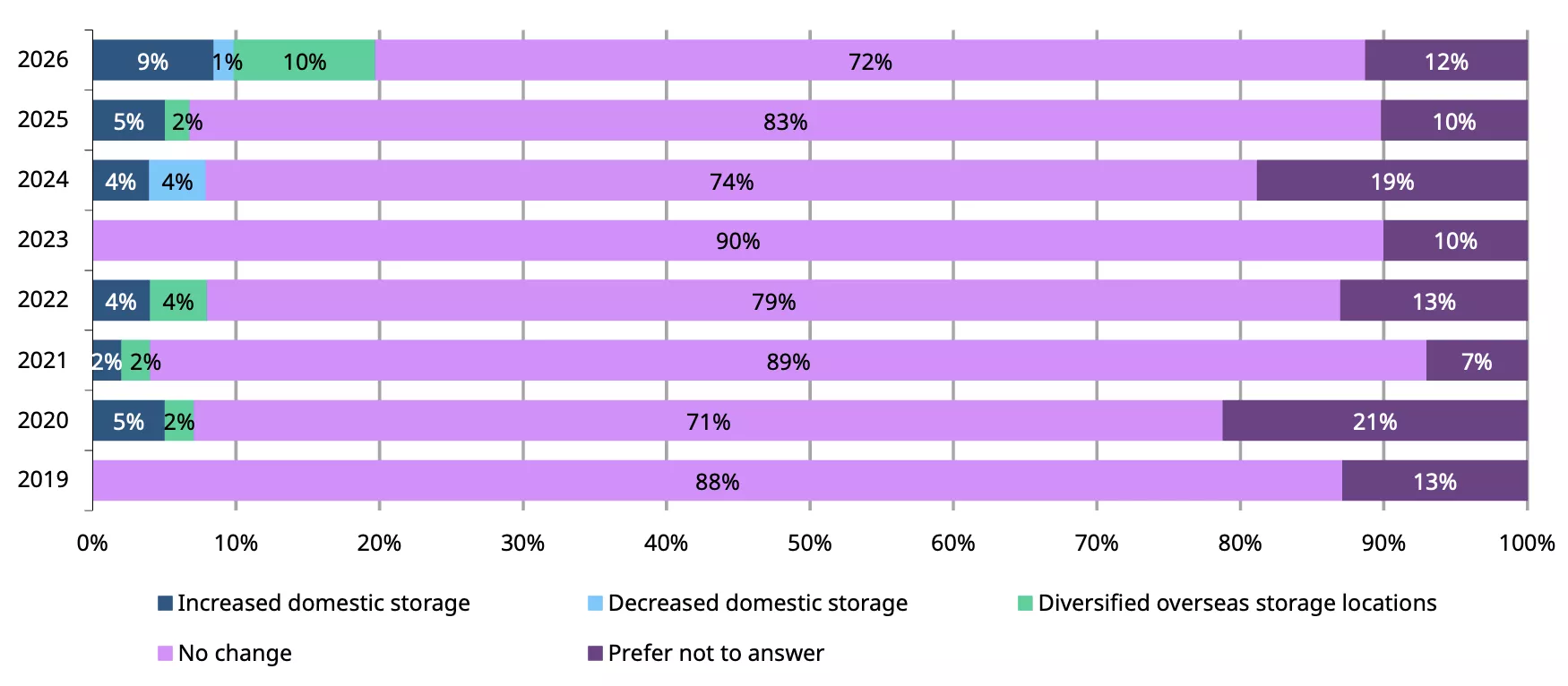
2026 base: All central banks who hold gold (68); advanced economy (16); EMDE (52).
Source: World Gold Council, YouGov
Chart 4: How, if at all, do you intend to change your custody arrangements over the next 12 months?
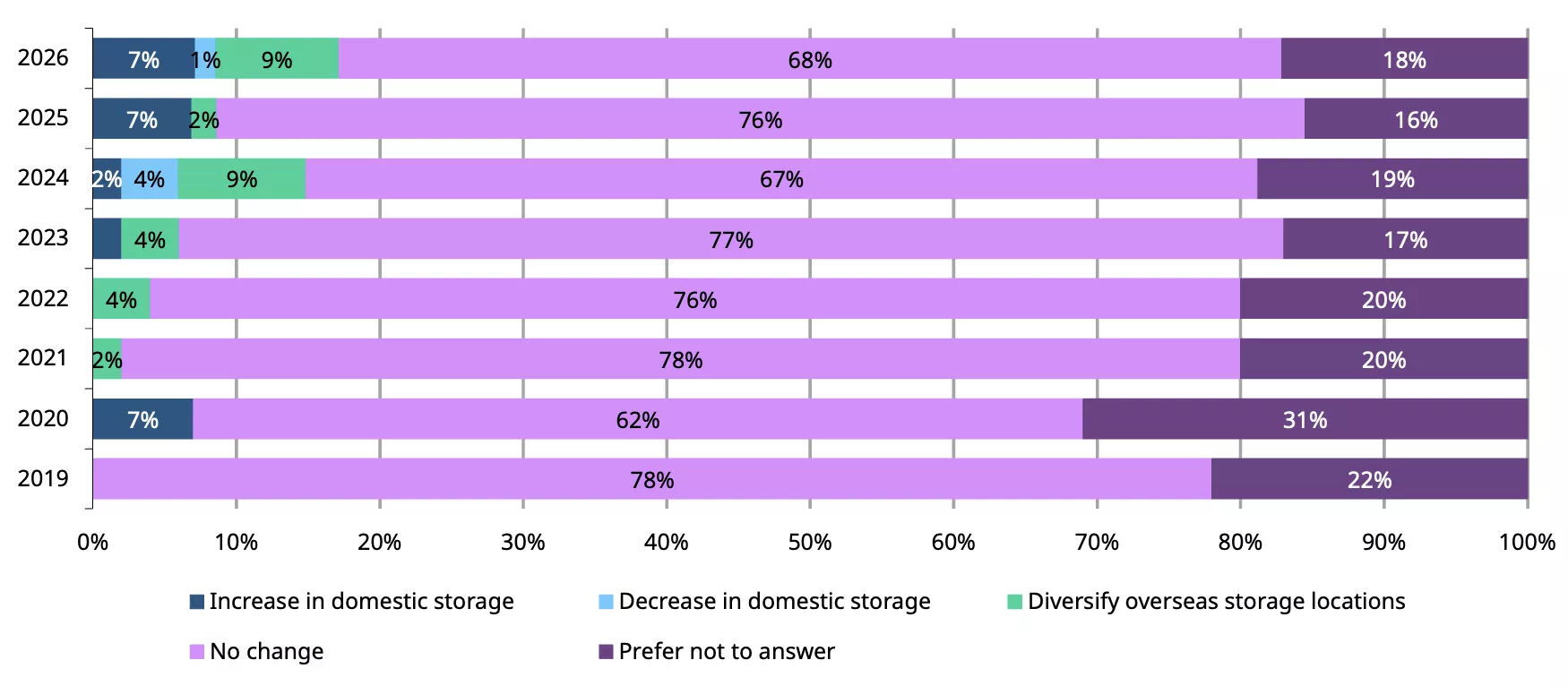
2026 base: All central banks who hold gold (67); advanced economy (15); EMDE (52).
Source: World Gold Council, YouGov
These findings suggest growing interest among several central banks in reassessing and diversifying their gold storage arrangements. Some are increasing domestic storage, while others are broadening the range of overseas locations they use. This points to diversification of custody rather than a uniform move towards domestic storage.
Movement does not mean an intention to sell
Moving gold to a more liquid market can sound like preparation for a sale. But liquidity is valuable precisely because it provides options in an extreme event. Gold in a major trading centre can potentially be mobilised more efficiently, yet improving that capability does not, by itself, indicate whether a central bank expects to use it.
DNB was explicit that it did not expect to deploy the gold. Its objective was to ensure that the reserves would be more readily available if required. At the same time, the 2026 survey found that only 1% of respondents expected their own gold reserves to decline over the next 12 months, while a record 45% expected them to increase.
Recent transfers should therefore not be interpreted, by themselves, as evidence that central banks are preparing to sell. Instead, these examples illustrate how the location of gold has become an important part of active reserve management. Future adjustments may also involve a wider range of hubs: Singapore has announced planned vaulting services for foreign central banks and sovereign entities, while Hong Kong is expanding its gold clearing, settlement and storage infrastructure.13,14 But the emerging picture is one in which security alone is no longer enough. For some central banks, gold must also be accessible, tradable and distributed across locations that remain dependable under stress.
Footnotes
1DNB improves tradability of gold reserves, De Nederlandsche Bank
2Repatriation refers to the return of overseas-held gold to domestic custody. Other location changes can involve moving gold between foreign custodians, or selling gold in one market and replacing it in another, without changing the quantity owned.
3We had nothing but the best of experiences with our partners’ – Bundesbank on why it keeps its gold overseas, mining.com.
4Venezuela completes repatriation of gold reserves, Central Banking
5Bundesbank completes gold transfer ahead of schedule, Bundesbank
6Dutch central bank to move gold reserves out of Amsterdam, DutchNews
7Gold reserves, Oesterreichische Nationalbank
8Serbia to become first Eastern European country to store all gold reserves domestically, Serbia Business
9Half Yearly Report on Management of Foreign Exchange Reserves, Reserve Bank of India
10Banque de France 2025 results, Banque de France
11Chavez repatriates Venezuela's foreign gold reserves, BBC
12Dutch central bank moves gold bars out of New York over ‘geopolitical unrest’, Financial Times
13Singapore to establish OTC gold clearing system, introduce central bank gold-vaulting services, Reuters
14Hong Kong scales up in bid to attract central bank gold, Central Banking
Disclaimer
Important information and disclaimers
© 2026 World Gold Council. All rights reserved. World Gold Council and the Circle device are trademarks of the World Gold Council or its affiliates.
All references to LBMA Gold Price are used with the permission of ICE Benchmark Administration Limited and have been provided for informational purposes only. ICE Benchmark Administration Limited accepts no liability or responsibility for the accuracy of the prices or the underlying product to which the prices may be referenced. Other content is the intellectual property of the respective third party and all rights are reserved to them.
Reproduction or redistribution of any of this information is expressly prohibited without the prior written consent of World Gold Council or the appropriate copyright owners, except as specifically provided below. Information and statistics are copyright © and/or other intellectual property of the World Gold Council or its affiliates or third-party providers identified herein. All rights of the respective owners are reserved.
The use of the statistics in this information is permitted for the purposes of review and commentary (including media commentary) in line with fair industry practice, subject to the following two pre-conditions: (i) only limited extracts of data or analysis be used; and (ii) any and all use of these statistics is accompanied by a citation to World Gold Council and, where appropriate, to Metals Focus or other identified copyright owners as their source. World Gold Council is affiliated with Metals Focus.
The World Gold Council and its affiliates do not guarantee the accuracy or completeness of any information nor accept responsibility for any losses or damages arising directly or indirectly from the use of this information.
This information is for educational purposes only and by receiving this information, you agree with its intended purpose. Nothing contained herein is intended to constitute a recommendation, investment advice, or offer for the purchase or sale of gold, any gold-related products or services or any other products, services, securities or financial instruments (collectively, “Services”). This information does not take into account any investment objectives, financial situation or particular needs of any particular person.
Diversification does not guarantee any investment returns and does not eliminate the risk of loss. Past performance is not necessarily indicative of future results. The resulting performance of any investment outcomes that can be generated through allocation to gold are hypothetical in nature, may not reflect actual investment results and are not guarantees of future results. The World Gold Council and its affiliates do not guarantee or warranty any calculations and models used in any hypothetical portfolios or any outcomes resulting from any such use. Investors should discuss their individual circumstances with their appropriate investment professionals before making any decision regarding any Services or investments.
This information may contain forward-looking statements, such as statements which use the words “believes”, “expects”, “may”, or “suggests”, or similar terminology, which are based on current expectations and are subject to change. Forward-looking statements involve a number of risks and uncertainties. There can be no assurance that any forward-looking statements will be achieved. World Gold Council and its affiliates assume no responsibility for updating any forward-looking statements.
Information regarding the LBMA Gold Price
The LBMA Gold Price is used by the World Gold Council with permission under license by ICE Benchmark Administration Limited and is subject to the restrictions set forth here (www.gold.org/terms-and-conditions).
Information regarding QaurumSM and the Gold Valuation Framework
Note that the resulting performance of various investment outcomes that can be generated through use of Qaurum, the Gold Valuation Framework and other information are hypothetical in nature, may not reflect actual investment results and are not guarantees of future results. Neither World Gold Council (including its affiliates) nor Oxford Economics provides any warranty or guarantee regarding the functionality of the tool, including without limitation any projections, estimates or calculations.
Information from ICRA Analytics Limited
All information obtained from ICRA Analytics Limited contained in this document is subject to the disclaimer set forth here (www.icraanalytics.com/terms-of-use/disclaimer).
Latest research
Looking for insight and analysis on gold? Our team of experts produce market-leading research and macroeconomic commentary on gold.