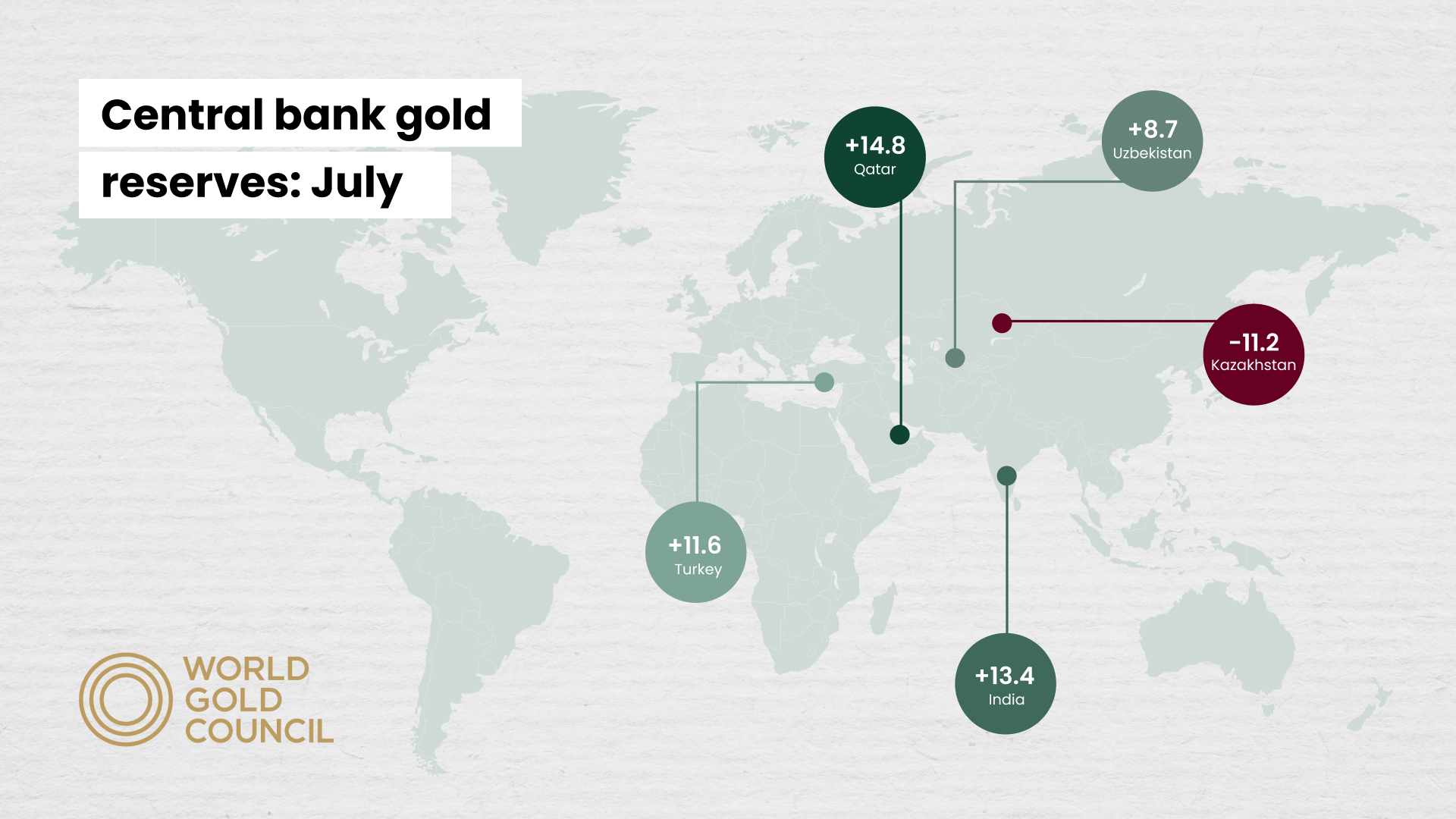
Central bank demand remained robust in July. Global gold reserves increased by 37t (net), below June’s 64t increase. Added to the 270 of net purchases over H1, this pushes YTD central bank demand towards the 300t mark.
Central banks’ appetite for gold continues in July
Krishan Gopaul
Senior Analyst, EMEA World Gold Council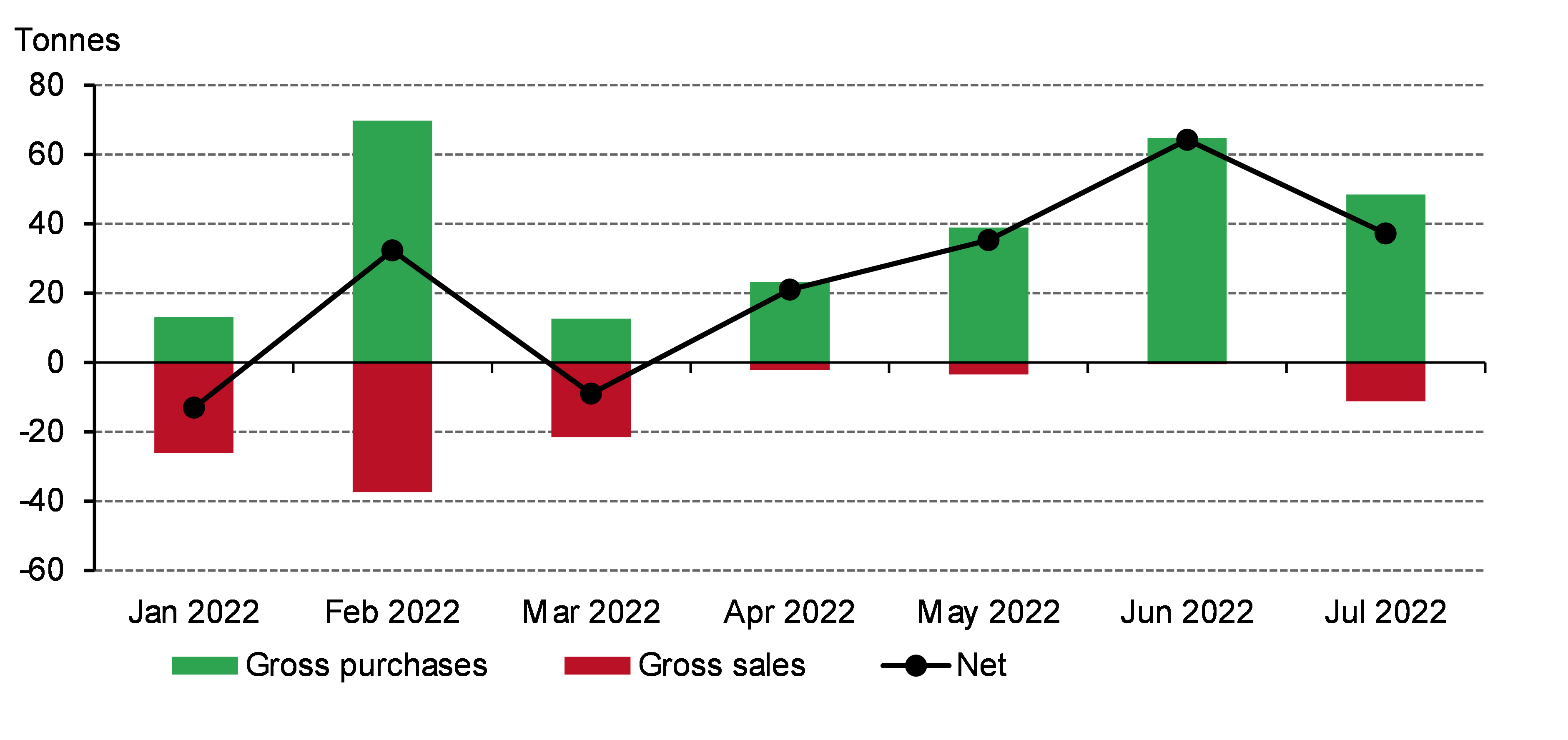
*Data July 2022 where available.
Source: IMF IFS, Respective central banks, World Gold Council
Few central banks were active during the month, but those that were acted with purpose.
- The Qatar Central Bank was the largest buyer, adding 15t of gold to its official reserves in July. This addition appears to be the largest monthly increase on record (back to 1967), although it should be noted that early data is patchy. Its gold reserves now stand at 72t (10% of total reserves), the highest on record in tonnage terms.
- The Reserve Bank of India, a regular buyer, added over 13t tonnes to its gold reserves - the highest monthly purchase since September 2021 (19t). This lifts total gold reserves to 781t, up 27t year-to-date.
- The Central Bank of Türkiye (Turkey) increased official gold reserves by 12t in July. This is broadly in line with the monthly average so far this year, and takes y-t-d net gold purchases to 75t. Total official gold reserves now stand at 469t, a two-year high.
- The Central Bank of Uzbekistan bought a further 9t of gold in July – the same volume as in June. After sales of 25t in Q1, net purchases for the year so far now total 11t. Gold reserves now total 373t (61% of total reserves).
- The National Bank of Kazakhstan was the only notable seller according to official reported data. It sold 11t in July, bringing its y-t-d net sales to just under 30t. Total official gold reserves now amount to 373t, accounting for 64% of total reserves. As reported by Bloomberg, the bank indicated that any further sales would be dependent on market conditions.
In addition to the officially reported data, Reuters reported a 6t fall in gold reserves at the Central Bank of Venezuela during the first half of 2022, to 73t. This change in gold reserves has yet to be reflected in the IMF statistics, with the last available data point from June 2018, but will continue to monitor this for developments and update our data accordingly.
*Data July 2022 where available.
Source: IMF IFS, Respective central banks, World Gold Council
Summer slowdown for central bank net purchases
Krishan Gopaul
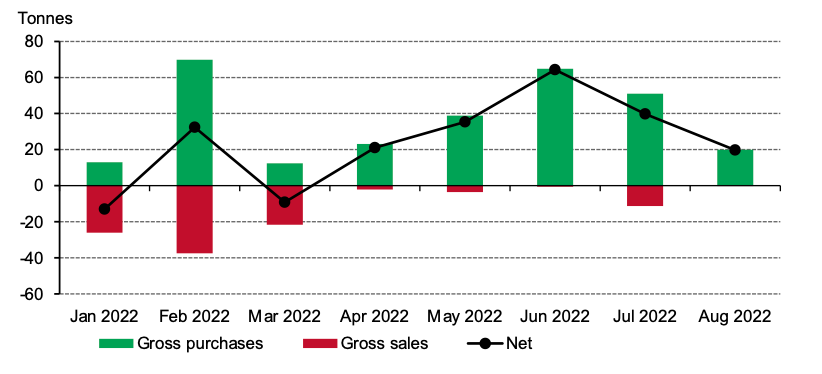
Senior Analyst, EMEA World Gold CouncilCentral bank net purchases of gold slowed to 20t in August, halving m-o-m.1 This is the fifth consecutive month of net purchases from the central banking sector.
Central bank net purchases slowed in August*
*Data to 30 August 2022 where available.
Source: IMF IFS, Respective central banks, World Gold Council
Gold-related activity among central banks was muted in August; only a handful of banks meaningfully contributed to the overall monthly total. Three banks published an increased to their gold reserves by a tonne or more, while there were no notable sellers by the same measure in the available data.
Turkey – the largest gold buyer so far this year – bought another 9t during the month. This increased its total gold purchases to 84t y-t-d, lifting its official gold reserves (central bank plus treasury holdings) to 478t – the highest level since Q2 2020.
Uzbekistan also added 9t tonnes to its reserves in August, the same amount as the previous two months. This brings its y-t-d net purchases to over 19t despite having begun the year by selling almost 25t in Q1. Its gold reserves now total over 381t (59% of total reserves). In addition, following a reduction of 11t in July, Kazakhstan switched to net purchases in August, incrementally increasing its gold holdings by 2t. Its total gold reserves are now just shy of 375t, down almost 28t since the start of the year. As we have noted before, it is not uncommon for banks which buy from domestic production – such as Uzbekistan and Kazakhstan – to switch between buying and selling.
Finally, preliminary data published by the Qatar Central Bank suggests a further addition to its gold reserves during August. But as the precise tonnage increase has not yet been reported in the IMF IFS database, we have decided to exclude from our data. If confirmed, it would be the fifth consecutive month in which Qatar’s official gold reserves have risen. Total gold reserves stood at 72t at the end of July, up 16t (+27%) since the start of the year.
We will analyse the full Q2 and y-t-d picture, as well as update our outlook of central bank net gold purchases in the next Gold Demand Trends report. This will be published at the end of October.
Year-to-date central bank net purchases and sales*
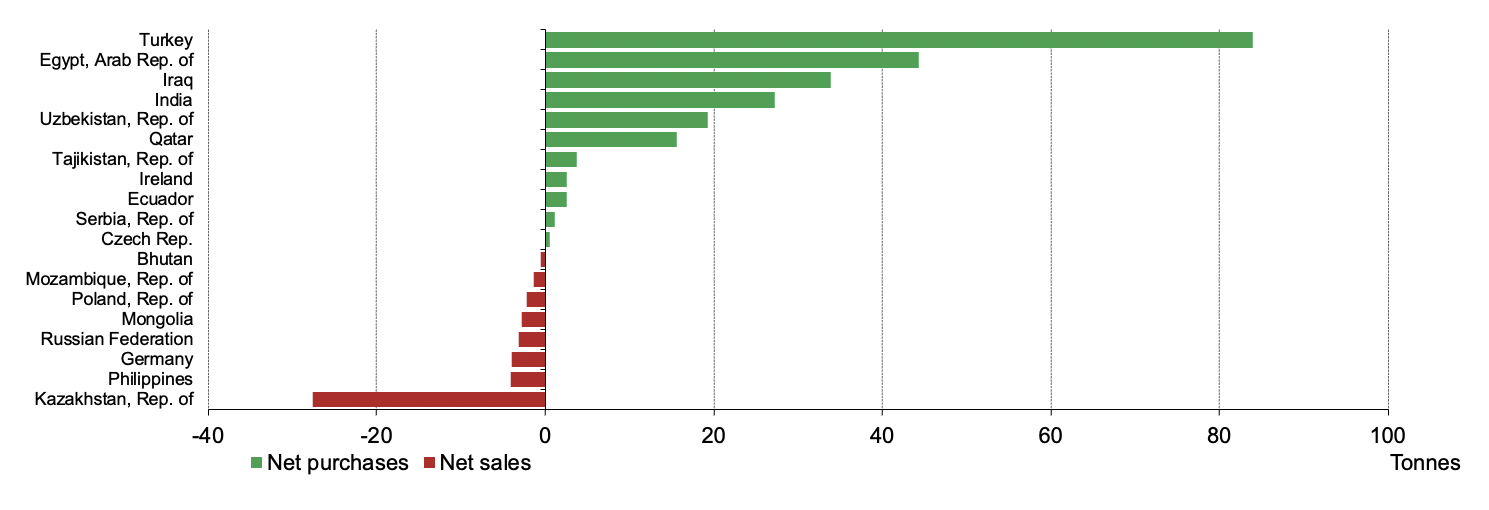
*Data to 30 August 2022 where available. Note: chart includes only purchases/sales of 0.5t or more.
Source: IMF IFS, Respective Central Banks, World Gold Council
Footnotes
1 Our data set is based on IMF data but is supplemented with data from respective central banks where it is available and not reported through the IMF at the time of publication. This data may be revised in our next monthly update should more data become available.
A Central Banker's Perspective: the role of gold in Kazakhstan
Aliya Moldabekova
Deputy Chairman National Bank of the Republic of KazakhstanKazakhstan has rightfully taken a leading global position in the mining and processing of gold; the country produces around 70-80 tonnes of refined product each year.
The success of its domestic refined gold industry, along with the investment characteristics gold has demonstrated throughout the last decade, have positioned it as fundamental to the reserves of the Central Bank of Kazakhstan.
Aliya Moldabekova, Deputy Chairman of the National Bank of the Republic of Kazakhstan, spoke in detail about the current trends, plans and the results of past years in terms of gold.
Current standing of the gold portfolio in the NBK’s reserves
Gold plays an important role in the management of reserve assets, being one of the few assets that are widely approved under the investment guidelines used by the world's central banks. The National Bank of the Republic of Kazakhstan (NBK) is no exception, with its share of gold reserves now standing at 69% of total reserves. Over the last few years the ambition to grow its gold portfolio has served as the main driver of growth within the NBK’s gold assets. As of July 2022 the bank held 372.8t of refined gold worth about US$21.1bn. These figures put Kazakhstan in 15th place by reserves of gold and in sixth place worldwide by gold holdings growth over the past decade, according to the World Gold Council.
The purpose of gold asset management is to safeguard and protect against possible reductions in the attractiveness of foreign currency assets in international financial markets.
The gold portfolio of the NBK can be structurally divided into ‘internal’ and ‘external’ parts.
The main share of the Bank’s gold portfolio is ‘internal’ domestic gold, which is physical bullion of refined gold stored in the state vault within the country’s territory. The ‘external’ part of the gold portfolio consists of physical bullion stored in specialised foreign repositories, as well as gold in unallocated form in metal accounts made at market rates with major global banks that carry high credit ratings and are accredited by the London Bullion Market Association (LBMA).
Operations of the National Bank in the domestic market
The gold reserves of sovereign Kazakhstan were established in 1995. Despite a dynamic history of growth, the most active phase of procuring gold assets has been during the last decade, following the implementation of legislation that gives the NBK a priority right to purchase gold from domestic producers at market conditions. This approach of effectively managing gold assets while increasing gold reserves has allowed the National Bank to join the top ranks of countries whose central banks have reserves of the precious metal.

Source: NBK
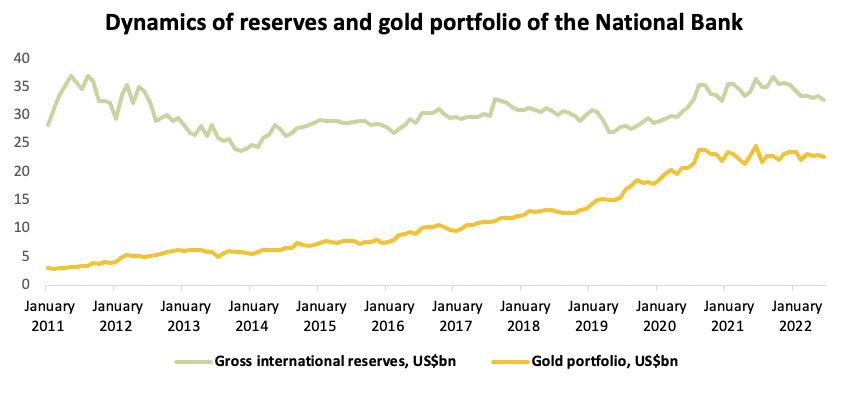
Source: NBK
In general, preferential purchase of gold by the National Bank has been positive for the local gold industry. It has created conditions that give both counterparty and credit institutions a significant guarantee of stable cash flows from the sale of gold under contract, thereby reducing volatility and uncertainty in the sales market. The NBK represents a reliable buyer and enhances the attraction of investing in gold – and this is supported by the year-on-year growth in the volume of gold it purchases.
It should be noted that the National Bank purchases only the final product in the form of refined gold bars of national and international standards, which are produced at the facilities of local refineries: Kazakhmys Smelting LLP, Kazzinc LLP and Tau-Ken Altyn LLP. Currently, Kazzinc LLP and Tau-Ken Altyn LLP produce refined gold to the international London Good Delivery (LGD) standard. Tau-Ken Altyn LLP's refinery successfully obtained LGD certificate in September 2019. The Balkhash plant, Kazakhmys Smelting LLP, produces refined gold to the national standard.
Before it is refined and sold to the NBK, gold is processed through several key phases.

To improve the quality of its gold portfolio, the NBK re-melts gold bars that are of national standard to meet London Good Delivery standards. The national standard of gold in Kazakhstan has strict requirements for the chemical composition and appearance of bars, compared with the LGD LBMA standard.
Gold operations within the National Bank
Favorable market conditions for precious metals have opened up many new opportunities for the NBK, which in recent years has become much more active in the global gold markets.
The NBK exports physical gold bars to the international market and transacts with derivative financial instruments in order to buy gold. In doing so it hedges its gold portfolio and diversifies its assets. Meanwhile, Kazakhstani gold bars have become widely accepted by world markets.
By its nature, gold investment is protective and allows the NBK to meet its objective of preserving the country’s assets. As well as NBK’s gold reserves, gold is used in Kazakhstan's sovereign fund and in its National Fund, which as of July 2022 held $53.3bn in assets. The National Fund was set up to provide long-term investment of the income derived from the country's oil and gas complex; the Fund invests in a wide range of fixed-income instruments and in equity markets of both developed and emerging countries. In order to diversify assets, the long-term allocation of the Fund was changed in 2019 when the share of gold was set as a maximum of 5% of total assets within the savings portfolio. The gold portfolio of the National Fund is backed by physical gold via a sale of 39.5t of refined gold, previously part of the NBK’s gold assets.
Gold bars continue to gain popularity
From 2017 the National Bank has been selling certified refined gold bars to the public; these bars weigh from 10g to 100g. And in November 2018, bars weighing 5 grams went on sale. The main aim of selling gold bars is to provide the citizens of Kazakhstan with an additional investment and savings tool. A total of 94,600 gold bars with a total weight of 3.2t have been sold to Kazakhstani citizens since their launch. Liquidity is ensured as the investor can resell to banks and non-banking exchange offices and be paid on the same day.
In Kazakhstan, as well as in the rest of the world, the demand for gold as a vehicle for investment is expected to grow. 2021 became a record-breaking year in terms of gold bar sales to the Kazakhstani public and from 2017 to 2021 the cumulative average annual growth rate in sales has been 69%.
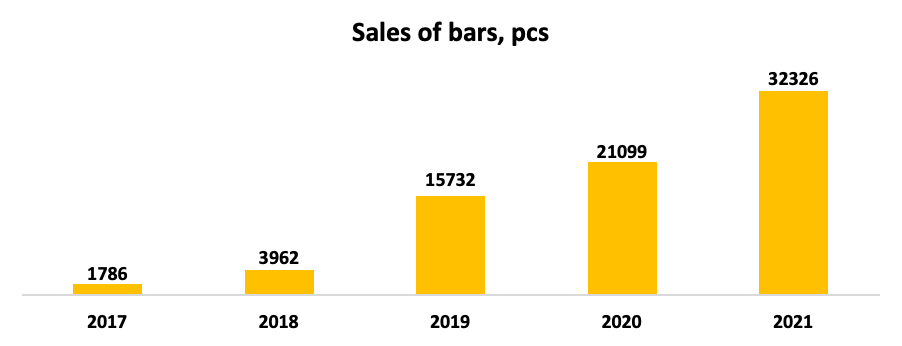
Source: NBK
Central banks maintain their appetite for gold
Krishan Gopaul
Senior Analyst, EMEA World Gold CouncilCentral banks continue to accumulate gold according to the latest data available.1 In October – data is lagged by two months – central banks added a further net 31t of gold to international reserves (-41% m-o-m). This initial figure helps lifts global official gold reserves to its highest level since November 1974 (36,782t).
Global central bank gold reserves are back to mid-1970s levels*
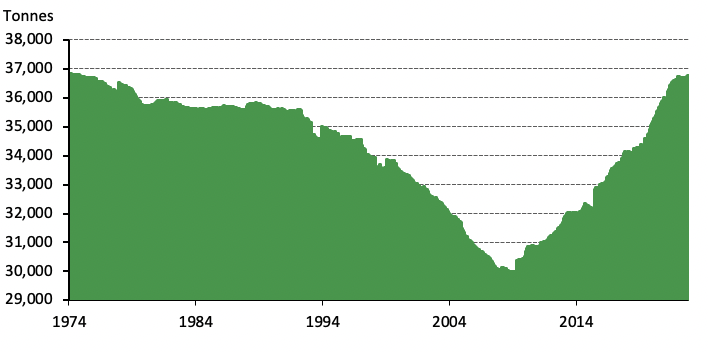
*Data to 31 October 2022 based on available data and WGC calculations.
Source: IMF IFS, Respective Central Banks, World Gold Council
Gold purchases were limited to a handful of central banks in October, while none reported a meaningful decline in their gold reserves. The Central Bank of the UAE was the largest buyer in October, adding just over 9t to its gold reserves. This takes y-t-d net purchases to 18t and lifts total gold reserves to almost 74t (3% of total reserves).
The Central Bank of Türkiye (Turkey), the largest gold buyer y-t-d, bought a further 9t of gold in October.2 Its y-t-d net purchases now total 103t, the highest level of buying since 2019 (126t), with gold reserves standing at 498t (27% of total reserves).
The Central Bank of the Republic of Uzbekistan bought a further 9t of gold during the month – the same volume of gold for the fifth consecutive month. Y-t-d net buying now amounts to 37t; total gold reserves to 399t. The National Bank of Kazakhstan added 3t to its official gold reserves in October. This lowers y-t-d net sales to 18t, with total official gold reserves standing at 384t.
The Central Bank of Qatar added 1t to its gold reserves during the month, taking gold reserves to 88t (11% of total reserves). We have updated out dataset to include activity from August, September and October based on data direct from the central bank as this has not yet been reported to the IMF.3 This shows that the central bank bought an estimated 15t during this three month period, taking its y-t-d net purchases to 31t. The Reserve Bank of India also increased its gold reserves by 1t in October, with gold reserves standing at 786t.
Year-to-date central bank net purchases and sales*
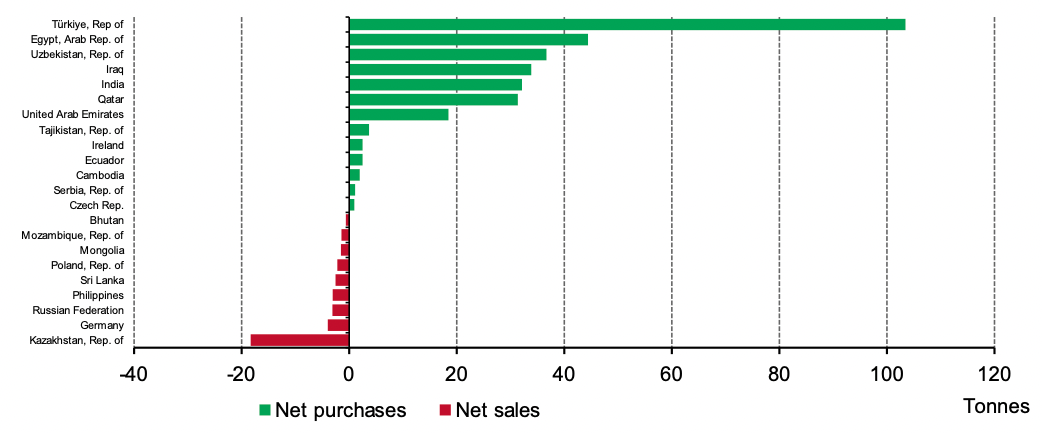
*Data to 31 October 2022 where available. Note: chart includes only purchases/sales of 0.5t or more.
Source: IMF IFS, Respective Central Banks, World Gold Council
Other noteworthy changes to the dataset:
- Recently published data by the IMF shows that the Central Bank of Sri Lanka has sold almost 3t of gold so far this year, with all sales coming in Q1. Official gold reserves now total less than 0.5t at the end of September.
- Updated IMF data shows that the National Bank of Cambodia has bought a net 2t to end-September. Purchases were made between July-September, lifting total gold reserves to 52t (16% of total reserves) – a new record high.
As we noted in our recently published Gold Demand Trends report: “The continued trend of official sector demand for gold corroborates findings from our 2022 annual central bank survey, in which one-quarter of respondents stated their intention to increase gold reserves in the next 12 months (up from one-fifth in in 2021).”
Looking ahead, while sporadic selling can’t be discounted during the final two months of the year, central banks remain on course to register a strong year of net buying in 2022.
Footnotes
1 Our data set is based on IMF data but is supplemented with data from respective central banks where it is available and not reported through the IMF at the time of publication. This data may be revised in our next monthly update should more data become available.
2 Türkiye official sector gold reserves are the sum of central bank owned gold and Treasury gold holdings. This is equivalent to gross gold reserves less all gold held at the central bank in relation to commercial sector gold policies, such as the Reserve Option Mechanism (ROM), collateral, deposits, and swaps. Please see this link for information on this methodology: https://www.gold.org/download/file/16208/Central-bank-stats-methodology-technical-adjustments.pdf
3 Estimated gold holdings and changes are derived from value figures provided by the central bank. These figures may be adjusted based on data reported to the IMF.
Central banks add more gold in November as China joins the fray
Krishan Gopaul
Senior Analyst, EMEA World Gold CouncilI've spoken before about central banks' sizeable appetite for gold during 2022 in this blog series, and November was no different. Central banks bought a further 50 tonnes (t) on a net basis during the month, a 47% increase from October's (revised) 34t.1 Of this net total, three central banks accounted for gross buying of 55t, while two largely contributed to gross sales of 5t , showing the strength of demand.
Central banks added a further 50t to global official reserves in November*
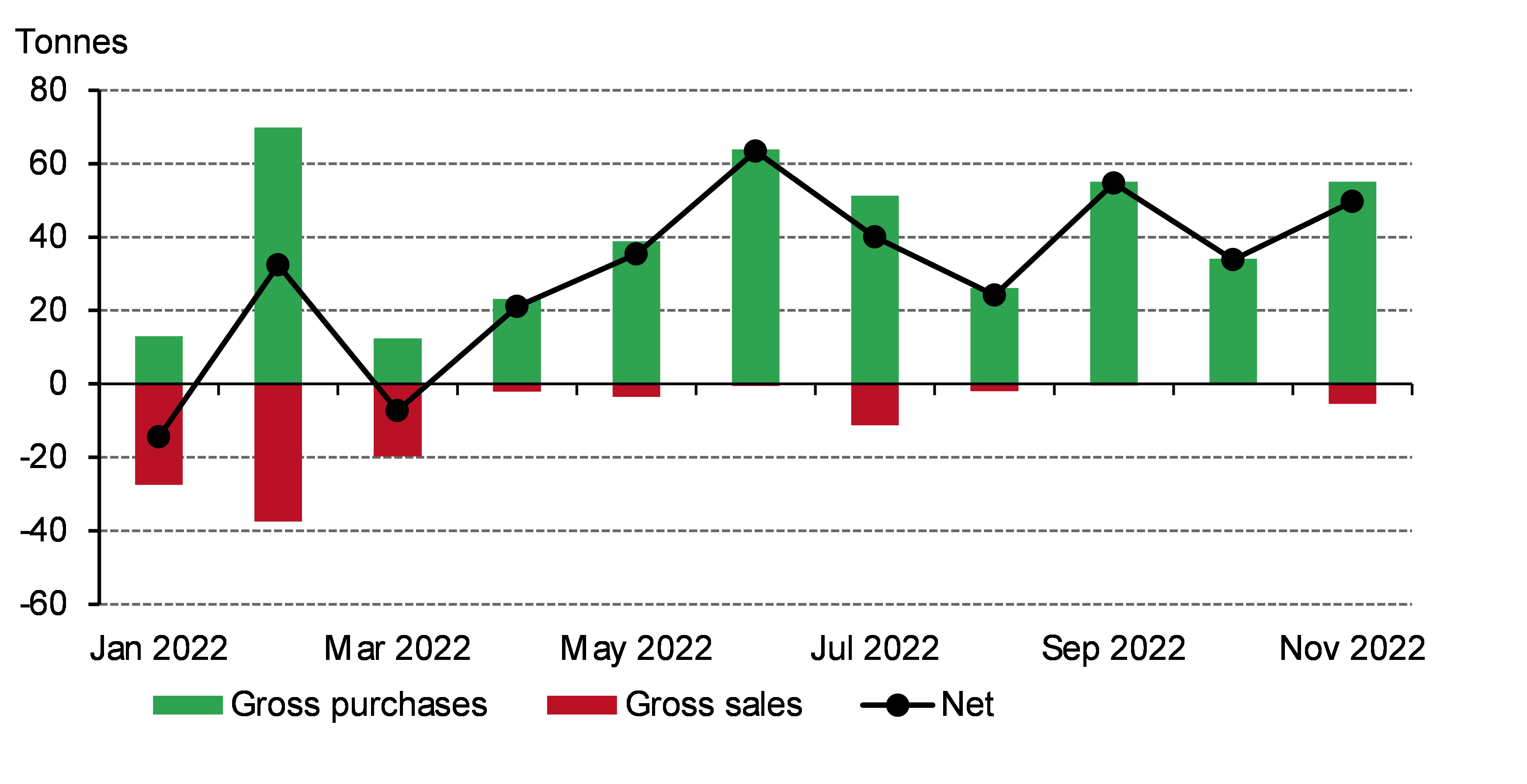
*Data to 30 November 2022 where available.
Source: IMF IFS, Respective Central Banks, World Gold Council
The biggest announcement of the month came from the People's Bank of China (PBoC). It reported an increase of 32t, the largest reported purchase in November and the first announced increase in its gold reserves since September 2019. This announcement is significant given China's historic position as a large gold buyer, having accumulated 1,448t between 2002 and 2019. It remains to be seen whether this is followed up with reports of continued buying in December. At the end of November, PBoC gold reserves stood at 1,980t (3.4% of total reserves).
The Central Bank of Türkiye continued to buy gold in November, adding a further 19t to its official (central bank + Treasury) reserves.2 This lifts its YTD net purchases of gold to 123t – the largest reported by any country – and its official gold reserves to 517t (27% of total reserves). The Central Bank of the Kyrgyz Republic added to its gold reserves for the first time this year, buying 3t in November to increase its total gold reserves to 16t (+61% YTD).
On the sales side, the National Bank of Kazakhstan and the Central Bank of Uzbekistan were the largest sellers. Kazakhstan reduced its gold reserves by around 4t to 380t (-5% YTD), while Uzbekistan’s gold reserves fell by almost 2t to 397t, 10% higher YTD. We have noted previously that it is not uncommon for central banks who purchase gold from domestic sources - as both Kazakhstan and Uzbekistan do - to also be frequent sellers of gold.
Gold purchases/sales by the central banks of gold producing nations in 2022 *
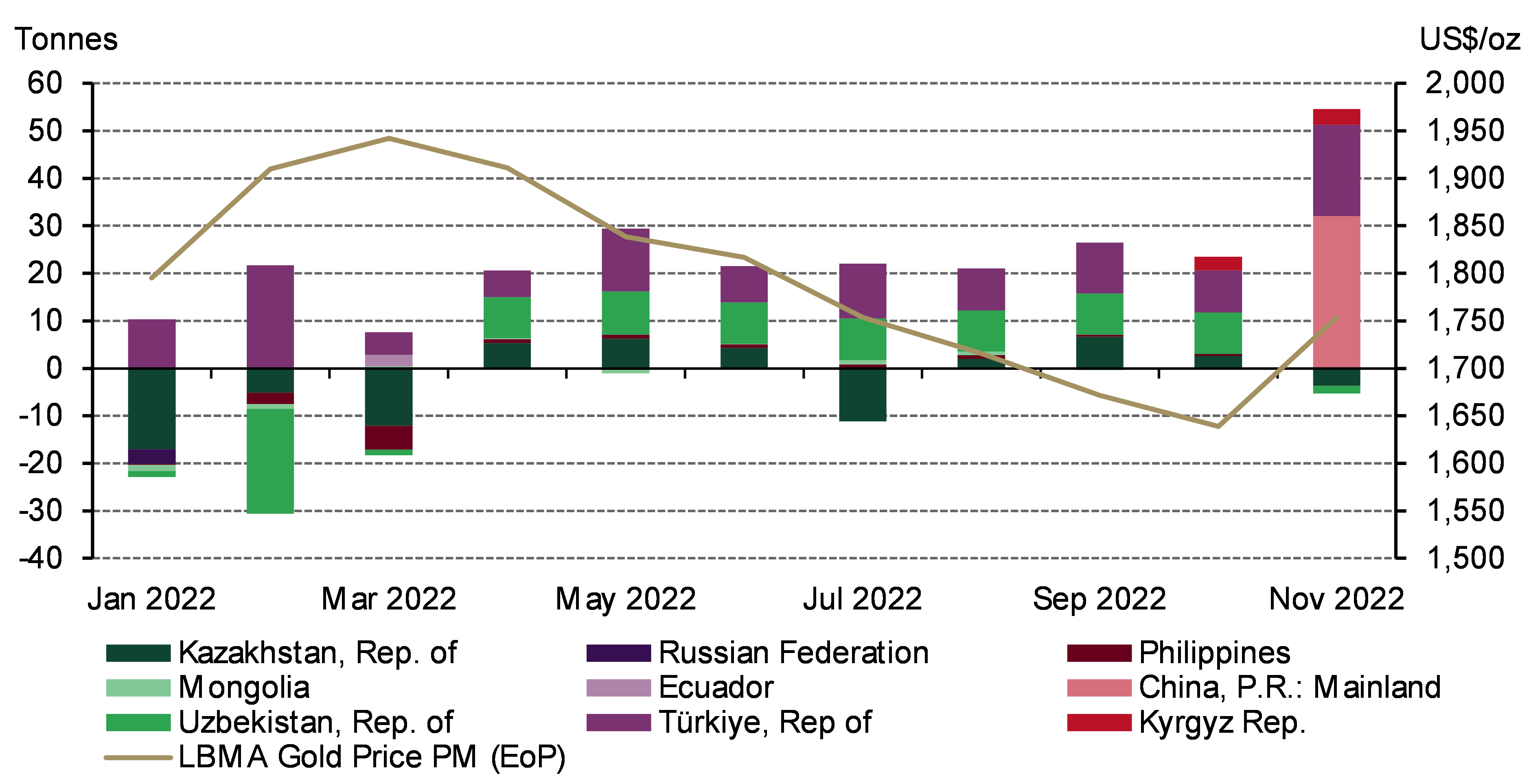
*Data to 30 November 2022 where available.
Source: IMF IFS, Respective Central Banks, World Gold Council
The central bank sector has been one of the highlights of the gold market in 2022, having bought a net 673t between Q1 and Q3 .3 Looking ahead to the full year picture, it's likely that central banks accumulated a multi-decade high level of gold in 2022. How much exactly? Stay tuned for our Gold Demand Trends report which will be published at the end of January to find out.
Footnotes
1Our data set is based on IMF data but is supplemented with data from respective central banks where it is available and not reported through the IMF at the time of publication. This data may be revised in our next monthly update should more data become available.
2Türkiye official sector gold reserves are the sum of central bank owned gold and Treasury gold holdings. This is equivalent to gross gold reserves less all gold held at the central bank in relation to commercial sector gold policies, such as the Reserve Option Mechanism (ROM), collateral, deposits, and swaps. Please see this link for information on this methodology: https://www.gold.org/download/file/16208/Central-bank-stats-methodology-technical-adjustments.pdf
3We provide two separate sources for central bank data and depending on which data set one refers to for their data, the results may differ. The source for our Gold Demand Trends publication is primarily Metals Focus, who make their own estimates of official sector activity incorporating what is reported to the IMF. While the source for the monthly central bank statistics is the IMF IFS statistics (supplemented with data directly from central bank websites where needed and available).
4Both data sets are subject to revision as new information is made available. The IMF IFS data is also subject revision as official sector institutions continue to update, revise, and report their holdings. Most institutions will report their data on a regular basis, which means our data is up to date with a two-month lag. However, very often institutions will be late in reporting and not report their updated gold holdings for several months. In these cases, gold purchases and sales will be reported with a significant delay due mostly to the late reporting of the central bank. Sometimes Metals Focus has insight on these purchases as they are happening in the market and may therefore already have this incorporated in their numbers, and therefore not require a revision.
Central banks round off 2022 with more net purchases in December
Krishan Gopaul
Senior Analyst, EMEA World Gold CouncilIn December, central banks have reported adding a net 28t of gold to global reserves, down sharply (53%) from the previous month (60t).1 This is the ninth consecutive month of net reported additions, as central banks have resumed the trend of consistent buying which wavered at the end of 2021 and beginning of 2022. The available data – only about 50% of banks have reported data for December at the time of writing –shows that two large purchases were partially offset by one chunky sale.
Central banks resumed trend of consistent monthly net buying during 2022*
Monthly net central bank gold demand in tonnes
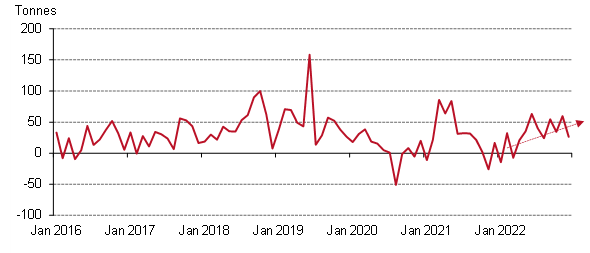
*Data to 31 December 2022.
Source: IMF IFS, Respective Central Banks, World Gold Council
The People’s Bank of China (PBoC) reported the largest increase in gold reserves during the month. The bank bought a further 30t, following on from the 32t it added in November. It’s gold reserves now total 2,011t (4% of total reserves). We will continue to wait and see w hether further purchases are reported by the PBoC in the coming months.
The Central Bank of Türkiye (Turkey) continued its consistent buying in December, adding another 25t to its swelling official gold reserves. 2 This brings full year net purchases to just shy of 150t, surpassing the 126t it bought in 2019 and the largest reported by any central bank in 2022. Its gold reserves now total 542t (28% of total reserves). The Reserve Bank of India also bought again in December, with gold reserves rising by 1t to 787t, while Croatia added 2t after having not reported any gold reserves since 2001.
The National Bank of Kazakhstan (NBK) was the largest reported seller in December, its gold reserves dropped by 29t – the largest monthly decline on record.3 For 2022 as a whole, the NBK reduced its gold reserves by 51t to 352t (58% of total reserves). The Central Bank of Uzbekistan was also a net seller for the second consecutive month, reducing its gold reserves by just over 1t. It remains a net purchaser over the whole of 2022, increasing its holdings by 34t to 396t (62% of total reserves). It is not uncommon for central banks who purchase gold from domestic sources – as both Kazakhstan and Uzbekistan do – also to be frequent sellers of gold.
2022 was a remarkable year for central bank demand for gold. While we continued to see robust demand for gold from emerging market central banks, the volume of activity – buying in particular – has been noteworthy.4 To read our review of central bank gold demand in 2022, and our outlook for 2023, please see our recently published Gold Demand Trends Full Year and Q4 2022 report.
Footnotes
1Our data set is based on IMF data but is supplemented with data from respective central banks where it is available and not reported through the IMF at the time of publication. This data may be revised in our next monthly update should more data become available.
2IMF data for Kazakhstan gold reserves is available back to December 1993.
3We provide two separate sources for central bank data and depending on which data set one refers to for their data, the results may differ. The source for our Gold Demand Trends publication is primarily Metals Focus, who make their own estimates of official sector activity incorporating what is reported to the IMF. While the source for the monthly central bank statistics is the IMF IFS statistics (supplemented with data directly from central bank websites where needed and available). Both data sets are subject to revision as new information is made available. The IMF IFS data is also subject revision as official sector institutions continue to update, revise, and report their holdings. Most institutions will report their data on a regular basis, which means our data is up to date with a two-month lag. However, very often institutions will be late in reporting and not report their updated gold holdings for several months. In these cases, gold purchases and sales will be reported with a significant delay due mostly to the late reporting of the central bank. Sometimes Metals Focus has insight on these purchases as they are happening in the market and may therefore already have this incorporated in their numbers, and therefore not require a revision.
No dry January for central bank gold buying
Krishan Gopaul
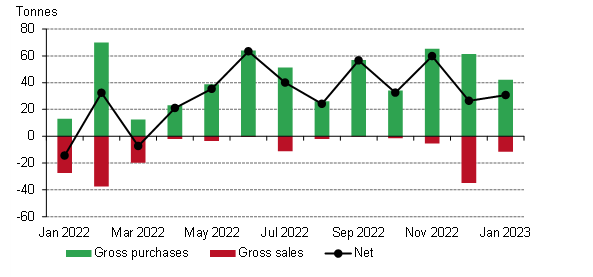
Senior Analyst, EMEA World Gold CouncilCentral bank gold demand in 2023 picked up from where it left off in 2022. In January, central banks collectively added a net 31 tonnes (t) to global gold reserves (+16% m-o-m).1 This was also comfortably within the 20-60t range of reported purchases which has been in place over the last 10 consecutive months of net buying.
Central banks remained committed buyers of gold in January*
*Data to 31 January 2023. Please see footnote 1 for more information on the underlying data.
Source: IMF IFS, Respective Central Banks, World Gold Council
Activity was relatively concentrated during the month, with only three banks accounting for gross purchases of 44t and one bank offsetting this with 12t of sales. 2
The largest reported purchaser in 2022 was also the largest buyer in January: the Central Bank of Türkiye (Turkey) added 23t to its official gold reserves, which now stand at 565t . 3 People’s Bank of China (PBoC) also bought again during the month, adding 15t on top of the 62t of gold reported between November and December 2022. Its gold reserves now total 2,025t (3.7% of total reserves). The National Bank of Kazakhstan increased its gold reserves by a modest 4t in January, taking its gold reserves to 356t.
The European Central Bank (ECB) reported a near 2t rise In Its gold reserves In January, however It was not an outright purchase by the bank. This was related to Croatia joining the currency union, as the country was required to transfer the gold, as part of a larger transfer of reserve assets, to the ECB.4 For this, the country bought nearly 2t of gold in December.
The Central Bank of Uzbekistan was the only prominent seller during the month, reducing its official gold reserves by almost 12t (-3% m-o-m). Its gold holdings now total 384t, 66% of total reserves.
Focus on this sector of the gold market has been intense in recent months, owing to the record level of buying from central banks in 2022.5 We have faced questions from some investors on whether central banks will sustain this appetite for gold. As we noted in our latest Gold Demand Trends report:
“Looking ahead, we see little reason to doubt that central banks will remain positive towards gold and continue to be net purchasers in 2023. However, by how much is difficult to call, as evidenced by our expectations at the start of 2022. But it is also reasonable to believe that central bank demand in 2023 may struggle to reach the level it did last year.”
The healthy January data we have so far gives us little reason, at this time at least, to deviate from this outlook either.
Footnotes
1Based on IMF data supplemented with data from respective central banks where available and not reported through the IMF at the time of publication. Figures may be revised in our next monthly update should more data become available.
2Totals may not sum due to rounding.
3Türkiye official sector gold reserves are the sum of central bank-owned gold and Treasury gold holdings. This is equivalent to gross gold reserves less all gold held at the central bank in relation to commercial sector gold policies (such as the Reserve Option Mechanism (ROM), collateral, deposits and swaps). For information on this methodology, see: https://www.gold.org/download/file/16208/Central-bank-stats-methodology-technical-adjustments.pdf
5We publish two series of central bank gold activity, which are drawn from different sources. Central bank demand reported in Gold Demand Trends is primarily sourced from Metals Focus, whose proprietary estimates of official sector activity incorporate the IMF data. The monthly time series of central bank holdings reported on goldhub.com uses IMF IFS statistics supplemented with data directly from central bank websites where needed and available. Both data sets are subject to revision as new information is made available and/or to accommodate late or updated data reported by official institutions to the IMF. IMF IFS data is reported with a two-month lag and most institutions report on a regular basis, although some will report with a – sometimes significant – delay. Metals Focus sometimes has insight into these transactions before they are reported and will incorporate these into their data, which will therefore not require a revision.
You asked, we answered: the history, context and outlook for central bank gold buying
Louise Street
Senior Markets Analyst World Gold Council- Last year’s bumper buying by central banks prompted a look back at history to compare and contrast attitudes and behaviour towards gold as a reserve asset
- We maintain our outlook for continued buying by this sector, with emerging market countries leading the charge as their allocations languish behind those of advanced economies.
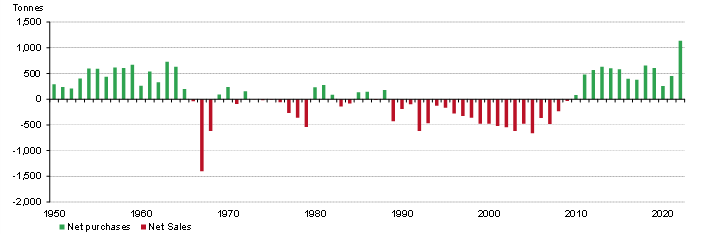
2022 was a record-breaking year for central bank gold buying. The 1,136 tonne total grabbed headlines and attention – particularly when accompanied by this eyebrow-raising chart.
Central bank gold buying broke records in 2022
Sources: Metals Focus, Refinitiv GFMS, World Gold Council
*Data to 31 December 2022.
Not surprisingly, we’ve fielded a flurry of questions from investors and analysts on this topic in recent weeks – around what is driving this buying and what the future may hold. And, crucially, whether the extended period of net buying that kicked off in 2010 will give way to significant net sales, as we saw in the late 1960s?
The short answer to that final question is no, we don’t expect this to happen. In fact, we’re confident that central banks will continue to build their official gold holdings. And not just because they have suggested as much.
To understand our view, the context of the 1960s is vital: a form of Gold Standard was still in operation at that time. Under the Bretton Woods system, the US – and a syndicate of European central banks – was committed to defending a fixed price of gold, which was convertible to the US dollar at US$35/ounce.
The hefty sales we saw in 1967 were a consequence of this price peg coming under attack as investors piled into gold. The influx was driven by safe-haven motives (fuelled by jitters that a devaluation of sterling signalled a possible currency collapse) and the lure of potential profit as speculators bet that the dollar would be next to fall and the gold price would be unleashed . 1
The banks in question avoided this scenario by selling vast quantities of gold – around 2,000 tonnes in total over 1967/68. But the episode effectively signalled the end of the Bretton Woods system and the last remnants of the Gold Standard.
Fast forward to 2022 and the picture is vastly different. The gold market is deeper and more liquid. It is structurally different – take the liberalisation and growth of both India and China and the launch of gold ETFs, for example. But the most important difference is in the behaviour of central banks themselves, namely:
- A structured programme of controlled sales during the noughties vastly reduced Western central banks’ ‘over-allocation’ to gold, while Emerging Market (EM) central banks are still relatively under-allocated, even after sizable additions in recent years
- There has been a concerted shift away from over-reliance on the US dollar as a reserve currency, in an environment of non-existent real yields on sovereign debt.
Upon expiry of the last Central Bank Gold Agreement in 2019, the – largely European – signatories reaffirmed that ‘Gold remains an important element of monetary reserves’. 2 Words that have been backed up by a distinct lack of further selling.
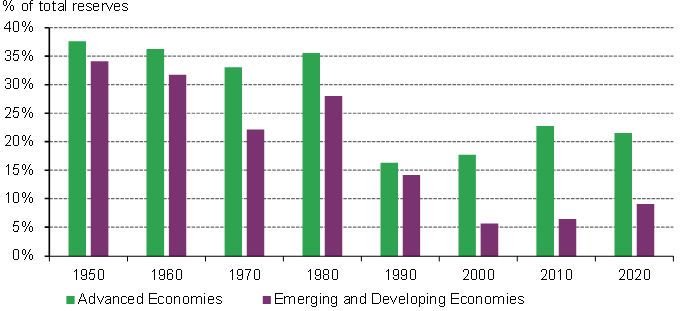
Meanwhile, despite significant buying in recent years, emerging market banks remain relatively under-allocated. According to IMF data, EM countries have a collective allocation to gold of below 10%, less than half that of advanced economies. But even this figure is distorted by a few markets with towering allocations to gold, often bought from domestic production. The central banks of Kazakhstan and Uzbekistan, for example hold around 60% of their portfolios in gold. Thus the average for those without such domestic buying programmes is likely significantly lower than the chart below suggests.
Gold’s share of Emerging Market reserves lags far behind that of Developed countries
Source: IMF IFS; World Gold Council
*Data to 31st Dec 2020
What is driving today’s gold buying …and will it continue?
Central banks have different strategic objectives to institutional investors. Official reserves must be invested in assets that are safe and liquid. Investment guidelines for emerging and developing country central banks are often very narrow, limited to gold, SDRs, IMF reserve balances, highly-rated sovereign debt and deposits.
This makes central banks disproportionately exposed to advanced economy government debt. But the real yield on many of these sovereign bonds is still very low, if not negative. What’s more, as we saw during the Eurozone debt crisis, these countries are far from immune from default risk. And rising sanctions risks could make bonds in some markets less appealing. Currency wars also remain a threat.
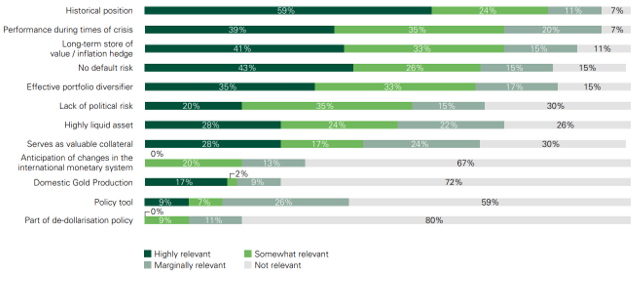
In this environment gold looks very attractive compared to other reserve assets. It has no political risk, it can’t be de-based and it can’t be talked down in a currency war of words. Our comprehensive central bank surveys confirm that gold is an important reserve asset – valued for its performance in times of crisis, its long-term store of value and lack of default risk. And it confirms that central bankers expect further growth in global gold reserves.
Central banks prize gold’s hedging and diversification benefits, and its lack of default risk
Source: World Gold Council
Q: How relevant are the following factors in your organisation’s decision to hold gold?
Base: Total sample of central banks that currently hold gold (46), of which Advanced (12), Emerging (34)
There are, of course, risks. The last few years have reduced the overall reserves of some central banks, meaning they have less to allocate to gold. A steep rise in the gold price could curb some buying, as well as encouraging sales from banks based in gold-producing countries. But, overall, we expect further buying, with EM banks at the forefront of this trend as they continue to redress the imbalance in gold allocations with their developed market peers.
Footnotes
1For a detailed consideration of this period, read ‘The New World of Gold’, Timothy Green, 1993
Latest research
Looking for insight and analysis on gold? Our team of experts produce market-leading research and macroeconomic commentary on gold.