• Goldhub
  • Research
  • Central Banks

  • Latest issue

    Central Banks


    Healthy central bank demand continues in May

    Krishan Gopaul

    Senior Analyst, EMEA World Gold Council


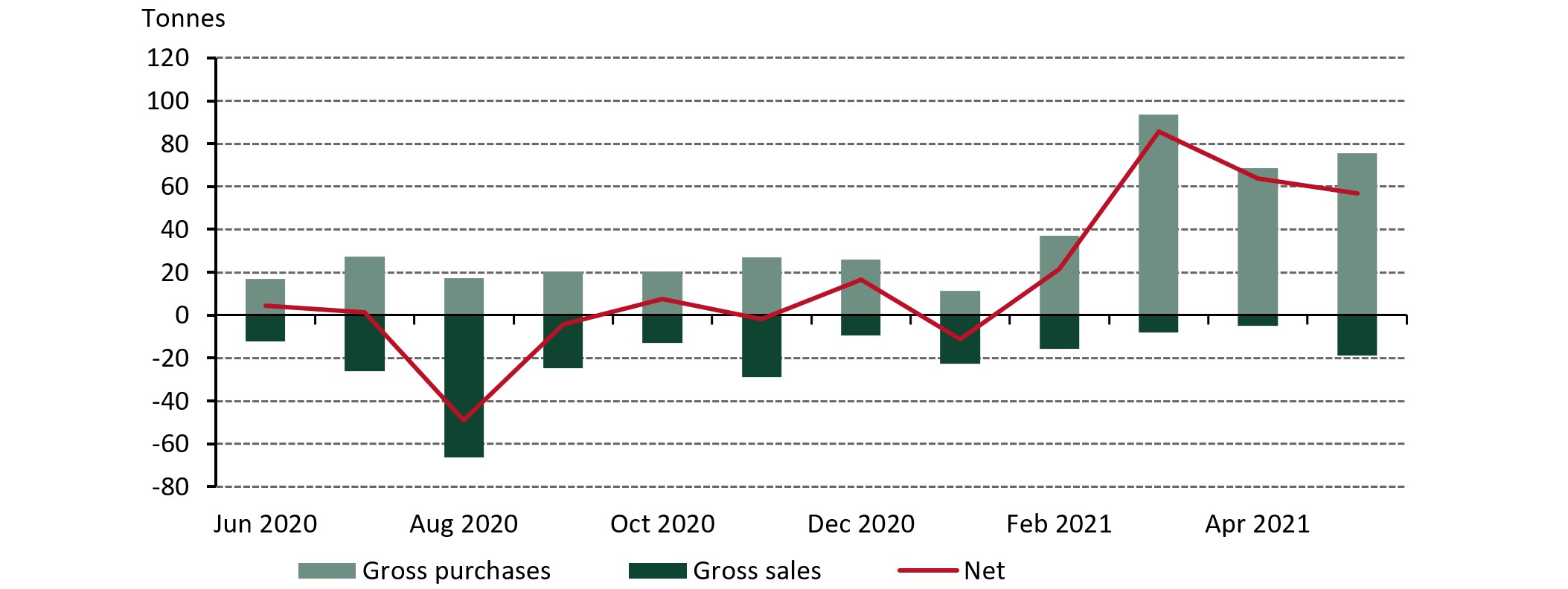
    Following a higher level of monthly net purchases in March and April, our latest data published today shows that this trend continued into May. Central banks net purchases totalled a healthy 56.7t during the month, down 11% m-o-m but 43% above the y-t-d monthly average.1,2 The steady buying in recent months stands in contrast to the more inconsistent picture from mid-2020 when central banks switched between net buying and selling.
     

    Healthy levels of central bank net purchases in recent months

    Central bank net purchases in tonnes*


    *Data as at 31 May 2021. Note: Gross purchases in March exclude the 81t increase in Japanese gold reserves as reported to the IMF. For more information on this, please see Gold Demand Trends Q1 2021.
    Source: IMF IFS, Respective Central Banks, World Gold Council


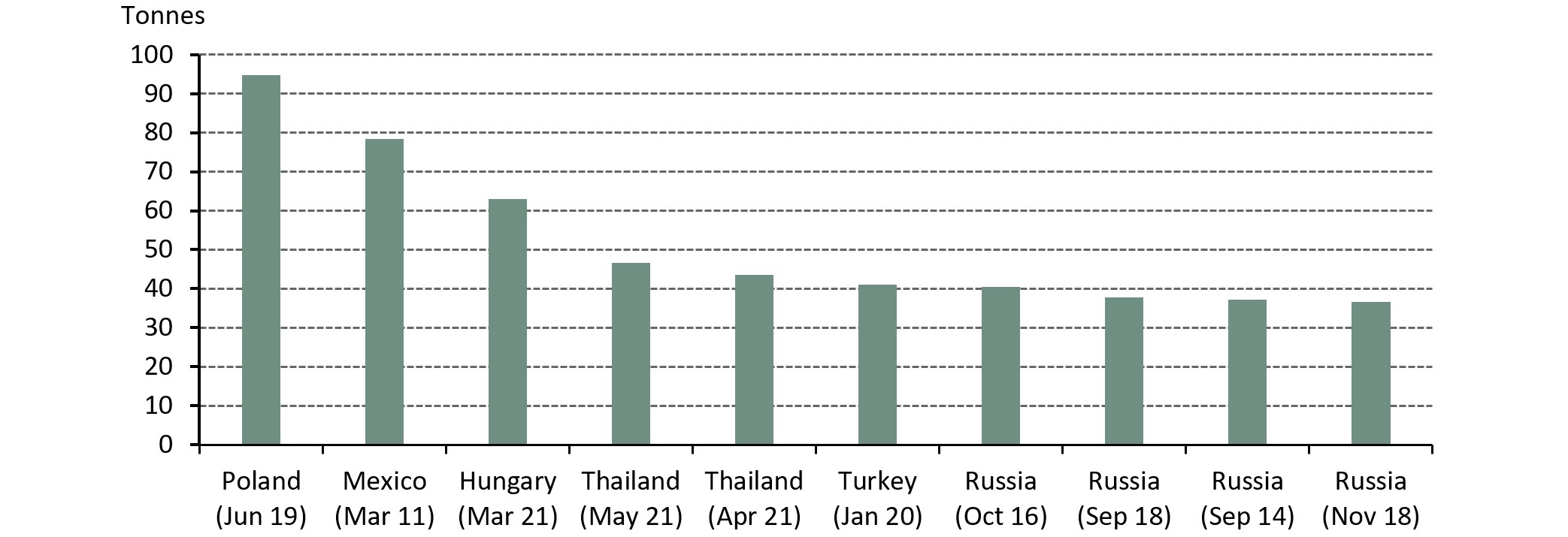
    While the pick-up in net purchases over the last three months is significant, the vast majority of this came from just two central banks: Hungary and Thailand. Together, they have bought over 150t between the start of March and end of May, and these recent monthly additions have been among the largest individual central bank purchases we have seen since the start of 2010.


    Recent monthly purchases from Hungary and Thailand are among the largest since 2010

    Largest monthly net purchases by individual central banks*


    *Data as of 31 May 2021.
    Source: IMF IFS, Respective Central Banks, World Gold Council

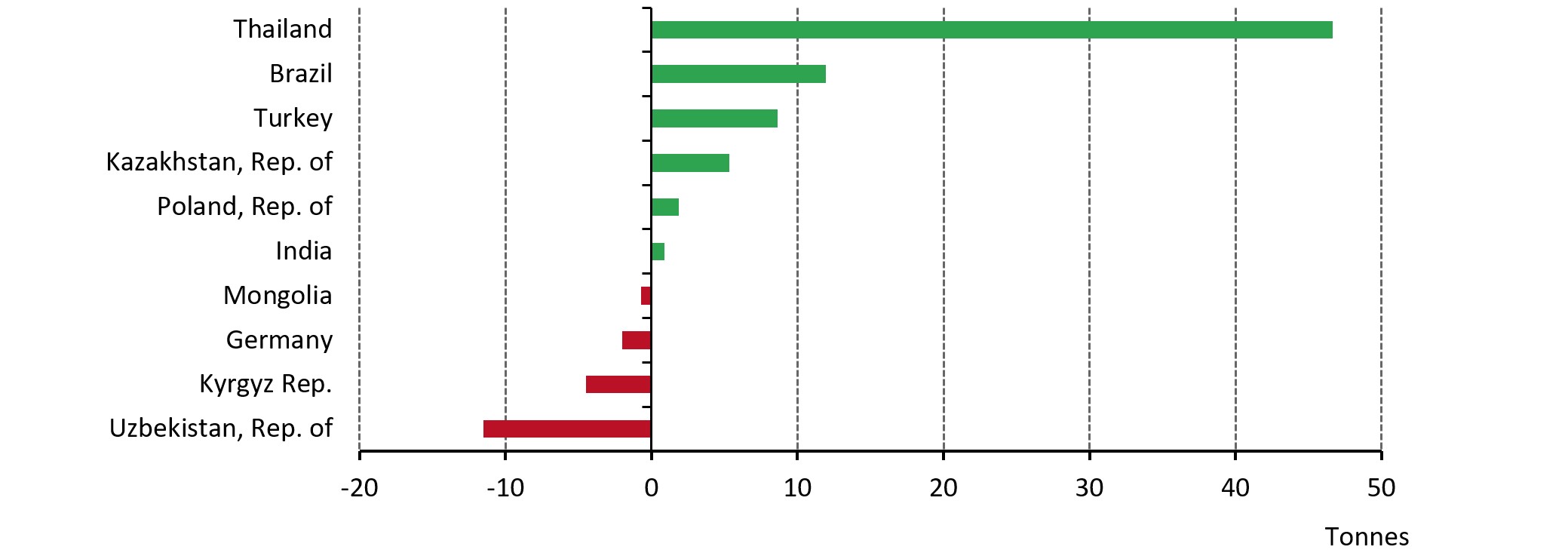
    For a second consecutive month, Thailand was the biggest buyer, adding a further 46.7t in May and accounting for 82% of total net purchases for the month. This was on top of the 43.5t bought in April, and brings Thailand’s gold reserves to 244.2t, or 6% of total reserves. This represents an almost 60% increase in gold reserves since March. Recent comments from Dr Sethaput Suthiwartnarueput, Governor of the Bank of Thailand, indicated the bank’s belief that gold addresses the key objectives of security, return, diversification and tail-risk hedging.

    Turkey also increased gold reserves by 8.6t during the month, bringing official sector reserves to 415t.3 This increase was calculated using data published by the Central Bank of the Republic Turkey and reflects newly available, more granular data, which enables us to better separate out gold held at the central bank that belongs to non-official sector institutions. Based on this new information we have also revised our Turkish official sector data series going back to 2017. More detail on this change to our data can be found here.

    Brazil increased gold reserves by 11.9t, its first addition since November 2012. Gold reserves now stand at 79.3t (1% of total reserves) – the highest level since November 2000. Kazakhstan (5.3t), Poland (1.9t), and India (0.9t) were the other notable buyers during the month. This is Poland’s first increase in gold reserves since the middle of 2018, when the central bank bought 100t between May and July. This continues the increased level of interest in gold we have seen among Central and Eastern European countries in recent years.

    There was also a m-o-m pick-up in sales during May, with gross sales totalling 18.9t, the highest level since January (22.5t). This was predominately driven by four central banks: Uzbekistan saw the largest fall in gold reserves, of 11.5t, with the Kyrgyz Republic (4.5t), Germany (2t), and Mongolia (0.7t) the other major sellers during the month.


    Six central banks increased gold reserves in May, led by Thailand, while four saw gold reserves fall

    Significant net purchases and sales in May in tonnes*


    *Data as of 31 May 2021. Note: Chart only includes changes greater than 0.5t.
    Source: IMF IFS, Respective Central Banks, World Gold Council


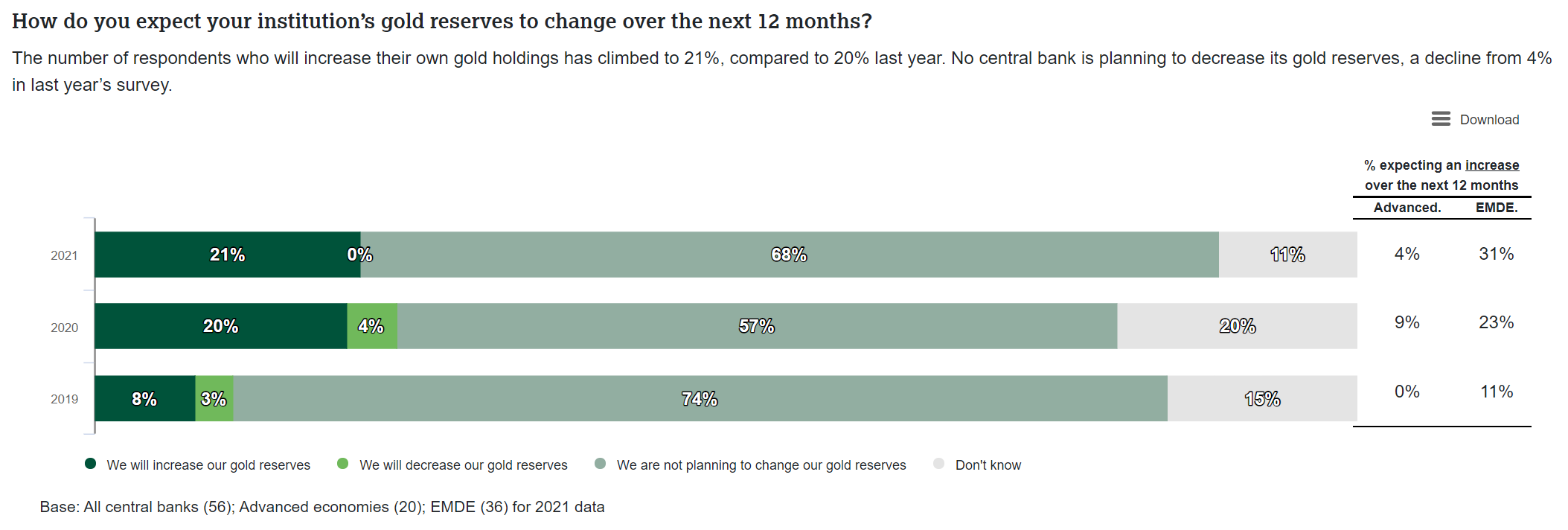
    The full monthly dataset can be downloaded here. In addition, our 2021 Central Bank Gold Survey also provides additional insight into how the central banking community currently view gold.

    A full update on central bank demand will be available in our upcoming Gold Demand Trends Q2 2021 report which will be published at the end of July.


    1Our data set is based on IMF data, but is supplemented with data from respective central banks where is it available and not reported through the IMF at the time of publication. This data may be revised in our next monthly update should more data become available.

    2The y-t-d average for this calculation excludes the 81t increase in Japanese gold reserves as reported to the IMF. For more information on this, please see Gold Demand Trends Q1 2021.

    3Official sector reserves refers to combined gold reserves by the Central Bank of the Republic of Turkey (CBRT) and the Turkish Treasury.

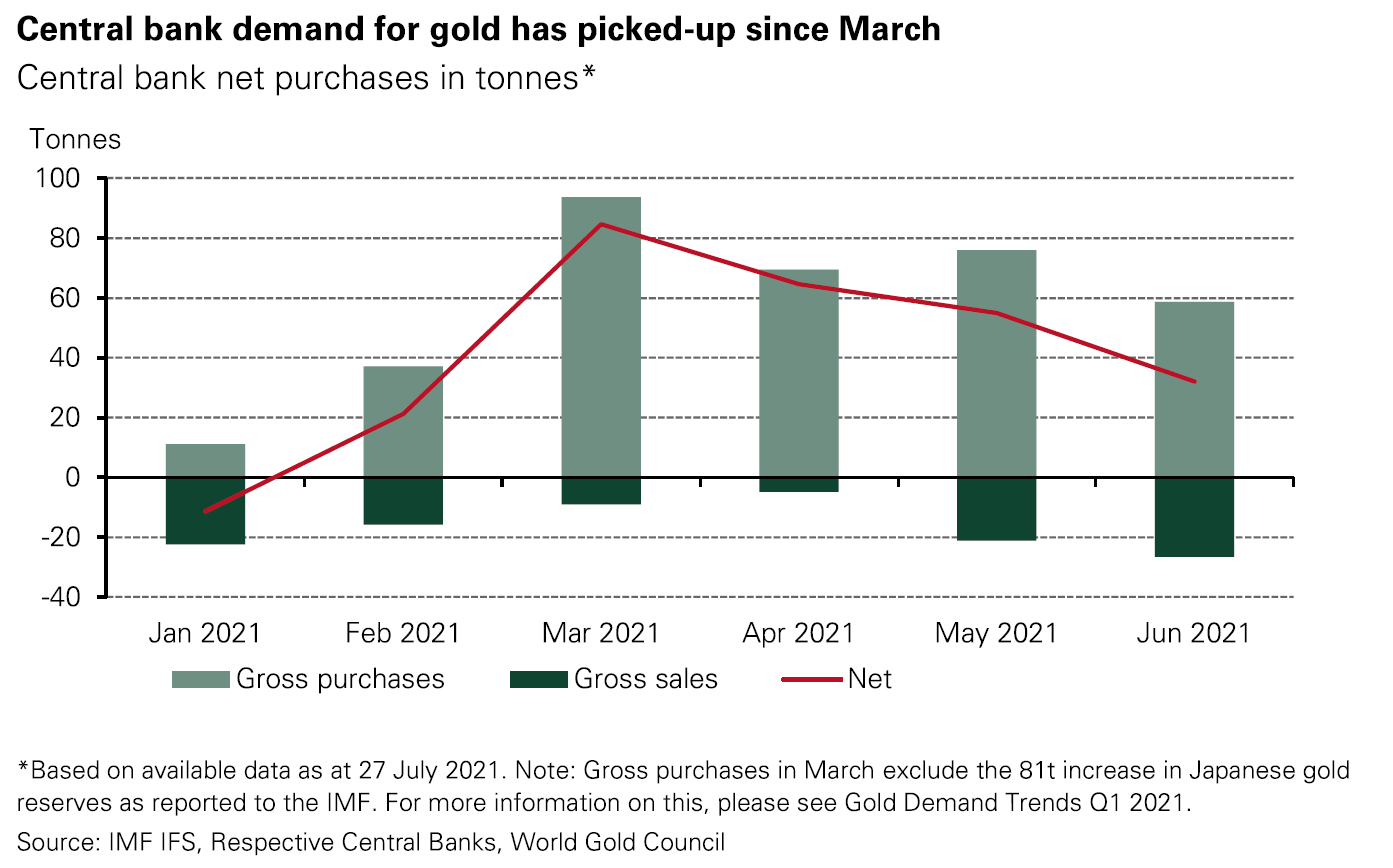
    On Twitter: central banks bought a net 32t of gold in June

    Krishan Gopaul

    Senior Analyst, EMEA World Gold Council


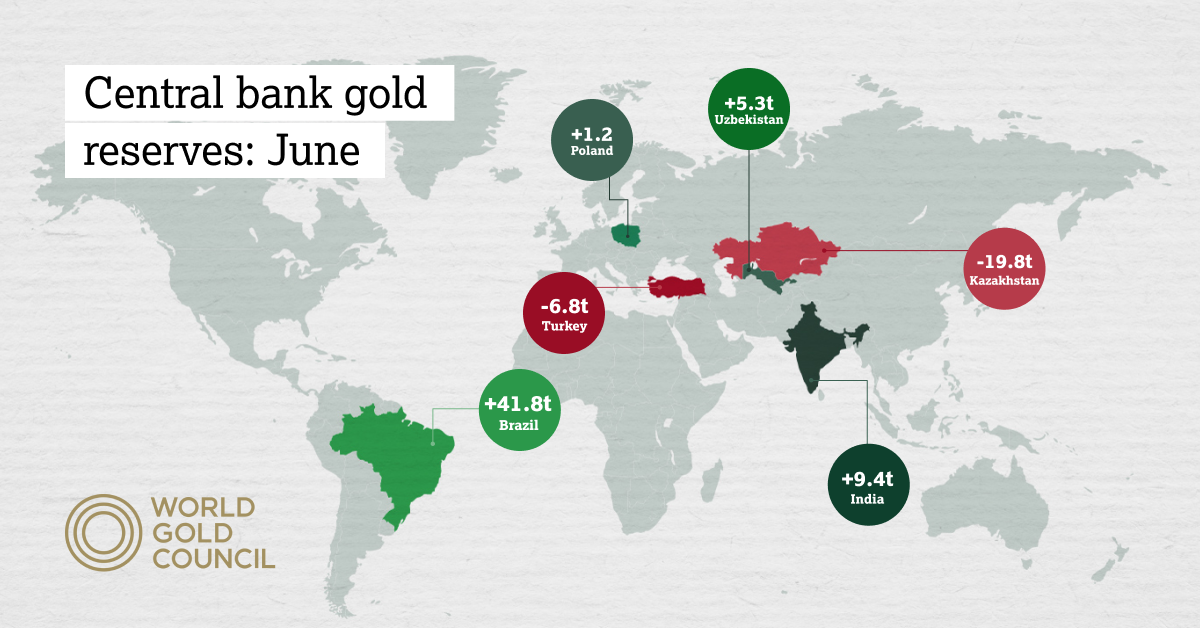
    @KrishanGopaul: Based on available data, central banks bought a net 32t of #gold in June 2021. While Brazil was by far the bigger buyer in the month, several other central banks were active.

    Our full dataset is available to download now on Goldhub.

    Central bank gold reserves in June


    Year-to-date, central bank #gold demand has picked up significantly since March, with several sizeable purchases but some notable sales too. Activity remains concentrated among emerging market banks.


    Central bank gold reserves chart


    This increased demand tallies with our recent survey, which found that central banks continue to be positive on #gold. We continue to expect central banks to be net purchasers for the whole of 2021.


    Central bank survey results


    Read more and follow Krishan for real-time updates on Twitter.

    Central banks maintain interest in gold in July

    Krishan Gopaul

    Senior Analyst, EMEA World Gold Council


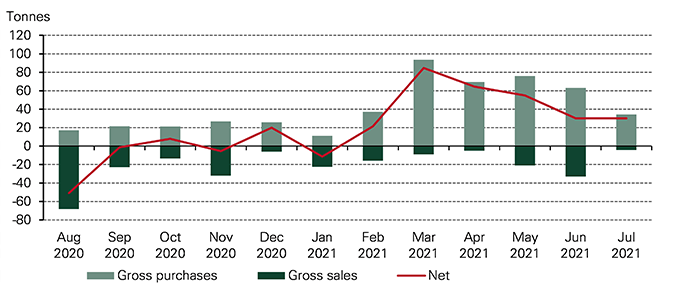
    Today we’ve published our latest central bank statistics which now includes data for July.1 Central banks added a net 30.1 tonnes (t) to global official gold reserves during the month, virtually in line (+0.3%) with net purchases in June. This continues the healthy level of interest in gold we have seen from central banks so far this year.

    Overall central bank net purchases remained healthy in July

    Central bank net purchases in tonnes* 

    *Data as at 31 July 2021. Note: Gross purchases in March exclude the 81t increase in Japanese gold reserves as reported to the IMF. For more information on this, please see Gold Demand Trends Q1 2021.
    Source: IMF IFS, respective central banks, World Gold Council

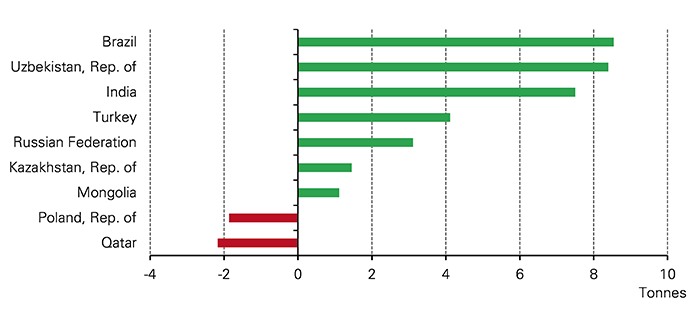
    Gross purchases totalled 34.3t for the month, down significantly from 63.1t in June, which was boosted by Brazil’s 41.8t purchase. The large, strategic purchases we have seen from Hungary, Thailand, and Brazil in recent months are unlikely to be repeated frequently. Activity in July therefore represents a return to the trend of more modest buying by a range of emerging market central banks. Brazil (8.5t) was the largest purchaser, followed by Uzbekistan (8.4t) and India (7.5t) in adding significantly to their gold reserves. Turkey, Russia, Kazakhstan, and Mongolia bought a combined 9.8t over the month. We believe that Russia’s addition was a one-off purchase likely as a rebalance following a few months of coinage-related sales.

    Individual purchases and sales were more modest than in recent months

    Central bank net purchases by country in tonnes*

    *Data as of 31 July 2021.
    Source: IMF IFS, respective central banks, World Gold Council

    Total gross sales were also significantly lower compared to June. In July, they totalled a meagre 4.2t, down 28.9t m-o-m. Qatar (2.2t) and Poland (1.9t) were the only two central banks to register meaningful declines in their gold reserves.

    The latest data, coupled with the findings from our recent Central Bank Survey, reinforces the view that central banks remain positive on gold. We maintain our expectation that central bank net buying will be positive for the year, and it’s looking more and more likely that it will be at a significantly higher level than 2020.


    1Our data set is based on IMF data but is supplemented with data from respective central banks where it is available and not reported through the IMF at the time of publication. This data may be revised in our next monthly update should more data become available.

    Quiet summer for central bank buying

    Krishan Gopaul

    Senior Analyst, EMEA World Gold Council


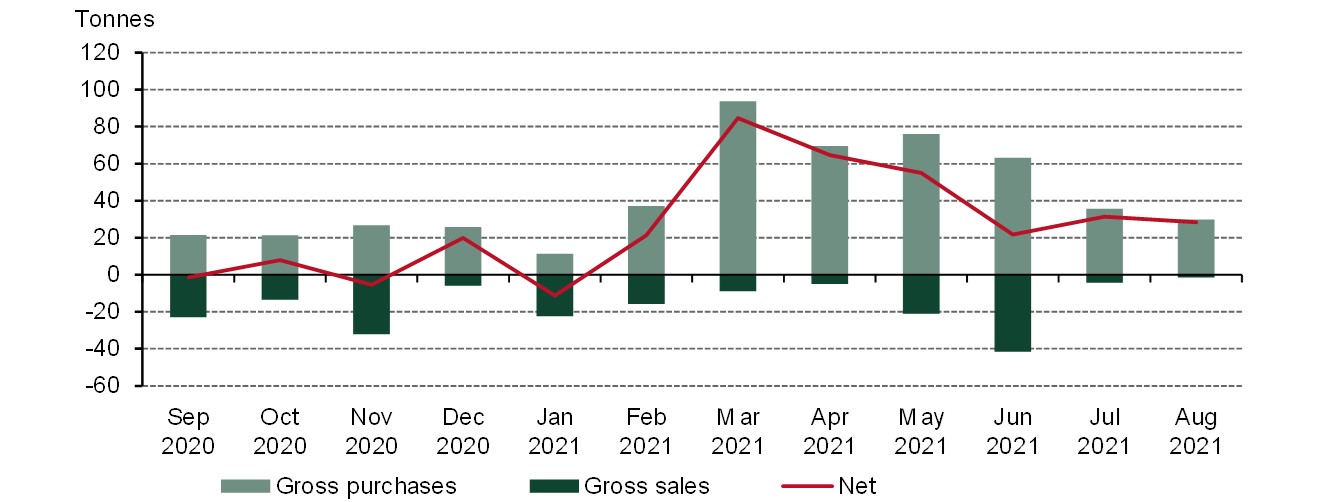
    Central banks bought 28.4t of gold in August,1 9% less than in July. Leaving aside January’s 11.2t net sale, this is the lowest level of monthly net purchases so far this year.


    Central bank gold buying slowed over the summer

    Central bank net purchases of gold*


    *Data to 31 August 2021.
    Source: IMF IFS, Respective Central Banks, World Gold Council


    This slower pace of buying over the summer was partly due to the absence of any sizeable purchases. Central bank demand between March-June was marked by several large-scale purchases from Thailand, Hungary, and Brazil, which boosted global net purchases in H1 to 333t (39% above the five-year H1 average).

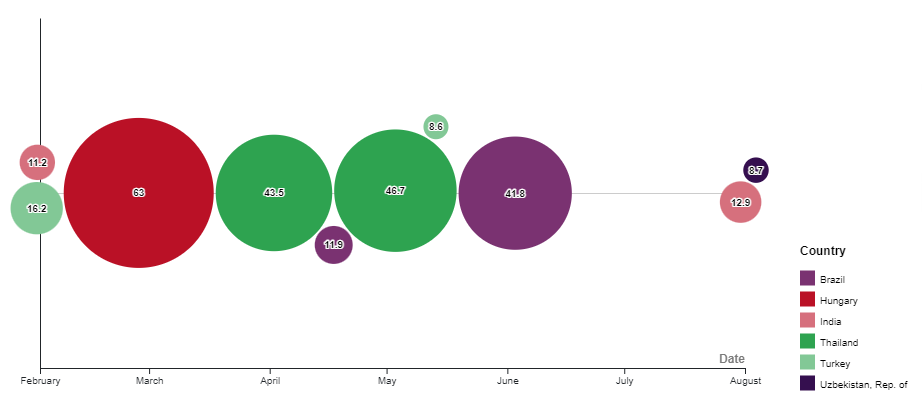
    By the end of August, just six central banks have accounted for the ten largest purchases so far this year, totalling a remarkable 264.5t.


    Six central banks have accounted for the ten largest monthly purchases in 2021

    Individual central bank monthly purchases in tonnes*


    *Data to 31 August 2021
    Source: IMF IFS, Respective Central Banks, World Gold Council


    At the gross level, central banks bought 30t in August. Interest was limited to a small group of familiar faces, with recent buyers India (12.9t), Uzbekistan (8.7t), Kazakhstan (5.3t) and Turkey (2.8t) all adding to their gold reserves once again.

    On the other hand, gross sales were insignificant. They totalled less than two tonnes, with Qatar registering the largest drop in gold reserves of -0.9t.

    The chart above shows a clear downward trend in net buying since March. What, if anything, can we conclude from this? Well, it’s probably too early to suggest the recent trend of buying is running out of steam. Central banks have stated their positive sentiment towards gold, and it’s unlikely that this will change imminently. But without larger purchases like we saw between March and June, we anticipate a more modest levels of buying going forward.

    For more regular data and insight on central banks, why not follow me on twitter.

    1On a net basis (i.e. gross purchases less gross sales)

    A Central Banker's Perspective: the role of gold in Uzbekistan

    Bobir Abubakirov

    Deputy Governor The Central Bank of the Republic of Uzbekistan


    With annual production of around 100 tonnes, Uzbekistan is one of the leading producers of gold worldwide. Gold also has a fundamental role to play within the Uzbek economy, as Bobir Abubakirov, Deputy Governor of the Central Bank of Uzbekistan explains.

    Gold has a number of key characteristics that mark it out as a significant and valuable asset. A source of economic stability, it acts as an anchor within the financial system and preserves wealth for future generations. In recognition of these attributes, the Central Bank of Uzbekistan (CBU) allocates around 60% of its foreign reserves to gold.

    We hold these reserves to meet multiple objectives. First, they help us to implement monetary policy effectively, supporting our exchange rate and instilling confidence across all our stakeholders that we can service our external obligations. Gold also facilitates the settlement of international transactions, and protects our country’s economic well-being, in the event of national disasters or external shocks.

    Over the years, we have built up reserves of around 375 tonnes, valued at almost US$22 billion. This position reflects a conscious decision both to amass significant amounts of gold within our reserves and to do so in such a way as to confer maximum benefit on the Uzbek economy.

    As such, we recognise the need to enhance our gold management practices and embrace active management so as to put our vast gold reserves to better use. To this end, we joined the World Bank’s Reserve Advisory and Management Partnership (RAMP) in 2020 in order to further develop our gold reserve management skills.


    The right to buy

    Although gold has been part of Uzbekistan’s history for centuries, our most recent journey began in 2003, when the Central Bank of Uzbekistan was granted an exclusive right to purchase all locally refined gold. Under this right, we bought London Good Delivery (LGD) standard gold from domestic producers/refiners on a monthly basis, at prevailing international market prices. This system worked well for many years but, in 2019 the scheme was phased out as part of a package of reforms enacted by the Uzbek Government to strengthen legal processes and drive economic growth. Under these reforms, the CBU’s exclusive right to buy gold was replaced with a priority right. This means that domestic refiners have to offer their gold to the CBU before anyone else, but, if we choose not to buy, they can sell to local jewellers through the Uzbek Commodity Exchange or directly at their own discretion.

    The system is designed to allow the CBU to play a central role in the local gold market, while liberalising the broader precious metals market and stimulating the domestic jewellery industry. In addition, artisanal miners, who were largely unregulated until 2018, can now sell their gold to local refiners or licensed jewellers. We can also sell gold directly to jewellers, with commercial banks acting as their agents. This is particularly helpful for jewellers with large orders, as we sell 400oz LGD bars, whereas producers and the commodity exchange sell kilo bars.


    Leveraging gold

    Our gold holdings are primarily sold on the international market and this has been especially evident in recent years, as part of a series of measures designed to foster Uzbekistan’s long-term economic prosperity. However, we also deposit part of our gold holdings with bullion banks to enhance our returns.

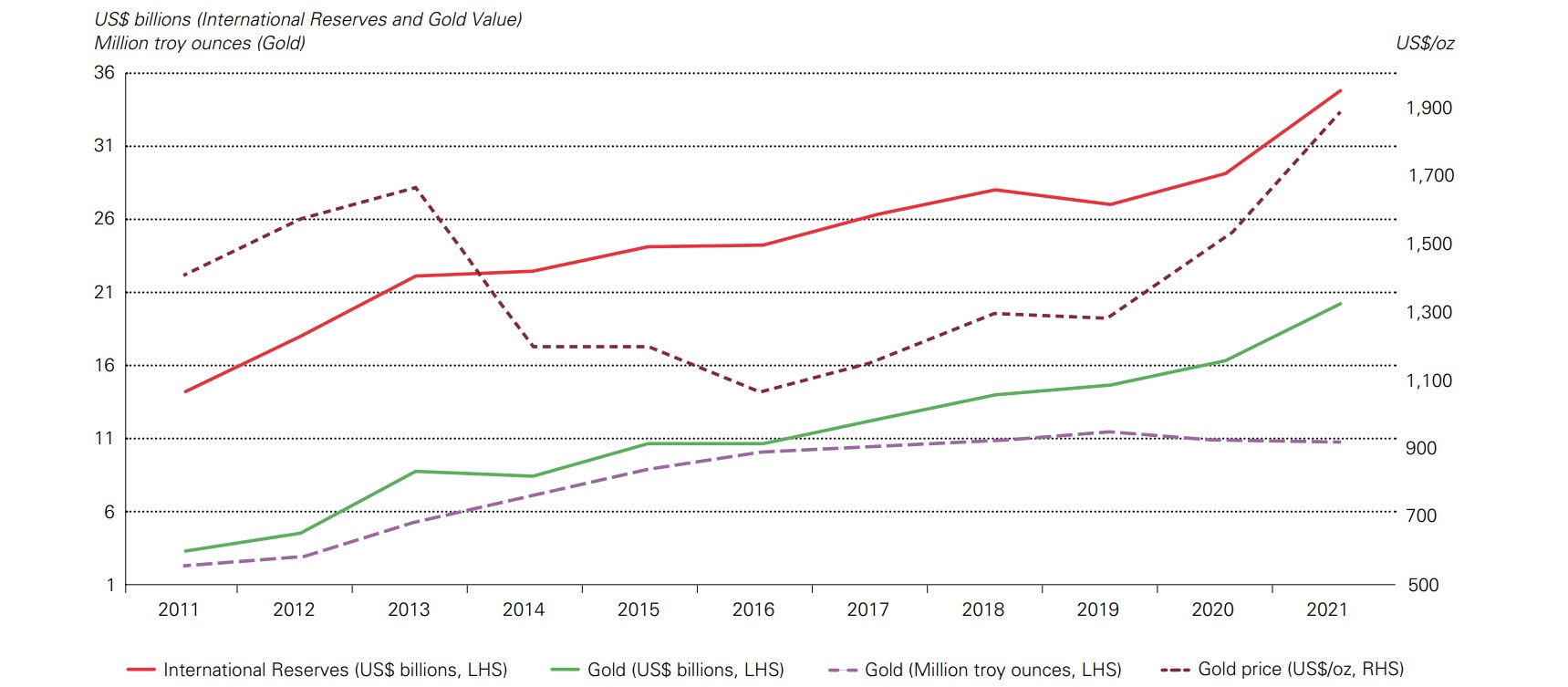
    In common with other significant gold-producing countries, whenever we buy gold from refiners, a large amount of local currency is injected into economy. This has clear monetary policy implications, in effect flooding the economy with excess liquidity. To mitigate this risk, we have adopted a neutrality principle, whereby purchases of gold are offset by foreign exchange sales on the local currency exchange. We do not aim to use reserves to support certain levels of exchange rate. Rather, our interventions are designed to sterilise any excess liquidity arising from the purchase of locally produced precious metals in domestic currency. We adopted this neutrality principle in 2018, since when our annual production of gold has been sold in full, leaving the amount of gold reserves unchanged over the period (see chart below).


    CBU International Reserves and Gold Reserves


    Striving for greater transparency

    We have also sought, in recent times to increase transparency and accountability, in line with international best practice. In 2018, we adopted the IMF’s Enhanced General Data Dissemination System (e-GDDS). And in 2019, we published our first annual report, containing in-depth analysis of our reserve management practices with special attention to gold reserves. Looking ahead, we intend to adopt the IMF Special Data Dissemination Standard (SDDS) by 2022, which will provide the public with more detailed external sector statistics.1

    As part of our desire to ensure continued confidence and trust in Uzbek gold, we understand the need to adopt responsible sourcing processes and maintain rigorous due diligence standards. Both of our major gold refiners – Navoi Mining and Metallurgical Combinat (NMMC) and Almalyk Mining and Metallurgical Complex (AMMC) – fully comply with the LBMA’s Responsible Sourcing programme, a mandatory independent audit programme that verifies the legitimacy of gold supply chains and ensures that sourcing meets international ethical standards.2


    Gold as an investment

    We also recognise the role of gold as a savings and investment vehicle for the Uzbek people. In 2018, we began selling commemorative, high-purity gold coins and we recently added bars sold through commercial banks, in accordance with best international practices and experience. Commemorative coins weighing 15, 20 and 31.1 grams and bars weighing 5, 10, 20, and 50 grams are offered in special packaging, complete with certification and unique serial numbers. Sale and buyback prices are set in national currency per gram, based on the international gold price with a margin (or discount for buybacks) to cover operational expenses. Prices are published daily on the CBU’s website.

    To ensure liquidity, owners of gold bars can sell their goods at commercial bank branches and receive immediate payment, provided the packaging is intact. Bars with damaged or unqualified packages are sent for special expert inspection but, once the gold’s integrity has been confirmed, the seller can receive payment based on the buyback price set by CBU. Bars with undamaged packaging may also be taken out of the Republic of Uzbekistan. As of September 1st, 2021, we had sold around 5 100 (95.3 kg) and 2 500 (73.3 kg) gold bars and coins respectively.


    1https://www.imf.org/en/About/Factsheets/Sheets/2016/07/27/15/45/Standards-for-Data-Dissemination

    2The Programme follows the five-step due diligence framework set out in the OECD Guidance and requires Good Delivery List refiners to demonstrate their efforts to combat money laundering, terrorist financing and human rights abuses, and respect the environment globally

    Central bank digital currencies and the implications for the gold market

    Shaokai Fan

    Head of Asia Pacific (ex China) & Global Head of Central Banks World Gold Council


    Technological change has always been a driving force in the evolution of money. The barter system could only give way to commodity money because refining and standardisation built trust in precious metal coinage. Paper notes gained acceptability because improved printing technology reduced the risk of counterfeiting. Throughout the history of money, technological change has helped to reduce the core challenges of transacting: ease, reliability, and trust.

    The world appears to be poised for the next step in the evolution of money. Private cryptocurrencies have emerged as a potential new medium of exchange, although their long-term viability is yet to be proven. Central banks have also seized on the possibilities brought about by our highly digitised world with the development of central bank digital currencies, or CBDCs. Together with our partners at OMFIF, we are launching a new report – Central Bank Digital Currencies and Gold – that discusses the development of CBDCs and the potential implications on the gold market.


    CBDCs can potentially enable a wide range of new features. Money can become programmable, allowing policymakers to incentivise certain spending behaviours that can optimise economic impact or address social concerns. The trackable nature of CBDCs can also help to deter financial crimes or the use of currency to pay for illegal items. However, these features also touch on concerns about personal privacy and the freedom to spend as one sees fit. Although the exact function of CBDCs will only be determined as they begin to be used in the real world, their potential impacts on societies may be significant.

    It is interesting therefore to examine the impacts of this newest form of money on one of the oldest – gold. Gold functioned as money for centuries, a role which it lost only fifty years ago with the end of Bretton Woods system. Nevertheless, gold has continued to thrive as a distinct asset class, a form of money that is outside the control of policymakers. With CBDCs on the horizon, discussions about privacy, monetary policy, and programmability will inevitably emerge. Some may turn to gold as a way to allay these concerns. Increasing cross-border usage of CBDCs may lead to greater currency volatility, prompting some central banks to potentially build up greater gold reserves as a result.

    This report will examine the potential paths which CBDCs might take and their impact on gold as well. While the possibilities that we explore are all speculative, this report can serve as a starting point for thinking about the wider impacts of CBDCs on our relationship with money. Money will continue to evolve with changing technology, but how these changes will impact how we spend, save, and transact can only be understood over time.

    Central banks slide into net sales in November

    Krishan Gopaul

    Senior Analyst, EMEA World Gold Council


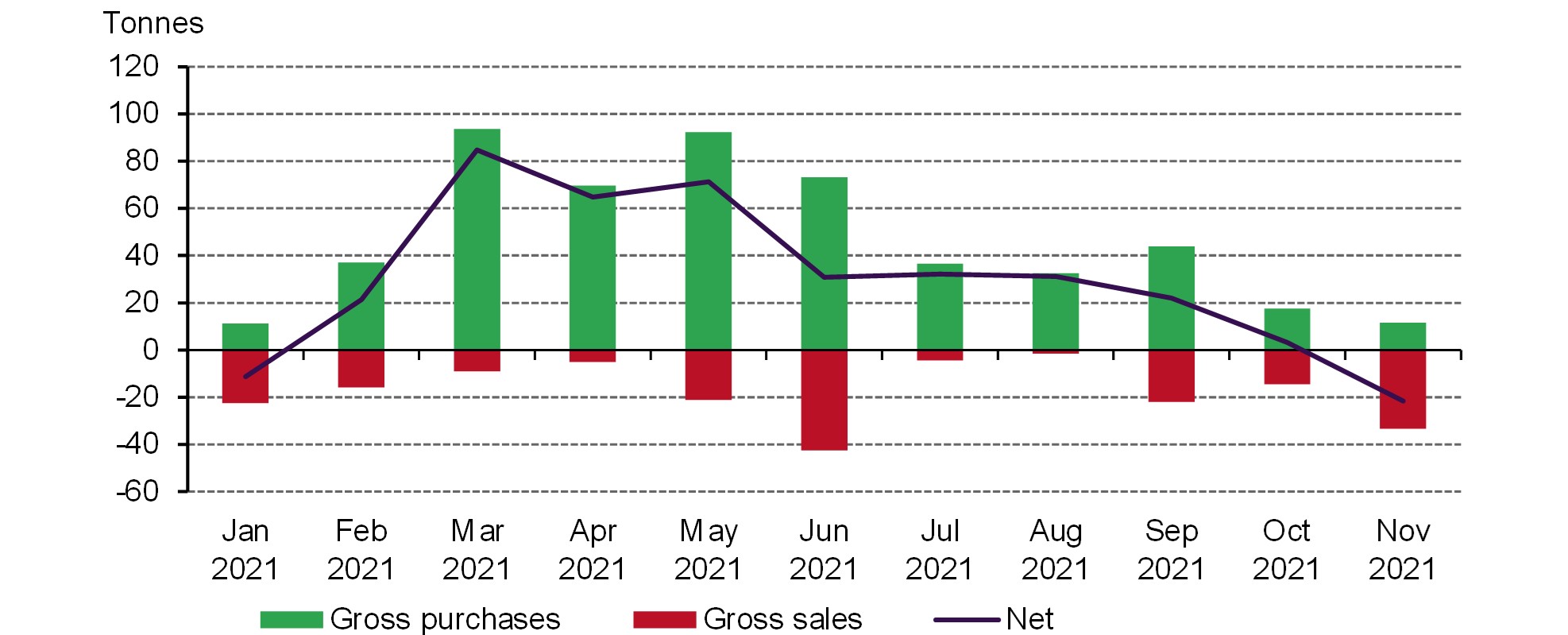
    Global official gold reserves fell by 21.5t in November according to data released by the IMF.1 A sizable sale from Uzbekistan tipped the balance in what would have otherwise been a flat month. This marks the first monthly decline since January 2021, when central banks collectively sold a net 11.2t.

    November saw central banks register net sales for the second month in 2021*

    Selling activity in November was dominated by four central banks. Uzbekistan registered the largest decline; its gold reserves fell by 21.5t to 353.6t. This is not the first significant sale, or purchase, we have seen from Uzbekistan over recent years: the active management of its gold reserves means changes are common, and something which Bobir Abubakinov, Deputy Governor of the Central Bank of Uzbekistan discussed in a recent blog. Despite this sizeable move, gold reserves still account for nearly 60% of total reserves, and have increased by 21.2t so far in 2021.2 Turkey (-7t), Russia (-3.1t), and the Kyrgyz Republic (-1.4t) were the other notable sellers during November.

    Net purchases during the month were concentrated amongst a small group of regular buyers: Kazakhstan (4.3t), Poland (3.4t), India (2.8t), and Ireland (0.7t). Ireland’s addition was the third consecutive month of purchases, taking year-to-date buying to just under 3t.

    Despite the swing into net sales in November, central banks remain on course to be healthy net purchasers for 2021. We will be assessing the full year performance in our upcoming Gold Demand Trends report which will be published at the end of January.


    1Our data set is based on IMF data but is supplemented with data from respective central banks where it is available and not reported through the IMF at the time of publication. This data may be revised in our next monthly update should more data become available.

    2Through 30 November 2021.

    Central banks flipped back to net purchases in December

    Mukesh Kumar

    Former Senior Analyst, India World Gold Council


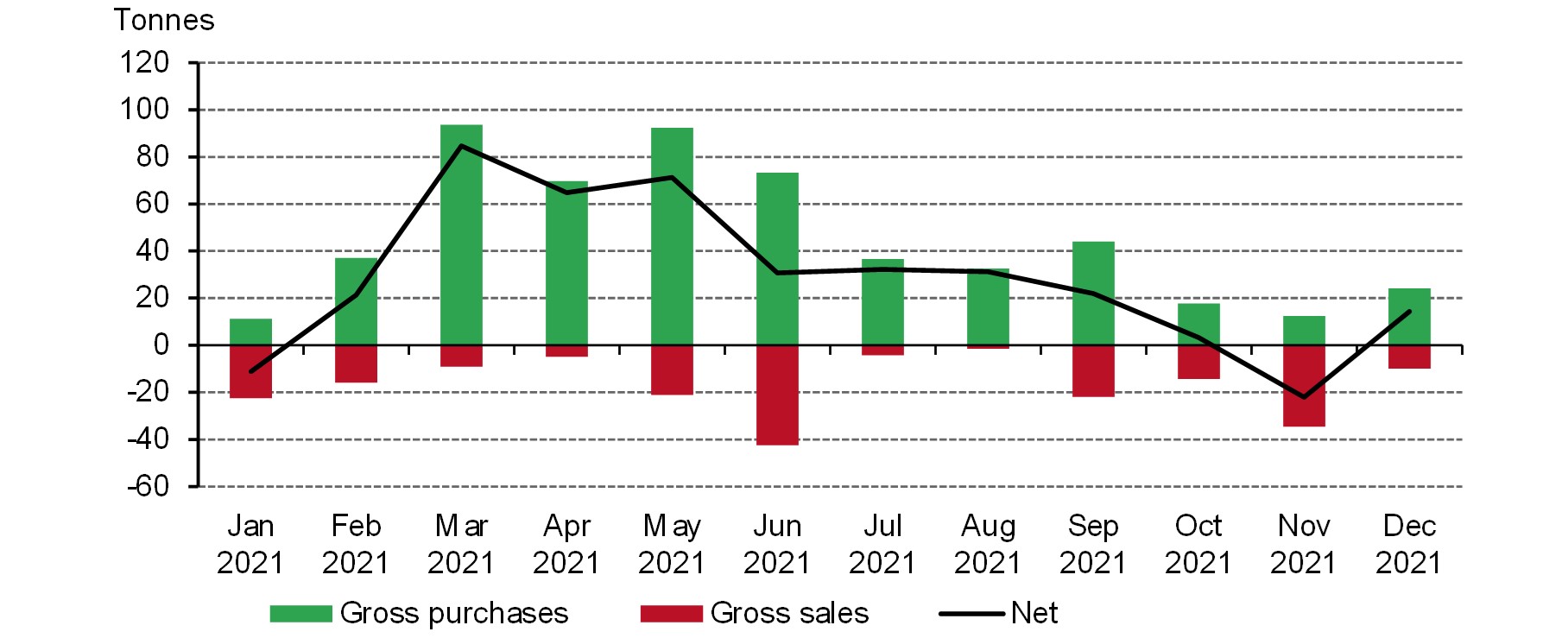
    Global official gold reserves increased by 14.2t in December according to data released by the IMF.1 Healthy purchases from Turkey and Uzbekistan lifted gross purchases during the month. This marked the tenth monthly purchases for 2021.

    *Data to 31 December 2021. Note: Japan’s reported 81t increase in its gold reserves in March 2021 has been excluded as this was the culmination of an off-market transaction between two different divisions within the Ministry of Finance.
    Source: IMF IFS, Respective Central Banks, World Gold Council

    Gross purchases were dominated by three central banks. Turkey purchased 10.1t in December, taking its gold reserves to 394.2t. Uzbekistan added 8.4t during the month after a sale of 21.5t during November. Such purchases and sales are common for Uzbekistan due to its active management of gold reserves, something we’ve highlighted previously. India purchased an additional 3.7t during December taking its total gold reserves to 754.1t by the end of the year. India’s gold reserves increased by 77.5t in 2021, the biggest increase since 2009 when it bought 200t from the IMF. Kyrgyz Republic (1.1t), Czech Republic (0.4t) and Ukraine (0.3t) were also notable purchasers during the month.

    Gross sales in December were concentrated among a small group of central banks: Kazakhstan (-4.8t), Sri Lanka (-3.6t) and Poland (-1.6t). Sri Lanka’s sale represented around half its gold reserves and was done to help bolster the liquidity of its foreign reserves, which had hit a 12-year low in November.2 However, the door was left open to future gold purchases when foreign reserves have increased.

    The broad range of buying in 2021 has shown there is still significant appetite for gold as a reserve asset. While demand from central banks can, at times, be less predictable than other sources of gold demand – given it is often policy rather than market driven – we remain confident that the overall trend of net buying will continue into 2022.


    1Our data set is based on IMF data but is supplemented with data from respective central banks, where available, and not reported through the IMF at the time of publication. This may be revised in our next monthly update should more data become available.

    2Sri Lanka’s sale in December is sourced from the Central Bank of Sri Lanka. IMF data for Sri Lanka is updated till January 2021 and our central bank statistics will be updated with the recent data once IMF updates its data for Sri Lanka.


    Latest research

    Looking for insight and analysis on gold? Our team of experts produce market-leading research and macroeconomic commentary on gold.