• Goldhub
  • Research
  • Central Banks

  • Latest issue

    Central Banks


    Central banks accumulate more gold in January – starting 2024 as they mean to go on?

    Krishan Gopaul

    Senior Analyst, EMEA World Gold Council


    • Central banks added 39 tonnes (t) to global gold reserves in January
    • Turkey and China again led the charge among buyers, while significant sales were virtually non-existent
    • The themes underpinning central bank demand remain in play, and have in some cases intensified, likely keeping central bank demand well supported in 2024.

    Our Full Year 2023 Gold Demand Trends report – published in January – confirmed another stellar year for central bank gold demand. While it fell slightly short of  the annual record set in 2022, it was close. This generated even more attention as central bank gold demand has become a key support for gold.

    Naturally, the focus has been not only on what has happened but also on what is to come. Will central banks continue to buy gold, and if so why and how much?  

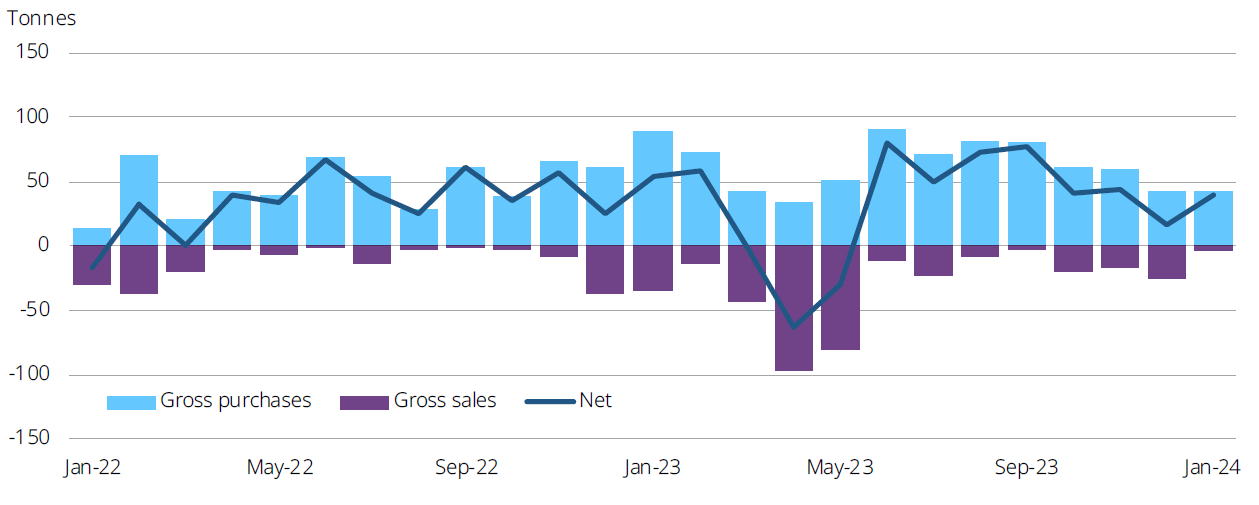
    On the first and last of these questions, we have the beginnings of an answer. In January, central banks reported that they increased global official gold reserves by 39t. This was more than double the (revised) December net purchases of 17t, and the eighth consecutive month of net purchases.1

    Central banks have now bought gold for eight consecutive months*

    Six central banks increased their gold reserves (of a tonne or more) during the month; all six have been regular buyers of late:

    • The Central Bank of Turkey was the largest buyer, increasing official gold holdings by 12t.2  This helped lift total gold holdings to 552 tonnes, just 6% off the all-time high of 587 tonnes back in February 2023
    • Gold reserves at the People’s Bank of China rose by 10t – the 15th consecutive month of additions. Total gold holdings now stand at 2,245t, nearly 300t higher than at the end of October 2022 when the bank  resumed reporting gold purchases
    • The Reserve Bank of India added nearly 9t. This is the first monthly increase in its gold reserves since October 2023 and the largest since July 2022; its gold holdings now total 812t
    • The National Bank of Kazakhstan bought 6t of gold, the first monthly addition since January 2023
    • The Central Bank of Jordan bought 3t in January, the second consecutive month of additions, lifting total gold holdings to 75t
    • The Czech National Bank added nearly 2t – the eleventh consecutive month of buying. Over that period gold reserves have surged from 12t to more than 32t (+170%).

    Reported selling was limited in January, the only noteworthy sale coming from the Central Bank of Russia (CBR). Gold reserves at the CBR declined by 3t in a continuation of a pattern that has been in place since 2021: frequent 3t declines that are subsequently replenished. We believe this activity is related to the country’s coin minting programme.

    January’s buying also lends support to our expectation that 2024 will be another solid year of central bank gold demand. Central banks, particularly those in emerging markets, have shown since 2010 that they have a long-term strategy towards gold accumulation.

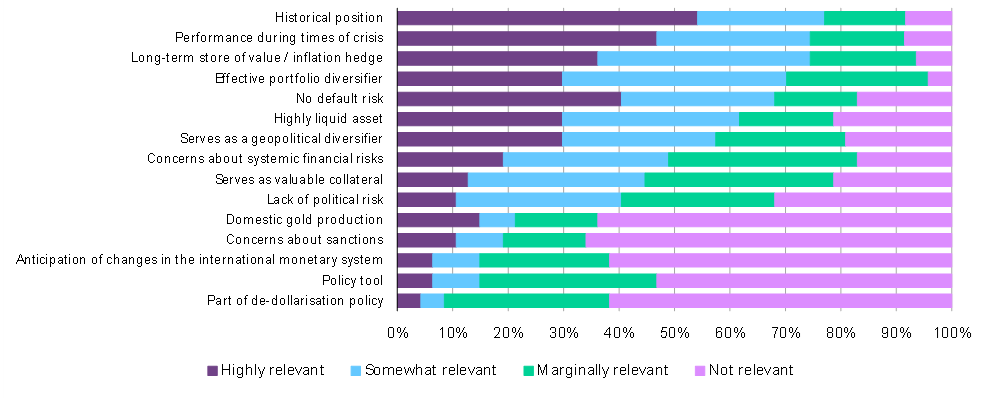
    As for why central banks are continuing to add gold to their reserves, our Central Bank Gold Survey remains instructive. Last year central banks placed great emphasis on gold’s value in crisis response, diversification attributes and store-of-value credentials. A few months into 2024 the world seems no less uncertain meaning those reasons for owning gold are as relevant as ever.

    How relevant are the following factors in your organisation’s decision to hold gold?

    Footnotes

    1Based on monthly IMF IFS data (reported with a two-month lag) and supplemented with data from respective central banks where applicable. Most institutions report on a regular basis, but some may report with a – sometimes significant – delay. Late availability of data may lead to revisions. The data reported here informs, but is distinct from, the central bank demand estimates we report in Gold Demand Trends.

    2Turkey’s official sector gold reserves are the sum of central bank-owned gold and Treasury gold holdings. This is equivalent to gross gold reserves less all gold held at the central bank in relation to commercial sector gold policies (such as the Reserve Option Mechanism (ROM), collateral, deposits and swaps). For information on this methodology, click here.

    Central banks bolster gold reserves further in February, albeit at a slower pace

    Krishan Gopaul

    Senior Analyst, EMEA World Gold Council


    • Central banks bought a net 19 tonnes (t), down 58% m/m1
    • Demand continues to be driven by emerging market banks, such as China and India
    • The slower pace of accumulation in February has had little impact on the broad trend in central bank buying

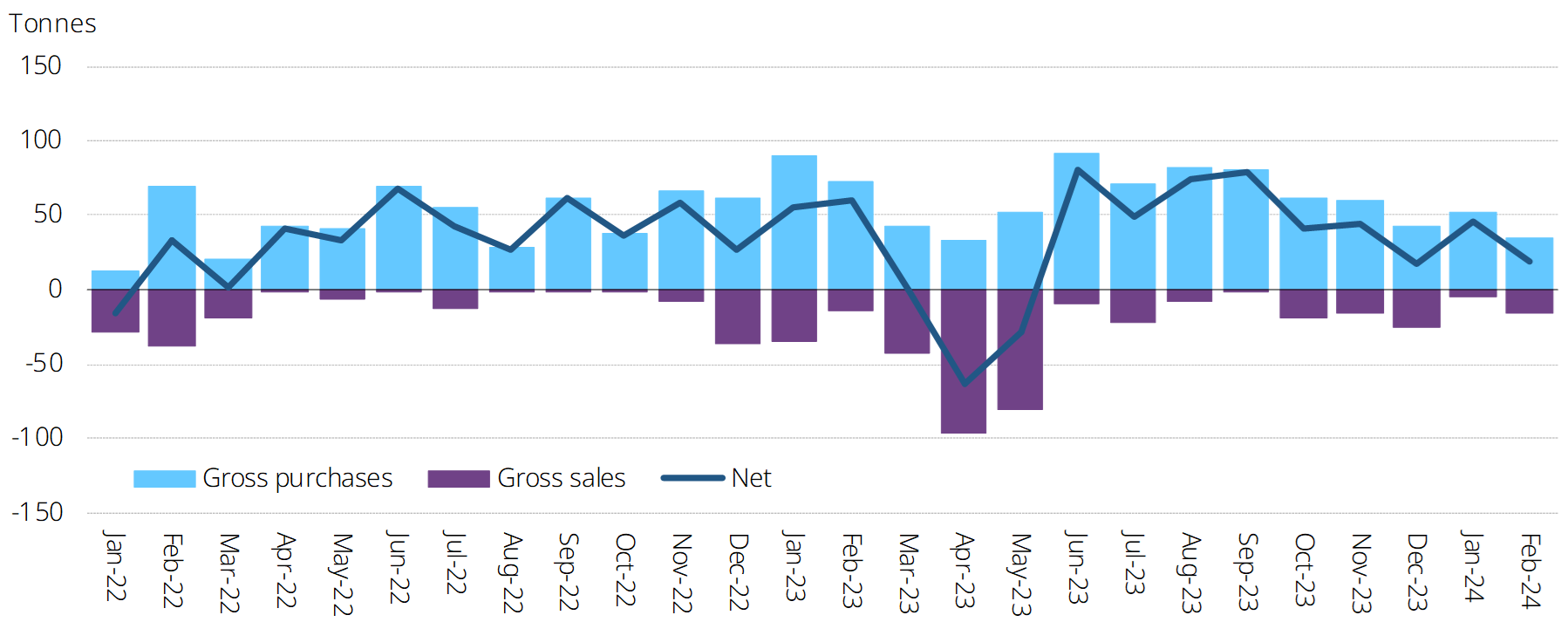
    Available data for February shows that reported global central bank gold reserves rose by 19t, the ninth consecutive month of growth. But a combination of slower gross purchases and a higher volume of sales meant that February’s buying was 58% lower than January’s total of 45t. On a y-t-d basis central banks report the addition of 64t over January and February, 43% lower than the same period in 2023 but a fourfold increase on 2022.

    Central bank gold demand slowed in February
    Monthly central bank gold purchases and sales*

    As in preceding months, activity was mostly limited to those who have been regular buyers/sellers in recent years.

    • The People’s Bank of China was the largest buyer in the month, increasing its gold reserves by 12t to 2,257t. Including February, PBoC’s gold reserves have grown for 16 consecutive months, although gold’s share of total reserves remains around 4%
    • The National Bank of Kazakhstan increased its gold reserves by 6t in February, continuing its strong start to 2024. Y-t-d net purchases now amount to 12t, lifting total holdings to just over 306t
    • Weekly data from the Reserve Bank of India showed its gold reserves rose by a further 6t in February. This lifts its y-t-d buying to over 13t and total gold holdings to 817t
    • Official gold reserves at the Central Bank of Turkey rose by 4t in February, lifting holdings to 556t2
    • The Monetary Authority of Singapore added 2t to its gold reserves during the month, first increase in gold holdings since September 2023. Gold reserves now total 232t
    • Czech National Bank data shows its gold reserves rose by around 2t in February – the twelfth straight month of gold buying (of 1t or more). Over that period Czech buying has totalled almost 22t, lifting gold holdings to 34t, 183% higher than at the end of February 2023
    • The Qatar Central Bank reported that its gold reserves rose by nearly 2t in February. Its total gold holdings surpassed 100t in December, and now stand at just below 103t
    • Data from the National Bank of the Kyrgyz Republic showed that its gold reserves rose by more than 1t in February, with y-t-d net purchases now totalling 2t. Total gold holdings now stand at almost 24t
    • Available data shows that there were only two notable sellers during the month. The Central Bank of Uzbekistan reduced its gold reserves by 12t during the month, while the Central Bank of Jordan lowered its gold holding by 4t.

    Central bank purchases comfortably outweigh sales y-t-d
    Individual central bank net purchases/sales in tonnes*

    Despite slower demand from central banks in February, the year has got off to a healthy start and the broad trend of gold buying remains intact. Look out for our next Gold Demand Trends report in late April, which will cover central bank demand for the entire first quarter. 

    Footnotes

    1Based on monthly IMF IFS data (reported with a two-month lag) and supplemented with data from respective central banks where applicable. Most institutions report on a regular basis, but some may report with a – sometimes significant – delay. Late availability of data may lead to revisions. The data reported here informs, but is distinct from, the central bank demand estimates we report in Gold Demand Trends.

    2Turkey’s official sector gold reserves are the sum of central bank-owned gold and Treasury gold holdings. This is equivalent to gross gold reserves less all gold held at the central bank in relation to commercial sector gold policies (such as the Reserve Option Mechanism (ROM), collateral, deposits and swaps). For information on this methodology, click here.

    Central bank gold statistics - March 2024

    Krishan Gopaul

    Senior Analyst, EMEA World Gold Council


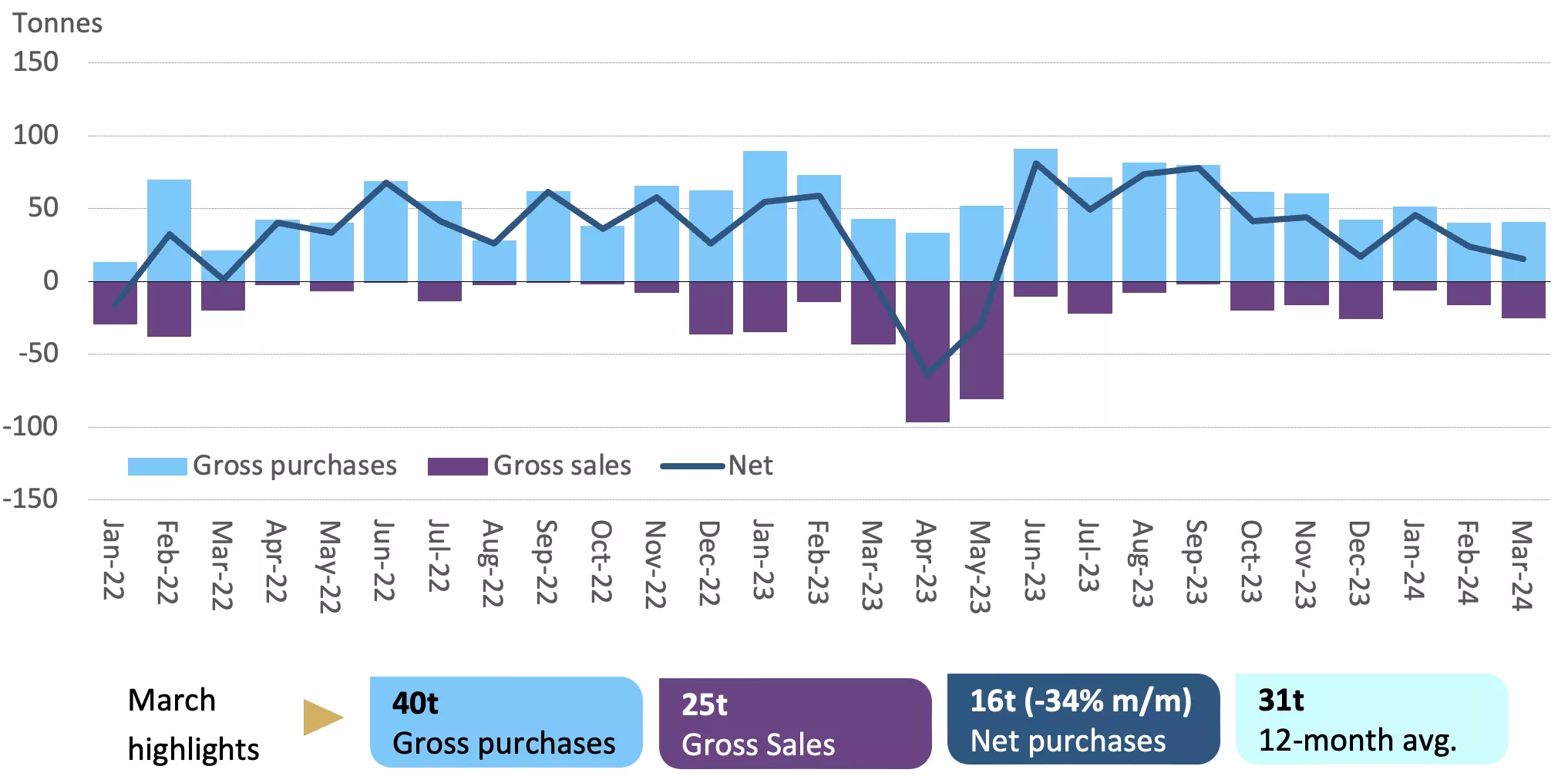
    Central banks reported 16t of net buying in March via the IMF and other public data sources.

    Demand remained healthy: monthly gross purchases were steady m/m at 40t, partly offset by gross sales of 25t.*


    infographic 1

    March changes by country


    March transactions were led by central banks who have been active recently.

    Major buyers were all from emerging markets. The Central Bank of Turkey added the most gold during the month (14t), followed by the Reserve Bank of India and the People’s Bank of China.

    **The 3t increase in gold reserves at the State Oil Fund of the Republic of Azerbaijan occurred over the period Jan-Mar 2024.
    ***This relates to an adjustment in reporting only gold with a purity of at least 995/1,000. This does not affect the amount of gold held as Net Foreign Assets and reported under BOT’s Financial Statements.


    Year-to-date changes by country


    Buying strength has continued into 2024, with emerging market banks the main driving force for both purchases and sales.

    The Monetary Authority of Singapore remains the sole developed market bank adding gold to its reserves.

    SOFAZ is notable as it is the only sovereign wealth fund which has reported increasing its gold holdings, by 3t y-t-d.


    *Totals may not sum due to rounding. Excludes SOFAZ which only reports quarterly data. 
    Note: Change by country and YTD changes charts include changes of a tonne or more only.


    Central bank gold buying picks up in April

    Krishan Gopaul

    Senior Analyst, EMEA World Gold Council


    • Net purchases totalled 33t in April, rebounding from a revised net 3t in March
    • Broad buying from several emerging market banks offset negligible sales
    • June sees the release of findings from our Central Bank Gold Survey 2024.

    The rapid rise in the gold price during March raised  several questions. One of these was whether central banks – whose demand has been posited as a key reason for the recent rally – would change their gold buying behaviour in response.

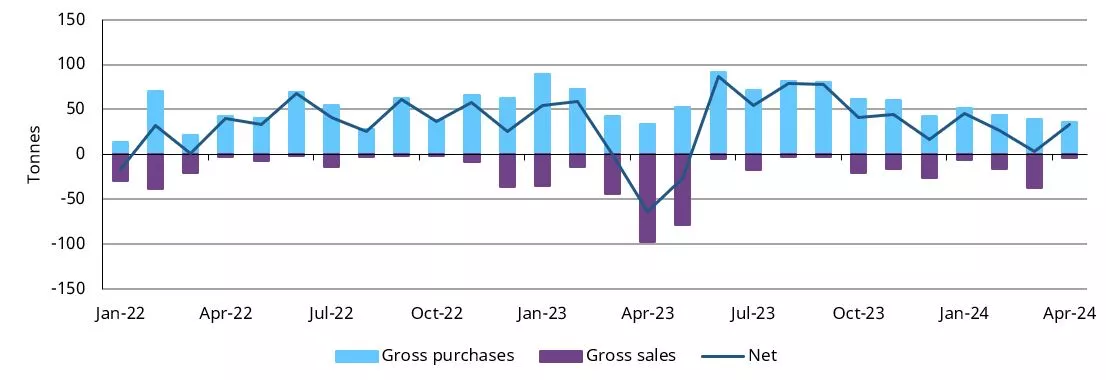
    We now have the benefit of a more complete picture for March, as well as initial data for April, to help inform our perspective. Latest figures – reported via the IMF and publicly available sources – show that global gold reserves rose by a net 33t in April, similar to levels seen in February (27t).1 Although gross purchases dipped to 36t, from 39t in March, gross sales saw a more pronounced m/m drop from 36t to just 3t in April.   


    Central bank net buying rebounds in April

    Monthly central bank gross purchases and sales, tonnes*


    Central bank net buying rebounds in April

    *Data to 30 April 2024 where available.
    Source: IMF IFS, respective central banks, World Gold Council

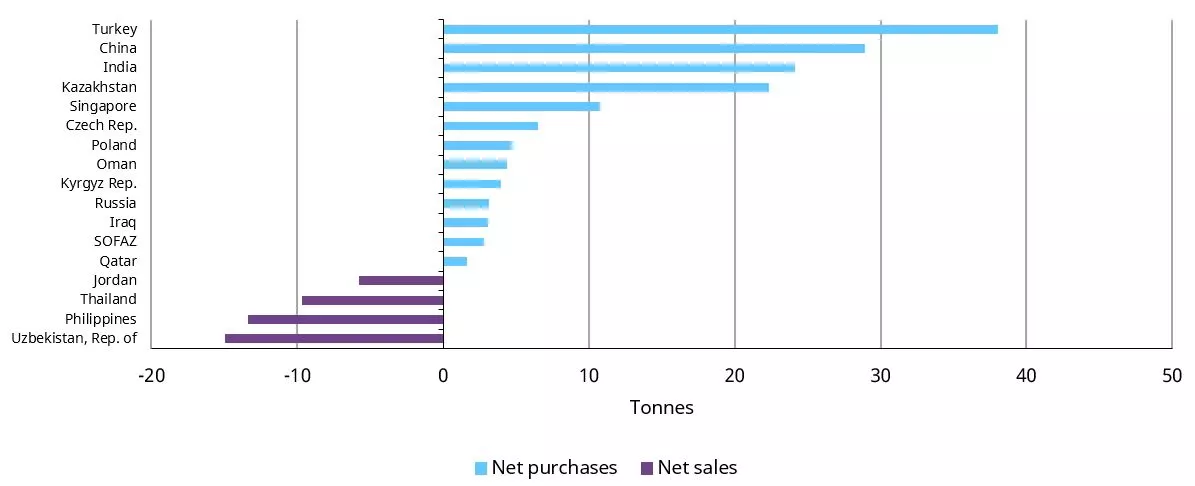
    Eight central banks increased their gold reserves by a tonne or more in April. The Central Bank of Turkey was the largest buyer, increasing its official reserves by 8t.2 With 11 consecutive months of buying, the bank’s y-t-d net purchases now total 38t and lift its total official gold holdings to 578t. The National Bank of Kazakhstan (6t), Reserve Bank of India (6t), National Bank of Poland (5t), Monetary Authority of Singapore (4t), Central Bank of Russia (3t) and Czech National Bank (2t) were the other major buyers in the month.

    The People's Bank of China reported a significant slowdown in its gold buying. The bank reported that its gold reserves rose by just under 2t in April to 2,264t – the lowest monthly  increase since it resumed reporting in November 2022 and well below the 18t monthly average prior to April.

    Notable gross sales were limited to the Central Banks of Uzbekistan and Jordan. Both reported a 1t decline in their gold reserves, a notable reduction in the pace of selling seen in February and March.


    Central bank gold demand remains healthy so far in 2024

    Y-t-d net purchases/sales of a tonne or more by central bank*


    Central bank gold demand remains healthy so far in 2024

    *Data to 30 April 2024 where available.
    Source: IMF IFS, respective central banks, World Gold Council

    Looking back at March, net purchases for the month have been revised to just 3t following the late reporting of a 12t sale by the Central Bank of the Philippines.  While gross purchases during March were relatively stable in the face of the rapidly rising gold price, gross sales saw a marked pick-up thanks to heavy sales from (now) four banks . This suggests that price performance may well have had some impact on the activity of some central banks.

    Despite the slowdown in March, the preliminary pick-up in net purchases in April   may suggest that central banks have thus far shaken off the rally in the gold price and continue with their strategic buying plans. Of course, more data for April, as it becomes available, as well as data for May, will be instructive to further assess how central banks’ approach to gold purchases will evolve. In addition, June sees the publication of findings from our Central Bank Gold Survey 2024, which will provide a rich insight into central banks’ thinking towards gold, and how this may influence gold buying going forward.


    Footnotes

    1 Based on monthly IMF IFS data (reported with a two-month lag) and supplemented with data from respective central banks where applicable. Most institutions report on a regular basis, but some may report with a – sometimes significant – delay. Late availability of data may lead to revisions. The data reported here informs, but is distinct from, the central bank demand estimates we report in Gold Demand Trends.

    2 Turkey’s official sector gold reserves are the sum of central bank-owned gold and Treasury gold holdings. This is equivalent to gross gold reserves less all gold held at the central bank in relation to commercial sector gold policies (such as the Reserve Option Mechanism (ROM), collateral, deposits and swaps). For information on this methodology, click here.


    Central Bank Gold Statistics: May 2024

    Krishan Gopaul

    Senior Analyst, EMEA World Gold Council


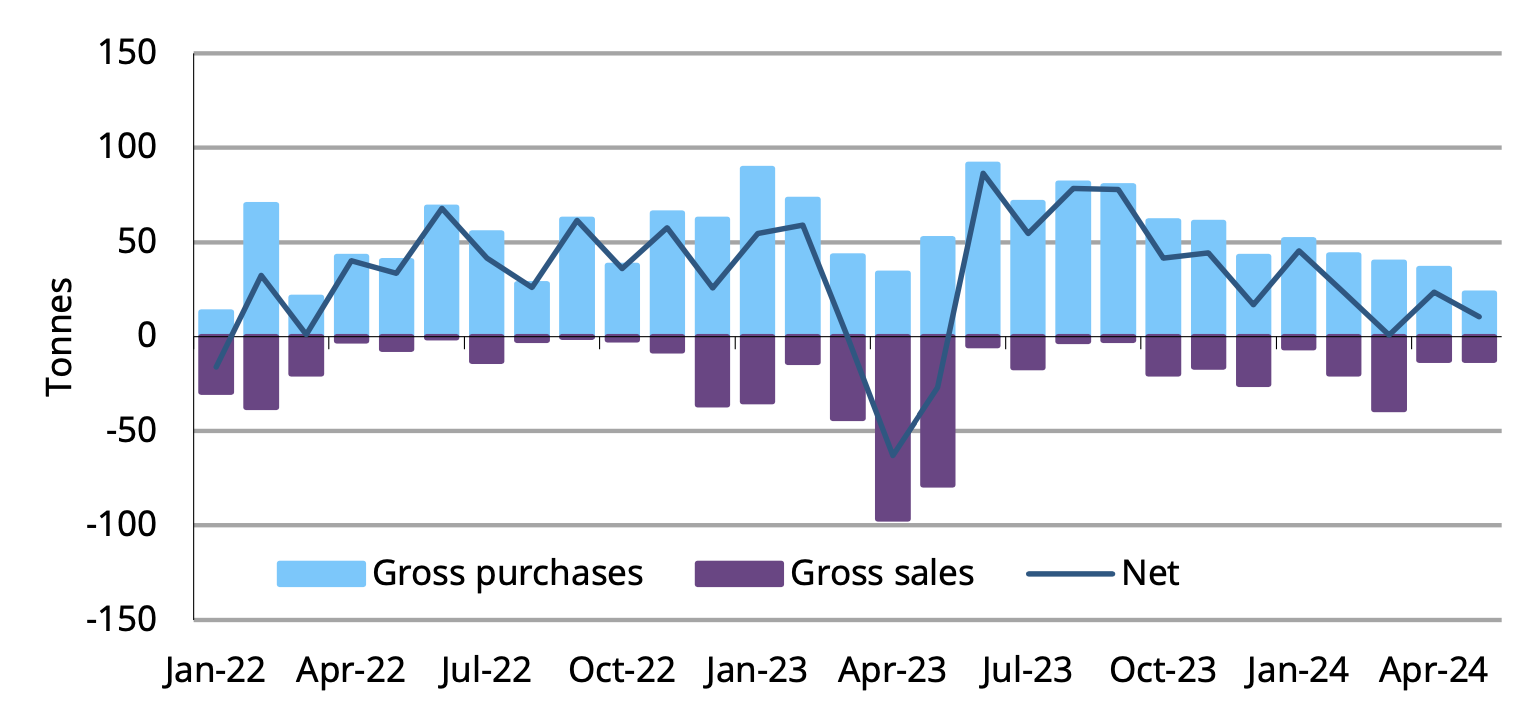
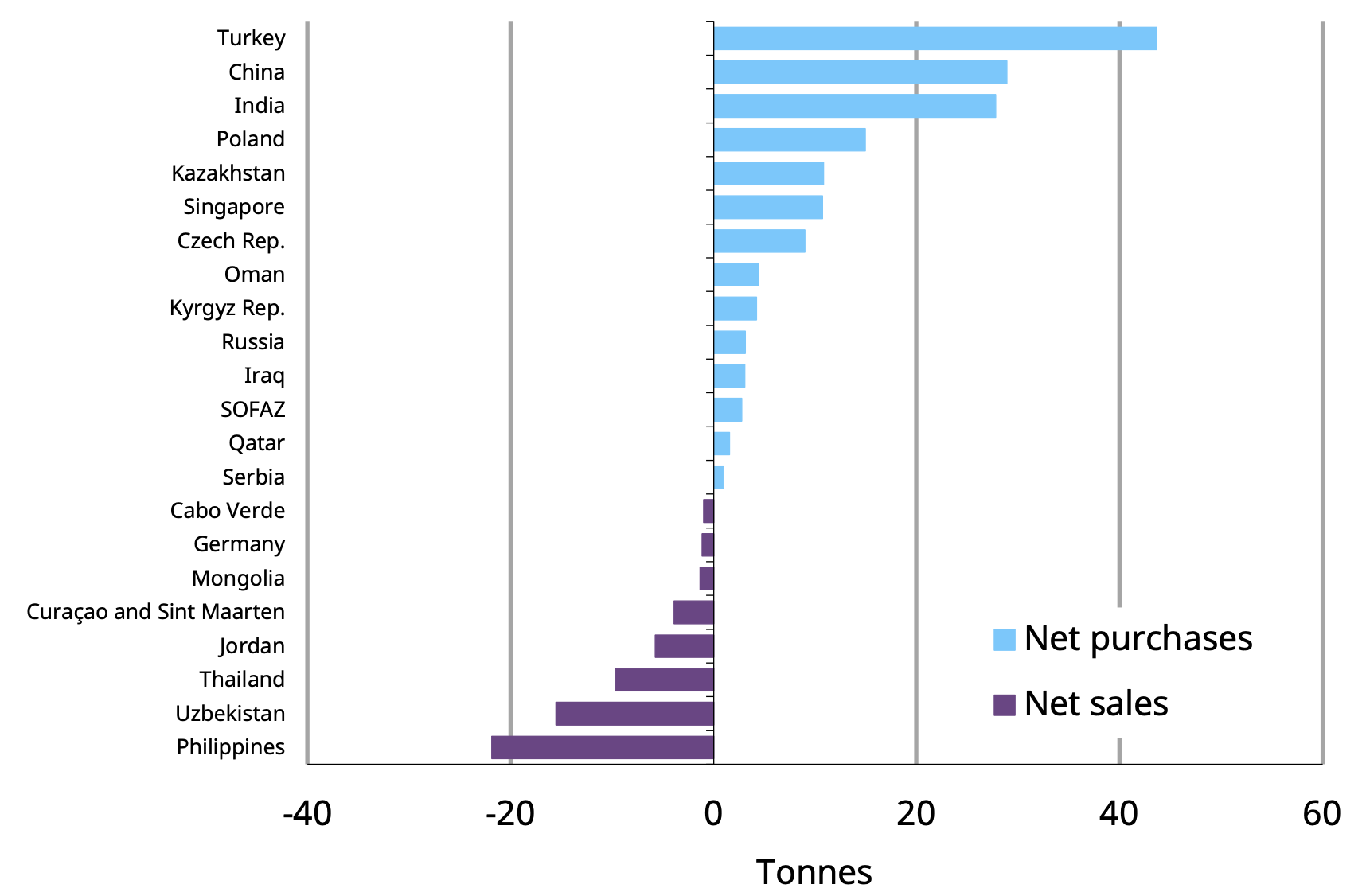
    Central banks reported 10t of net buying in May via the IMF and other public data sources. Demand moderated during the month: monthly gross purchases fell to 23t and offset by gross sales of 12t.*

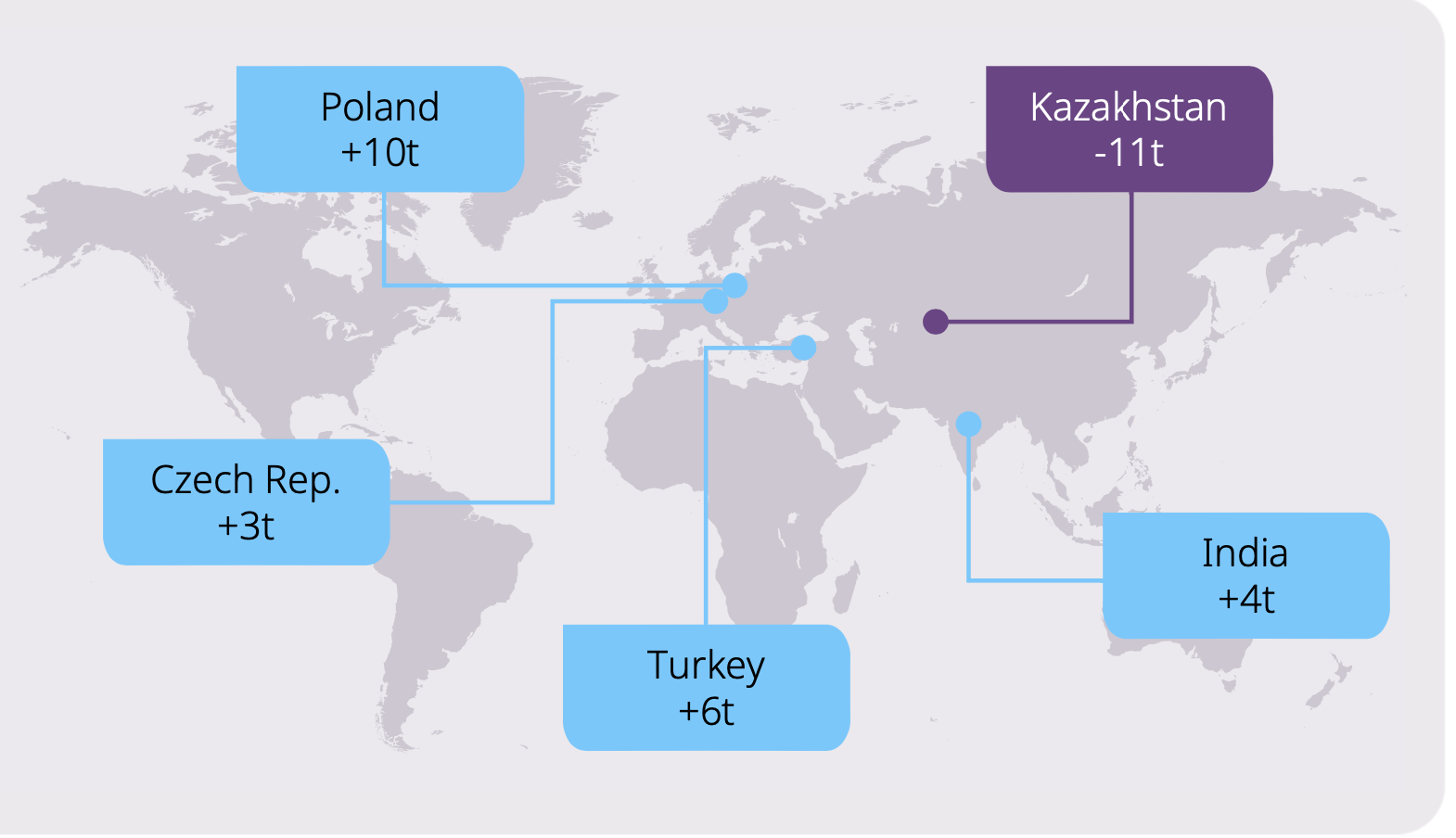
    May changes by country

    May transactions were led by emerging market central banks. The National Bank of Poland was the largest gold purchaser during the month (10t), followed by the Central Bank of Turkey and the Reserve Bank of India.

    Year-to-date changes by country

    Buying strength continues in 2024, although gross purchases and sales are lower compared to the same period last year.

    Emerging market banks the main driving force for both purchases and sales. The Monetary Authority of Singapore remains the sole developed market bank having increased its gold reserves.

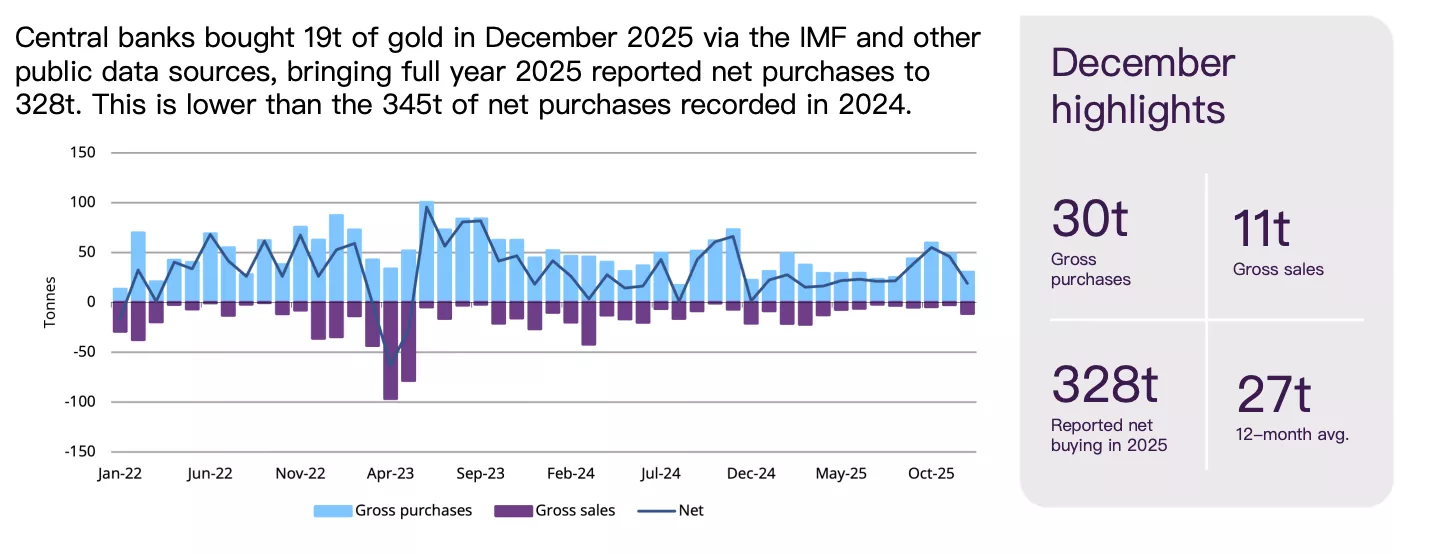
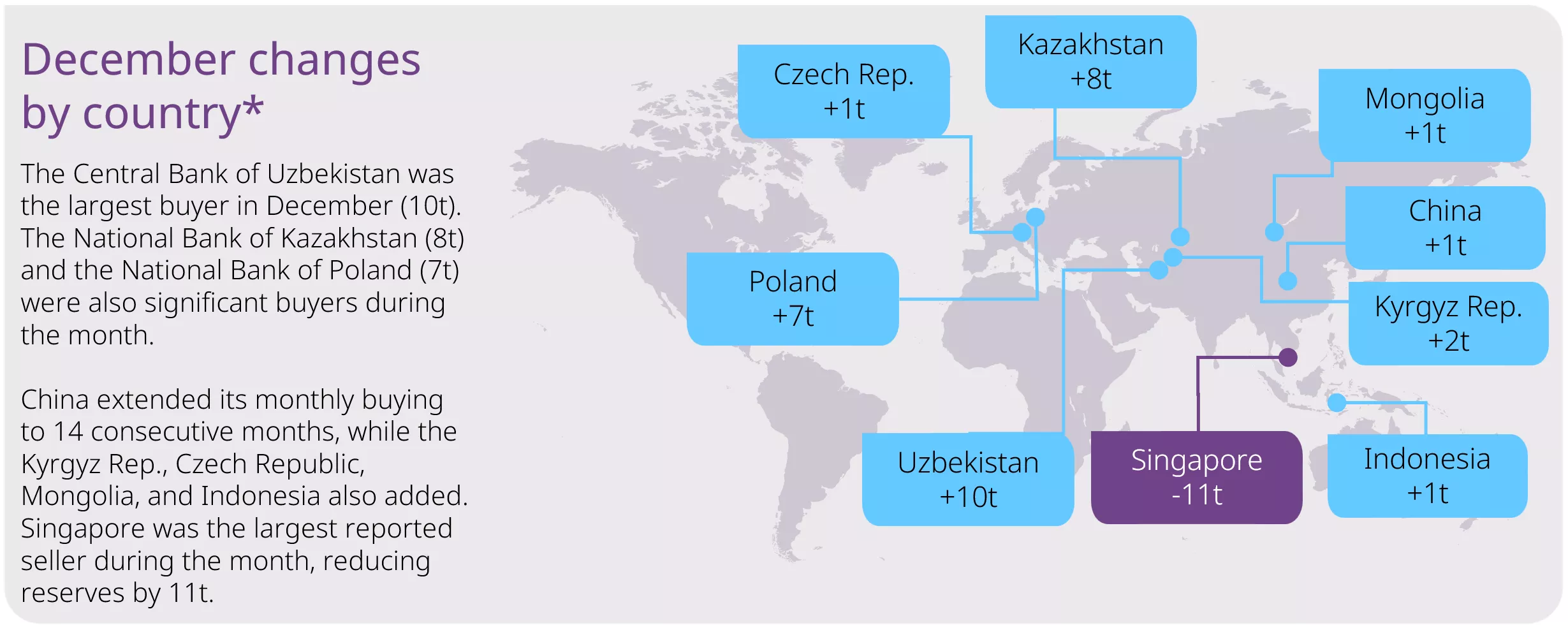
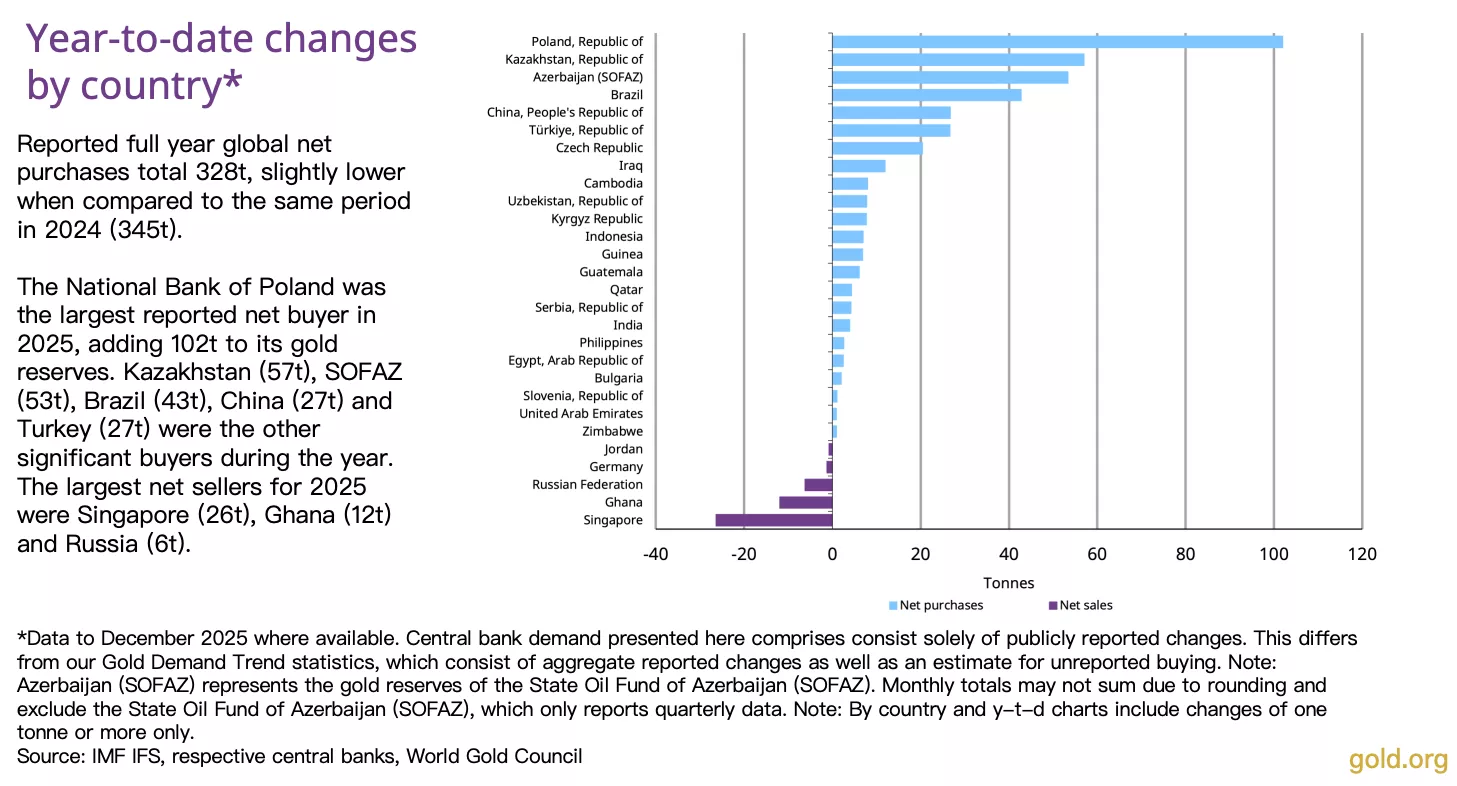
    Central bank gold statistics: December 2025

    Marissa Salim

    Senior Research Lead, APAC World Gold Council


    1

    Image 2

    3

    Disclaimer

    Important information and disclaimers

    © 2026 World Gold Council. All rights reserved. World Gold Council and the Circle device are trademarks of the World Gold Council or its affiliates.

    All references to LBMA Gold Price are used with the permission of ICE Benchmark Administration Limited and have been provided for informational purposes only. ICE Benchmark Administration Limited accepts no liability or responsibility for the accuracy of the prices or the underlying product to which the prices may be referenced. Other content is the intellectual property of the respective third party and all rights are reserved to them.

    Reproduction or redistribution of any of this information is expressly prohibited without the prior written consent of World Gold Council or the appropriate copyright owners, except as specifically provided below. Information and statistics are copyright © and/or other intellectual property of the World Gold Council or its affiliates or third-party providers identified herein. All rights of the respective owners are reserved.

    The use of the statistics in this information is permitted for the purposes of review and commentary (including media commentary) in line with fair industry practice, subject to the following two pre-conditions: (i) only limited extracts of data or analysis be used; and (ii) any and all use of these statistics is accompanied by a citation to World Gold Council and, where appropriate, to Metals Focus or other identified copyright owners as their source. World Gold Council is affiliated with Metals Focus.

    The World Gold Council and its affiliates do not guarantee the accuracy or completeness of any information nor accept responsibility for any losses or damages arising directly or indirectly from the use of this information.

    This information is for educational purposes only and by receiving this information, you agree with its intended purpose. Nothing contained herein is intended to constitute a recommendation, investment advice, or offer for the purchase or sale of gold, any gold-related products or services or any other products, services, securities or financial instruments (collectively, “Services”). This information does not take into account any investment objectives, financial situation or particular needs of any particular person.

    Diversification does not guarantee any investment returns and does not eliminate the risk of loss. Past performance is not necessarily indicative of future results. The resulting performance of any investment outcomes that can be generated through allocation to gold are hypothetical in nature, may not reflect actual investment results and are not guarantees of future results. The World Gold Council and its affiliates do not guarantee or warranty any calculations and models used in any hypothetical portfolios or any outcomes resulting from any such use. Investors should discuss their individual circumstances with their appropriate investment professionals before making any decision regarding any Services or investments.

    This information may contain forward-looking statements, such as statements which use the words “believes”, “expects”, “may”, or “suggests”, or similar terminology, which are based on current expectations and are subject to change. Forward-looking statements involve a number of risks and uncertainties. There can be no assurance that any forward-looking statements will be achieved. World Gold Council and its affiliates assume no responsibility for updating any forward-looking statements.

    Information regarding the LBMA Gold Price

    The LBMA Gold Price is used by the World Gold Council with permission under license by ICE Benchmark Administration Limited and is subject to the restrictions set forth here (www.gold.org/terms-and-conditions).

    Information regarding QaurumSM and the Gold Valuation Framework

    Note that the resulting performance of various investment outcomes that can be generated through use of Qaurum, the Gold Valuation Framework and other information are hypothetical in nature, may not reflect actual investment results and are not guarantees of future results. Neither World Gold Council (including its affiliates) nor Oxford Economics provides any warranty or guarantee regarding the functionality of the tool, including without limitation any projections, estimates or calculations.

    Information from ICRA Analytics Limited

    All information obtained from ICRA Analytics Limited contained in this document is subject to the disclaimer set forth here (www.icraanalytics.com/terms-of-use/disclaimer).


    md
    theme-purple surface surface--primary surface--light surface--default

    Central bank gold statistics: Buying momentum continues into November

    Marissa Salim

    Senior Research Lead, APAC World Gold Council


    Highlights

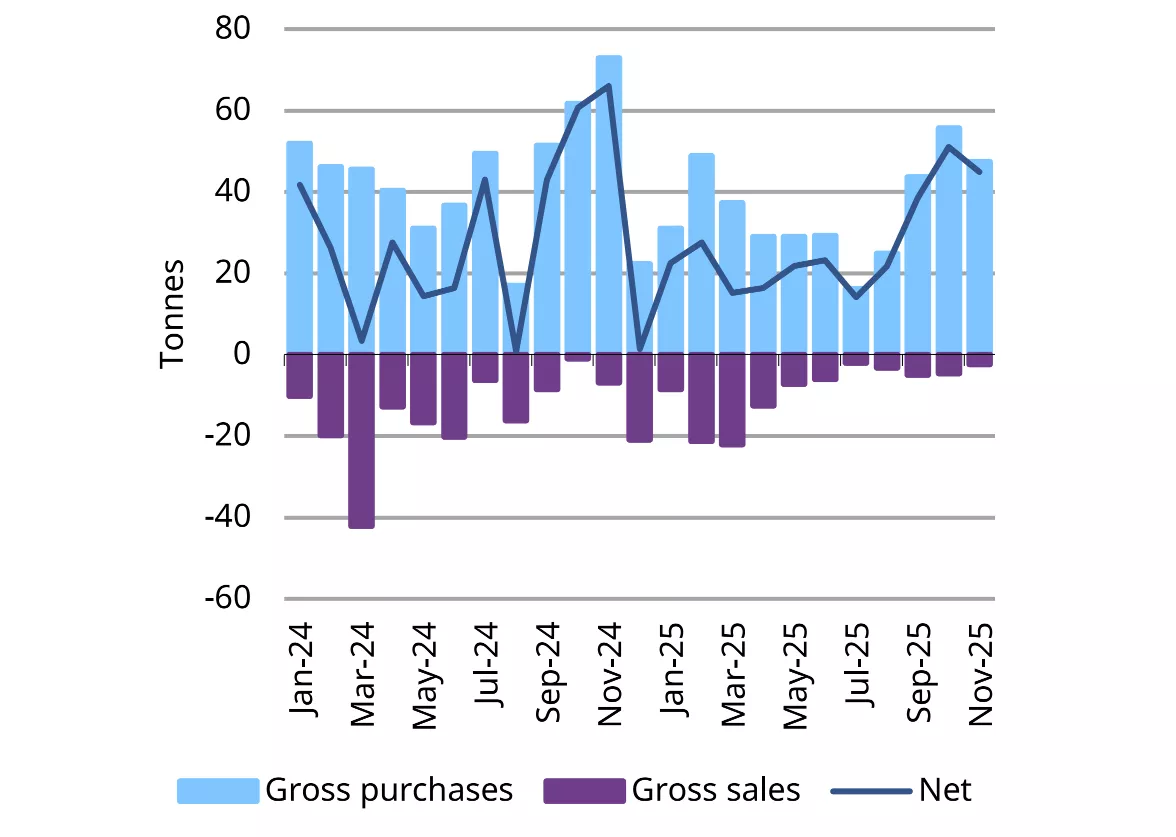
    • Central banks bought a net 45t in November, and while down slightly from October, buying has remained elevated compared to the earlier months of this year.1
    • National Bank of Poland led net buying for the second consecutive month after October’s resurgent buying from the bank.
    • Total y‑t‑d reported buying total through November was a solid 297t, though lower than the same period in the previous record setting years.

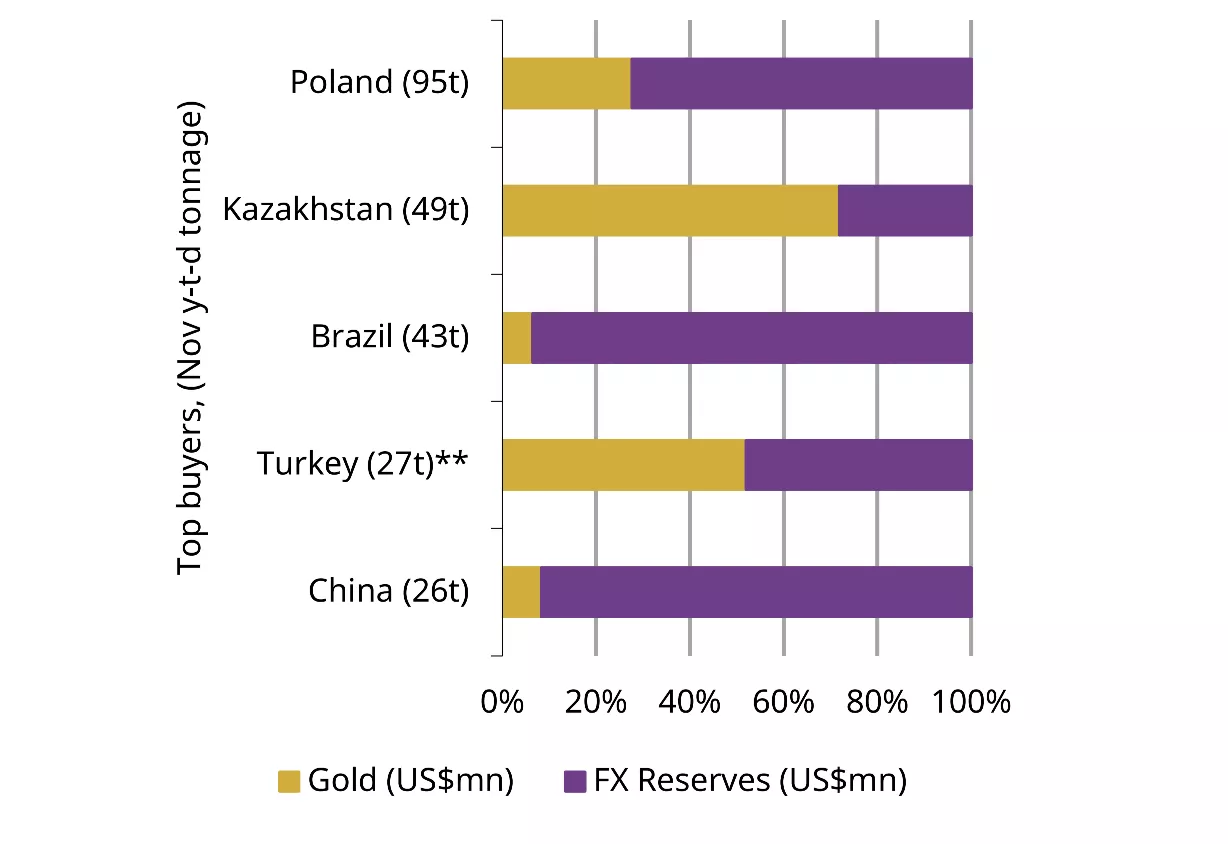
    Central bank gold demand remained firm in November (Chart 1). Net purchases totalled 45t, with y-t-d figures pushing 297t, as emerging-market central banks continued their significant gold buying this year. Among these central banks, gold holdings for top buyers as a percentage of total reserves showed a wide range (Chart 2).


    Chart 1: Central bank gold buyer has picked up pace in recent months

    Monthly reported central bank activity, tonnes*


    chart1

    *Data to 30 November 2025, where available.
    Source: IMF, respective central banks, World Gold Council


    Chart 2: Total gold holdings for top buyers as of November

    Gold share as a percentage of total reserves*


    chart2

    *Data to 30 November 2025, **Turkey data to end-October.
    Source: IMF, respective central banks, World Gold Council


    Notably, activity has been concentrated in: 

    • The National Bank of Poland bought 12t this month, continuing its buying streak since October. The purchase lifted its gold reserves to 543t, or almost 28% of total reserves at end-November prices.2
    • The Central Bank of Brazil bought gold for the third consecutive month, adding 11t in November. The central bank has purchased 43t over the last three months, bringing its total gold reserves to 172 tonnes, or 6% of its total reserves.
    • The Central Bank of Uzbekistan (10t), National Bank of Kazakhstan (8t), the National Bank of the Kyrgyz Republic (2t), Czech National Bank (2t), the People’s Bank of China (1t) and Bank Indonesia (1t) were also buyers in November.
    • Net sellers during the month were the Central Bank of Jordan (2t) and the Qatar Central Bank (1t).
    • Also in November, the Bank of Tanzania stated it had accumulated 15 tonnes of refined monetary gold in the first year of its Domestic Gold Purchase Programme, as part of efforts to strengthen its foreign reserves.3

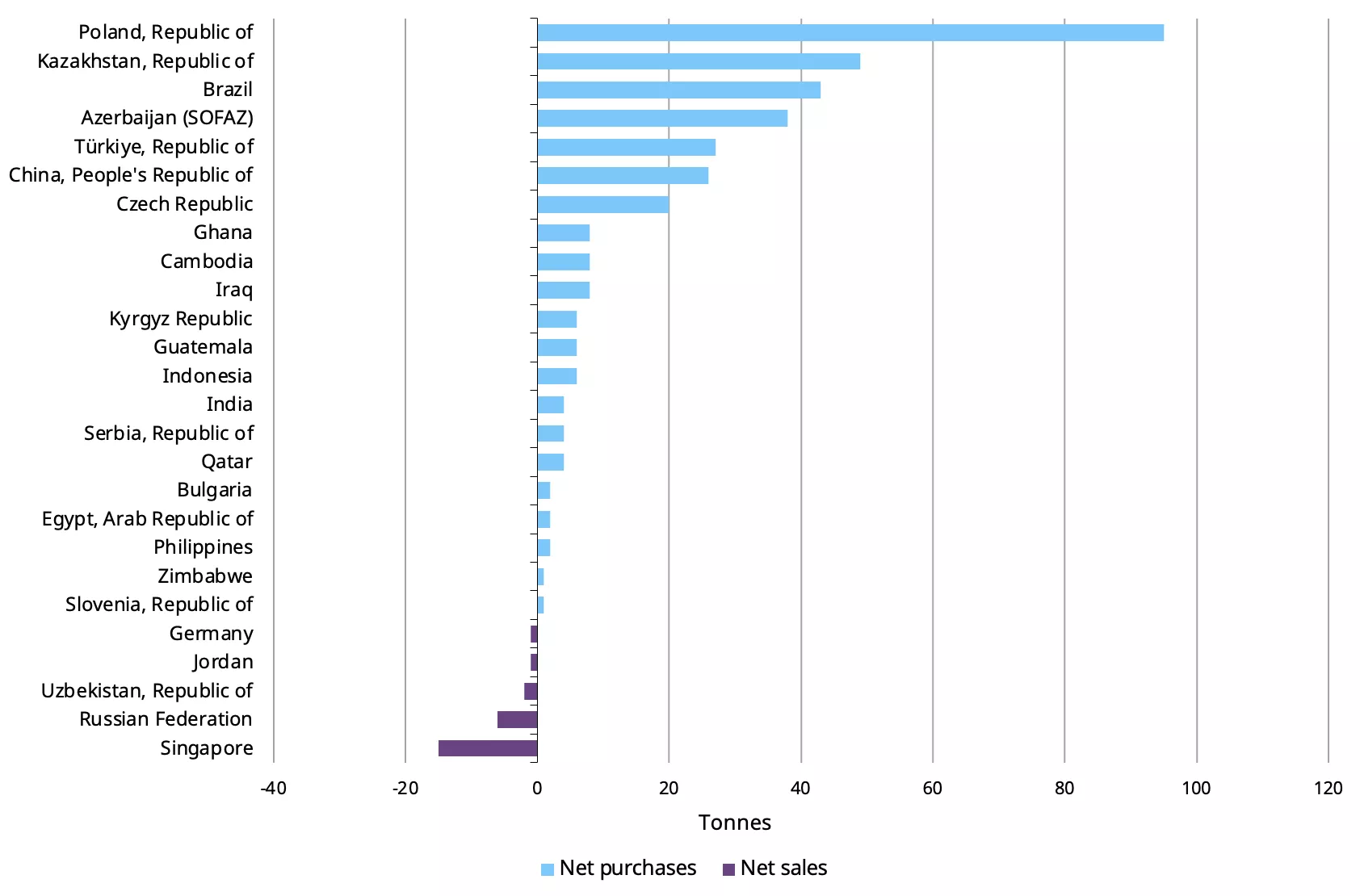
    Year-to-date, the National Bank of Poland (95t) continues to be the largest reported official-sector gold buyer, almost double the purchases of the next largest buyer, Kazakhstan (49t) (Chart 3). While y-t-d reported net purchases through November are at a slower pace than previous years, central bank gold buying momentum remains relatively robust.


    Chart 3: November y-t-d remains robust with Poland leading the pack, yet again

    Y-t-d central bank net purchases and sales, tonnes*


    chart 3

    *Data to 30 November 2025, where available.
    Source: IMF, respective central banks, World Gold Council


    Footnotes

    1Based on reported data through the IMF and other official public sources. This will differ from data shown in Gold Demand Trends, which also includes estimates on unreported buying.

    2Based on LBMA Gold Price PM in USD.

    3Bloomberg.


    Disclaimer

    Important information and disclaimers

    © 2026 World Gold Council. All rights reserved. World Gold Council and the Circle device are trademarks of the World Gold Council or its affiliates.

    All references to LBMA Gold Price are used with the permission of ICE Benchmark Administration Limited and have been provided for informational purposes only. ICE Benchmark Administration Limited accepts no liability or responsibility for the accuracy of the prices or the underlying product to which the prices may be referenced. Other content is the intellectual property of the respective third party and all rights are reserved to them.

    Reproduction or redistribution of any of this information is expressly prohibited without the prior written consent of World Gold Council or the appropriate copyright owners, except as specifically provided below. Information and statistics are copyright © and/or other intellectual property of the World Gold Council or its affiliates or third-party providers identified herein. All rights of the respective owners are reserved.

    The use of the statistics in this information is permitted for the purposes of review and commentary (including media commentary) in line with fair industry practice, subject to the following two pre-conditions: (i) only limited extracts of data or analysis be used; and (ii) any and all use of these statistics is accompanied by a citation to World Gold Council and, where appropriate, to Metals Focus or other identified copyright owners as their source. World Gold Council is affiliated with Metals Focus.

    The World Gold Council and its affiliates do not guarantee the accuracy or completeness of any information nor accept responsibility for any losses or damages arising directly or indirectly from the use of this information.

    This information is for educational purposes only and by receiving this information, you agree with its intended purpose. Nothing contained herein is intended to constitute a recommendation, investment advice, or offer for the purchase or sale of gold, any gold-related products or services or any other products, services, securities or financial instruments (collectively, “Services”). This information does not take into account any investment objectives, financial situation or particular needs of any particular person.

    Diversification does not guarantee any investment returns and does not eliminate the risk of loss. Past performance is not necessarily indicative of future results. The resulting performance of any investment outcomes that can be generated through allocation to gold are hypothetical in nature, may not reflect actual investment results and are not guarantees of future results. The World Gold Council and its affiliates do not guarantee or warranty any calculations and models used in any hypothetical portfolios or any outcomes resulting from any such use. Investors should discuss their individual circumstances with their appropriate investment professionals before making any decision regarding any Services or investments.

    This information may contain forward-looking statements, such as statements which use the words “believes”, “expects”, “may”, or “suggests”, or similar terminology, which are based on current expectations and are subject to change. Forward-looking statements involve a number of risks and uncertainties. There can be no assurance that any forward-looking statements will be achieved. World Gold Council and its affiliates assume no responsibility for updating any forward-looking statements.

    Information regarding the LBMA Gold Price

    The LBMA Gold Price is used by the World Gold Council with permission under license by ICE Benchmark Administration Limited and is subject to the restrictions set forth here (www.gold.org/terms-and-conditions).

    Information regarding QaurumSM and the Gold Valuation Framework

    Note that the resulting performance of various investment outcomes that can be generated through use of Qaurum, the Gold Valuation Framework and other information are hypothetical in nature, may not reflect actual investment results and are not guarantees of future results. Neither World Gold Council (including its affiliates) nor Oxford Economics provides any warranty or guarantee regarding the functionality of the tool, including without limitation any projections, estimates or calculations.

    Information from ICRA Analytics Limited

    All information obtained from ICRA Analytics Limited contained in this document is subject to the disclaimer set forth here (www.icraanalytics.com/terms-of-use/disclaimer).


    md
    theme-purple surface surface--primary surface--light surface--default

    Central Bank Gold Statistics: Central banks ramp up gold buying in October

    Krishan Gopaul

    Senior Analyst, EMEA World Gold Council


    Highlights

    • Central banks bought a net 53t in October, 36% higher m/m and the largest monthly net demand y-t-d
    • A familiar set of buyers – led by a resurgent National Bank of Poland – drove the gains
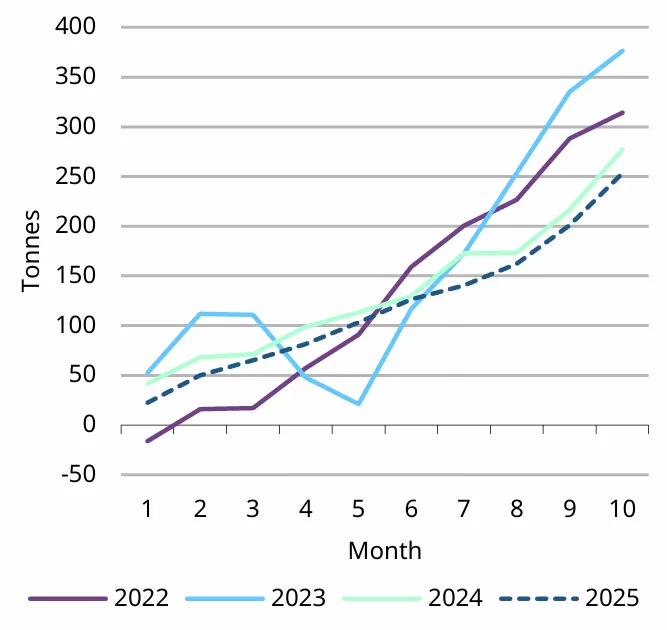
    • Total y‑t‑d reported buying through October solidly positive at 254t, but slower than previous years.

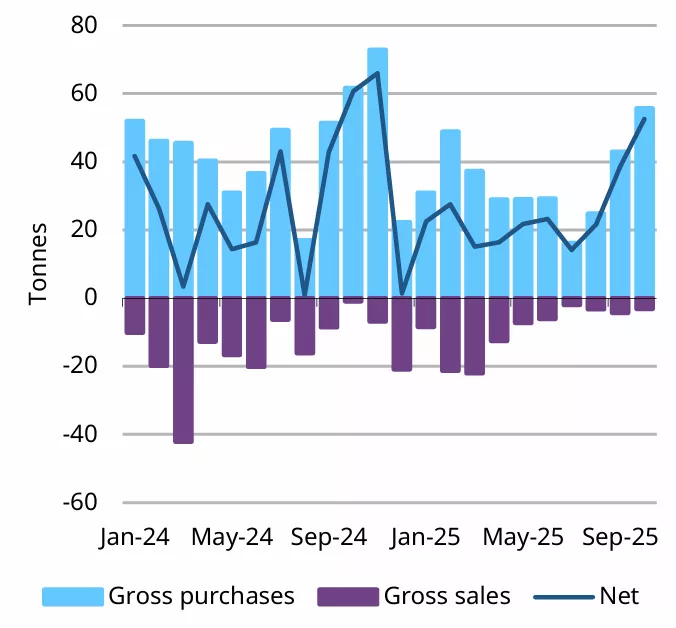
    Central bank demand for gold remained robust in October, totalling 53t (+36% m/m) and continuing the strong trend seen throughout the year (Chart 1). Buying remained concentrated among a small number of central banks, led by the National Bank of Poland which became active again during the month.


    Chart 1: Central bank gold buying has picked up pace in recent months

    Monthly reported central banks activity, tonnes*


    chart 1

    *Data to 31 October 2025, where available.
    Source: IMF, respective central banks, World Gold Council


    Y-t-d reported net purchases through October totalled 254t, a slower pace when compared with the previous three years (Chart 2). This possibly reflects the impact of higher prices. Even so, sustained activity from emerging-market central banks – supported by the findings from our annual survey – strongly suggests that these purchases are strategic rather than opportunistic, reinforcing gold’s importance amid persistent macroeconomic uncertainty.


    Chart 2: Y-t-d reported buying trails the previous three years

    Cumulative reported gold buying, tonnes*


    chart2

    *Data to 31 October 2025, where available. 
    Source: IMF, respective central banks, World Gold Council


    The buyer cohort in October was dominated by names we’ve seen throughout the year, with a handful of central banks accounting for the bulk of additions:

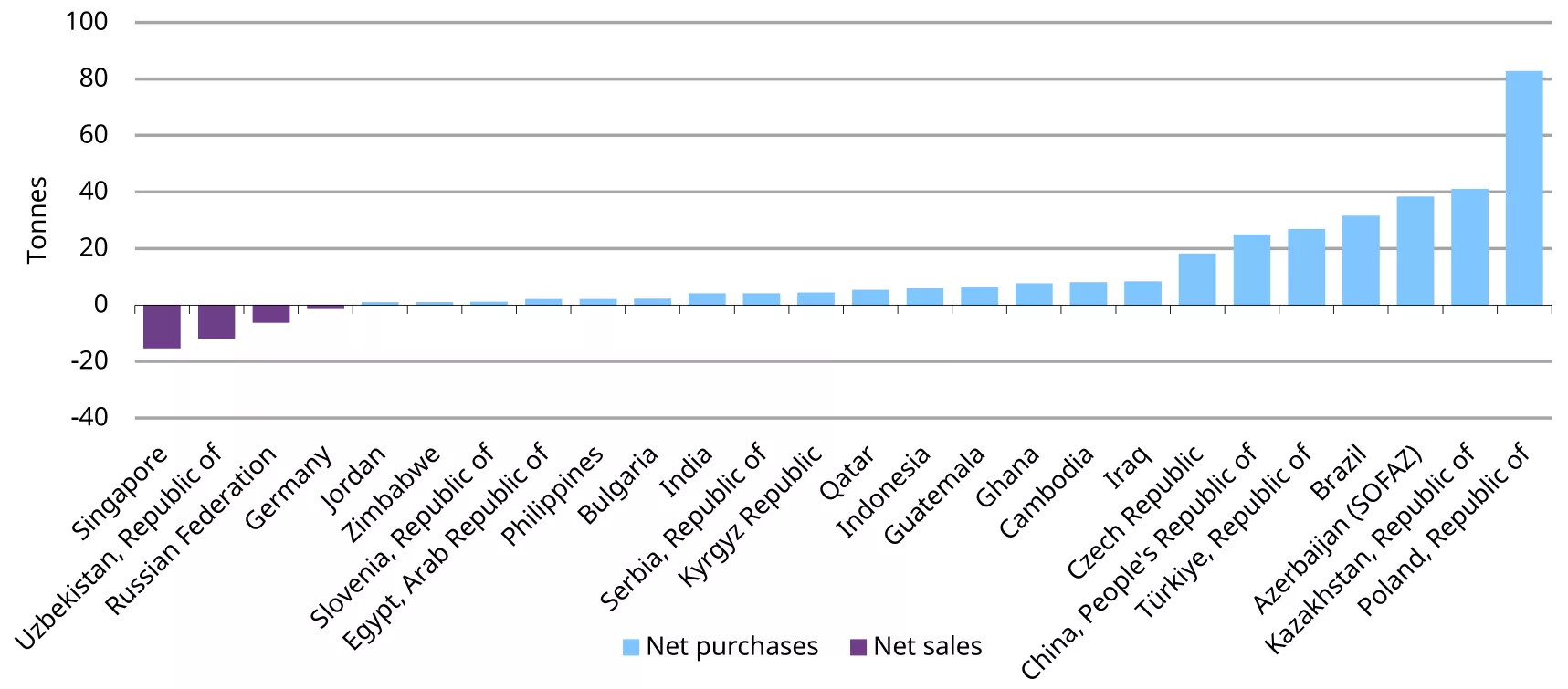
    • The National Bank of Poland re-entered the market in October, having paused its buying since May. After recently increasing its target gold allocation to 30%,1 the purchase of 16t in the month lifted its gold reserves to 531t, 26% of total reserves at end-October prices.
    • The Central Bank of Brazil bought gold for the second consecutive month, adding 16t in October following its 15t purchase in September. Its gold reserves now stand at 161t, accounting for 6% of total reserves.
    • The Central Bank of Uzbekistan (9t), Bank Indonesia (4t), Central Bank of Turkey (3t), Czech National Bank (2t), National Bank of the Kyrgyz Republic (2t), Bank of Ghana (>1t), People’s Bank of China (>1t), National Bank of Kazakhstan (>1t) and the Central Bank of the Philippines (>1t) were also buyers in October.

    At the time of writing, the Central Bank of Russia was the only bank to report a decline in gold reserves in the month – falling by 3t to 2,327t.

    Year-to-date, the National Bank of Poland (83t) continues to be largest official-sector gold buyer, with double the purchases of the next largest buyer, Kazakhstan (41t) (Chart 3). While buying continues to be concentrated among emerging-market central banks, the list of buyers – old and new – remains broad.


    Chart 3: The National Bank of Poland extends y-t-d buying in October

    Y-t-d central bank net purchases and sales, tonnes*


    2

    *Data to 31 October 2025, where available.
    Source: IMF, respective central banks, World Gold Council


    Central banks eye bigger gold reserves

    The National Bank of Serbia plans to boost its gold reserves to at least 100t by 2030, according to a recent statement from Serbian President Aleksandar Vucic.2 This long-term target represents a near-doubling of current holdings, which stood at 52t at the end of October, and signals a continued commitment to gold as a strategic asset in the country’s reserve portfolio.

    At the recent LBMA conference in Kyoto, Madagascar and South Korea also signalled interest in increasing their gold reserves, though neither has provided a specific timeline for these plans.3

    This reinforces the findings of our 2025 survey, which showed that 95% of respondents expected central bank gold reserves to increase in the year ahead.


    Disclaimer

    Important information and disclaimers

    © 2025 World Gold Council. All rights reserved. World Gold Council and the Circle device are trademarks of the World Gold Council or its affiliates.

    Reproduction or redistribution of any of this information is expressly prohibited without the prior written consent of World Gold Council or the appropriate copyright owners, except as specifically provided below. Information and statistics are copyright © and/or other intellectual property of the World Gold Council or its affiliates or third-party providers identified herein. All rights of the respective owners are reserved. 

    The use of the statistics in this information is permitted for the purposes of review and commentary (including media commentary) in line with fair industry practice, subject to the following two pre-conditions: (i) only limited extracts of data or analysis be used; and (ii) any and all use of these statistics is accompanied by a citation to World Gold Council and, where appropriate, to Metals Focus or other identified copyright owners as their source. World Gold Council is affiliated with Metals Focus. 

    The World Gold Council and its affiliates do not guarantee the accuracy or completeness of any information nor accept responsibility for any losses or damages arising directly or indirectly from the use of this information. 

    This information is for educational purposes only and by receiving this information, you agree with its intended purpose. Nothing contained herein is intended to constitute a recommendation, investment advice, or offer for the purchase or sale of gold, any gold-related products or services or any other products, services, securities or financial instruments (collectively, “Services”). This information does not take into account any investment objectives, financial situation or particular needs of any particular person.  

    Diversification does not guarantee any investment returns and does not eliminate the risk of loss. Past performance is not necessarily indicative of future results. The resulting performance of any investment outcomes that can be generated through allocation to gold are hypothetical in nature, may not reflect actual investment results and are not guarantees of future results. The World Gold Council and its affiliates do not guarantee or warranty any calculations and models used in any hypothetical portfolios or any outcomes resulting from any such use. Investors should discuss their individual circumstances with their appropriate investment professionals before making any decision regarding any Services or investments. 

    This information may contain forward-looking statements, such as statements which use the words “believes”, “expects”, “may”, or “suggests”, or similar terminology, which are based on current expectations and are subject to change. Forward-looking statements involve a number of risks and uncertainties. There can be no assurance that any forward-looking statements will be achieved. World Gold Council and its affiliates assume no responsibility for updating any forward-looking statements. 

    Information regarding the LBMA Gold Price 

    The LBMA Gold Price is administered and published by ICE Benchmark Administration Limited (IBA).  The LBMA Gold Price is a trademark of Precious Metals Prices Limited and is licensed to IBA as administrator of the LBMA Gold Price. ICE and ICE Benchmark Administration are registered trademarks of IBA and/or its affiliates. The LBMA Gold Price is used by the World Gold Council with permission under license by IBA. 

    Published LBMA Gold Price information may not be indicative of future LBMA Gold Price information or performance.  None of IBA, Intercontinental Exchange, Inc. (ICE) or any third party that provides data used to administer or determine the LBMA Gold Price (data providers), or any of  its or their affiliates makes any claim, prediction, warranty or representation whatsoever as to the timeliness, accuracy or completeness of LBMA Gold Price information, the results to be obtained from any use of LBMA Gold Price information, or the appropriateness or suitability of using LBMA Gold Price information for any particular purpose. to the fullest extent permitted by applicable law, all implied terms, conditions and warranties, including, without limitation, as to quality, merchantability, fitness for purpose, title or non-infringement, in relation to LBMA Gold Price information, are hereby excluded, and none of IBA, ICE or any data provider, or any of its or their affiliates will be liable in contract or tort (including negligence), for breach of statutory duty or nuisance, or under antitrust laws, for misrepresentation or otherwise, in respect of any inaccuracies, errors, omissions, delays, failures, cessations or changes (material or otherwise) in LBMA Gold Price information, or for any damage, expense or other loss (whether direct or indirect) you may suffer arising out of or in connection with LBMA Gold Price information or any reliance you may place upon it. 

    LBMA Gold Price information provided by the World Gold Council may be used by you internally to review the analysis provided by the World Gold Council, but may not be used for any other purpose. LBMA Gold Price information provided by the World Gold Council may not be disclosed by you to anyone else. 

    md

    Latest research

    Looking for insight and analysis on gold? Our team of experts produce market-leading research and macroeconomic commentary on gold.