• Goldhub
  • Research
  • Central Banks

  • Latest issue

    Central Banks


    Gold as a strategic asset

    New Frontier Advisors and the World Gold council examine the case for gold as a long-term or strategic investment for US investors. From a long-term perspective, a fairly wide consensus exists that gold retains inflation hedging properties despite considerable fluctuations in the shorter term. Earlier studies that reported favourable evidence for the investment value of gold were generally limited by data availability and other methodological deficiencies. Using state-of-the-art statistical estimation technology based on Resampled Efficiency™ optimisation, this study shows that gold may have a comparable portfolio weight to asset classes such as small cap and emerging markets stocks due to its value as a diversifying asset. Gold may provide stability in poor markets and economic climates to long-term institutional strategic investors.

    Central bank demand still sizzling in August

    Krishan Gopaul

    Senior Analyst, EMEA World Gold Council


    • Central banks reported adding 77t of gold to global reserves in August
    • China, Poland and Turkey were again buyers; no notable sales during the month
    • As we head into Q4, central banks remain on course for a strong annual total.

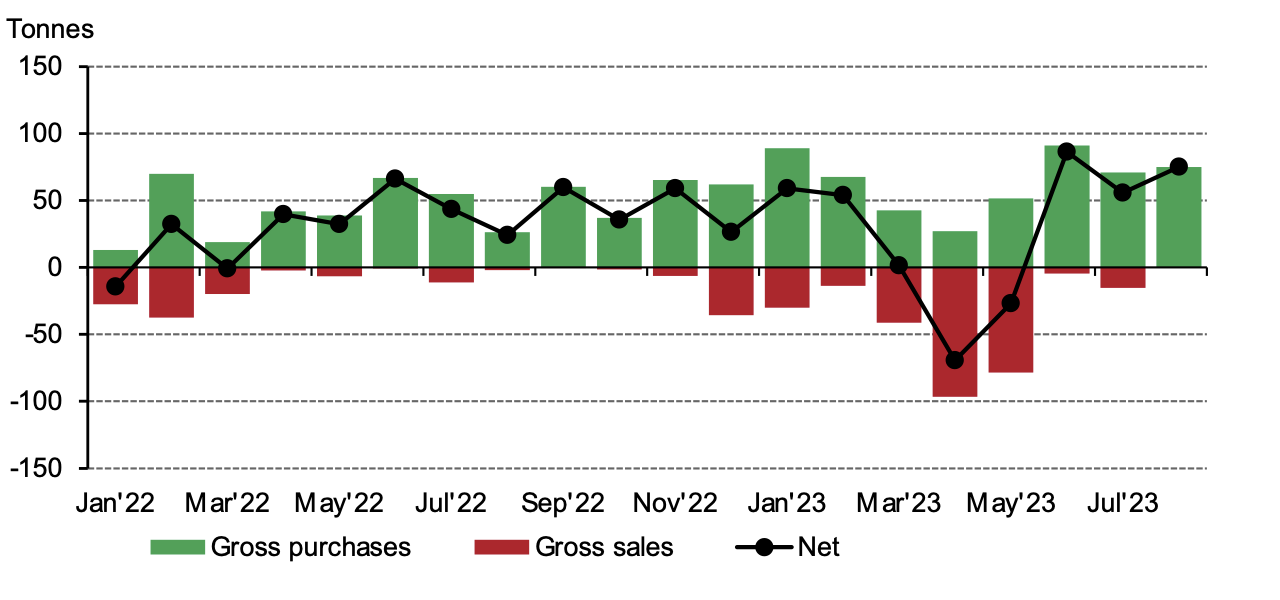
    Central banks collectively increased their gold reserves in August for the third consecutive month. They added – based on the reported data at the time of writing – 77t to global official reserves during the month, a 38% up-tick from July’s buying.1 Over the last three months, their combined net buying has totalled 219t, comfortably outweighing the combined net sales from April and May (96t). 
     

    Central banks post another month of strong gold buying in August*

    This recent buying suggests that we have now firmly moved past the net selling we saw in April and May, which was primarily driven by heavy, non-strategic selling from Turkey. We are therefore confident that the long-term trend of healthy central bank demand remains in place.

    Buying, however, continues to be sizeable but limited to a small number of banks. The People’s Bank of China once again led the pack, adding a further 29t during the month. This brings its y-t-d net purchases to 155t, and its total buying since last November – when it began regularly reporting purchases – to 217t. As a result, gold holdings climbed to 2,165t at the end of August, accounting for just over 4% of total reserves.

    The National Bank of Poland (NBP) also remained a significant buyer during the month. The NBP bought a further 18t, bringing its y-t-d net buying to 88t and a step closer to its previously stated 100t buying target.2  Its gold reserves now amount to 314t (11% of total reserves). Meanwhile, the Central Bank of Turkey added 15t to its gold reserves in August as it continues to rebuild its reserves following the sales mentioned above.3  

    The Central Bank of Uzbekistan (9t), the Reserve Bank of India (2t), the Czech National Bank (2t), Singapore (2t) and National Bank of the Kyrgyz Republic (1t), were the other buyers in the month. The Central Bank of Russia also reported a 3t increase in its gold reserves in August, taking its gold reserves back to where they started the year at 2,333 tonnes.

    While reported sales were virtually non-existent in the month, Bloomberg reported claims that the Central Bank of Bolivia had “monetised” 17t of its gold reserves between May and August. This follows new legislation in May enabling the central bank to utilise its gold reserves.4 If confirmed, this would represent a 40% decline in its gold reserves (tonnage terms). Until confirmed, however, there is ambiguity in the use of “monetise” as this could mean several things, including, for example, outright sales or swap agreements. Currently, data on gold reserves at the Central Bank of Bolivia is not available after April, so we await more information.


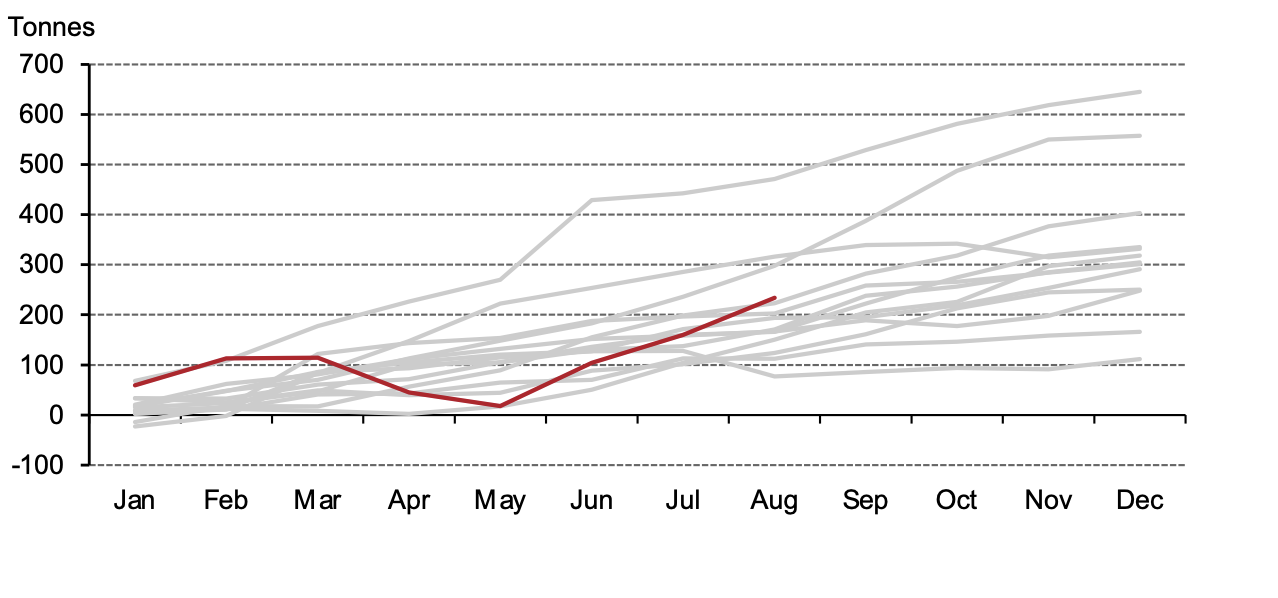
    Cumulative reported central bank demand by year since 2010 (red line: YTD 2023)*

    Suffice to say, central bank buying remains healthy. Even accounting for the net sales earlier in the year, the pace of buying so far this year suggests that we are on course for another strong annual total. We’ll cover overall central bank demand for Q3 and y-t-d in our next Gold Demand Trends report, which will be published at the end of October.

    Footnotes

    1Based on monthly IMF IFS data and supplemented with data from respective central banks where available and not reported through the IMF at the time of publication. IMF IFS data is reported with a two-month lag, and while most institutions report on a regular basis, some may report with a – sometimes significant – delay. Figures may be subsequently revised as more data becomes available. The data used here informs but is distinct from the central bank demand estimates we report in Gold Demand Trends. Please see footnote 3 for more information.

    2www.biznes.interia.pl/gospodarka/news-adam-glapinski-prezes-nbp-bede-namawiac-rpp-do-kolejnej-podw,nId,5823037

    3Turkey’s official sector gold reserves are the sum of central bank-owned gold and Treasury gold holdings. This is equivalent to gross gold reserves less all gold held at the central bank in relation to commercial sector gold policies (such as the Reserve Option Mechanism (ROM), collateral, deposits and swaps). For information on this methodology, click here.

    4www.bloomberg.com/news/articles/2023-05-05/bolivian-senate-approves-general-terms-of-bill-to-monetize-gold
    Central bank gold buying remains hot in July

    Krishan Gopaul

    Senior Analyst, EMEA World Gold Council


    • Central banks added 55t to global gold reserves in July
    • China and Poland both added around 23t, while Turkey was again among the buyers
    • Selling was limited but volumes were still notable


    Having reported a return to net buying in June, the latest data shows global central banks continued to add to their gold reserves in July. Central banks reported healthy net purchases of 55t during the month.1 Despite the month-on-month slowdown – owing to the late reporting of a 30t purchase by the Central Bank of Libya in June – the latest data does seem to support our view that the longer-term buying trend remains in place.


    Central banks remained net buyers in July*

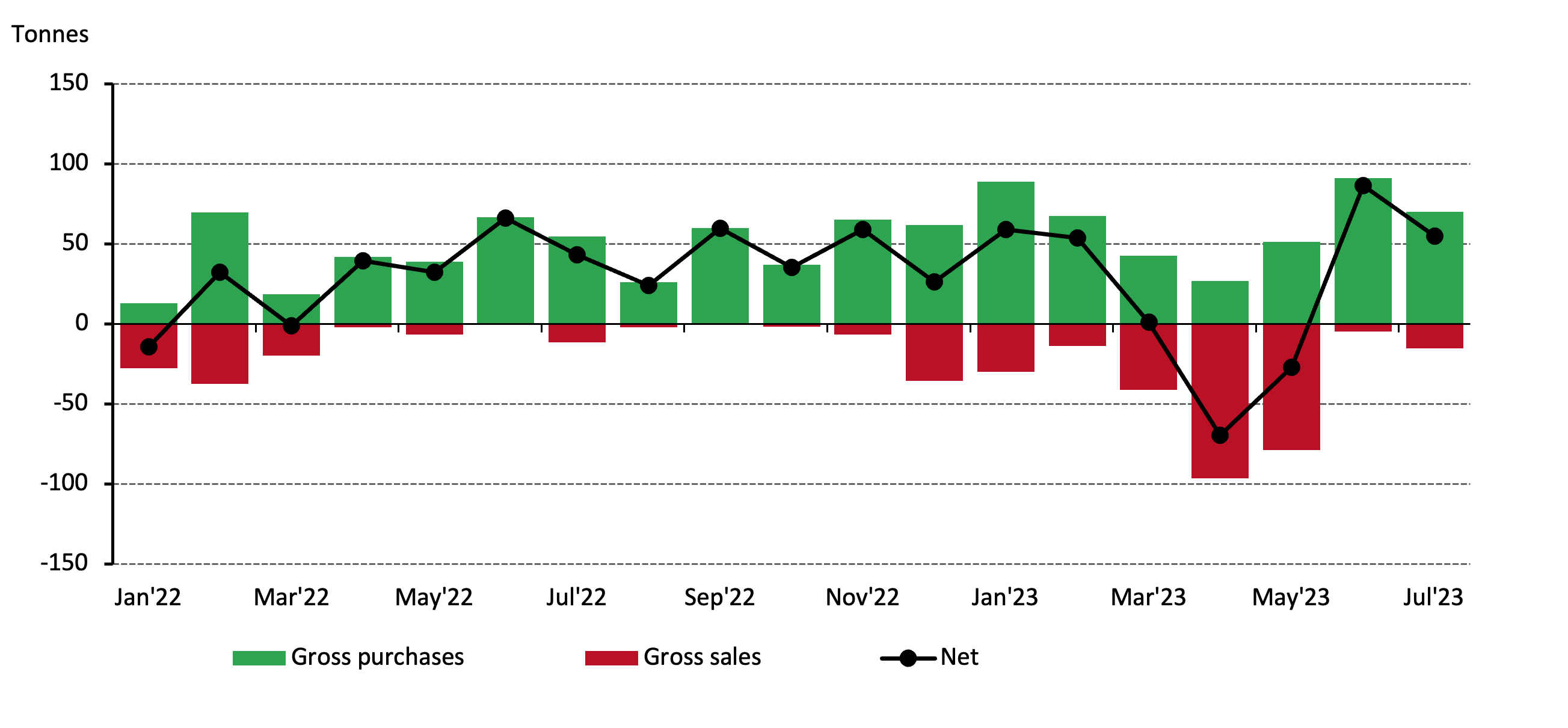
    Looking at the detailed activity during July, two things are notable: 1) relatively few banks altered their gold holdings in July, and 2) many that did buy/sell did so sizeably.

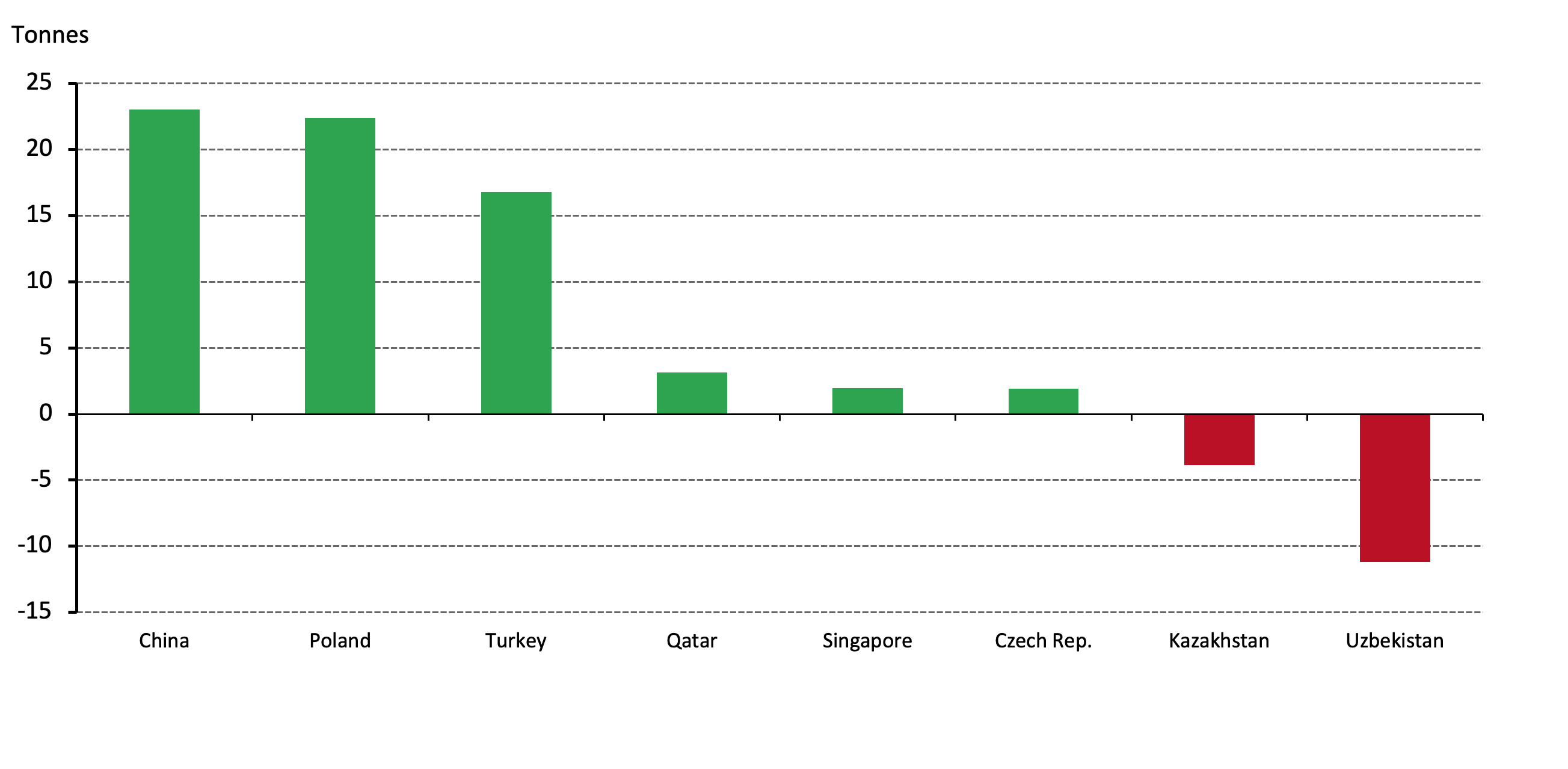
    The People’s Bank of China (PBoC) was once again the largest buyer, adding 23t during the month and cementing its place as the largest buyer year-to-date (126t). Since it began regularly reporting gold buying in November, the PBoC has bought a net 188t, lifting its total gold reserves to 2,136t (4% of total reserves). The National Bank of Poland (NBP) was a close second, increasing its gold reserves by 22t during July, boosting its total gold holdings to 299t. This is the fourth consecutive month of net buying, with purchases over this period totalling 71t – just 29t shy of the NBP’s stated aim of increasing its gold reserves by 100t.2

    The Central Bank of Turkey was again among the buyers in July.3 Having flipped back to net purchases in June (11t), it added a further 17t in July. However, on a year-to-date basis the central bank remains a net seller (85t) owing to the heavy selling between March and May. Gold import quotas were reinstated in early August so it remains to be seen whether this will lead to renewed selling from the central bank should local gold demand remain elevated.4 Qatar (3t), Singapore (2t) and the Czech Republic (2t) also bought gold during the month.

    In early August, it was also reported that Russia would recommence the buying of foreign currency and gold.5 However, scant information was available on the size or timing of any future gold purchases so we just need to watch the monthly data.


    Buying and selling was limited in July, but volumes were sizeable*

    There were fewer sales than purchases in July, but volumes were still meaningful. The Central Bank of Uzbekistan (11t) and the National Bank of Kazakhstan (4t) were the two noteworthy and familiar sellers in the month. Further sales from central banks should not be discounted, especially from those that buy from domestic sources, such as the two above. In fact, the National Bank of Kazakhstan has been upfront on its plans to further reduce its gold reserves by the end of the year.6

    Following the release of our latest Gold Demand Trends report, it’s undeniable that strength of central bank gold demand remains headline news. After recent heavy selling – largely from Turkey – monthly net purchases have re-established themselves in June and July. As such, we think this is a sector gold observers should continue to pay attention to.

    Footnotes

    1Based on monthly IMF IFS data and supplemented with data from respective central banks where available and not reported through the IMF at the time of publication. IMF IFS data is reported with a two-month lag, and while most institutions report on a regular basis, some may report with a – sometimes significant – delay. Figures may be subsequently revised as more data becomes available. The data used here informs but is distinct from the central bank demand estimates we report in Gold Demand Trends. Please see footnote 3 for more information.

    2biznes.interia.pl/gospodarka/news-adam-glapinski-prezes-nbp-bede-namawiac-rpp-do-kolejnej-podw,nId,5823037

    3Turkey’s official sector gold reserves are the sum of central bank-owned gold and Treasury gold holdings. This is equivalent to gross gold reserves less all gold held at the central bank in relation to commercial sector gold policies (such as the Reserve Option Mechanism (ROM), collateral, deposits and swaps). For information on this methodology, click here.

    4www.reuters.com/world/middle-east/turkey-plans-gold-import-quota-cut-ca-deficit-source-2023-08-07

    5www.bloomberg.com/news/articles/2023-08-03/russia-to-restart-buying-currency-gold-as-energy-income-revives

    6www.bloomberg.com/news/articles/2023-07-31/one-big-gold-seller-among-central-banks-has-even-more-to-offload?

    Central banks return to net buying in June

    Krishan Gopaul

    Senior Analyst, EMEA World Gold Council


    • Central banks bought a net 55t of gold in June following three straight months of selling
    • The Central Bank of Türkiye's return to net buying in June helped the trend in central bank demand remain steadfast


    Following three months of net sales, central banks reported net buying again in June* 

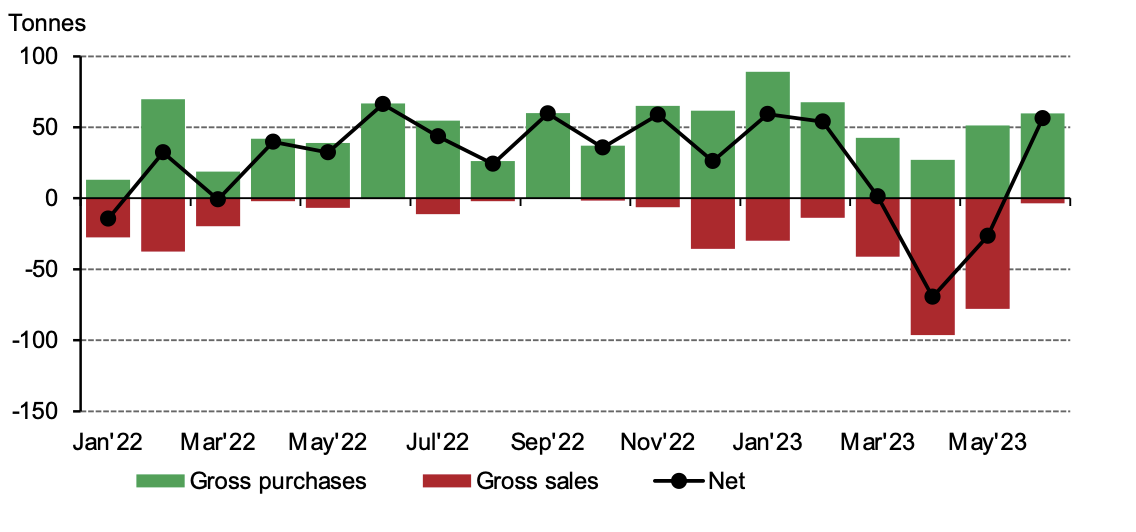
    Reported net purchases from central banks totalled 55t, the first month of sizeable global net buying since February.1 

    As in recent months, activity from the Central Bank of Türkiye (CBRT) was pivotal to the global total.2 Having been a significant net seller between March and May in order to meet local demand, it swung back to net buying in June, adding 11t to its official reserves.3 The CBRT’s total gold reserves stood at 440t at the end of June (29% of total reserves).

    The bank’s activity underlined and clarified the continuing trend in central bank gold demand. Six central banks added gold during the month, with only two notable sellers. Among the buyers, the People’s Bank of China was the largest. It added 21t to its gold reserves during June, the eighth consecutive month of purchases. Since it began reporting increases in November 2022, gold reserves have grown by 165t (+8%), of which 103t has been bought in 2023, making it the largest buyer y-t-d.

    The National Bank of Poland (NBP) was another large purchaser in June, increasing its gold reserves by 14t. This is the third consecutive month of buying from the bank, which last year indicated that it planned to add 100t to its gold reserves.4 The NBP has added 48t y-t-d, pushing its total gold holdings to 277t. Uzbekistan (8t), the Czech Republic (3t), Qatar (2t) and India (1t) were the other notable buyers in June.

    At the time of writing, Kazakhstan and Singapore were the only significant (one tonne or more) sellers in June. Kazakhstan’s official gold reserves fell by 3t to 314t (56% of total reserves), with the bank indicating that more selling will likely occur before the end of the year.5 More frequent buying and selling from banks that obtain gold from domestic sources, such as Kazakhstan, is not uncommon. The Monetary Authority of Singapore reduced its gold reserves by 1t during the month.

    To read more about central bank gold demand in H1 as a whole, please see our latest Gold Demand Trends report.6 

    Footnotes

    1Based on monthly IMF IFS data and supplemented with data from respective central banks where available and not reported through the IMF at the time of publication. IMF IFS data is reported with a two-month lag, and while most institutions report on a regular basis, some may report with a – sometimes significant – delay. Figures may be subsequently revised as more data becomes available. The data used here informs but is distinct from the central bank demand estimates we report in Gold Demand Trends. Please see footnote 3 for more information.

    2Türkiye official sector gold reserves are the sum of central bank-owned gold and Treasury gold holdings. This is equivalent to gross gold reserves less all gold held at the central bank in relation to commercial sector gold policies (such as the Reserve Option Mechanism (ROM), collateral, deposits and swaps). For information on this methodology, click here.

    3For more, see: Turkey to suspend some gold imports after earthquake -Bloomberg News | Reuters

    4biznes.interia.pl/gospodarka/news-adam-glapinski-prezes-nbp-bede-namawiac-rpp-do-kolejnej-podw,nId,5823037

    5www.bloomberg.com/news/articles/2023-07-31/one-big-gold-seller-among-central-banks-has-even-more-to-offload

    6For purposes of Gold Demand Trends, central bank demand is defined as net purchases (i.e. gross purchases less gross sales) by central banks and other official sector institutions, including supra national entities such as the IMF and sovereign wealth funds where applicable. Our quarterly central bank demand data is sourced from Metals Focus, whose proprietary estimates of official sector activity incorporate various sources, including IMF IFS reports, international trade data, and others. As such, IMF IFS data is a subset of what is included in Gold Demand Trends. Both data sets are subject to revision as new information is made available and/or to accommodate late or updated data reported by official institutions.

    Central banks bought 77t in September

    Krishan Gopaul

    Senior Analyst, EMEA World Gold Council


    Download PDF

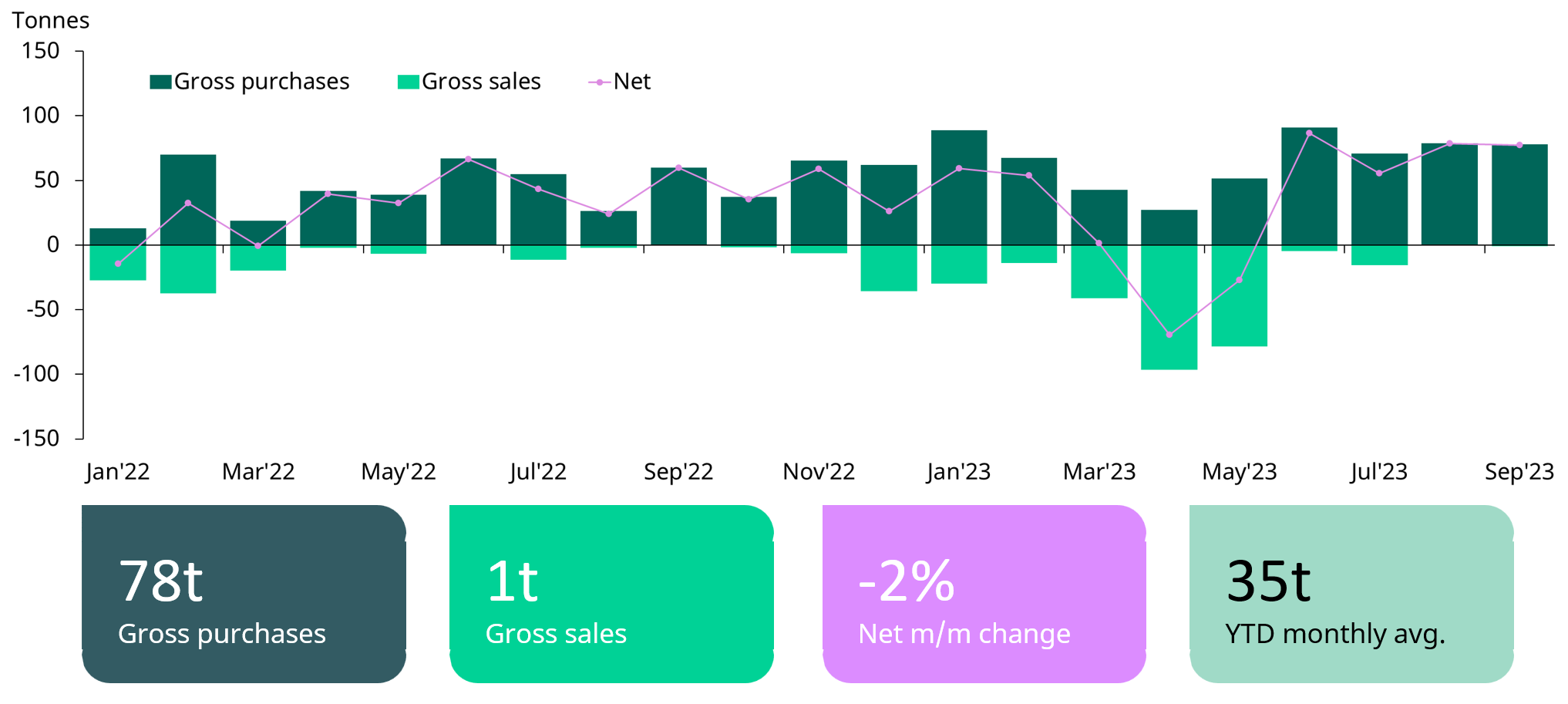
    • Reported global central bank gold reserves, via the IMF and publicly available sources, rose by a net 77t in September
    • Gross sales (1t) were dwarfed by gross purchases (78t), highlighting the strength of buying

    Change by country

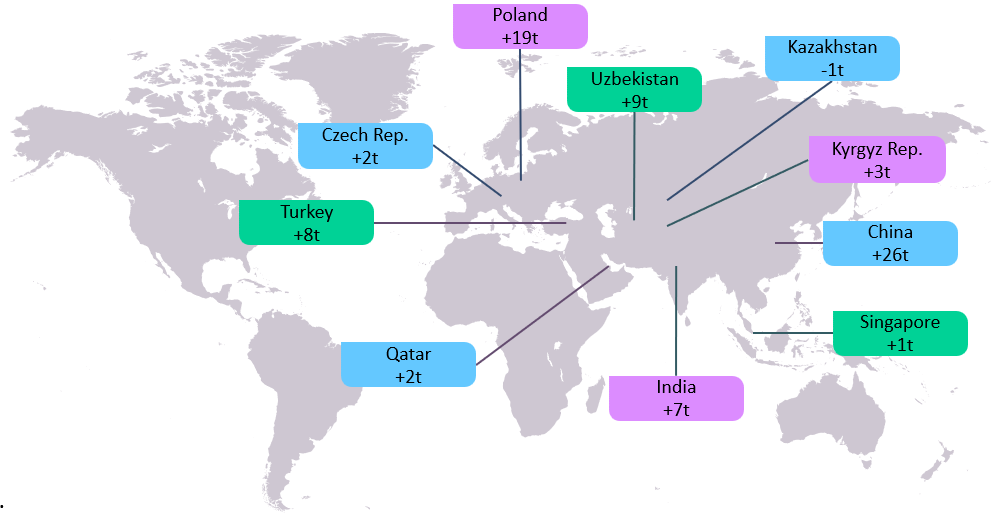
    Central bank purchases in September 2023 were dominated by banks who have been regular buyers so far this year.

    Major buyers were all from emerging markets. The People’s Bank of China added the most gold during the month (26t), followed by the National Bank of Poland and the Central Bank of Uzbekistan.

    Changes year-to-date

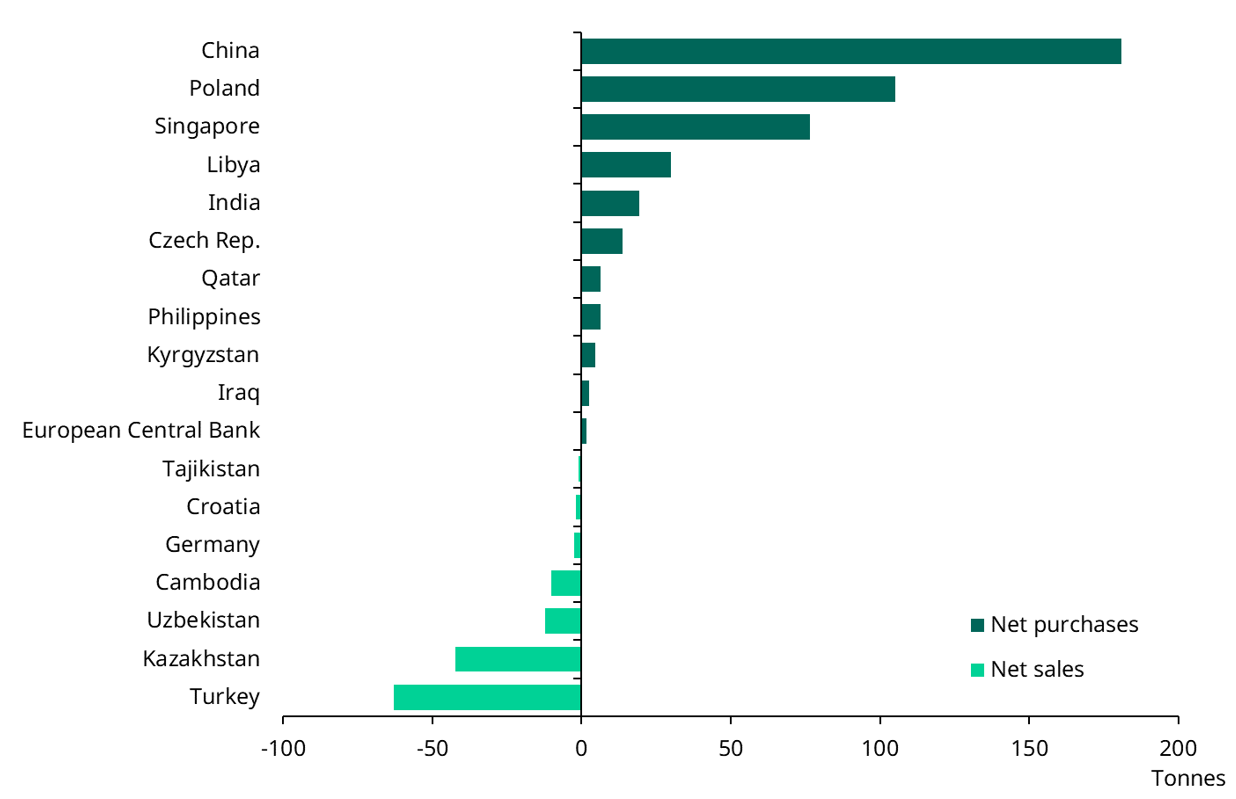
    The People’s Bank of China remains the largest gold purchaser in 2023.

    Emerging market banks have been the driving force on both the purchases and sales side.

    The Monetary Authority of Singapore remains the sole developed market bank adding gold to its reserves (the ECB addition was related to Croatia joining the eurozone in January).


    Latest research

    Looking for insight and analysis on gold? Our team of experts produce market-leading research and macroeconomic commentary on gold.