You asked, we answered: Markets may not buy the buybacks
21 August, 2026
In response to a relentless rise in longer-term bond yields, the US Treasury announced that they were increasing their ‘buybacks’ of longer-term Treasuries to stem the rise.1 Yields dropped, as did the dollar and gold rallied 3% (Chart 1). This is not yield-curve control (YCC) but it might be a step in that direction, as Mohamed El-Erian remarked following the announcement.2 Here’s our take on what it means.
Chart 1: Yields, dollar and gold react to US Treasury buyback announcement
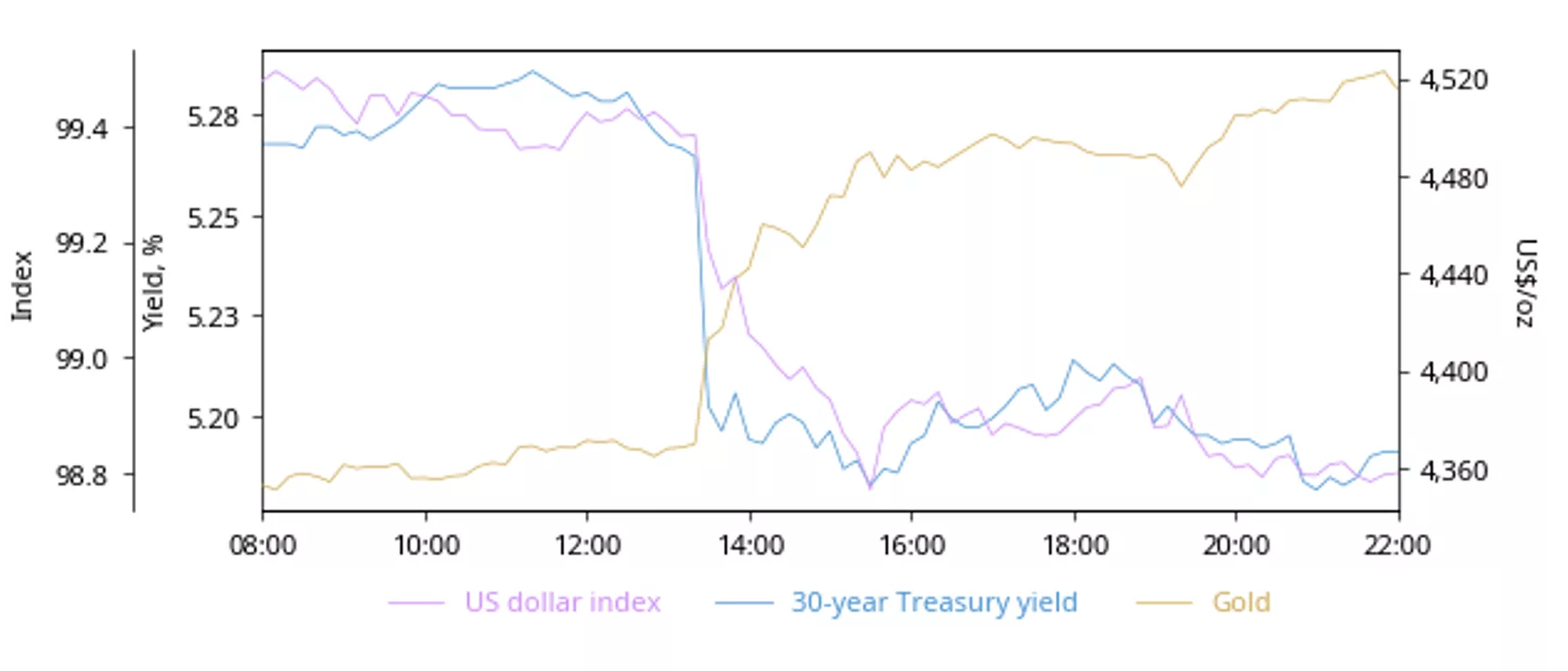
* Intraday reaction to Treasury buyback announcement on 19 August 2026.
Source: Bloomberg, World Gold Council
Who’s going to buy our bonds?
While Treasury yields ultimately reflect expectations for growth, inflation and monetary policy, investors are paying increasing attention to the balance between a growing supply of government debt and the willingness of different buyer groups to absorb it.
On the supply side, issuance continues to grow: persistent fiscal deficits require ever larger amounts of borrowing, alongside an expanding debt stock that also needs refinancing.3,4
On the demand side, some traditional buyers appear more skittish. Foreign official institutions continue to diversify reserves, foreign private investors face attractive yields elsewhere and official ones are diversifying US dollar exposure. Banks remain balance-sheet constrained5, and corporate borrowing linked to AI and data-centre investment is competing for investor capital (Chart 2). Plus, a growing share of Treasury demand has come from highly price-sensitive private-sector investors, including hedge funds.6
Chart 2: Treasury issuance rising sharply but AI-related issuance competing for capital
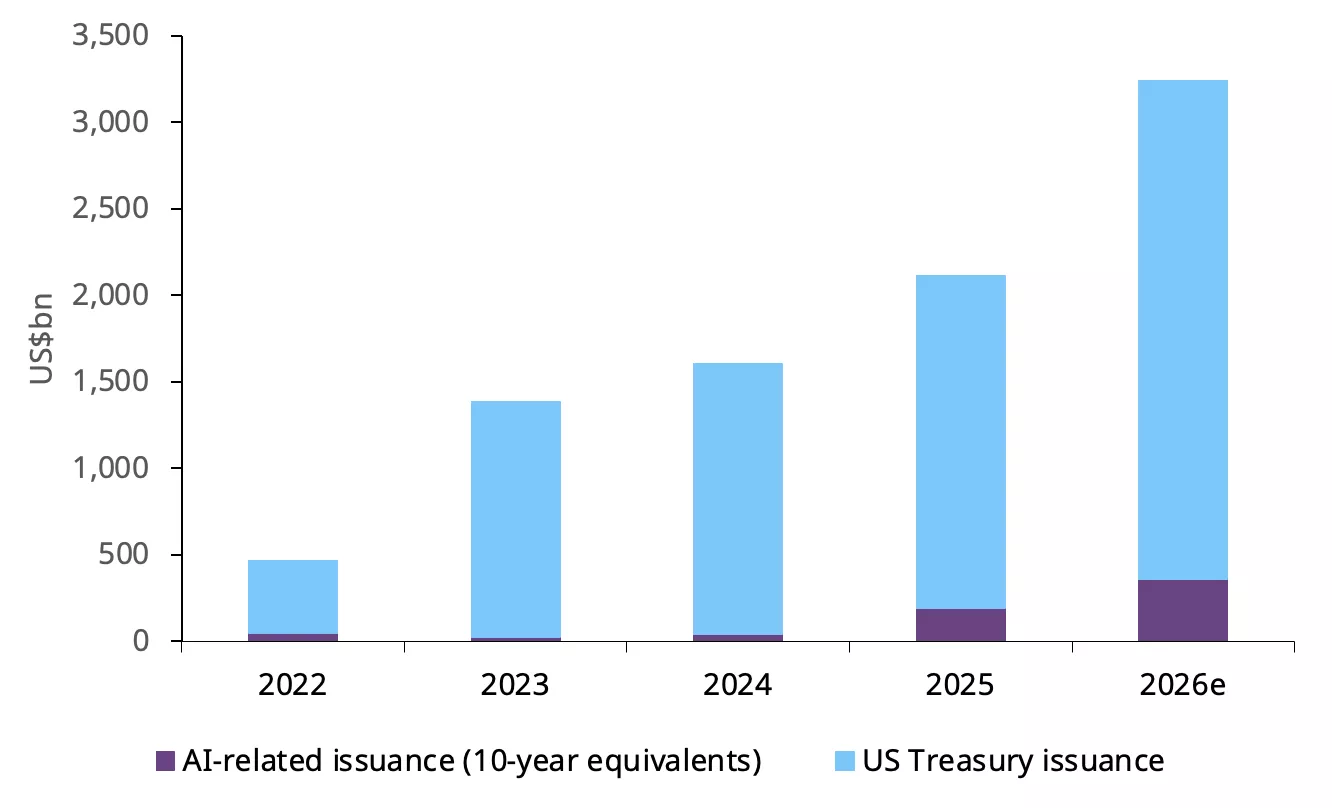
*AI issuance sourced from Dallas Fed How AI debt financing impacts duration supply and interest rates - Dallasfed.org. Treasury issuance sourced from SIFMA
Source: Bloomberg, Dallas Fed, SIFMA, World Gold Council
In this environment - and against a backdrop of elevated inflation, concerns around the trajectory of public debt and the independence of policymakers - investors are demanding greater compensation to hold long-dated Treasuries. The recent yield rise suggests that investors no longer assume Treasury supply will be absorbed effortlessly. Instead, the balance between supply and demand has become an increasingly important determinant of pricing.
Policymakers’ options are limited
The Treasury’s increased use of buybacks highlights a willingness by policymakers to intervene at the margin without resorting to more overt forms of support such as QE.
There are softer options including reconfiguring the enhanced Supplementary Leverage Ratio ( eSLR)7, discouraging sales of Treasuries – as we saw during the yen intervention8 in early August – as well as stablecoin promotion. But these measures probably just paper over the cracks.
Fed support via a new round of QE is unlikely, because it carries significant credibility baggage. Why deploy an extraordinary balance-sheet tool to manage the long end of the curve, that the Fed Chair has been vocally opposed to9, when rate hikes could, in principle, achieve a similar outcome by tempering the inflation outlook and containing term premia? Alas, rate hikes may not be palatable ahead of the Midterms. An alternative might be yield curve control (YCC), where the Fed rather than the Treasury, would intervene directly to cap yields.
Why YCC might be tabled, unofficially
YCC may be more than just an academic concept. It was tabled by the Fed in 2020 in response to COVID.10 It was used in the 1940s in the US and was initially successful. Japan and Australia also deployed YCC in the last decade.11 For those two countries it was meant to prevent yields from falling below desired levels as well as influence the shape of the curve. In today's US context, the goal would be to cap yield rises, as it did in the 1940s.
Unlike QE, YCC doesn't necessarily require a large expansion of the Fed's balance sheet. QE is about quantity. It creates a visible balance-sheet expansion and helped underpin one of the defining post-GFC narratives for gold. YCC could conceivably be implemented sporadically, with a much smaller balance-sheet footprint. It could even be sold as a measure to improve market functioning rather than macroeconomic stimulus. Just because it walks like a duck and quacks like a duck, doesn't mean it's a duck. It's monetary policy's version of plausible deniability.
What it might mean for gold
As with everything, the impact on gold is unsurprisingly not a one-way street. Aside from the fact that US monetary policy is only one of many drivers of global gold prices, even for Western investors, YCC wouldn't automatically translate into a bullish outcome for gold. But our view is that the positives would likely outweigh the negatives and likely invite substantial interest in gold:
- Pressure on the US dollar. A weaker dollar would probably be the most immediate channel through which YCC would benefit gold. We caught a glimpse of that during the buyback announcement on 19 August. In our view the expensive US dollar is already facing pressure from several corners and YCC, much like the buyback program, could increasingly force the adjustment through the currency rather than the bond market12
- Financial repression, another fancy term for keeping yields at bay, would usher in a tug of war between policymakers and the market. A Treasury market that clears at an administratively influenced price brings uncertainty because investors don’t know where yields would settle absent intervention. As we've seen with interventions elsewhere, most notably Japan, markets can be relentless. It doesn't require aggressive short sellers, perhaps not even outright sellers, just an absence of buyers. And it’s perhaps not just low yields that would attract investors to gold, but that yields are being kept low because letting them clear at market prices are a policy concern
- Lower real rates. YCC would likely make it harder for nominal yields to keep up with rising inflation expectations. If policymakers succeed in capping yields with elevated inflation, investors face lower real returns on government bonds. The inverse relationship between gold and real yields would likely become stronger as a result.
But of course, YCC could work, if investors viewed the policy as credible and temporary. It would remove concerns about market dysfunction and probably compress term premia and improve sentiment. And oddly, that could see gold weaker even in the face of lower bond yields. But the US experience in the 1940s suggests that such arrangements can become difficult to maintain. During that episode, YCC eventually unravelled, colliding with rising inflation and concerns over Fed independence. Sound familiar?
Unfortunately, we don’t have a counterfactual for how gold would have performed then, as it wasn’t freely available to buy and sell, like other hard metals such as silver and copper. And gold mining companies were an imperfect proxy: they captured some of the monetary demand for gold but margins were simultaneously squeezed by rising costs.
But our experience over the last few years suggests that the debt mountain concern – in the US and elsewhere - remains one of the pillars of gold demand and any attempts to manage that burden not involving a reduction of debt or deficits are likely to continue favouring gold.
Footnotes
1US Treasury to boost long-term bond purchases in bid to steady market
3The Budget and Economic Outlook: 2026 to 2036 | Congressional Budget Office
4Federal Debt Management: Treasury Is Meeting Borrowing Needs but the Deteriorating Fiscal Outlook Poses Risks | U.S. GAO
5Treasury Market Resiliency and Large Banks’ Balance Sheet Constraints - Bank Policy Institute
6The Fed - Decomposing Hedge Funds’ U.S. Treasury Exposures
7Bank Capital Requirements and Treasury Market Resiliency
8US Treasury undertakes historic intervention in yen market
9Shrinking the Fed’s Balance Sheet Is Easier Said Than Done | Stanford Graduate School of Business
10Minutes of the Federal Open Market Committee June 9-10, 2020
Disclaimer
Important information and disclaimers
© 2026 World Gold Council. All rights reserved. World Gold Council and the Circle device are trademarks of the World Gold Council or its affiliates.
All references to LBMA Gold Price are used with the permission of ICE Benchmark Administration Limited and have been provided for informational purposes only. ICE Benchmark Administration Limited accepts no liability or responsibility for the accuracy of the prices or the underlying product to which the prices may be referenced. Other content is the intellectual property of the respective third party and all rights are reserved to them.
Reproduction or redistribution of any of this information is expressly prohibited without the prior written consent of World Gold Council or the appropriate copyright owners, except as specifically provided below. Information and statistics are copyright © and/or other intellectual property of the World Gold Council or its affiliates or third-party providers identified herein. All rights of the respective owners are reserved.
The use of the statistics in this information is permitted for the purposes of review and commentary (including media commentary) in line with fair industry practice, subject to the following two pre-conditions: (i) only limited extracts of data or analysis be used; and (ii) any and all use of these statistics is accompanied by a citation to World Gold Council and, where appropriate, to Metals Focus or other identified copyright owners as their source. World Gold Council is affiliated with Metals Focus.
The World Gold Council and its affiliates do not guarantee the accuracy or completeness of any information nor accept responsibility for any losses or damages arising directly or indirectly from the use of this information.
This information is for educational purposes only and by receiving this information, you agree with its intended purpose. Nothing contained herein is intended to constitute a recommendation, investment advice, or offer for the purchase or sale of gold, any gold-related products or services or any other products, services, securities or financial instruments (collectively, “Services”). This information does not take into account any investment objectives, financial situation or particular needs of any particular person.
Diversification does not guarantee any investment returns and does not eliminate the risk of loss. Past performance is not necessarily indicative of future results. The resulting performance of any investment outcomes that can be generated through allocation to gold are hypothetical in nature, may not reflect actual investment results and are not guarantees of future results. The World Gold Council and its affiliates do not guarantee or warranty any calculations and models used in any hypothetical portfolios or any outcomes resulting from any such use. Investors should discuss their individual circumstances with their appropriate investment professionals before making any decision regarding any Services or investments.
This information may contain forward-looking statements, such as statements which use the words “believes”, “expects”, “may”, or “suggests”, or similar terminology, which are based on current expectations and are subject to change. Forward-looking statements involve a number of risks and uncertainties. There can be no assurance that any forward-looking statements will be achieved. World Gold Council and its affiliates assume no responsibility for updating any forward-looking statements.
Information regarding the LBMA Gold Price
The LBMA Gold Price is used by the World Gold Council with permission under license by ICE Benchmark Administration Limited and is subject to the restrictions set forth here (www.gold.org/terms-and-conditions).
Information regarding QaurumSM and the Gold Valuation Framework
Note that the resulting performance of various investment outcomes that can be generated through use of Qaurum, the Gold Valuation Framework and other information are hypothetical in nature, may not reflect actual investment results and are not guarantees of future results. Neither World Gold Council (including its affiliates) nor Oxford Economics provides any warranty or guarantee regarding the functionality of the tool, including without limitation any projections, estimates or calculations.
Information from ICRA Analytics Limited
All information obtained from ICRA Analytics Limited contained in this document is subject to the disclaimer set forth here (www.icraanalytics.com/terms-of-use/disclaimer).