You asked, we answered: Why are central banks moving their gold reserves
15 September, 2026
Gold on the move
On 2 September, De Nederlandsche Bank (DNB) announced that it had transferred approximately 86t of gold from New York and Ottawa to London.1 The operation, conducted between March and August 2026, was designed to improve the liquidity and tradability of DNB’s gold reserves and strengthen its preparedness for severe crises.
At first glance, the decision might look like another example of a central bank bringing its gold closer to home. It is more revealing than that. London’s share of Dutch gold reserves rose from 18.1% to 32.1%, surpassing domestic holdings of 30.8% and making London, rather than the Netherlands, the largest single storage location for Dutch gold. The shares held in New York and Ottawa fell to 18.5% each, from 31.3% and 19.7%, respectively.
The mechanics were equally significant. Around 59t was sold in New York and replaced with internationally tradable gold in London. More than 27t of gold was physically transported from North America to DNB’s facility in Zeist, while a similar quantity moved from Zeist to London. This was therefore a strategic reallocation of reserve locations, not simply 86t of bullion being flown across the Atlantic.
The announcement nevertheless highlights a broader shift in central bank thinking on where gold reserves should be stored to balance security, accessibility and liquidity.
From repatriation to location strategy
Gold repatriation is not new.2 In 2000, Germany transferred around 930t from London to Frankfurt, with the Bundesbank subsequently confirming that the gold had been inspected and that some bars were to be recast to meet Good Delivery standard.3 But the issue became much more prominent after the global financial crisis.
Venezuela returned 160t from foreign institutions in 2011–12.4 Germany followed with a second programme, transferring 674t from New York and Paris to Frankfurt between 2013 and 2017.5 The Netherlands moved 122.5t from New York to Amsterdam in 2014,6 while Austria moved 90t from London between 2015 and 2018.7 Later in the decade, Türkiye changed the overseas custody location of part of its gold, while Hungary and Poland moved physical reserves into domestic storage.
The range of countries reviewing or changing their gold storage arrangements has broadened since then. Serbia reportedly returned around 13t between 2021 and 2022.8 India has progressively increased domestic gold holdings since 2022, with the pace of relocation accelerating sharply after March 2023.9 France also changed the geographical distribution of its gold exposure in 2025–26, selling 129t held in New York and acquiring an equivalent quantity of replacement gold in Europe. The Banque de France did not describe the operation as a physical relocation.10
Chart 1: Selected central bank repatriations, strategic relocations and uncompleted proposals since 2000
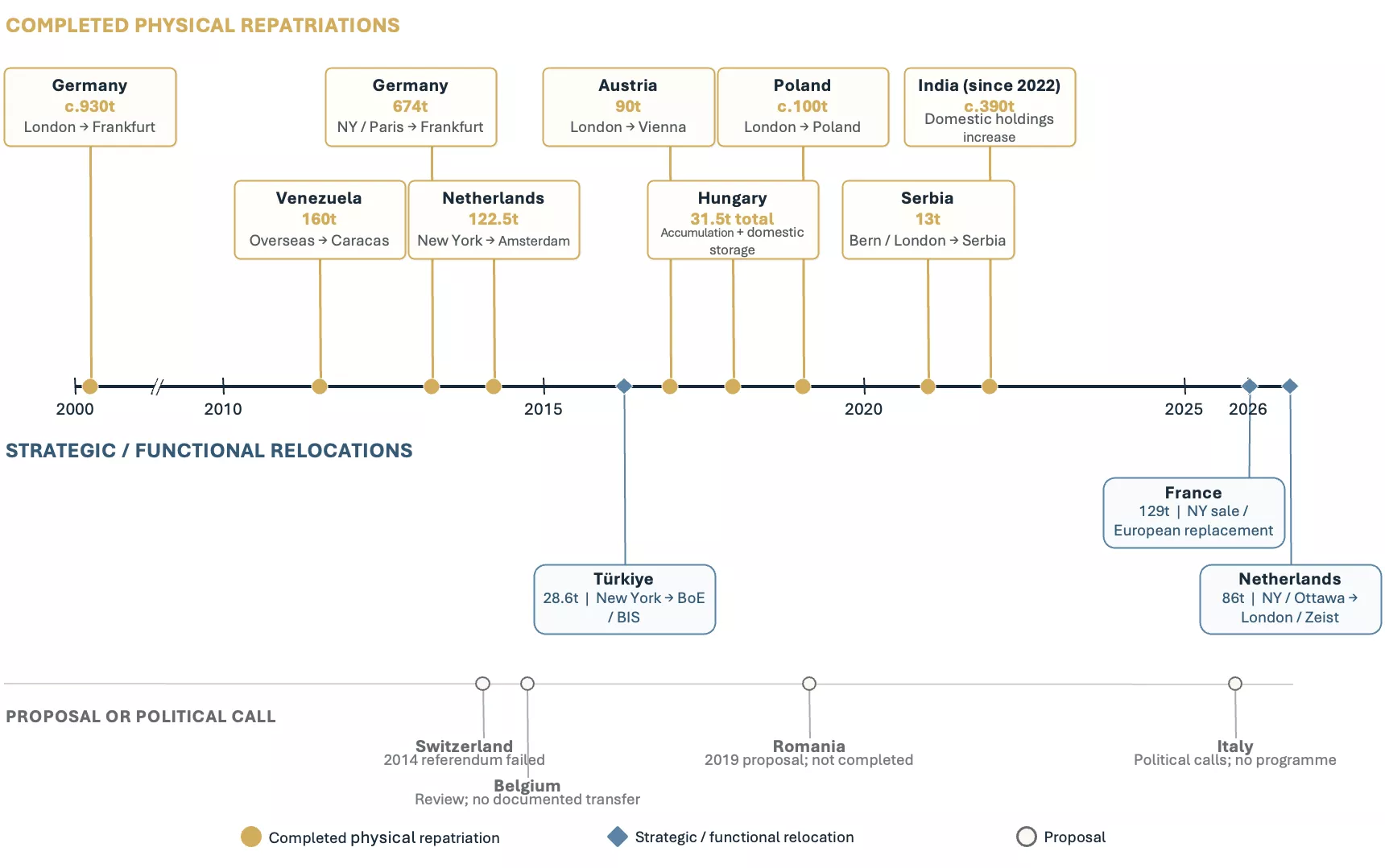
Dates reflect the announcement or broad programme period. Routes are simplified. Changes in custody position do not always prove physical shipment.
Source: World Gold Council analysis of central bank disclosures and cited public sources
Three waves, but no single motivation
One way to interpret the post-2000 history is through three broad, overlapping waves:
- The first wave reflected an early reassessment of reserve location arrangements. Germany’s transfer of around 930t from London to Frankfurt in 2000 showed that the geographical distribution of official gold was already being reconsidered well before repatriation became a prominent geopolitical issue.
- In the second wave, from roughly 2011 to 2019, questions of national control and public confidence became more visible. Venezuela presented its decision in terms of greater national control.11 Elsewhere, central banks generally pursued more balanced strategies. Germany wanted half of its reserves in Frankfurt, while Austria also ultimately held half of its gold reserves domestically but retained substantial holdings in London and Switzerland to preserve access to international markets; Poland combined domestic repatriation with a major expansion of its gold reserves.
- The third wave is more complex. Heightened geopolitical uncertainty has increased attention on jurisdiction, access during a crisis and exposure to overseas financial infrastructure.12 Yet recent operations by France and DNB show that the answer does not necessarily lie in domestic storage alone. Central banks are increasingly optimising across three considerations: custody risk, physical accessibility and market liquidity.
DNB’s decision captures this evolution particularly well. In 2014, it moved gold from New York to Amsterdam to increase the proportion held domestically. In 2026, it moved gold from North America predominantly to London to make it more readily deployable. These decisions point in different geographical directions, but share the same objective: resilience through a more purposeful distribution of reserves.
Chart 2: Where do you currently vault your gold reserves? (Please select all that apply)
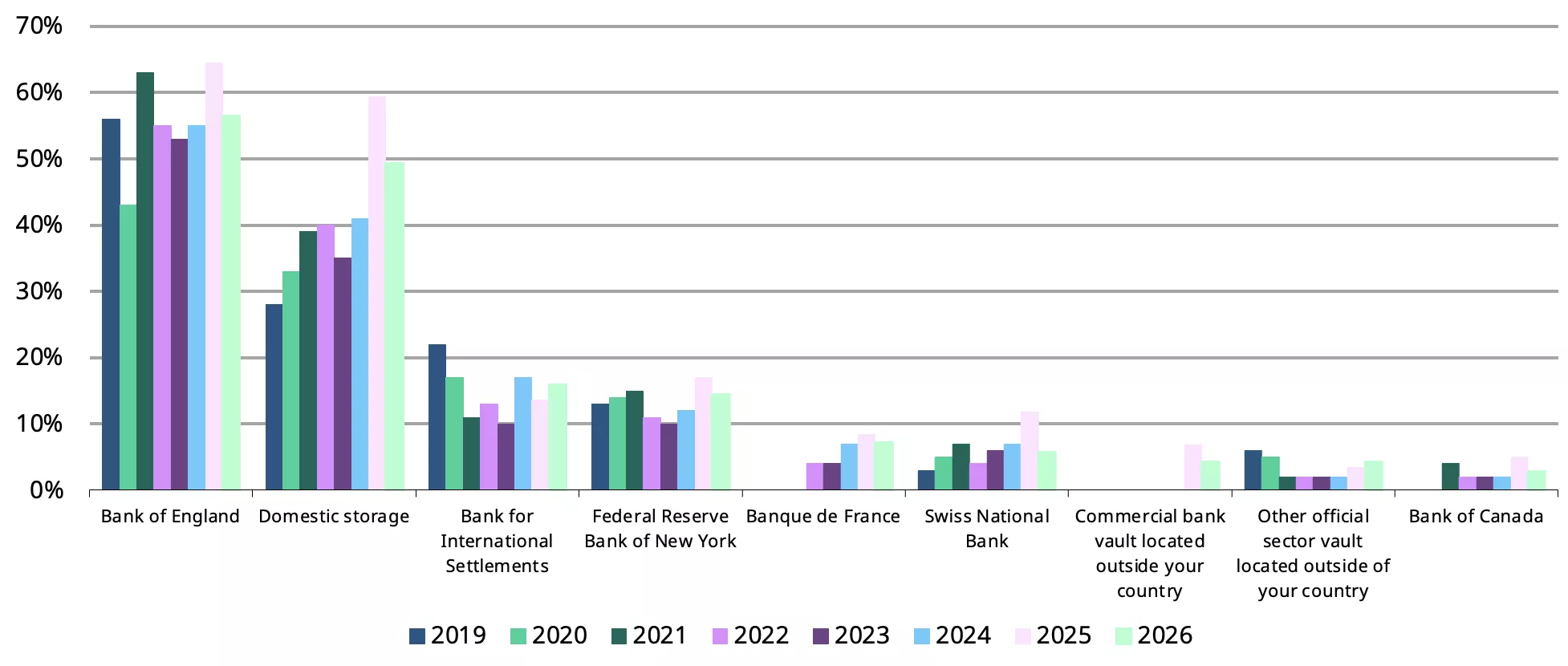
2026 base: All central banks who hold gold (69); advanced economy (16); EMDE (53). Note: Respondents were able to select all options that applied.
Source: World Gold Council, YouGov
What central banks themselves are saying
Our 2026 Central Bank Gold Reserves Survey reinforces this interpretation. The Bank of England remains the most commonly cited vaulting location, used by 57% of respondents, while 49% reported holding at least some gold domestically.
Over the preceding 12 months, 9% of respondents had increased domestic storage, but 10% had diversified their overseas storage locations. Looking ahead, 7% planned to increase domestic storage and 9% expected to diversify further overseas. The latter figure rose from just 2% in the previous survey.
Chart 3: How, if at all, have your custody arrangements changed over the past 12 months?
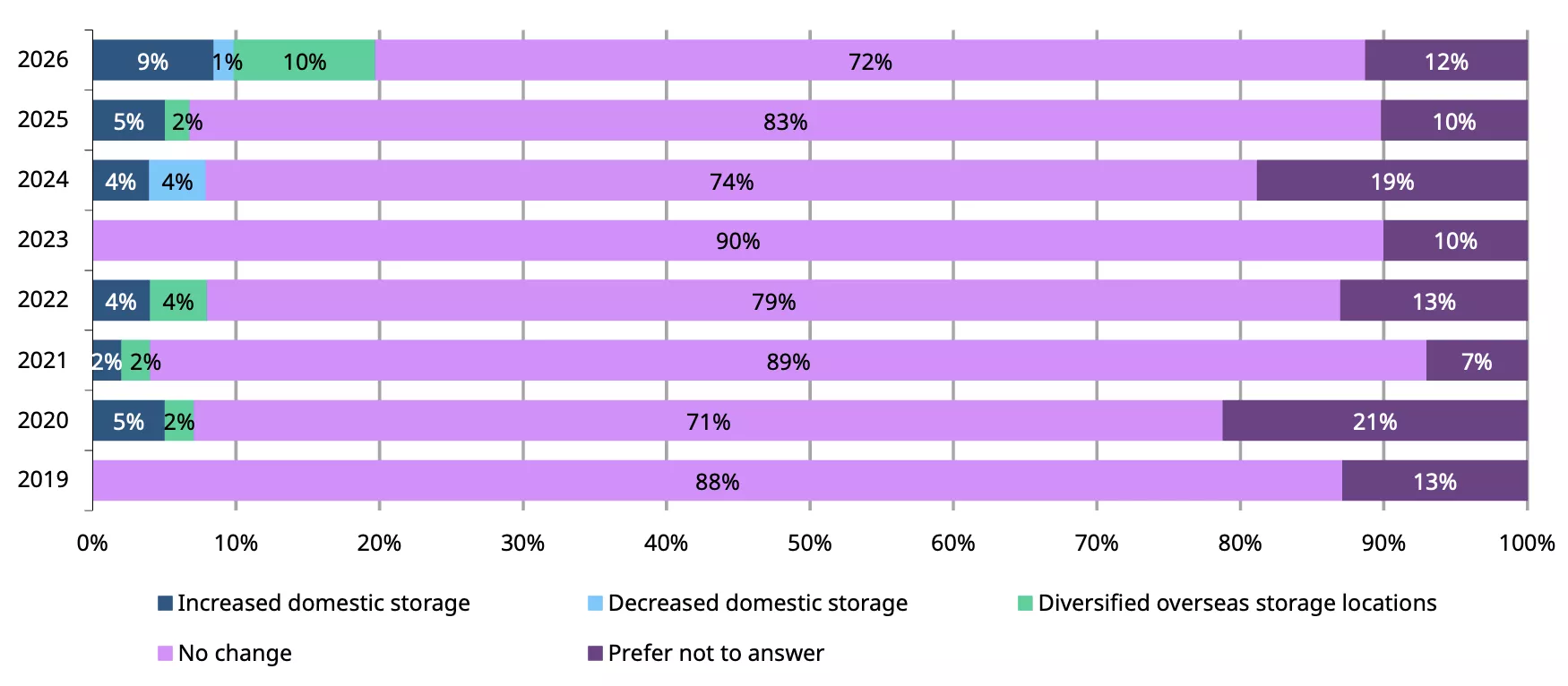
2026 base: All central banks who hold gold (68); advanced economy (16); EMDE (52).
Source: World Gold Council, YouGov
Chart 4: How, if at all, do you intend to change your custody arrangements over the next 12 months?
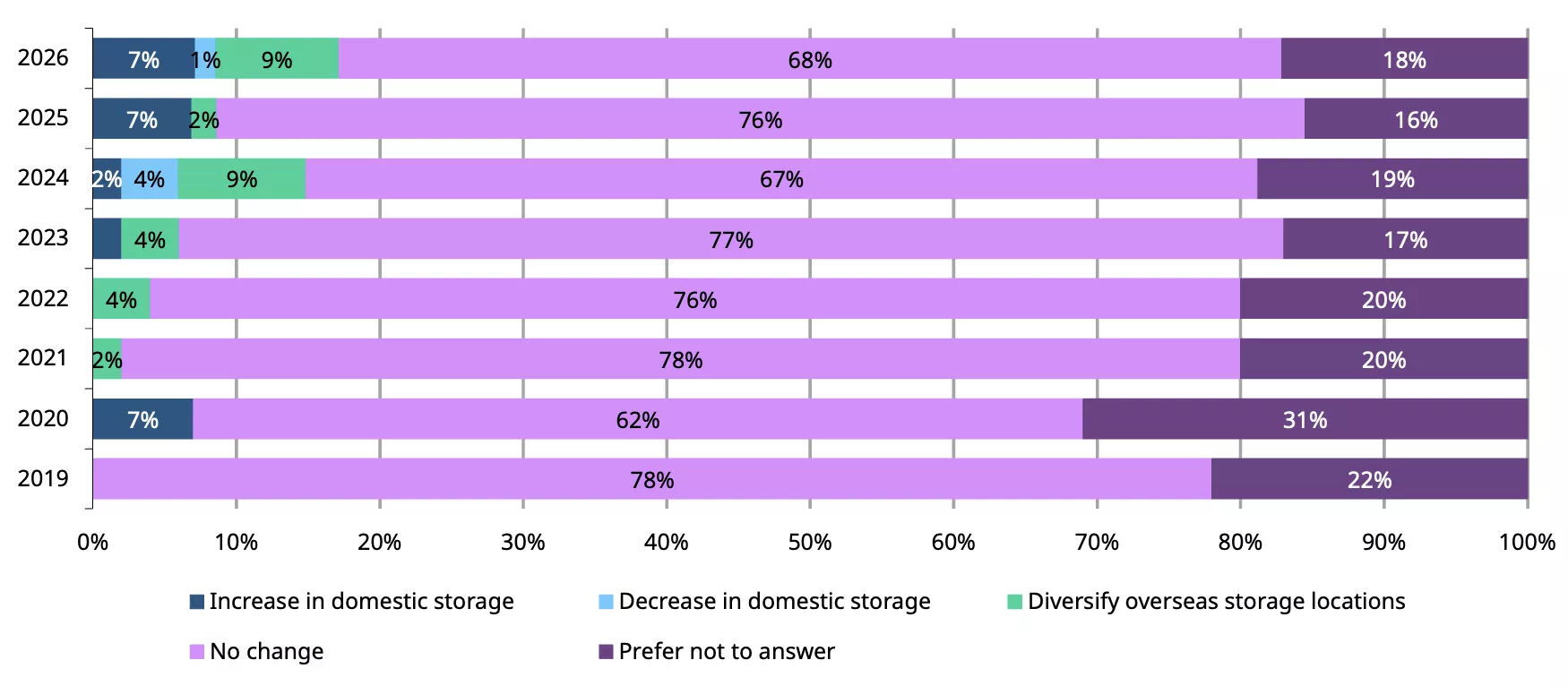
2026 base: All central banks who hold gold (67); advanced economy (15); EMDE (52).
Source: World Gold Council, YouGov
These findings suggest growing interest among several central banks in reassessing and diversifying their gold storage arrangements. Some are increasing domestic storage, while others are broadening the range of overseas locations they use. This points to diversification of custody rather than a uniform move towards domestic storage.
Movement does not mean an intention to sell
Moving gold to a more liquid market can sound like preparation for a sale. But liquidity is valuable precisely because it provides options in an extreme event. Gold in a major trading centre can potentially be mobilised more efficiently, yet improving that capability does not, by itself, indicate whether a central bank expects to use it.
DNB was explicit that it did not expect to deploy the gold. Its objective was to ensure that the reserves would be more readily available if required. At the same time, the 2026 survey found that only 1% of respondents expected their own gold reserves to decline over the next 12 months, while a record 45% expected them to increase.
Recent transfers should therefore not be interpreted, by themselves, as evidence that central banks are preparing to sell. Instead, these examples illustrate how the location of gold has become an important part of active reserve management. Future adjustments may also involve a wider range of hubs: Singapore has announced planned vaulting services for foreign central banks and sovereign entities, while Hong Kong is expanding its gold clearing, settlement and storage infrastructure.13,14 But the emerging picture is one in which security alone is no longer enough. For some central banks, gold must also be accessible, tradable and distributed across locations that remain dependable under stress.
Footnotes
1DNB improves tradability of gold reserves, De Nederlandsche Bank
2Repatriation refers to the return of overseas-held gold to domestic custody. Other location changes can involve moving gold between foreign custodians, or selling gold in one market and replacing it in another, without changing the quantity owned.
3We had nothing but the best of experiences with our partners’ – Bundesbank on why it keeps its gold overseas, mining.com.
4Venezuela completes repatriation of gold reserves, Central Banking
5Bundesbank completes gold transfer ahead of schedule, Bundesbank
6Dutch central bank to move gold reserves out of Amsterdam, DutchNews
7Gold reserves, Oesterreichische Nationalbank
8Serbia to become first Eastern European country to store all gold reserves domestically, Serbia Business
9Half Yearly Report on Management of Foreign Exchange Reserves, Reserve Bank of India
10Banque de France 2025 results, Banque de France
11Chavez repatriates Venezuela's foreign gold reserves, BBC
12Dutch central bank moves gold bars out of New York over ‘geopolitical unrest’, Financial Times
13Singapore to establish OTC gold clearing system, introduce central bank gold-vaulting services, Reuters
14Hong Kong scales up in bid to attract central bank gold, Central Banking
Disclaimer
Important information and disclaimers
© 2026 World Gold Council. All rights reserved. World Gold Council and the Circle device are trademarks of the World Gold Council or its affiliates.
All references to LBMA Gold Price are used with the permission of ICE Benchmark Administration Limited and have been provided for informational purposes only. ICE Benchmark Administration Limited accepts no liability or responsibility for the accuracy of the prices or the underlying product to which the prices may be referenced. Other content is the intellectual property of the respective third party and all rights are reserved to them.
Reproduction or redistribution of any of this information is expressly prohibited without the prior written consent of World Gold Council or the appropriate copyright owners, except as specifically provided below. Information and statistics are copyright © and/or other intellectual property of the World Gold Council or its affiliates or third-party providers identified herein. All rights of the respective owners are reserved.
The use of the statistics in this information is permitted for the purposes of review and commentary (including media commentary) in line with fair industry practice, subject to the following two pre-conditions: (i) only limited extracts of data or analysis be used; and (ii) any and all use of these statistics is accompanied by a citation to World Gold Council and, where appropriate, to Metals Focus or other identified copyright owners as their source. World Gold Council is affiliated with Metals Focus.
The World Gold Council and its affiliates do not guarantee the accuracy or completeness of any information nor accept responsibility for any losses or damages arising directly or indirectly from the use of this information.
This information is for educational purposes only and by receiving this information, you agree with its intended purpose. Nothing contained herein is intended to constitute a recommendation, investment advice, or offer for the purchase or sale of gold, any gold-related products or services or any other products, services, securities or financial instruments (collectively, “Services”). This information does not take into account any investment objectives, financial situation or particular needs of any particular person.
Diversification does not guarantee any investment returns and does not eliminate the risk of loss. Past performance is not necessarily indicative of future results. The resulting performance of any investment outcomes that can be generated through allocation to gold are hypothetical in nature, may not reflect actual investment results and are not guarantees of future results. The World Gold Council and its affiliates do not guarantee or warranty any calculations and models used in any hypothetical portfolios or any outcomes resulting from any such use. Investors should discuss their individual circumstances with their appropriate investment professionals before making any decision regarding any Services or investments.
This information may contain forward-looking statements, such as statements which use the words “believes”, “expects”, “may”, or “suggests”, or similar terminology, which are based on current expectations and are subject to change. Forward-looking statements involve a number of risks and uncertainties. There can be no assurance that any forward-looking statements will be achieved. World Gold Council and its affiliates assume no responsibility for updating any forward-looking statements.
Information regarding the LBMA Gold Price
The LBMA Gold Price is used by the World Gold Council with permission under license by ICE Benchmark Administration Limited and is subject to the restrictions set forth here (www.gold.org/terms-and-conditions).
Information regarding QaurumSM and the Gold Valuation Framework
Note that the resulting performance of various investment outcomes that can be generated through use of Qaurum, the Gold Valuation Framework and other information are hypothetical in nature, may not reflect actual investment results and are not guarantees of future results. Neither World Gold Council (including its affiliates) nor Oxford Economics provides any warranty or guarantee regarding the functionality of the tool, including without limitation any projections, estimates or calculations.
Information from ICRA Analytics Limited
All information obtained from ICRA Analytics Limited contained in this document is subject to the disclaimer set forth here (www.icraanalytics.com/terms-of-use/disclaimer).