Central Bank Gold Statistics: Central banks stay the course on gold in February
2 April, 2026
February Highlights1
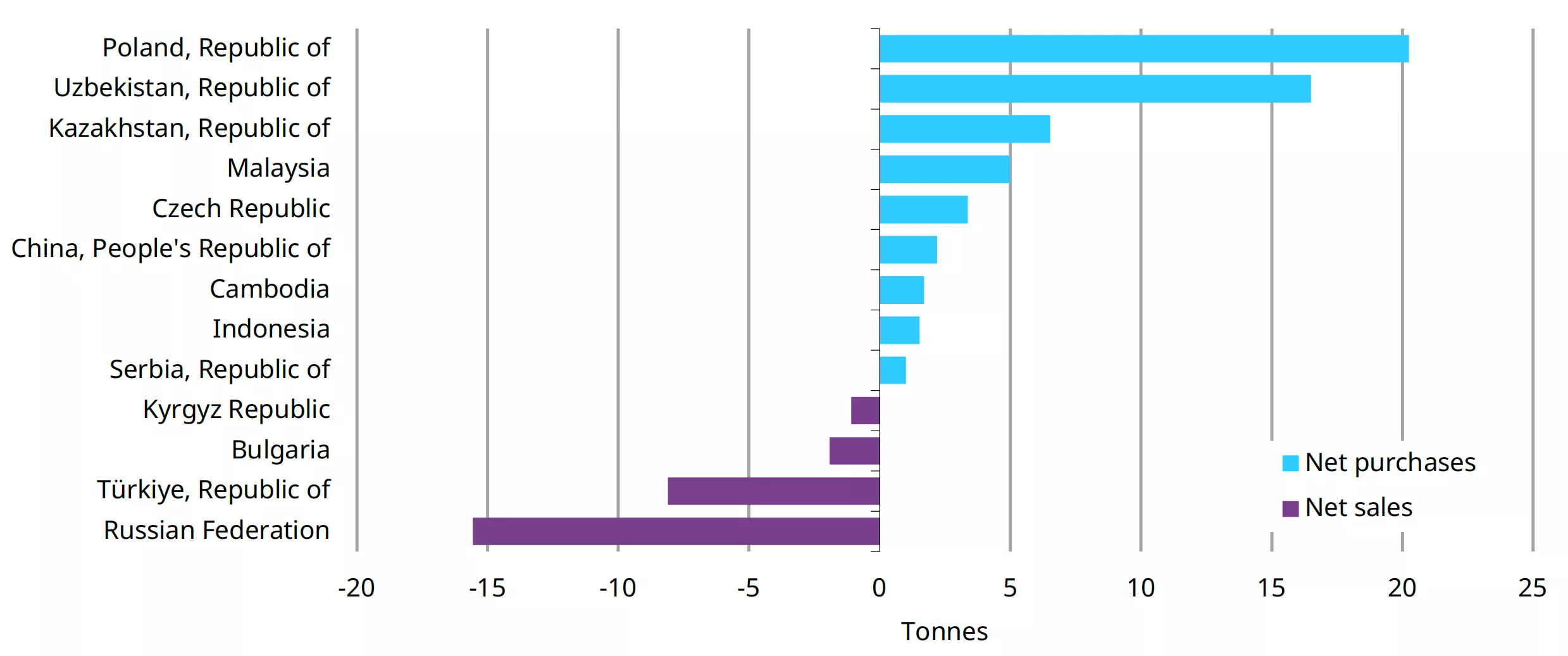
- February buying: Central banks bought a net 27t in February, with activity driven by Poland (20t), a marked rebound after a lull in January. Uzbekistan entered its fifth consecutive month of net buying (8t), followed by Kazakhstan (8t), Czech Republic (2t), Malaysia (2t), China (1t) and Cambodia (1t). Net sellers this month were Turkey (8t) and Russia (6t)
Notable takeaways
- Poland was the primary buyer for the month with net recorded buying at 20t, this is its highest purchase since February 2025, which was 29t.
- Track record of net buying maintained across some central banks with Czech Republic reporting its 36th consecutive month of net buying. China is on its 16th consecutive month of net purchases, followed by Uzbekistan tallying five consecutive months.
- A growing number of African central banks have been reported to turn to gold as a strategic diversification tool, to boost reserves and manage risks to the economy in international financial markets.
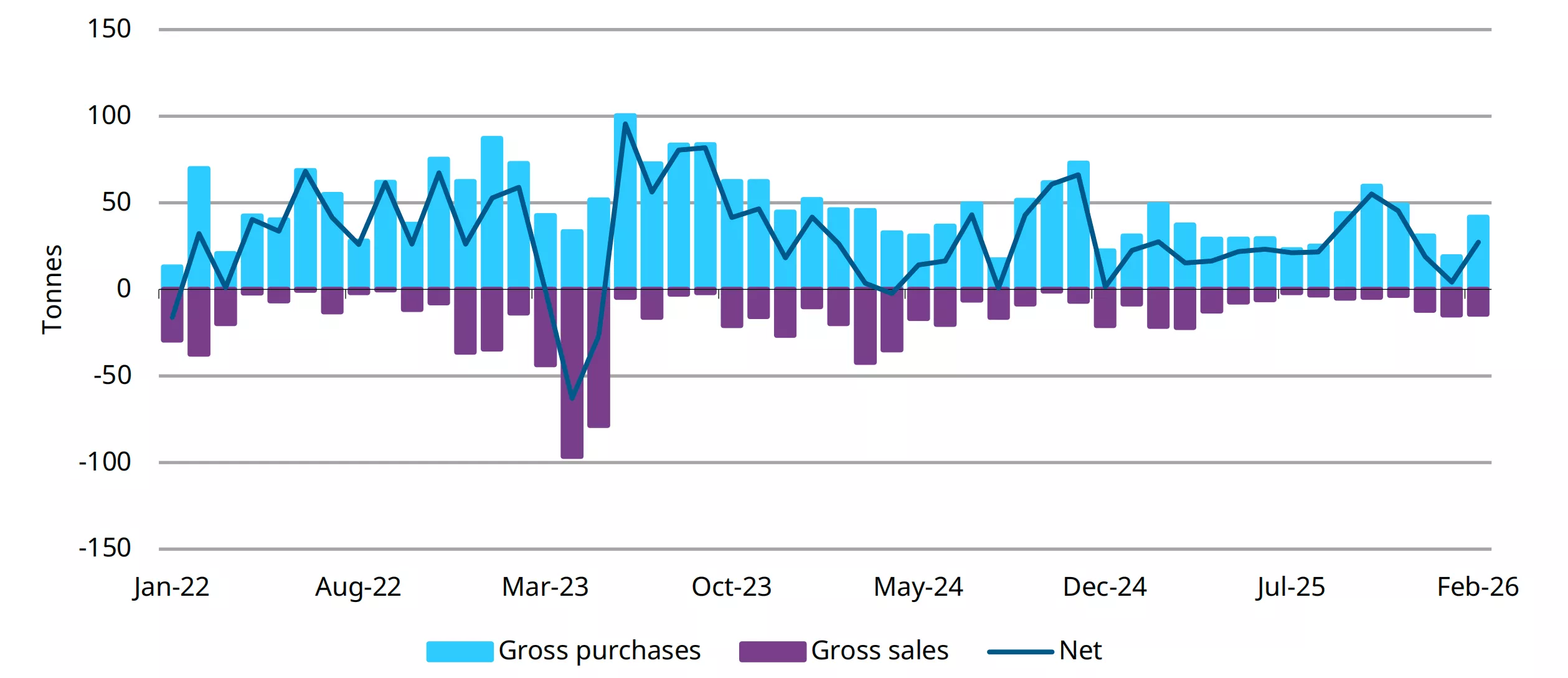
Central banks remain firm on gold accumulation in February, having bought a net 27t. This was a rebound from the lull we saw in January, and in line with the monthly average of 26t reported in 2025. Just two months into the year, central banks have bought 31t, a pace much slower than the same period last year (50t).
Chart 1: Central banks buying firm up in February
Monthly reported central banks activity, tonnes*
*Data to 28 February 2026, where available.
Source: IMF, respective central banks, World Gold Council
Reported activity in February was concentrated in:
- The National Bank of Poland drove much of this month’s buying activity, having bought 20t. This brings its total gold reserves to 570t, lifting its share of total reserves to 31%. The bank has set a target of 700t of gold, as announced by its Governor Adam Glapiński. In a recent development, Governor Glapiński had also proposed generating US$13bn through potential sale of gold reserves to finance defense spending, with the intention to “generate profits and to then buy it back”. Details on this proposal, though, remain unclear.
- Central Bank of Uzbekistan bought 8t of gold this month, lifting its gold reserves to 407t or 88% of its total reserves. Y-t-d, Uzbekistan bought 16t so far this year.
- National Bank of Kazakhstan added 8t to its gold reserves during the month, bringing its y-t-d net purchases to 7t. This also lifted its total gold holdings to 348t – the highest level of since January 2023.
- Bank Negara Malaysia’s renewed interest continued into February, its second month of net purchases, adding 2t during the month. Y-t-d net purchases total a modest 5t. Czech National Bank’s modest but consistent net purchases brings its gold reserves to 75t ot 7% of total reserves. A similar story for the People’s Bank of China, its 16th consecutive month of buying saw gold reserves grow to 2,308t or 10% of its total reserves.
- Turkey (8t) and Russia (6t) saw the biggest declines in gold reserves in February. In Turkey’s case, the reduction appeared to be reflective of a decline in Treasury holdings, rather than central bank reserves based on our calculations. In March, however, the central bank was highly active, with our estimates indicating it utilised around 50t of its gold reserves for liquidity purposes and FX operations.2 Governor Fatih Karahan noted that: “a significant part of these transactions are in the nature of gold-currency swap futures. In other words, when it matures, the gold in question will return to our reserves.”3
Chart 2: Year-to-date central bank gold activity
Central bank net purchases and sales, tonnes*
*Data to 28 February 2026, where available.
Source: IMF, respective central banks, World Gold Council
African central banks look towards gold for diversification
The Bank of Uganda launched its domestic gold buying programme two years ago, with active buying commencing in March 2026. The bank aims to purchase at least 100kg of gold between March and June this year from artisanal, medium and large-scale domestic producers. The move is aimed to bolster reserves and cushion the economy from risks in international financial markets. Uganda is not alone in this shift. Kenya's central bank Governor Kamau Thugge signalled similar intentions at a news conference in early February, which alludes to a broader trend of African central banks turning to gold as a strategic diversification tool.
Conclusion
February seems to indicate a rebound in central bank buying after a quiet January, highlighting commitment to gold’s role in reserves. At the same time, central banks may be prudently price sensitive in their accumulation. Poland's contribution this month highlights continued appetite from established buyers, with persistent buying streaks from Czech Republic, China and Uzbekistan signalling sustained demand. New entrants from Southeast Asian and African central banks suggest that the emerging market story continues.
Footnotes
1Please note that this blog post was updated on 7 April 2026 to include the February purchase by the National Bank of Kazakhstan.
2Based on data to 20 March 2026.
3Statements from CBRT Governor Karahan on gold-based transactions, Bloomberg HT, March 2026.
Disclaimer
Important information and disclaimers
© 2026 World Gold Council. All rights reserved. World Gold Council and the Circle device are trademarks of the World Gold Council or its affiliates.
All references to LBMA Gold Price are used with the permission of ICE Benchmark Administration Limited and have been provided for informational purposes only. ICE Benchmark Administration Limited accepts no liability or responsibility for the accuracy of the prices or the underlying product to which the prices may be referenced. Other content is the intellectual property of the respective third party and all rights are reserved to them.
Reproduction or redistribution of any of this information is expressly prohibited without the prior written consent of World Gold Council or the appropriate copyright owners, except as specifically provided below. Information and statistics are copyright © and/or other intellectual property of the World Gold Council or its affiliates or third-party providers identified herein. All rights of the respective owners are reserved.
The use of the statistics in this information is permitted for the purposes of review and commentary (including media commentary) in line with fair industry practice, subject to the following two pre-conditions: (i) only limited extracts of data or analysis be used; and (ii) any and all use of these statistics is accompanied by a citation to World Gold Council and, where appropriate, to Metals Focus or other identified copyright owners as their source. World Gold Council is affiliated with Metals Focus.
The World Gold Council and its affiliates do not guarantee the accuracy or completeness of any information nor accept responsibility for any losses or damages arising directly or indirectly from the use of this information.
This information is for educational purposes only and by receiving this information, you agree with its intended purpose. Nothing contained herein is intended to constitute a recommendation, investment advice, or offer for the purchase or sale of gold, any gold-related products or services or any other products, services, securities or financial instruments (collectively, “Services”). This information does not take into account any investment objectives, financial situation or particular needs of any particular person.
Diversification does not guarantee any investment returns and does not eliminate the risk of loss. Past performance is not necessarily indicative of future results. The resulting performance of any investment outcomes that can be generated through allocation to gold are hypothetical in nature, may not reflect actual investment results and are not guarantees of future results. The World Gold Council and its affiliates do not guarantee or warranty any calculations and models used in any hypothetical portfolios or any outcomes resulting from any such use. Investors should discuss their individual circumstances with their appropriate investment professionals before making any decision regarding any Services or investments.
This information may contain forward-looking statements, such as statements which use the words “believes”, “expects”, “may”, or “suggests”, or similar terminology, which are based on current expectations and are subject to change. Forward-looking statements involve a number of risks and uncertainties. There can be no assurance that any forward-looking statements will be achieved. World Gold Council and its affiliates assume no responsibility for updating any forward-looking statements.
Information regarding the LBMA Gold Price
The LBMA Gold Price is used by the World Gold Council with permission under license by ICE Benchmark Administration Limited and is subject to the restrictions set forth here (www.gold.org/terms-and-conditions).
Information regarding QaurumSM and the Gold Valuation Framework
Note that the resulting performance of various investment outcomes that can be generated through use of Qaurum, the Gold Valuation Framework and other information are hypothetical in nature, may not reflect actual investment results and are not guarantees of future results. Neither World Gold Council (including its affiliates) nor Oxford Economics provides any warranty or guarantee regarding the functionality of the tool, including without limitation any projections, estimates or calculations.
Information from ICRA Analytics Limited
All information obtained from ICRA Analytics Limited contained in this document is subject to the disclaimer set forth here (www.icraanalytics.com/terms-of-use/disclaimer).