Central bank gold statistics: November 2024
Krishan Gopaul
Senior Analyst, EMEA World Gold CouncilPublished 6 January 2025.
Central banks continue their great gold grab in November
- Based on available reported data, central banks bought a net 53t in November
- The National Bank of Poland (21t) was the biggest buyer, while the People's Bank of China reported its first addition (5t) since April
- The Monetary Authority of Singapore was the biggest seller during the month, while the Bank of Finland also announced a reduction in its gold reserves.
Assessing the final act of 2024, central banks around the world continued to play a leading role in the demand for gold. November represented another solid month of gold buying as central banks collectively added a net 53t to global official holdings based on available reported data. This extends the broader trend observed throughout this year where central banks – mostly those from emerging markets – have remained keen buyers of gold, driven by the need for a stable and secure asset amid global economic uncertainties.
Chart 1: Official gold reserves rose by a further 53t in November
Monthly reported central bank activity, tonnes*
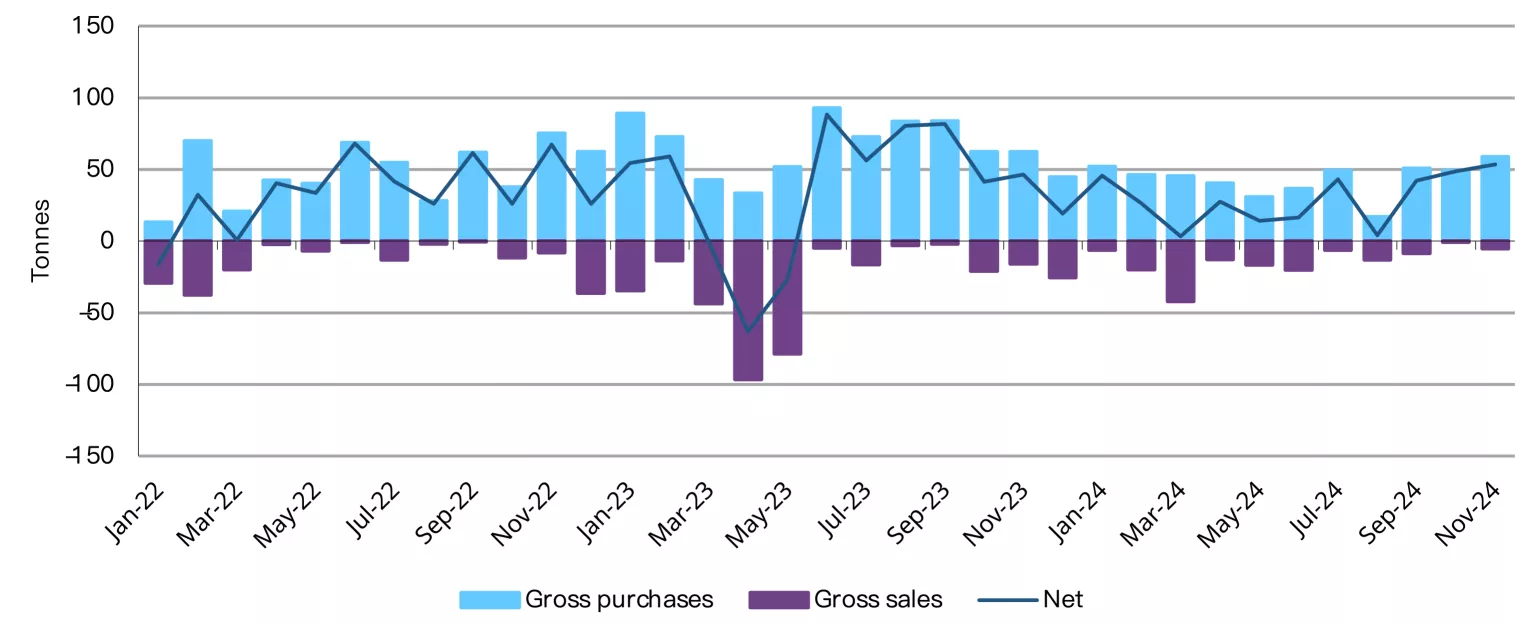
*Data to 30 November 2024 where available.
Source: IMF IFS, respective central banks, World Gold Council
The gold price dip in November, following the US election, may have provided some central banks with added impetus to accumulate. At a country level, much of the buying was limited to those who have been active in recent months:
- The National Bank of Poland (NBP) was once again a major buyer. It increased its gold reserves by 21t in November, to 448t. Gold now accounts for almost 18% of its total reserves, just below the previously stated target of 20%.1 This purchase also cemented the NBP’s position as the leading gold buyer on a y-t-d basis (90t)
- Data published by the Central Bank of Uzbekistan shows its gold reserves rose by 9t during the month – the first monthly addition since July. As a result, the bank’s y-t-d net purchases now total 11t and total gold holdings amount to 382t
- The Reserve Bank of India continued its 2024 buying streak, adding a further 8t to its gold reserves in November. This lifts y-t-d buying to 73t and total gold holdings to 876t, maintaining its position as the second largest buyer in 2024 after Poland2
- The National Bank of Kazakhstan increased its gold reserves by 5t, the second successive month of buying. As a result, the bank has flipped to being a net purchaser (1t) y-t-d, with total gold holdings now standing at 295t
- One of the most notable developments during the month was the announcement that the People's Bank of China (PBoC) had resumed gold purchases. After a six-month hiatus, the PBoC added 5t of gold to its reserves, increasing its y-t-d net purchases to 34t and its total reported gold holdings to 2,264t (5% of total reserves)
- Data published by the Central Bank of Jordan shows its gold reserves rose by over 4t in November - the first monthly increase since July. Y-t-d net purchases now total nearly 2t, lifting gold holdings to 73t
- The Central Bank of Turkey increased its gold reserves by 3t during the month. The central bank also entered into reverse swap agreements (gold for lira) with domestic commercial banks to manage liquidity
- Gold reserves held by the Czech National Bank rose by almost 2t in November – the 21st consecutive month of buying. Y-t-d net purchases now total almost 20t, lifting gold holdings to just above 50t
- The Bank of Ghana continued its gold accumulation as part of its domestic gold purchase programme, adding a further 1t in November. Y-t-d net purchases now total almost 10t, lifting total gold holdings to 29t. The bank also launched a Ghana Gold Coin to the public during the month as part of its “efforts to stabilise the economy and promote investment in Ghana’s gold reserves”3
- The Monetary Authority of Singapore was the month’s largest seller, reducing its gold reserves by 5t, bringing y-t-d net sales to 7t and overall gold holdings to 223t.
It was also announced in December that gold reserves at the Bank of Finland had been lowered by 10% to 44t – the sale most likely taking place during that month. The bank noted that: "Exchange rate risk is the most significant of the Bank of Finland’s financial asset risks. Increasing the size of its foreign exchange reserves elevates the Bank’s exchange rate risk considerably, and so the Bank is strengthening its foreign exchange rate provision by selling about 10% of its gold reserves".4This brings the bank’s gold reserves to their lowest level since December 1984.
Chart 2: Net purchases continue to heavily outweigh net sales in 2024
Y-t-d central bank net purchases and sales*
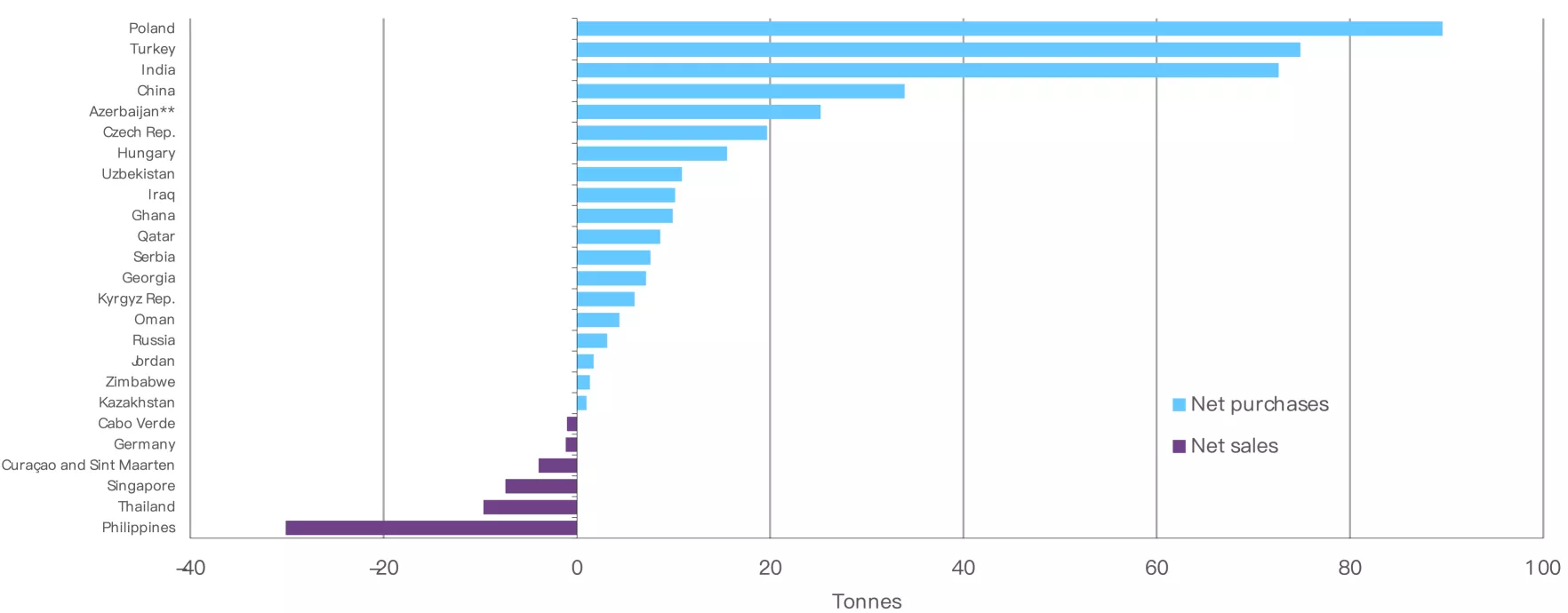
*Data to 30 November 2024 where available. Note: chart includes only purchases/sales of 1t or more. **Represents the gold reserves of the State Oil Fund of Azerbaijan (SOFAZ).
Source: IMF IFS, respective central banks, World Gold Council
Although we await the remaining 2024 data, the broad sustained interest in gold from central banks this year has clearly highlighted the metal’s enduring appeal. With only December data yet to be revealed, central banks will no doubt be substantial net purchasers for the 15th consecutive year. A performance fully deserving of a curtain call.
Don’t forget, our next Gold Demand Trends report will be published on 5 February 2025, in which we will review central bank gold demand for 2024 as a whole.
Footnotes
1tvpworld.com/77461458/poland-to-dramatically-boost-gold-reserves
2Our initial estimate for RBI buying in October (27t) was updated on 17 December 2024 to reflect the correct increase in gold reserves (14t).
3www.modernghana.com/news/1360389/bogs-gold-coin-launched-prices-range-from-gh11.html
4http://www.suomenpankki.fi/en/news-and-topical/press-releases-and-news/releases/2024/bank-of-finland-increases-its-foreign-exchange-reserves
Disclaimer
Copyright and other rights
© 2025 World Gold Council. All rights reserved. World Gold Council and the Circle device are trademarks of the World Gold Council or its affiliates.
Any references to LBMA Gold Price are used with the permission of ICE Benchmark Administration Limited and have been provided for informational purposes only. ICE Benchmark Administration Limited accepts no liability or responsibility for the accuracy of the prices or the underlying product to which the prices may be referenced. All third-party content is the intellectual property of the respective third party and all rights are reserved to such party.
Reproduction or redistribution of any of this information is expressly prohibited without the prior written consent of World Gold Council or the appropriate intellectual property owners, except as specifically provided below.
Use of any statistics in this information is permitted for the purposes of review and commentary in line with fair industry practice, subject to the following pre-conditions: (i) only limited extracts may be used; and (ii) any use must be accompanied by a citation to World Gold Council and, where appropriate, to Metals Focus, Refinitiv GFMS, or other identified third party, as their source.
World Gold Council does not guarantee the accuracy or completeness of any information and does not accept responsibility for any losses or damages arising directly or indirectly from the use of this information.
This information is not a recommendation or an offer for the purchase or sale of gold or any products, services, or securities.
This information contains forward-looking statements which are based on current expectations and are subject to change. Forward-looking statements involve a number of risks and uncertainties. There is no assurance that any forward-looking statements will be achieved.
Information regarding QaurumSM and the Gold Valuation Framework
Note that the resulting performance of various investment outcomes that can generated through use of Qaurum, the Gold Valuation Framework and other information are hypothetical in nature, may not reflect actual investment results and are not guarantees of future results. Neither WGC nor Oxford Economics provides any warranty or guarantee regarding the functionality of the tool, including without limitation any projections, estimates or calculations.
Central bank gold statistics December 2024
Krishan Gopaul
Senior Analyst, EMEA World Gold CouncilMarissa Salim
Senior Research Lead, APAC World Gold Council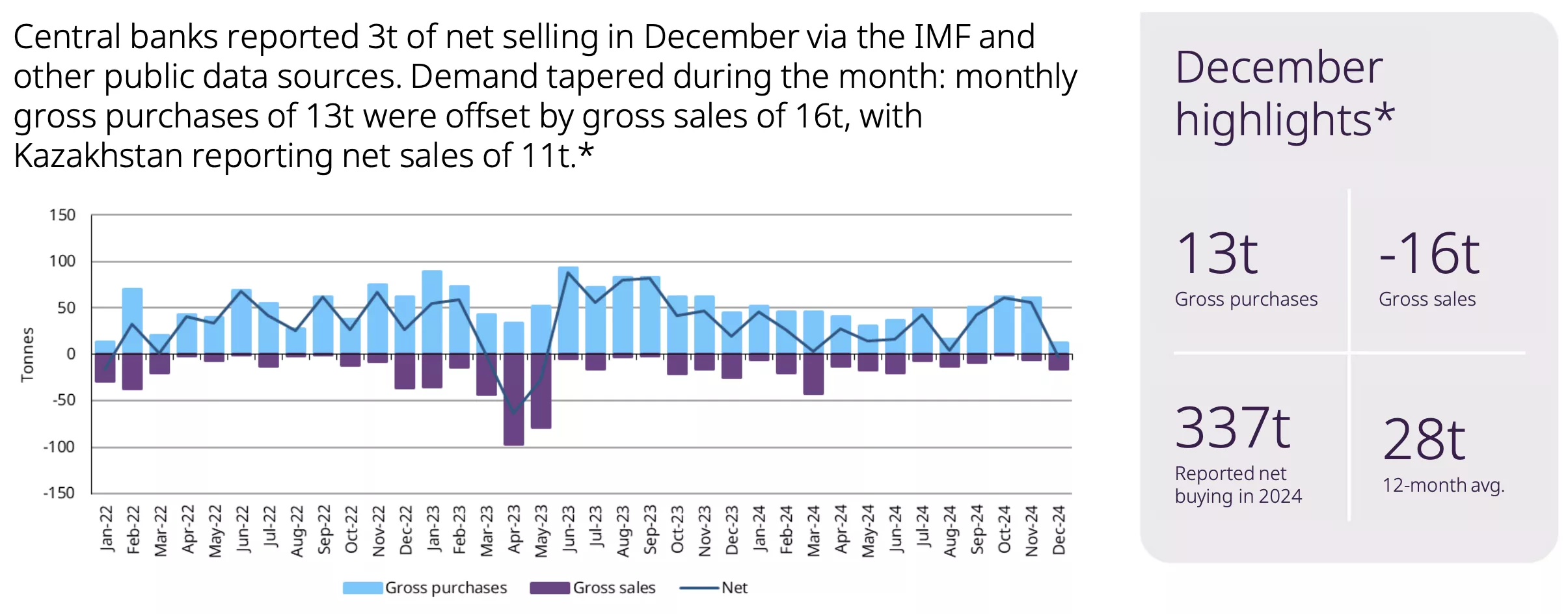
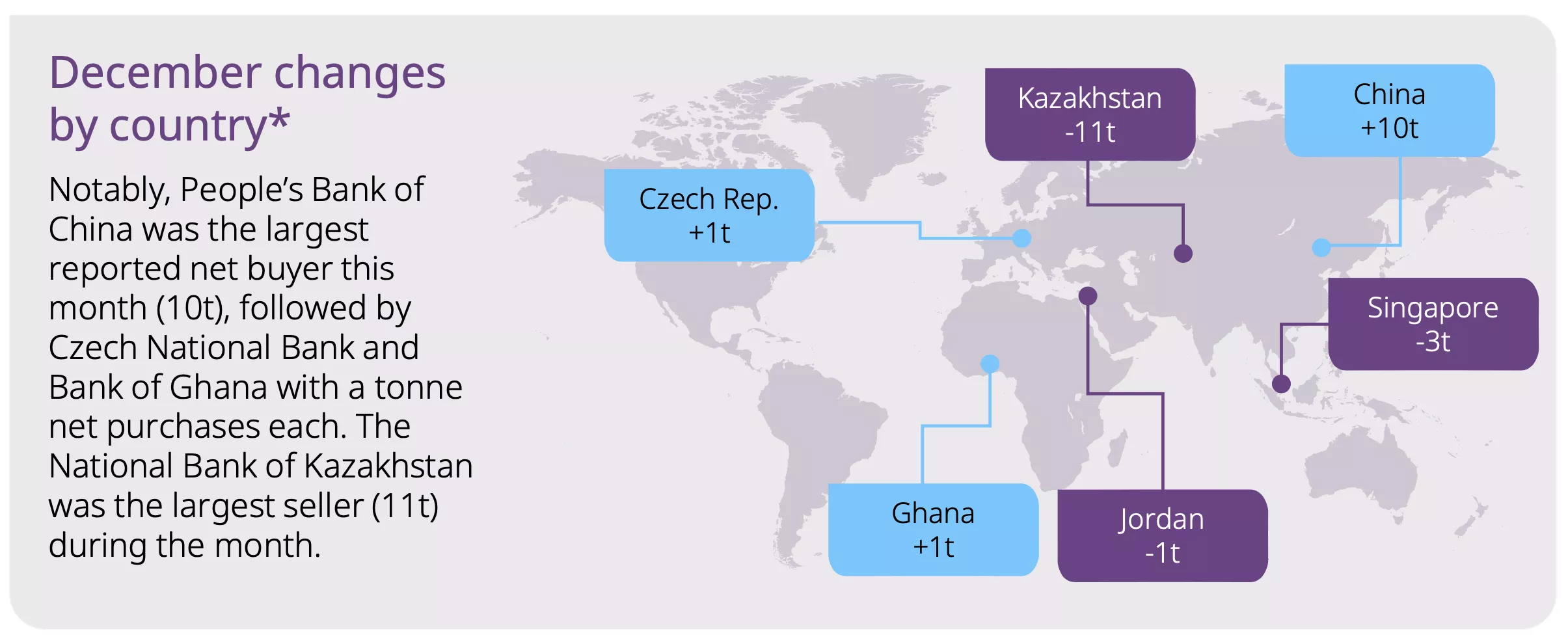
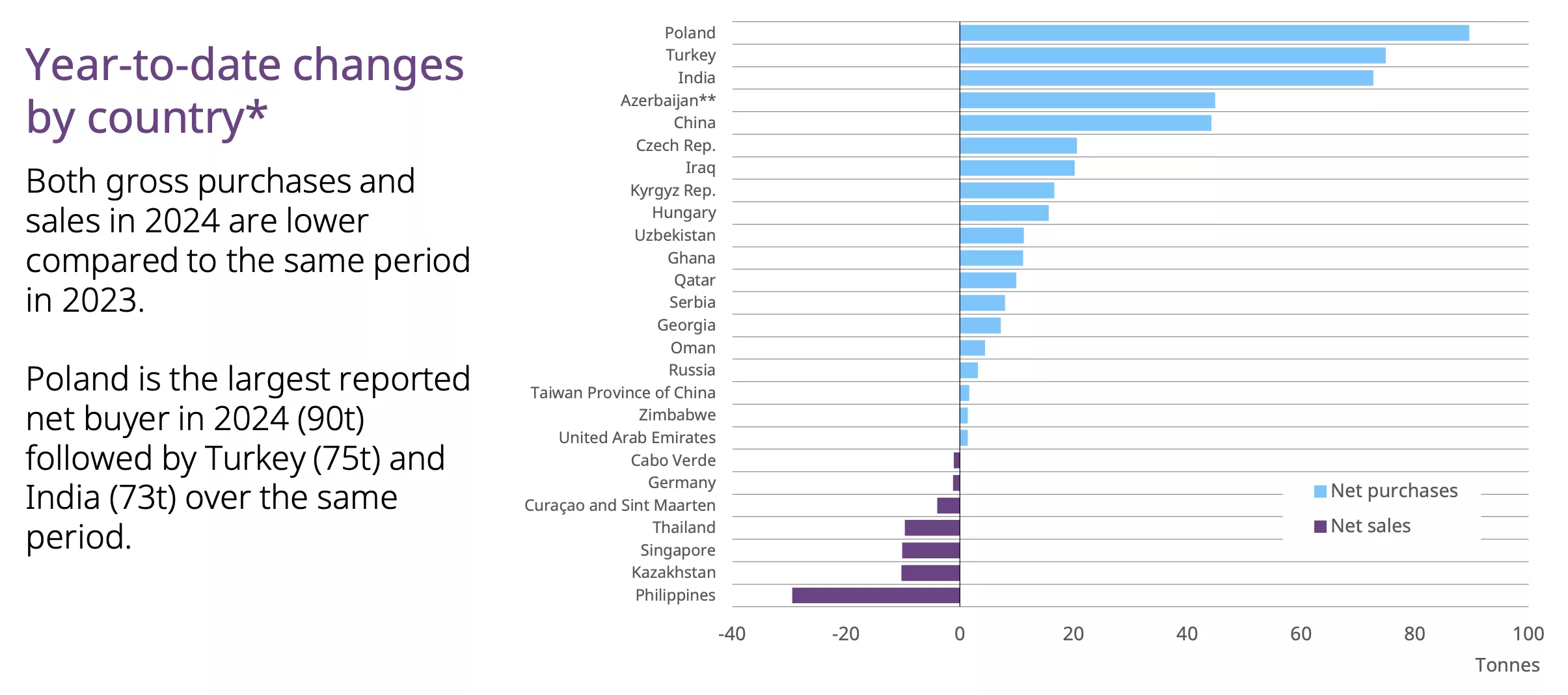
*Data to December 2024 where available. **Represents the gold reserves of the State Oil Fund of Azerbaijan (SOFAZ). Monthly totals may not sum due to rounding and exclude the State Oil Fund of Azerbaijan (SOFAZ), which only reports quarterly data. Note: By country and y-t-d charts include changes of a tonne or more only.
Source: IMF IFS, respective central banks, World Gold Council
Disclaimer
Important information and disclaimers
© 2025 World Gold Council. All rights reserved. World Gold Council and the Circle device are trademarks of the World Gold Council or its affiliates.
All references to LBMA Gold Price are used with the permission of ICE Benchmark Administration Limited and have been provided for informational purposes only. ICE Benchmark Administration Limited accepts no liability or responsibility for the accuracy of the prices or the underlying product to which the prices may be referenced. Other content is the intellectual property of the respective third party and all rights are reserved to them.
Reproduction or redistribution of any of this information is expressly prohibited without the prior written consent of World Gold Council or the appropriate copyright owners, except as specifically provided below. Information and statistics are copyright © and/or other intellectual property of the World Gold Council or its affiliates or third-party providers identified herein. All rights of the respective owners are reserved.
The use of the statistics in this information is permitted for the purposes of review and commentary (including media commentary) in line with fair industry practice, subject to the following two pre-conditions: (i) only limited extracts of data or analysis be used; and (ii) any and all use of these statistics is accompanied by a citation to World Gold Council and, where appropriate, to Metals Focus or other identified copyright owners as their source. World Gold Council is affiliated with Metals Focus.
The World Gold Council and its affiliates do not guarantee the accuracy or completeness of any information nor accept responsibility for any losses or damages arising directly or indirectly from the use of this information.
This information is for educational purposes only and by receiving this information, you agree with its intended purpose. Nothing contained herein is intended to constitute a recommendation, investment advice, or offer for the purchase or sale of gold, any gold-related products or services or any other products, services, securities or financial instruments (collectively, “Services”). This information does not take into account any investment objectives, financial situation or particular needs of any particular person.
Diversification does not guarantee any investment returns and does not eliminate the risk of loss. Past performance is not necessarily indicative of future results. The resulting performance of any investment outcomes that can be generated through allocation to gold are hypothetical in nature, may not reflect actual investment results and are not guarantees of future results. The World Gold Council and its affiliates do not guarantee or warranty any calculations and models used in any hypothetical portfolios or any outcomes resulting from any such use. Investors should discuss their individual circumstances with their appropriate investment professionals before making any decision regarding any Services or investments.
This information may contain forward-looking statements, such as statements which use the words “believes”, “expects”, “may”, or “suggests”, or similar terminology, which are based on current expectations and are subject to change. Forward-looking statements involve a number of risks and uncertainties. There can be no assurance that any forward-looking statements will be achieved. World Gold Council and its affiliates assume no responsibility for updating any forward-looking statements.
Information regarding QaurumSM and the Gold Valuation Framework
Note that the resulting performance of various investment outcomes that can be generated through use of Qaurum, the Gold Valuation Framework and other information are hypothetical in nature, may not reflect actual investment results and are not guarantees of future results. Neither World Gold Council (including its affiliates) nor Oxford Economics provides any warranty or guarantee regarding the functionality of the tool, including without limitation any projections, estimates or calculations.
Central banks stay bullish on bullion in January
Marissa Salim
Senior Research Lead, APAC World Gold Council- Central banks reported 18t of net purchases at the start of 2025
- Emerging market central banks remain at the forefront of net buying, with Uzbekistan, China and Kazakhstan the top three buyers
- Poland and India also continue to accumulate gold reserves 2025 – both central banks added 3t to their respective reserves in January.
Central banks continued their strong interest for gold in January with reported net purchases of 18t. The sustained buying highlights the strategic importance of gold in official reserves, particularly as central banks navigate heightened geopolitical risks.
Chart 1: Official gold reserves rose by a further 18t in January
Monthly reported central bank activity, tonnes*
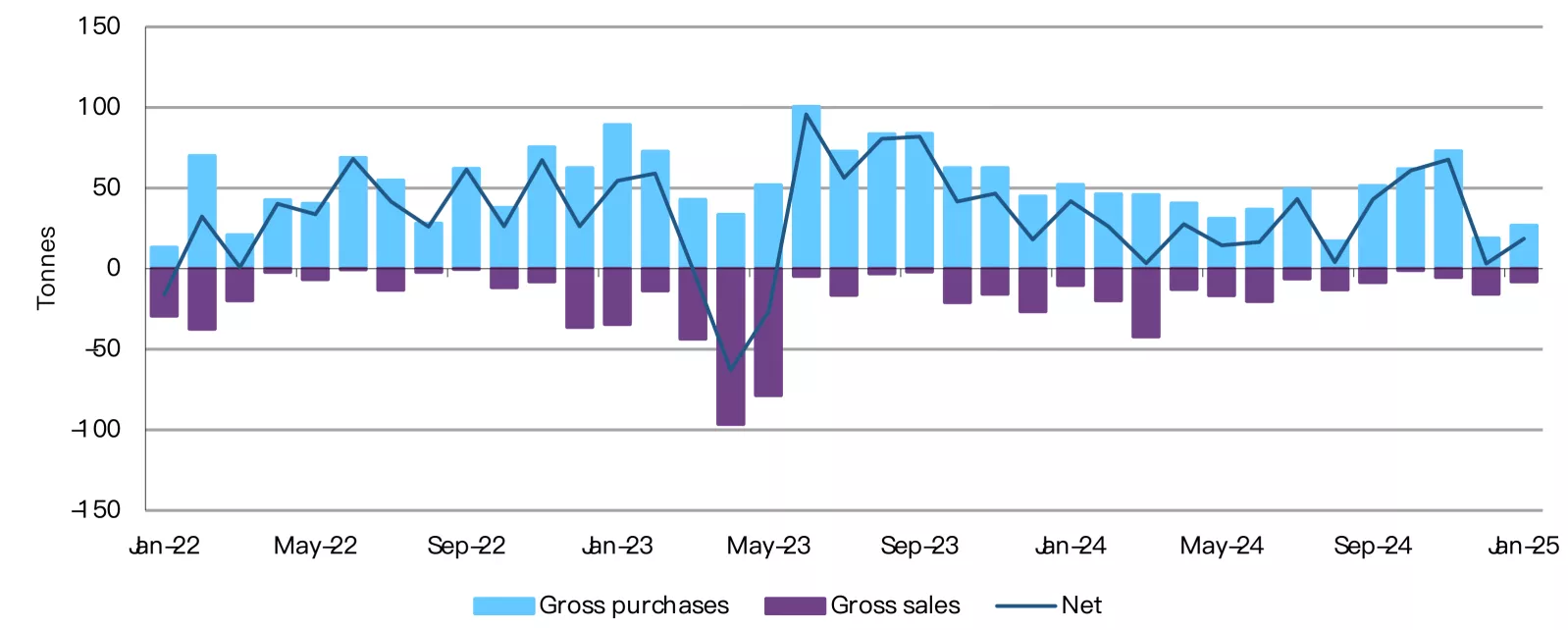
*Data to 31 January 2025, where available. Note: chart includes only purchases/sales of a tonne or more.
Source: IMF IFS, Respective Central Banks, World Gold Council
- The Central Bank of Uzbekistan reported 8t net purchases in January, with its gold holdings totalling 391t or 82% of its reserves.
- Sustained appetite at the People’s Bank of China (PBoC), with the central bank reporting its third consecutive month of net buying, adding 5t in January. The PBoC’s gold holdings rose to 2,285t, or 6% of total reserves, at the end of January.
- The National Bank of Kazakhstan (NBK) added 4t of gold to its reserves. At a press briefing on 17 January 2025, NBK Chairman Timur Suleimenov said that the central bank has “been discussing transitioning to monetary neutrality in gold purchases”, with the aim of boosting international reserves and “protect[ing] the economy from external shocks.” The NBK was reported to begin sale of US dollars as part of “mirroring operations related to gold purchases.” Gold holdings for Kazakhstan stood at 288t, which is 55% of its total reserves.
- The National Bank of Poland (3t), the Reserve Bank of India (3t) and the Czech National Bank (2t) and the Qatar Central Bank (1t) continued their net buying into 2025.
- Notable sellers for the month include the Central Bank of Russia and the Central Bank of Jordan, which both sold 3t respectively, and the National Bank of the Kyrgyz Republic which sold 2t.
Chart 2: Central banks appetite for gold resumes in January 2025
Y-t-d central bank net purchases and sales*
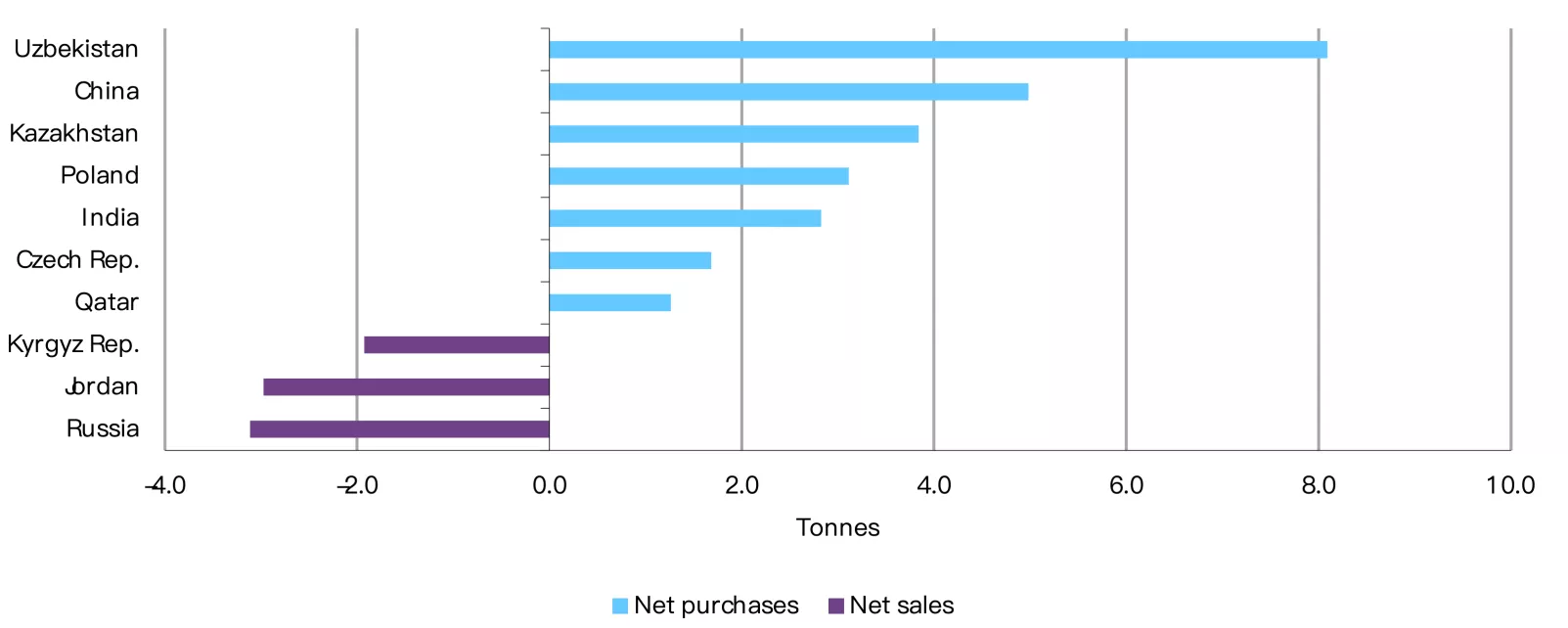
*Data to 31 January 2025, where available. Note: chart includes only purchases/sales of a tonne or more.
Source: IMF IFS, Respective Central Banks, World Gold Council
In our recently published 2024 Gold Demand Trends, we noted that central banks continue to play a pivotal role in global gold demand, with their purchasing patterns influenced by both economic and geopolitical shifts. The shift from armed conflict to broader economic tensions has reinforced their net buying trend especially apparent since 2022. Many central banks appear to have strategically leveraged temporary price pullbacks as buying opportunities, while sales have remained limited and largely tactical during price rallies.
Disclaimer
Important information and disclaimers
© 2025 World Gold Council. All rights reserved. World Gold Council and the Circle device are trademarks of the World Gold Council or its affiliates.
All references to LBMA Gold Price are used with the permission of ICE Benchmark Administration Limited and have been provided for informational purposes only. ICE Benchmark Administration Limited accepts no liability or responsibility for the accuracy of the prices or the underlying product to which the prices may be referenced. Other content is the intellectual property of the respective third party and all rights are reserved to them.
Reproduction or redistribution of any of this information is expressly prohibited without the prior written consent of World Gold Council or the appropriate copyright owners, except as specifically provided below. Information and statistics are copyright © and/or other intellectual property of the World Gold Council or its affiliates or third-party providers identified herein. All rights of the respective owners are reserved.
The use of the statistics in this information is permitted for the purposes of review and commentary (including media commentary) in line with fair industry practice, subject to the following two pre-conditions: (i) only limited extracts of data or analysis be used; and (ii) any and all use of these statistics is accompanied by a citation to World Gold Council and, where appropriate, to Metals Focus or other identified copyright owners as their source. World Gold Council is affiliated with Metals Focus.
The World Gold Council and its affiliates do not guarantee the accuracy or completeness of any information nor accept responsibility for any losses or damages arising directly or indirectly from the use of this information.
This information is for educational purposes only and by receiving this information, you agree with its intended purpose. Nothing contained herein is intended to constitute a recommendation, investment advice, or offer for the purchase or sale of gold, any gold-related products or services or any other products, services, securities or financial instruments (collectively, “Services”). This information does not take into account any investment objectives, financial situation or particular needs of any particular person.
Diversification does not guarantee any investment returns and does not eliminate the risk of loss. Past performance is not necessarily indicative of future results. The resulting performance of any investment outcomes that can be generated through allocation to gold are hypothetical in nature, may not reflect actual investment results and are not guarantees of future results. The World Gold Council and its affiliates do not guarantee or warranty any calculations and models used in any hypothetical portfolios or any outcomes resulting from any such use. Investors should discuss their individual circumstances with their appropriate investment professionals before making any decision regarding any Services or investments.
This information may contain forward-looking statements, such as statements which use the words “believes”, “expects”, “may”, or “suggests”, or similar terminology, which are based on current expectations and are subject to change. Forward-looking statements involve a number of risks and uncertainties. There can be no assurance that any forward-looking statements will be achieved. World Gold Council and its affiliates assume no responsibility for updating any forward-looking statements.
Information regarding QaurumSM and the Gold Valuation Framework
Note that the resulting performance of various investment outcomes that can be generated through use of Qaurum, the Gold Valuation Framework and other information are hypothetical in nature, may not reflect actual investment results and are not guarantees of future results. Neither World Gold Council (including its affiliates) nor Oxford Economics provides any warranty or guarantee regarding the functionality of the tool, including without limitation any projections, estimates or calculations.
Central banks keep gold in focus in February
Marissa Salim
Senior Research Lead, APAC World Gold Council- Central banks reported 24t net purchases in the second month of the year
- The National Bank of Poland led net purchases, adding 29t to its gold reserves, making February its 11th consecutive month of net buying
- The People’s Bank of China, the Central Bank of the Republic of Turkey, the Central Bank of Jordan, the Czech National Bank and the Qatar Central Bank also reported net purchases in February.
Demand for gold from central bankers continues, with data available for February showing reported global central bank gold reserves rising by 24t. Thus far, Poland, China, Turkey and the Czech Republic have led gold demand from emerging market central banks.
Chart 1: Official gold reserves rose by a further 24t in February
Monthly reported central bank activity, tonnes*
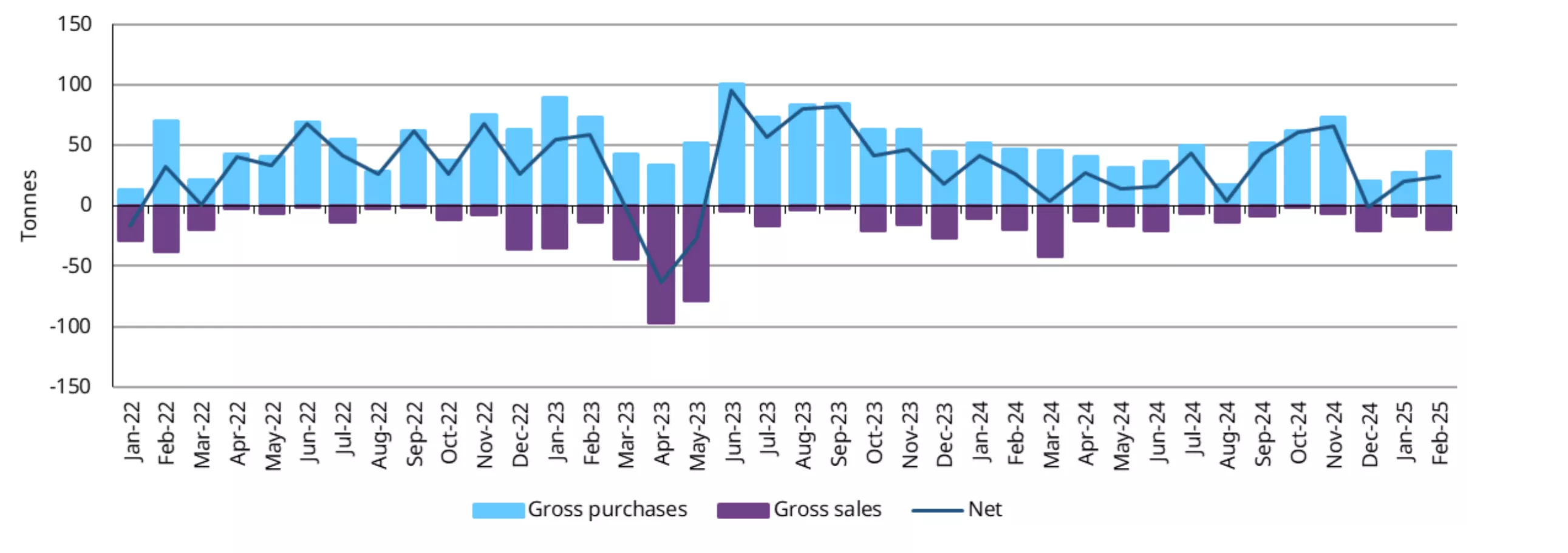
*Data to 31 March 2025 where available.
Note: The chart includes only purchases/sales of 0.5t or more.
Source: IMF IFS, respective central banks, World Gold Council
As in the preceding months, much of the buying was centred on those central banks that have been regular buyers/sellers of late:
- National Bank of Poland (NBP) lead month and year-to-date net buying, adding 29t in February alone. Year-to-date, NBP added 32t of gold, with its total gold holdings now 480t or 20% of its total reserves
- People’s Bank of China (PBoC) added 5t of gold in February, its fourth consecutive month of net buying since it resumed reporting in November 2024
- The Central Bank of the Republic of Turkey added 3t of gold in February, with its gold reserves totalling 623t or 38% of its total reserves
- The Central Bank of Jordan also added 3t of gold in February, with total gold reserves now at 72t or 30% of total reserves
- Qatar Central Bank reported 2t of net buying in February; its total gold holdings now stand at 114t which constitutes 19% of total reserves
- Czech National Bank added 2t of gold to their reserves this month, its gold holdings stand at 55t or 3% of total reserves
- Net sellers for the month of February were the National Bank of Kazakhstan (-8t) and the Central Bank of Uzbekistan (-12t). Both central banks lead net selling activity year-to-date, down 4t
- Despite net sales y-t-d, gold reserves form 54% of Kazakhstan's total reserves, bringing its total to 280t.
The National Bank of Belgium (NBB) has addressed recent media reports on the monetisation of Belgium’s gold reserve for public finance purposes, particularly defence spending. In a recent press release, NBB reaffirmed its independence and said gold reserves constitute assets allocated for achieving “public interest tasks entrusted to the Bank.”
Chart 2: Central banks' appetite for gold continues in February 2025
Y-t-d central bank net purchases and sales*
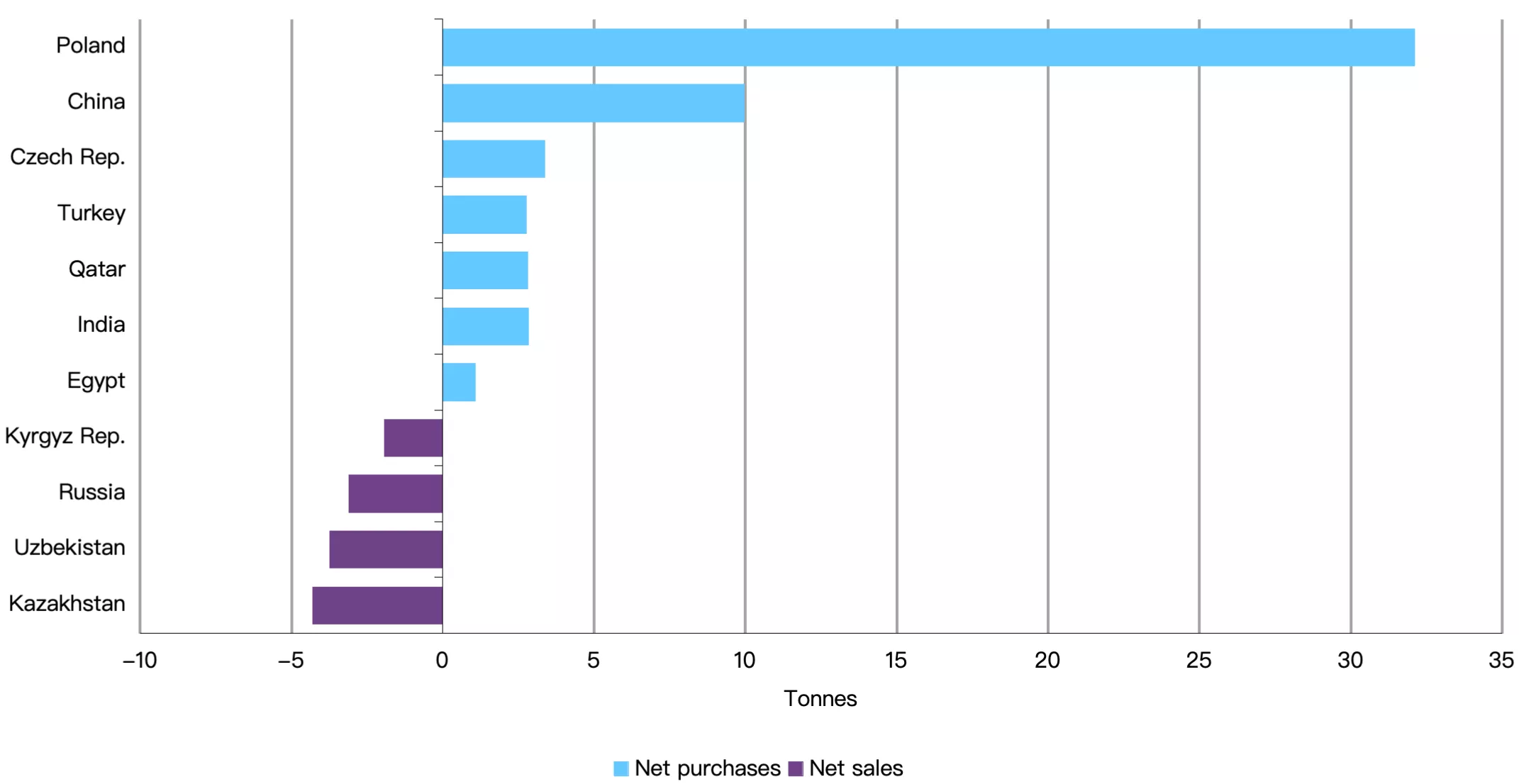
*Data to 31 March 2025 where available.
Note: The chart includes only purchases/sales of 0.5t or more.
Source: IMF IFS, respective central banks, World Gold Council
The year has had a decent start as central banks’ appetite for gold continues to be robust. Our upcoming Gold Demand Trends report scheduled for publication on 30th April, covering central bank demand for the entire first quarter.
Disclaimer
Important information and disclaimers
© 2025 World Gold Council. All rights reserved. World Gold Council and the Circle device are trademarks of the World Gold Council or its affiliates.
All references to LBMA Gold Price are used with the permission of ICE Benchmark Administration Limited and have been provided for informational purposes only. ICE Benchmark Administration Limited accepts no liability or responsibility for the accuracy of the prices or the underlying product to which the prices may be referenced. Other content is the intellectual property of the respective third party and all rights are reserved to them.
Reproduction or redistribution of any of this information is expressly prohibited without the prior written consent of World Gold Council or the appropriate copyright owners, except as specifically provided below. Information and statistics are copyright © and/or other intellectual property of the World Gold Council or its affiliates or third-party providers identified herein. All rights of the respective owners are reserved.
The use of the statistics in this information is permitted for the purposes of review and commentary (including media commentary) in line with fair industry practice, subject to the following two pre-conditions: (i) only limited extracts of data or analysis be used; and (ii) any and all use of these statistics is accompanied by a citation to World Gold Council and, where appropriate, to Metals Focus or other identified copyright owners as their source. World Gold Council is affiliated with Metals Focus.
The World Gold Council and its affiliates do not guarantee the accuracy or completeness of any information nor accept responsibility for any losses or damages arising directly or indirectly from the use of this information.
This information is for educational purposes only and by receiving this information, you agree with its intended purpose. Nothing contained herein is intended to constitute a recommendation, investment advice, or offer for the purchase or sale of gold, any gold-related products or services or any other products, services, securities or financial instruments (collectively, “Services”). This information does not take into account any investment objectives, financial situation or particular needs of any particular person.
Diversification does not guarantee any investment returns and does not eliminate the risk of loss. Past performance is not necessarily indicative of future results. The resulting performance of any investment outcomes that can be generated through allocation to gold are hypothetical in nature, may not reflect actual investment results and are not guarantees of future results. The World Gold Council and its affiliates do not guarantee or warranty any calculations and models used in any hypothetical portfolios or any outcomes resulting from any such use. Investors should discuss their individual circumstances with their appropriate investment professionals before making any decision regarding any Services or investments.
This information may contain forward-looking statements, such as statements which use the words “believes”, “expects”, “may”, or “suggests”, or similar terminology, which are based on current expectations and are subject to change. Forward-looking statements involve a number of risks and uncertainties. There can be no assurance that any forward-looking statements will be achieved. World Gold Council and its affiliates assume no responsibility for updating any forward-looking statements.
Information regarding QaurumSM and the Gold Valuation Framework
Note that the resulting performance of various investment outcomes that can be generated through use of Qaurum, the Gold Valuation Framework and other information are hypothetical in nature, may not reflect actual investment results and are not guarantees of future results. Neither World Gold Council (including its affiliates) nor Oxford Economics provides any warranty or guarantee regarding the functionality of the tool, including without limitation any projections, estimates or calculations.
Central bank gold statistics March 2025
Krishan Gopaul
Senior Analyst, EMEA World Gold CouncilMarissa Salim
Senior Research Lead, APAC World Gold Council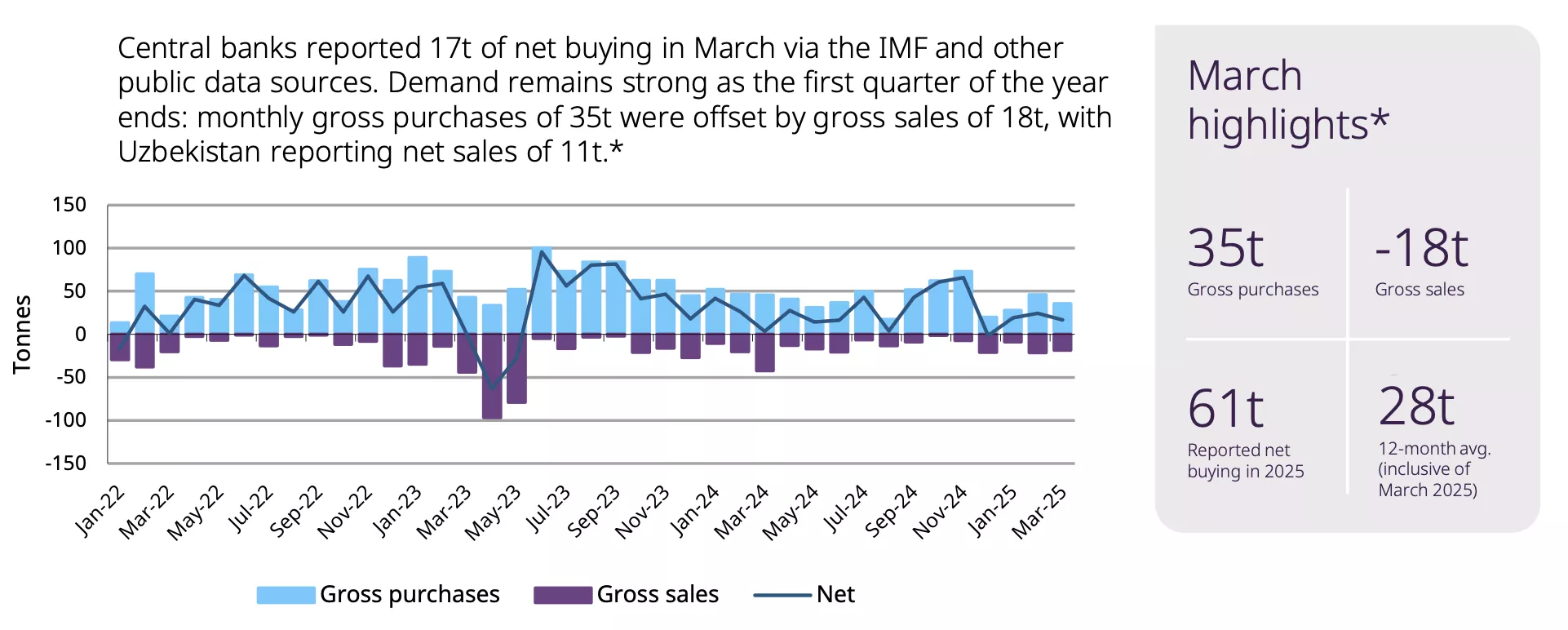
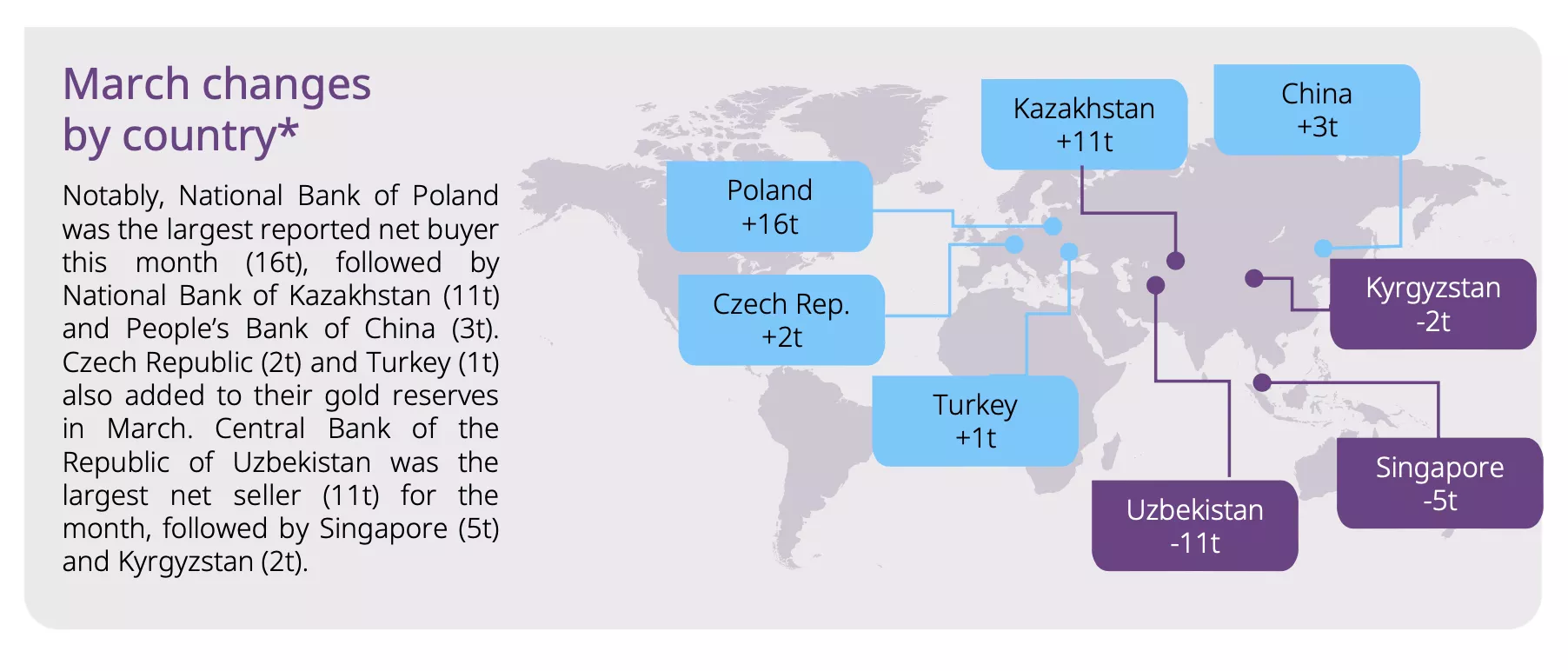
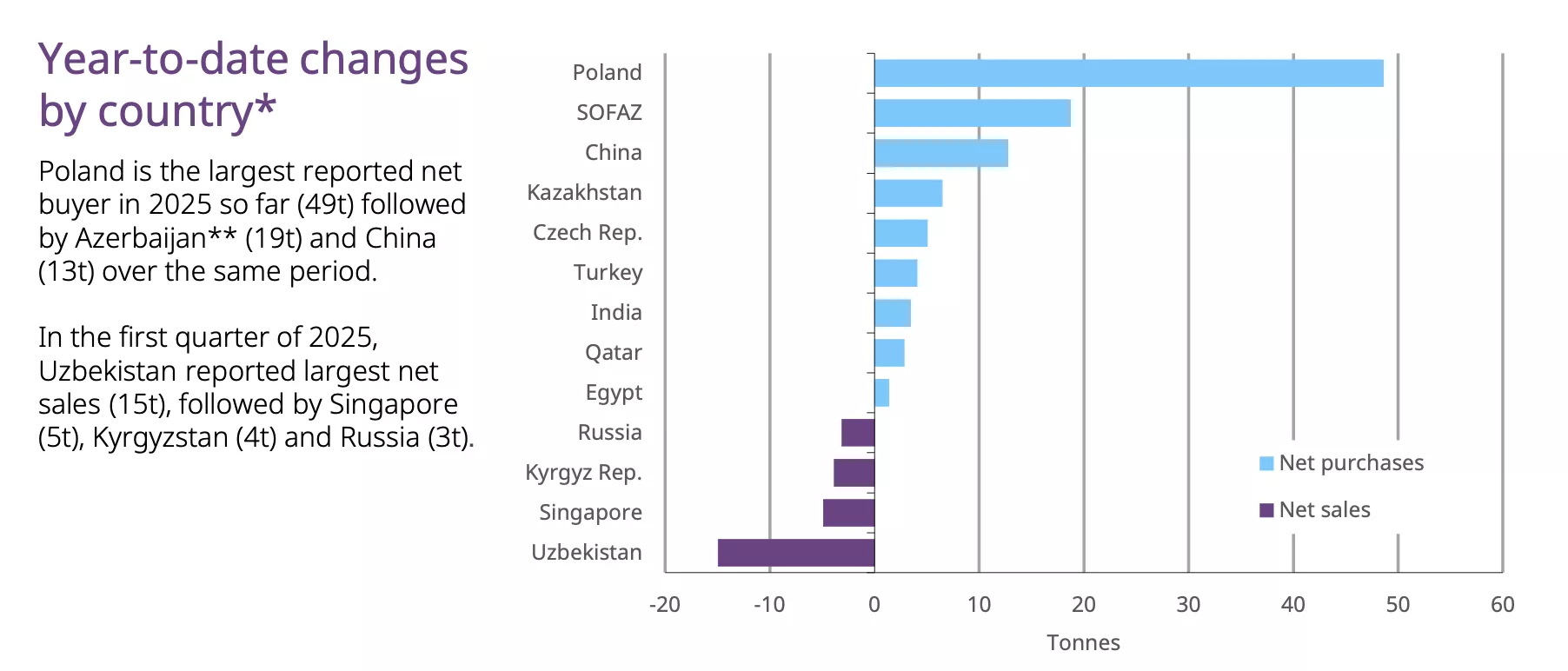
*Data to March 2025 where available.
**Represents the gold reserves of the State Oil Fund of Azerbaijan (SOFAZ). Monthly totals may not sum due to rounding and exclude the State Oil Fund of Azerbaijan (SOFAZ), which only reports quarterly data. Note: By country and y-t-d charts include changes of a tonne or more only.
Source: IMF IFS, respective central banks, World Gold Council
Disclaimer
Important information and disclaimers
© 2025 World Gold Council. All rights reserved. World Gold Council and the Circle device are trademarks of the World Gold Council or its affiliates.
All references to LBMA Gold Price are used with the permission of ICE Benchmark Administration Limited and have been provided for informational purposes only. ICE Benchmark Administration Limited accepts no liability or responsibility for the accuracy of the prices or the underlying product to which the prices may be referenced. Other content is the intellectual property of the respective third party and all rights are reserved to them.
Reproduction or redistribution of any of this information is expressly prohibited without the prior written consent of World Gold Council or the appropriate copyright owners, except as specifically provided below. Information and statistics are copyright © and/or other intellectual property of the World Gold Council or its affiliates or third-party providers identified herein. All rights of the respective owners are reserved.
The use of the statistics in this information is permitted for the purposes of review and commentary (including media commentary) in line with fair industry practice, subject to the following two pre-conditions: (i) only limited extracts of data or analysis be used; and (ii) any and all use of these statistics is accompanied by a citation to World Gold Council and, where appropriate, to Metals Focus or other identified copyright owners as their source. World Gold Council is affiliated with Metals Focus.
The World Gold Council and its affiliates do not guarantee the accuracy or completeness of any information nor accept responsibility for any losses or damages arising directly or indirectly from the use of this information.
This information is for educational purposes only and by receiving this information, you agree with its intended purpose. Nothing contained herein is intended to constitute a recommendation, investment advice, or offer for the purchase or sale of gold, any gold-related products or services or any other products, services, securities or financial instruments (collectively, “Services”). This information does not take into account any investment objectives, financial situation or particular needs of any particular person.
Diversification does not guarantee any investment returns and does not eliminate the risk of loss. Past performance is not necessarily indicative of future results. The resulting performance of any investment outcomes that can be generated through allocation to gold are hypothetical in nature, may not reflect actual investment results and are not guarantees of future results. The World Gold Council and its affiliates do not guarantee or warranty any calculations and models used in any hypothetical portfolios or any outcomes resulting from any such use. Investors should discuss their individual circumstances with their appropriate investment professionals before making any decision regarding any Services or investments.
This information may contain forward-looking statements, such as statements which use the words “believes”, “expects”, “may”, or “suggests”, or similar terminology, which are based on current expectations and are subject to change. Forward-looking statements involve a number of risks and uncertainties. There can be no assurance that any forward-looking statements will be achieved. World Gold Council and its affiliates assume no responsibility for updating any forward-looking statements.
Information regarding QaurumSM and the Gold Valuation Framework
Note that the resulting performance of various investment outcomes that can be generated through use of Qaurum, the Gold Valuation Framework and other information are hypothetical in nature, may not reflect actual investment results and are not guarantees of future results. Neither World Gold Council (including its affiliates) nor Oxford Economics provides any warranty or guarantee regarding the functionality of the tool, including without limitation any projections, estimates or calculations.
Central bank gold buying slowed in April
Krishan Gopaul
Senior Analyst, EMEA World Gold Council- Central banks added a net 12t to global gold reserves in April, the second consecutive month of slower accumulation
- The National Bank of Poland remains the leading buyer, both in April and year-to-date
- The Reserve Bank of India gave an update on where its gold is stored, while several African central banks look to add gold.
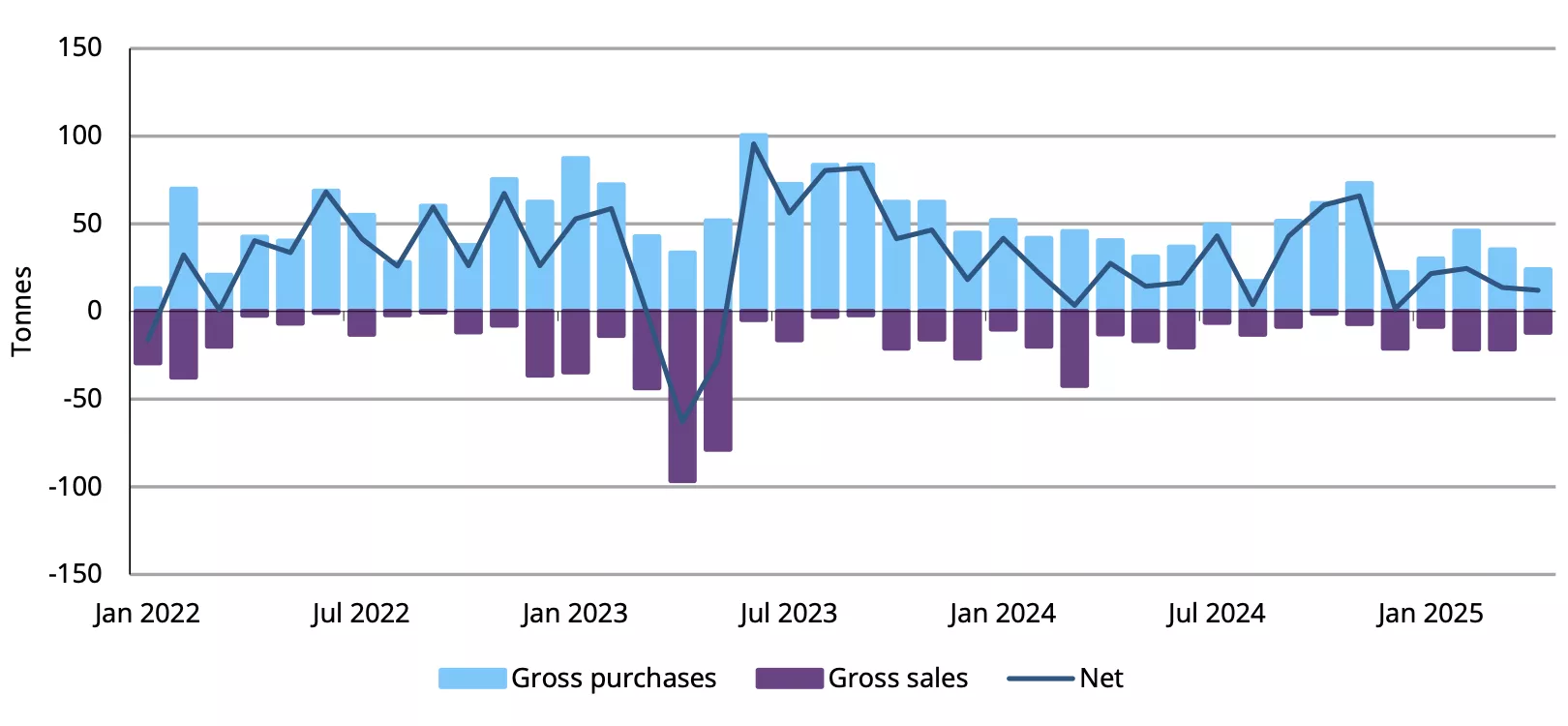
Global central banks bought a net 12t in April based on reported data, 12% lower than the previous month and below the 12-month average of 28t (Chart 1).1
What could be behind this recent decline in monthly purchases? It may, in part, be a response to the rapid appreciation in the gold price since the start of the year. While the rally to multiple new record highs is unlikely to deter central banks from buying gold – as they tend to be more strategic in nature – it could explain some of the deceleration in the pace of monthly net buying.
Chart 1: Central bank net purchases slowed in April for the second consecutive month
Monthly reported central bank activity, tonnes*
*Data to 30 April 2025 where available.
Source: IMF, respective central banks, World Gold Council
As the chart above shows, the data series are very volatile, meaning that activity in one month is not necessarily an indication of activity in subsequent months. What’s more, data can be released with, at times, a significant lag. As such, we caution against reading too much into this recent slowdown in reported purchases. And while higher prices may have pushed up gold allocations in some central bank portfolios, possibly closer to targets, we still expect overall buying to continue, given that the economic and geopolitical outlook remains highly uncertain.
Poland leads central bank gold purchases in April
In April, five central banks have reported changes (of 1t or more) to their gold reserves:
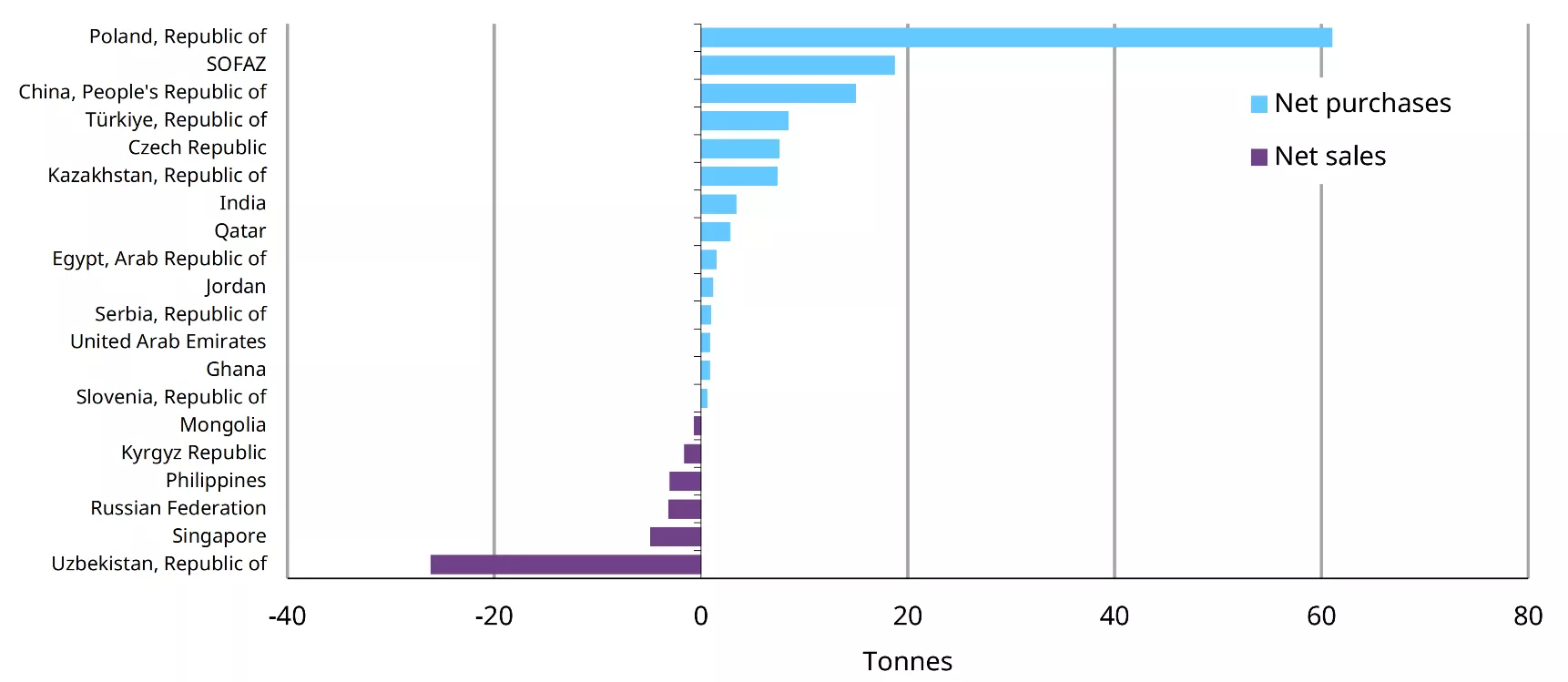
- National Bank of Poland (NBP) continued to be the largest buyer of gold amongst central banks. In April, the NBP added a further 12t to its gold reserves, lifting them to 509t, higher than gold reserves at the European Central Bank (507t). Since the start of the year, NBP gold reserves have increased by 61t, two-thirds of the 90t they added in 2024
- Czech National Bank reported that it had increased its gold reserves by a further 3t in April. It has now added gold for 26 consecutive months, over which time it has bought a total of 47t. Total gold holdings were nearly 59t at the end of April
- People's Bank of China data shows that its gold reserves increased by 2t in April - the sixth consecutive month of purchases. Y-t-d net purchases now total 15t, helping to lift gold reserves to 2,294t
- Central Bank of Turkey (Türkiye) reported a 2t increase in official (central bank + Treasury) gold holdings during the month, pushing gold holdings to 626t
- National Bank of the Kyrgyz Republic gold reserves rose by 2t in April, marking its first monthly net purchase since December. Y-t-d the bank is a net seller of 2t, with total gold holdings at 37t.
- National Bank of Kazakhstan added 1t to its gold reserves, nudging total gold held to 291t, 7t higher than at the end of 2024
- Central Bank of Jordan increased its gold reserves by almost 1t, to 73t
- Central Bank of Uzbekistan gold reserves fell by 11t in April, the third consecutive month of sales around that level. Y-t-d total gold holdings have fallen by 26t, to 356t.
On a y-t-d basis, central bank buying continues to be broad based, although confined to emerging markets and dominated by the National Bank of Poland (Chart 2). By comparison, sales are less widespread, but similarly dominated by a single bank.
Chart 2: Central banks continue their broad accumulation of gold in 2025
Y-t-d central bank net purchases and sales, tonnes*
*Data to 30 April 2025 where available. SOFAZ represents the gold reserves of the State Oil Fund of Azerbaijan (SOFAZ)
Source: IMF, respective central banks, World Gold Council
RBI maintains gold reserves and updates storage details
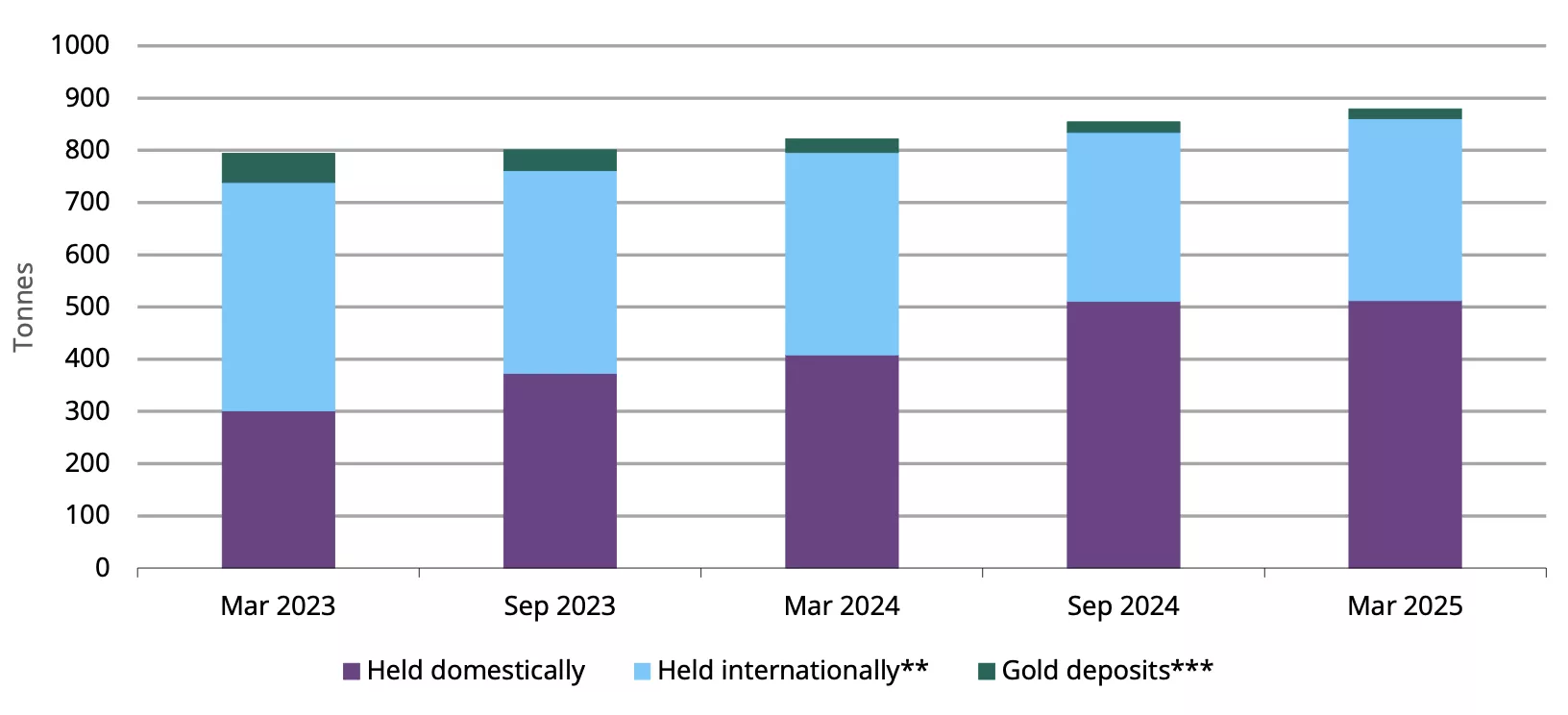
While the Reserve Bank of India (RBI) left its gold reserves unchanged at 880t in April, it did provide updated details on its reserves and where they are stored. In its half-yearly report the RBI stated that 512t (58%) was held domestically at the end of March, slightly higher on a tonnage basis (510t) but lower on a percentage basis (60%) compared to six months earlier (Chart 3). The RBI has made significant efforts in recent years to store a higher proportion of its gold reserves domestically – just two years ago it reported that only 38% of its gold reserves were held in India.
Chart 3: The RBI now holds almost two-thirds of gold reserves domestically
Semi-annual RBI gold holdings broken down by storage location, tonnes*
*Data to 31 March 2025.
**Gold held at the Bank of England and Bank of International Settlements.
***Gold held in the form of a financial instruments on which the RBI earns interest.
Source: Reserve Bank of India, World Gold Council
African banks plan on boosting gold reserves
At the start of May the Bank of Namibia announced plans to accumulate gold with the aim of increasing it to 3% of total reserves. The bank stated that this “aligns with global central banking trends, given gold’s strategic value in hedging against inflation and enhancing resilience during economic shocks”.2 According to the latest available IMF data (March 2019) the Bank of Namibia held no gold reserves.
The National Bank of Rwanda also announced during the month that it intends to build gold reserves. Governor Soraya Hakuziyaremye stated: “Similar to our peers, the central bank of Rwanda is conducting a study to see whether gold can be embraced as an additional asset that we can invest in given its ability to counter shocks on financial markets and as a hedging option in terms of external shocks”. The central bank has approved gold additions, starting from its new fiscal year in July.
Also in May, Bank of Uganda Govenor, Michael Atingi-Ego, told Bloomberg TV that the bank would be diversifying its reserves with gold sourced from artisanal miners. The aim was to use this gold accumulation to deal with maturing (cross currency) repos.
A statement from the Central Bank of Madagascar indicated that it will acquire 4t of gold as part of a plan to boost reserves and formalise gold exports.3
Elsewhere, Central Bank of Kenya Governor, Kamau Thugge, told Bloomberg TV in April that they are “actively considering” adding gold to their reserves for diversification purposes, although with no timeline as to when they might do so.4 As of March 2025 the bank held around 17kg of gold as part of its reserves, based on data reported to the IMF.
Footnotes
1Average monthly net purchases between April 2024 and March 2025.
2Namibia Joins Central Banks’ Gold Rush to Hedge Against Shocks, Bloomberg, May 2025
3Appel A Manifestation D’Interet Aux Operateurs Auriferes Candidats A L’Obtention D’Un Agrement De Comptoir De L’Or, Central Bank of Madagascar, May 2025
4Kenya Central Bank is ‘Actively Considering’ Buying Gold, Live Mint, April 2025
Disclaimer
Important information and disclaimers
© 2025 World Gold Council. All rights reserved. World Gold Council and the Circle device are trademarks of the World Gold Council or its affiliates.
All references to LBMA Gold Price are used with the permission of ICE Benchmark Administration Limited and have been provided for informational purposes only. ICE Benchmark Administration Limited accepts no liability or responsibility for the accuracy of the prices or the underlying product to which the prices may be referenced. Other content is the intellectual property of the respective third party and all rights are reserved to them.
Reproduction or redistribution of any of this information is expressly prohibited without the prior written consent of World Gold Council or the appropriate copyright owners, except as specifically provided below. Information and statistics are copyright © and/or other intellectual property of the World Gold Council or its affiliates or third-party providers identified herein. All rights of the respective owners are reserved.
The use of the statistics in this information is permitted for the purposes of review and commentary (including media commentary) in line with fair industry practice, subject to the following two pre-conditions: (i) only limited extracts of data or analysis be used; and (ii) any and all use of these statistics is accompanied by a citation to World Gold Council and, where appropriate, to Metals Focus or other identified copyright owners as their source. World Gold Council is affiliated with Metals Focus.
The World Gold Council and its affiliates do not guarantee the accuracy or completeness of any information nor accept responsibility for any losses or damages arising directly or indirectly from the use of this information.
This information is for educational purposes only and by receiving this information, you agree with its intended purpose. Nothing contained herein is intended to constitute a recommendation, investment advice, or offer for the purchase or sale of gold, any gold-related products or services or any other products, services, securities or financial instruments (collectively, “Services”). This information does not take into account any investment objectives, financial situation or particular needs of any particular person.
Diversification does not guarantee any investment returns and does not eliminate the risk of loss. Past performance is not necessarily indicative of future results. The resulting performance of any investment outcomes that can be generated through allocation to gold are hypothetical in nature, may not reflect actual investment results and are not guarantees of future results. The World Gold Council and its affiliates do not guarantee or warranty any calculations and models used in any hypothetical portfolios or any outcomes resulting from any such use. Investors should discuss their individual circumstances with their appropriate investment professionals before making any decision regarding any Services or investments.
This information may contain forward-looking statements, such as statements which use the words “believes”, “expects”, “may”, or “suggests”, or similar terminology, which are based on current expectations and are subject to change. Forward-looking statements involve a number of risks and uncertainties. There can be no assurance that any forward-looking statements will be achieved. World Gold Council and its affiliates assume no responsibility for updating any forward-looking statements.
Information regarding QaurumSM and the Gold Valuation Framework
Note that the resulting performance of various investment outcomes that can be generated through use of Qaurum, the Gold Valuation Framework and other information are hypothetical in nature, may not reflect actual investment results and are not guarantees of future results. Neither World Gold Council (including its affiliates) nor Oxford Economics provides any warranty or guarantee regarding the functionality of the tool, including without limitation any projections, estimates or calculations.
Central bank gold buying picks up in May
Marissa Salim
Senior Research Lead, APAC World Gold Council- Central banks added a net 20t to global gold reserves in May, an uptick from the previous month, though overall pace has moderated slightly
- The National Bank of Kazakhstan led buying this month (7t), followed by Turkey and Poland each with 6t net purchases, meanwhile the Monetary Authority of Singapore (MAS) reported sales of 5t over the same period
- In our recently released Central Bank Gold Reserves Survey 2025, 43% of central bankers surveyed stated their own central bank would increase their gold reserves and 95% believed that official gold reserves would continue to increase in the next 12 months, citing gold’s attributes as a diversifier and hedge during crisis and inflation as key factors influencing their decision to hold gold. This sentiment was echoed in the Official Monetary and Financial Institutions Forum (OMFIF) Global Public Investor 2025 where 32% of central banks expect to increase gold holdings in the next 12–24 months.
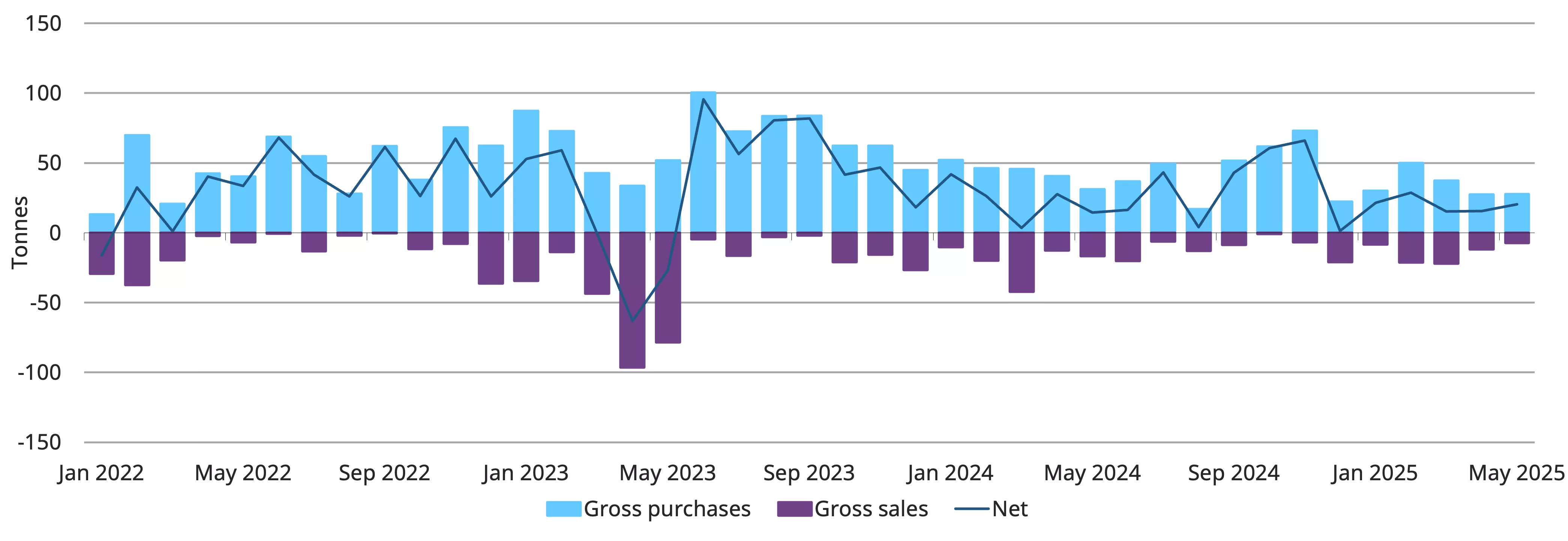
Global central banks bought a net 20t in May based on reported data, close to but still below the 12-month average of 27t (Chart 1).1 Fresh tensions in the Middle East may have reinforced the strategic appeal of gold for central banks looking to safeguard reserves against geopolitical shocks. This continued interest in gold was also highlighted in our recently released Central Bank Gold Reserves Survey 2025. Gold remains a focus for central banks worldwide with 95% of respondents believing that official gold reserves will continue to increase, up from 81% last year. A record 43% of central bankers also indicated that their own gold reserves would rise over the next 12 months.
Chart 1: Central bank net purchases ticked up in May
*Data to 30 May 2025 where available.
Source: IMF, respective central banks, World Gold Council
Kazakhstan leads central bank gold purchases in May
In May, these central banks have reported changes (of 1t or more) to their gold reserves:
- National Bank of Kazakhstan (NBK) reported adding 7t of gold to their reserves in May, lifting them to 299t. Since the start of the year, NBK gold reserves have increased by 15t
- Central Bank of Turkey reported 6t of gold purchases this month, lifting their y-t-d gold accumulation to 15t
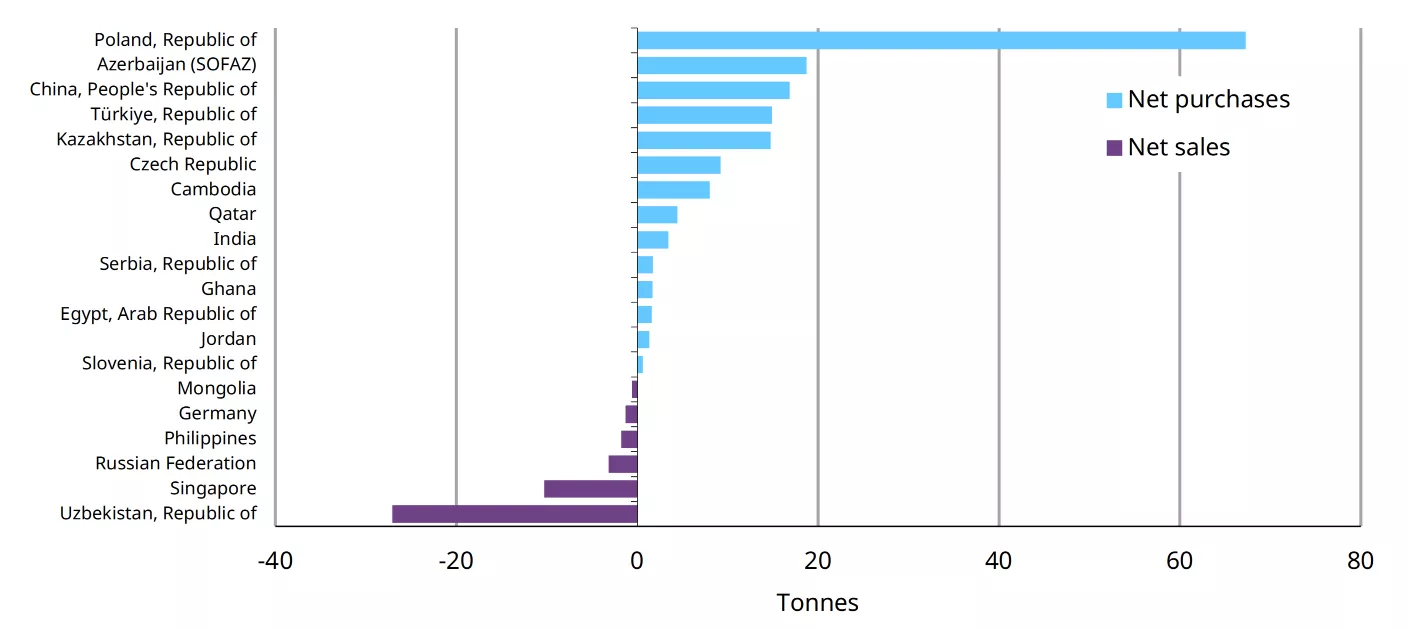
- National Bank of Poland also added 6t of gold to their reserves in May; the NBP remains the largest net purchaser of gold in 2025, adding 67t
- People’s Bank of China and Czech National Bank both added 2t of gold respectively this month, followed by three other central banks which added 1t of gold each this month: National Bank of the Kyrgyz Republic, National Bank of Cambodia, the Central Bank of the Philippines and the Bank of Ghana
- The Monetary Authority of Singapore led sales this month with 5t, followed by Central Bank of the Republic of Uzbekistan and the Deutsche Bundesbank, each sold 1t of gold this month.2 On a y-t-d basis, Uzbekistan remains the largest net seller (27t) followed by Singapore (10t) (Chart 2)
- Updated data for April 2025 also showed that the Qatar Central Bank purchased 2t of gold, bringing global net purchases that month to 16t.
Chart 2: Central banks continue their broad accumulation of gold in 2025
Y-t-d central bank net purchases and sales, tonnes*
*Data to 30 May 2025 where available. SOFAZ represents the gold reserves of the State Oil Fund of Azerbaijan (SOFAZ).
Source: IMF, respective central banks, World Gold Council
Central banks continue to hold favourable expectations on gold
Our recently released Central Bank Gold Reserves Survey 2025 reinforces gold’s relevance to the central bankers worldwide, with key insights highlighted below:
Record participation and growing engagement
a. A record 73 central banks participated in our survey reflecting continued interest in gold as a strategic reserve asset
Accelerated accumulation trends
a. Over the past three years, central banks have purchased more than 1000t of gold annually, compared to just 400t-500t per year in the prior decade
Optimism towards gold holdings
a. 95% of respondents expect global central-bank gold reserves to rise in the next 12 months
b. 43% anticipate an increase in their own holdings – up from 29% in 2024 – a record high; EMDE banks show stronger intent than advanced economies
Structural shift in reserve portfolios
a. 76% project gold will constitute a moderately or significantly higher share of total reserves over five years (up from 69%)
b. 73% expect a reduced share of US dollar reserves in the same period
Enhanced active management
a. 44% now actively manage gold separately (up from 37% in 2024)
Footnotes
1Average monthly net purchases between May 2024 and April 2025.
2The Bundesbank sale is likely related to its longstanding coin-minting programme.
Disclaimer
Important information and disclaimers
© 2025 World Gold Council. All rights reserved. World Gold Council and the Circle device are trademarks of the World Gold Council or its affiliates.
All references to LBMA Gold Price are used with the permission of ICE Benchmark Administration Limited and have been provided for informational purposes only. ICE Benchmark Administration Limited accepts no liability or responsibility for the accuracy of the prices or the underlying product to which the prices may be referenced. Other content is the intellectual property of the respective third party and all rights are reserved to them.
Reproduction or redistribution of any of this information is expressly prohibited without the prior written consent of World Gold Council or the appropriate copyright owners, except as specifically provided below. Information and statistics are copyright © and/or other intellectual property of the World Gold Council or its affiliates or third-party providers identified herein. All rights of the respective owners are reserved.
The use of the statistics in this information is permitted for the purposes of review and commentary (including media commentary) in line with fair industry practice, subject to the following two pre-conditions: (i) only limited extracts of data or analysis be used; and (ii) any and all use of these statistics is accompanied by a citation to World Gold Council and, where appropriate, to Metals Focus or other identified copyright owners as their source. World Gold Council is affiliated with Metals Focus.
The World Gold Council and its affiliates do not guarantee the accuracy or completeness of any information nor accept responsibility for any losses or damages arising directly or indirectly from the use of this information.
This information is for educational purposes only and by receiving this information, you agree with its intended purpose. Nothing contained herein is intended to constitute a recommendation, investment advice, or offer for the purchase or sale of gold, any gold-related products or services or any other products, services, securities or financial instruments (collectively, “Services”). This information does not take into account any investment objectives, financial situation or particular needs of any particular person.
Diversification does not guarantee any investment returns and does not eliminate the risk of loss. Past performance is not necessarily indicative of future results. The resulting performance of any investment outcomes that can be generated through allocation to gold are hypothetical in nature, may not reflect actual investment results and are not guarantees of future results. The World Gold Council and its affiliates do not guarantee or warranty any calculations and models used in any hypothetical portfolios or any outcomes resulting from any such use. Investors should discuss their individual circumstances with their appropriate investment professionals before making any decision regarding any Services or investments.
This information may contain forward-looking statements, such as statements which use the words “believes”, “expects”, “may”, or “suggests”, or similar terminology, which are based on current expectations and are subject to change. Forward-looking statements involve a number of risks and uncertainties. There can be no assurance that any forward-looking statements will be achieved. World Gold Council and its affiliates assume no responsibility for updating any forward-looking statements.
Information regarding QaurumSM and the Gold Valuation Framework
Note that the resulting performance of various investment outcomes that can be generated through use of Qaurum, the Gold Valuation Framework and other information are hypothetical in nature, may not reflect actual investment results and are not guarantees of future results. Neither World Gold Council (including its affiliates) nor Oxford Economics provides any warranty or guarantee regarding the functionality of the tool, including without limitation any projections, estimates or calculations.
Central bank gold statistics: June 2025
Krishan Gopaul
Senior Analyst, EMEA World Gold Council
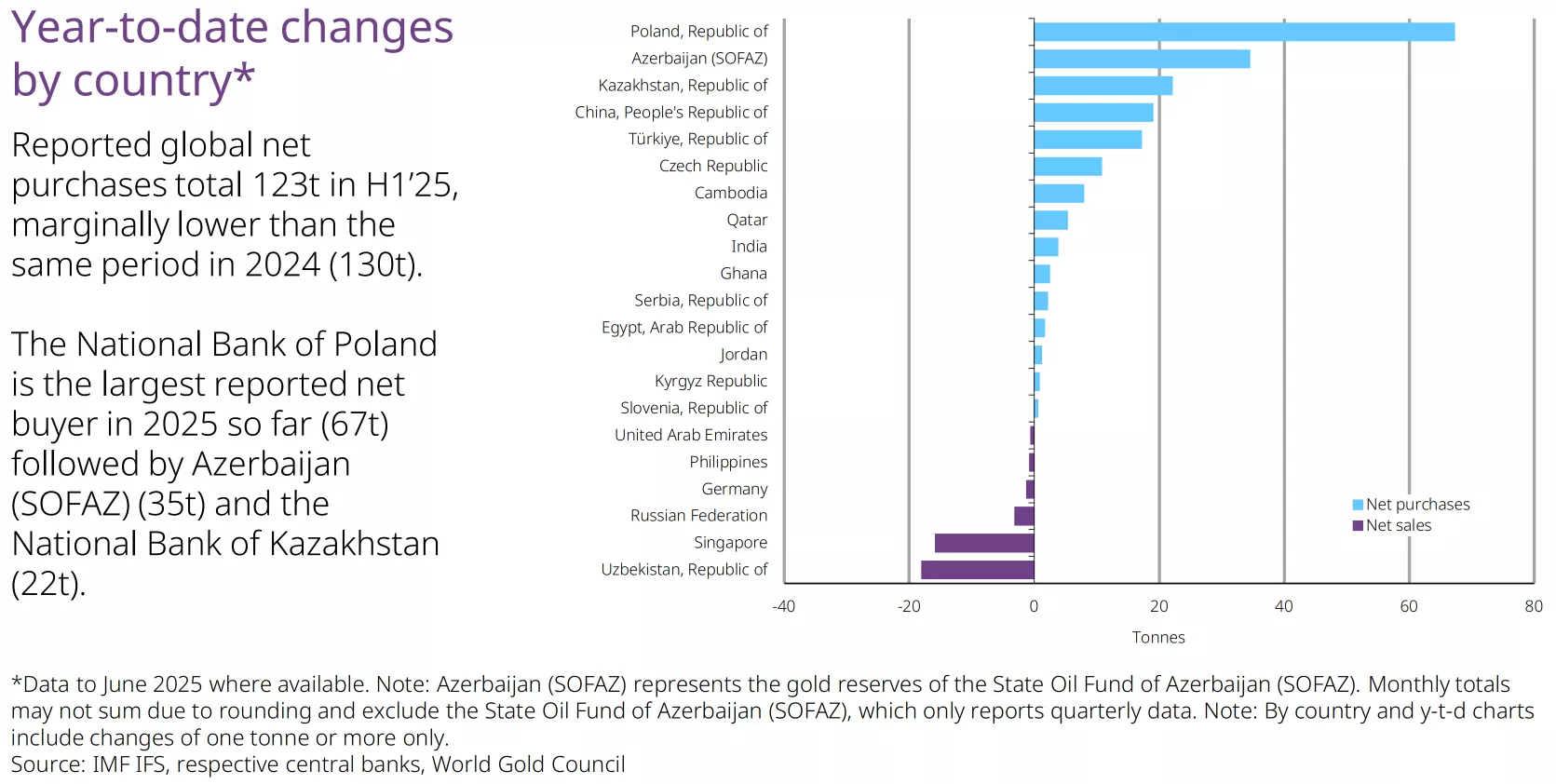
Disclaimer
Important information and disclaimers
© 2025 World Gold Council. All rights reserved. World Gold Council and the Circle device are trademarks of the World Gold Council or its affiliates.
Reproduction or redistribution of any of this information is expressly prohibited without the prior written consent of World Gold Council or the appropriate copyright owners, except as specifically provided below. Information and statistics are copyright © and/or other intellectual property of the World Gold Council or its affiliates or third-party providers identified herein. All rights of the respective owners are reserved.
The use of the statistics in this information is permitted for the purposes of review and commentary (including media commentary) in line with fair industry practice, subject to the following two pre-conditions: (i) only limited extracts of data or analysis be used; and (ii) any and all use of these statistics is accompanied by a citation to World Gold Council and, where appropriate, to Metals Focus or other identified copyright owners as their source. World Gold Council is affiliated with Metals Focus.
The World Gold Council and its affiliates do not guarantee the accuracy or completeness of any information nor accept responsibility for any losses or damages arising directly or indirectly from the use of this information.
This information is for educational purposes only and by receiving this information, you agree with its intended purpose. Nothing contained herein is intended to constitute a recommendation, investment advice, or offer for the purchase or sale of gold, any gold-related products or services or any other products, services, securities or financial instruments (collectively, “Services”). This information does not take into account any investment objectives, financial situation or particular needs of any particular person.
Diversification does not guarantee any investment returns and does not eliminate the risk of loss. Past performance is not necessarily indicative of future results. The resulting performance of any investment outcomes that can be generated through allocation to gold are hypothetical in nature, may not reflect actual investment results and are not guarantees of future results. The World Gold Council and its affiliates do not guarantee or warranty any calculations and models used in any hypothetical portfolios or any outcomes resulting from any such use. Investors should discuss their individual circumstances with their appropriate investment professionals before making any decision regarding any Services or investments.
This information may contain forward-looking statements, such as statements which use the words “believes”, “expects”, “may”, or “suggests”, or similar terminology, which are based on current expectations and are subject to change. Forward-looking statements involve a number of risks and uncertainties. There can be no assurance that any forward-looking statements will be achieved. World Gold Council and its affiliates assume no responsibility for updating any forward-looking statements.
Information regarding the LBMA Gold Price
The LBMA Gold Price is administered and published by ICE Benchmark Administration Limited (IBA). The LBMA Gold Price is a trademark of Precious Metals Prices Limited and is licensed to IBA as administrator of the LBMA Gold Price. ICE and ICE Benchmark Administration are registered trademarks of IBA and/or its affiliates. The LBMA Gold Price is used by the World Gold Council with permission under license by IBA.
Published LBMA Gold Price information may not be indicative of future LBMA Gold Price information or performance. None of IBA, Intercontinental Exchange, Inc. (ICE) or any third party that provides data used to administer or determine the LBMA Gold Price (data providers), or any of its or their affiliates makes any claim, prediction, warranty or representation whatsoever as to the timeliness, accuracy or completeness of LBMA Gold Price information, the results to be obtained from any use of LBMA Gold Price information, or the appropriateness or suitability of using LBMA Gold Price information for any particular purpose. to the fullest extent permitted by applicable law, all implied terms, conditions and warranties, including, without limitation, as to quality, merchantability, fitness for purpose, title or non-infringement, in relation to LBMA Gold Price information, are hereby excluded, and none of IBA, ICE or any data provider, or any of its or their affiliates will be liable in contract or tort (including negligence), for breach of statutory duty or nuisance, or under antitrust laws, for misrepresentation or otherwise, in respect of any inaccuracies, errors, omissions, delays, failures, cessations or changes (material or otherwise) in LBMA Gold Price information, or for any damage, expense or other loss (whether direct or indirect) you may suffer arising out of or in connection with LBMA Gold Price information or any reliance you may place upon it.
LBMA Gold Price information provided by the World Gold Council may be used by you internally to review the analysis provided by the World Gold Council, but may not be used for any other purpose. LBMA Gold Price information provided by the World Gold Council may not be disclosed by you to anyone else.
Latest research
Looking for insight and analysis on gold? Our team of experts produce market-leading research and macroeconomic commentary on gold.