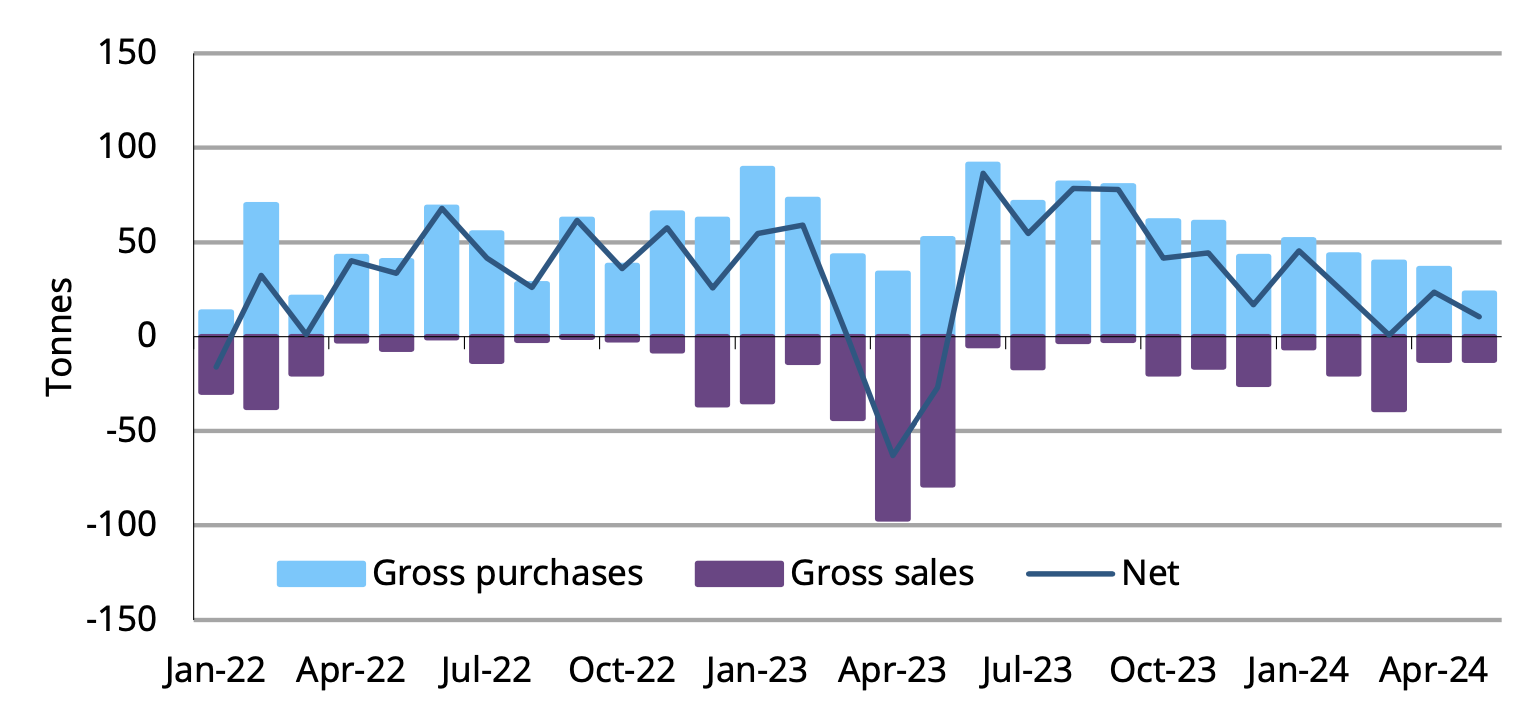
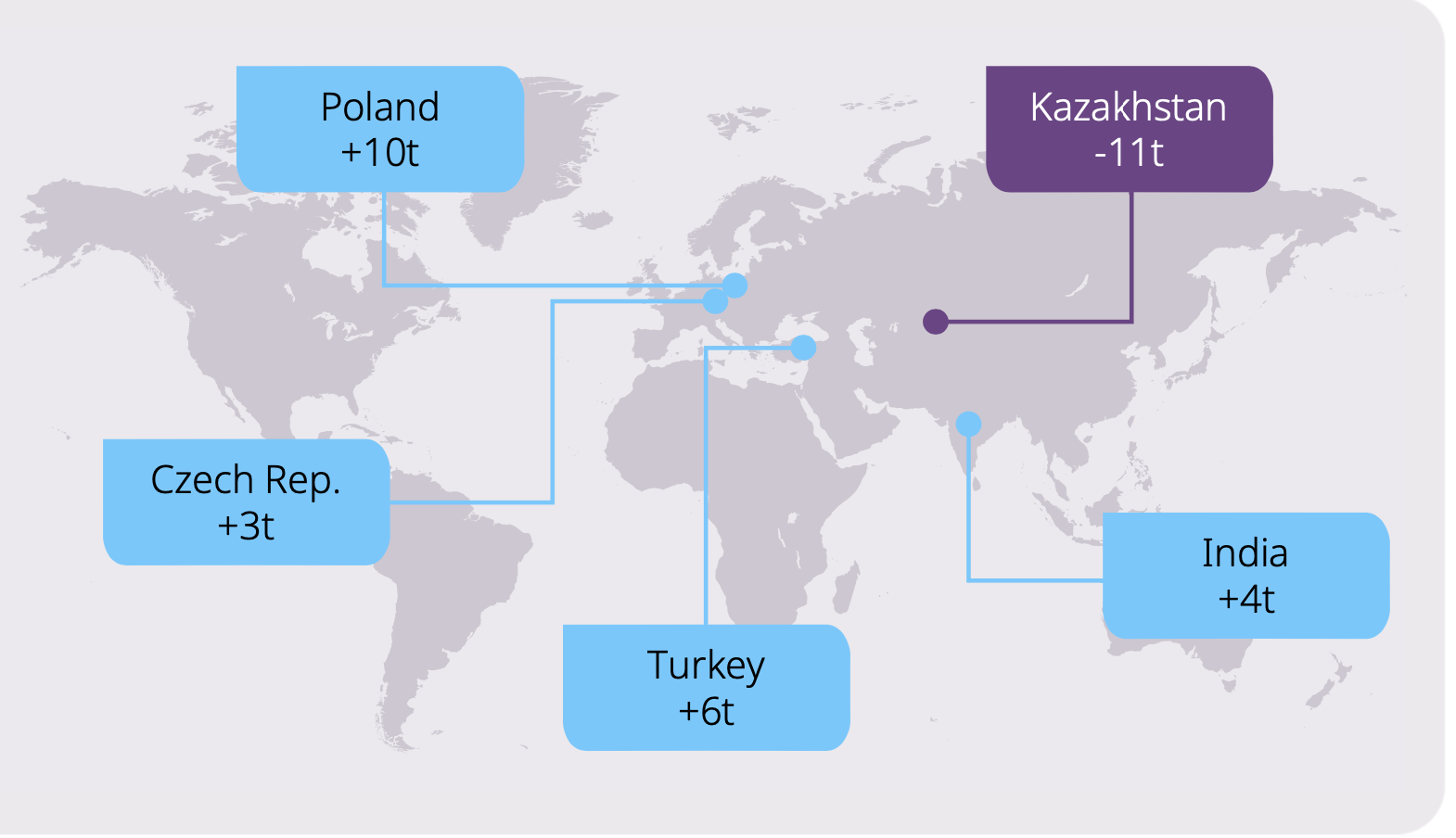
Central banks reported 10t of net buying in May via the IMF and other public data sources. Demand moderated during the month: monthly gross purchases fell to 23t and offset by gross sales of 12t.*
Central bank gold buying picks up in April
Krishan Gopaul
Senior Analyst, EMEA World Gold Council- Net purchases totalled 33t in April, rebounding from a revised net 3t in March
- Broad buying from several emerging market banks offset negligible sales
- June sees the release of findings from our Central Bank Gold Survey 2024.
The rapid rise in the gold price during March raised several questions. One of these was whether central banks – whose demand has been posited as a key reason for the recent rally – would change their gold buying behaviour in response.
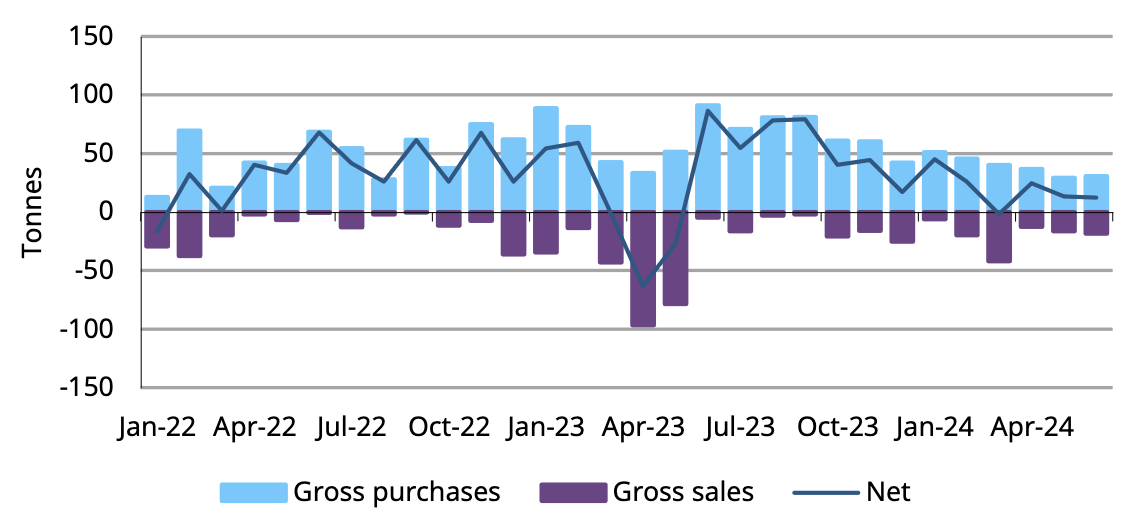
We now have the benefit of a more complete picture for March, as well as initial data for April, to help inform our perspective. Latest figures – reported via the IMF and publicly available sources – show that global gold reserves rose by a net 33t in April, similar to levels seen in February (27t).1 Although gross purchases dipped to 36t, from 39t in March, gross sales saw a more pronounced m/m drop from 36t to just 3t in April.
Central bank net buying rebounds in April
Monthly central bank gross purchases and sales, tonnes*
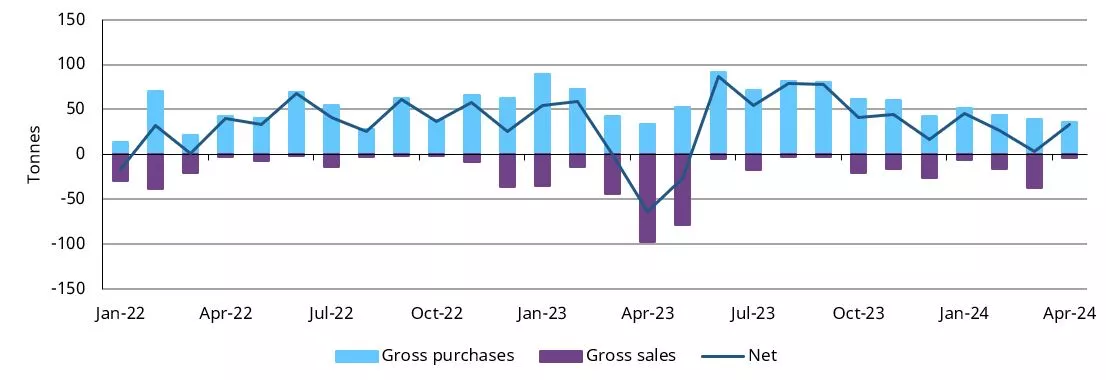
*Data to 30 April 2024 where available.
Source: IMF IFS, respective central banks, World Gold Council
Eight central banks increased their gold reserves by a tonne or more in April. The Central Bank of Turkey was the largest buyer, increasing its official reserves by 8t.2 With 11 consecutive months of buying, the bank’s y-t-d net purchases now total 38t and lift its total official gold holdings to 578t. The National Bank of Kazakhstan (6t), Reserve Bank of India (6t), National Bank of Poland (5t), Monetary Authority of Singapore (4t), Central Bank of Russia (3t) and Czech National Bank (2t) were the other major buyers in the month.
The People's Bank of China reported a significant slowdown in its gold buying. The bank reported that its gold reserves rose by just under 2t in April to 2,264t – the lowest monthly increase since it resumed reporting in November 2022 and well below the 18t monthly average prior to April.
Notable gross sales were limited to the Central Banks of Uzbekistan and Jordan. Both reported a 1t decline in their gold reserves, a notable reduction in the pace of selling seen in February and March.
Central bank gold demand remains healthy so far in 2024
Y-t-d net purchases/sales of a tonne or more by central bank*
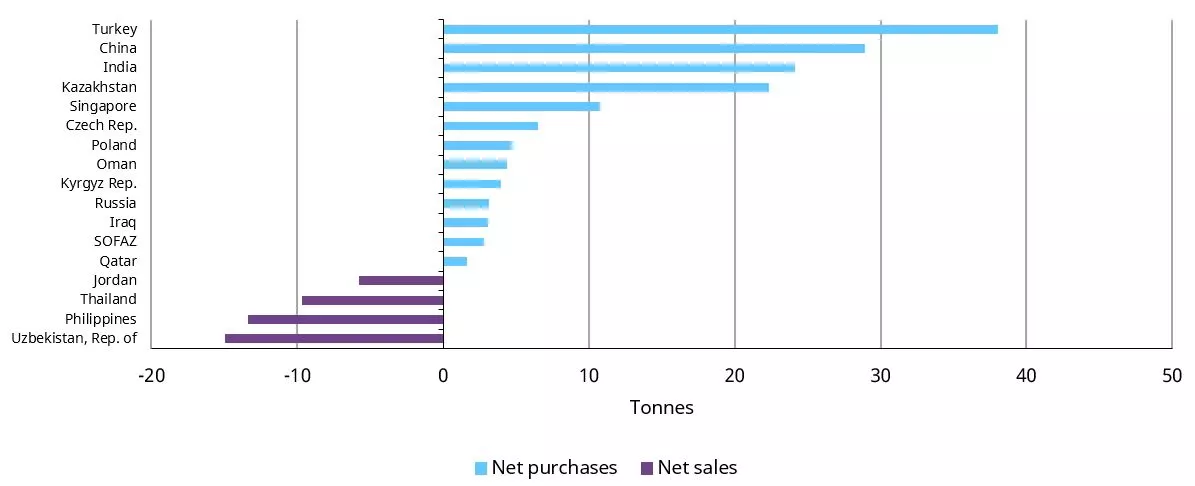
*Data to 30 April 2024 where available.
Source: IMF IFS, respective central banks, World Gold Council
Looking back at March, net purchases for the month have been revised to just 3t following the late reporting of a 12t sale by the Central Bank of the Philippines. While gross purchases during March were relatively stable in the face of the rapidly rising gold price, gross sales saw a marked pick-up thanks to heavy sales from (now) four banks . This suggests that price performance may well have had some impact on the activity of some central banks.
Despite the slowdown in March, the preliminary pick-up in net purchases in April may suggest that central banks have thus far shaken off the rally in the gold price and continue with their strategic buying plans. Of course, more data for April, as it becomes available, as well as data for May, will be instructive to further assess how central banks’ approach to gold purchases will evolve. In addition, June sees the publication of findings from our Central Bank Gold Survey 2024, which will provide a rich insight into central banks’ thinking towards gold, and how this may influence gold buying going forward.
Footnotes
1 Based on monthly IMF IFS data (reported with a two-month lag) and supplemented with data from respective central banks where applicable. Most institutions report on a regular basis, but some may report with a – sometimes significant – delay. Late availability of data may lead to revisions. The data reported here informs, but is distinct from, the central bank demand estimates we report in Gold Demand Trends.
2 Turkey’s official sector gold reserves are the sum of central bank-owned gold and Treasury gold holdings. This is equivalent to gross gold reserves less all gold held at the central bank in relation to commercial sector gold policies (such as the Reserve Option Mechanism (ROM), collateral, deposits and swaps). For information on this methodology, click here.
Central Bank Gold Statistics: May 2024
Krishan Gopaul
Senior Analyst, EMEA World Gold CouncilMay Highlights

May changes by country
May transactions were led by emerging market central banks. The National Bank of Poland was the largest gold purchaser during the month (10t), followed by the Central Bank of Turkey and the Reserve Bank of India.
Year-to-date changes by country
Buying strength continues in 2024, although gross purchases and sales are lower compared to the same period last year.
Emerging market banks the main driving force for both purchases and sales. The Monetary Authority of Singapore remains the sole developed market bank having increased its gold reserves.
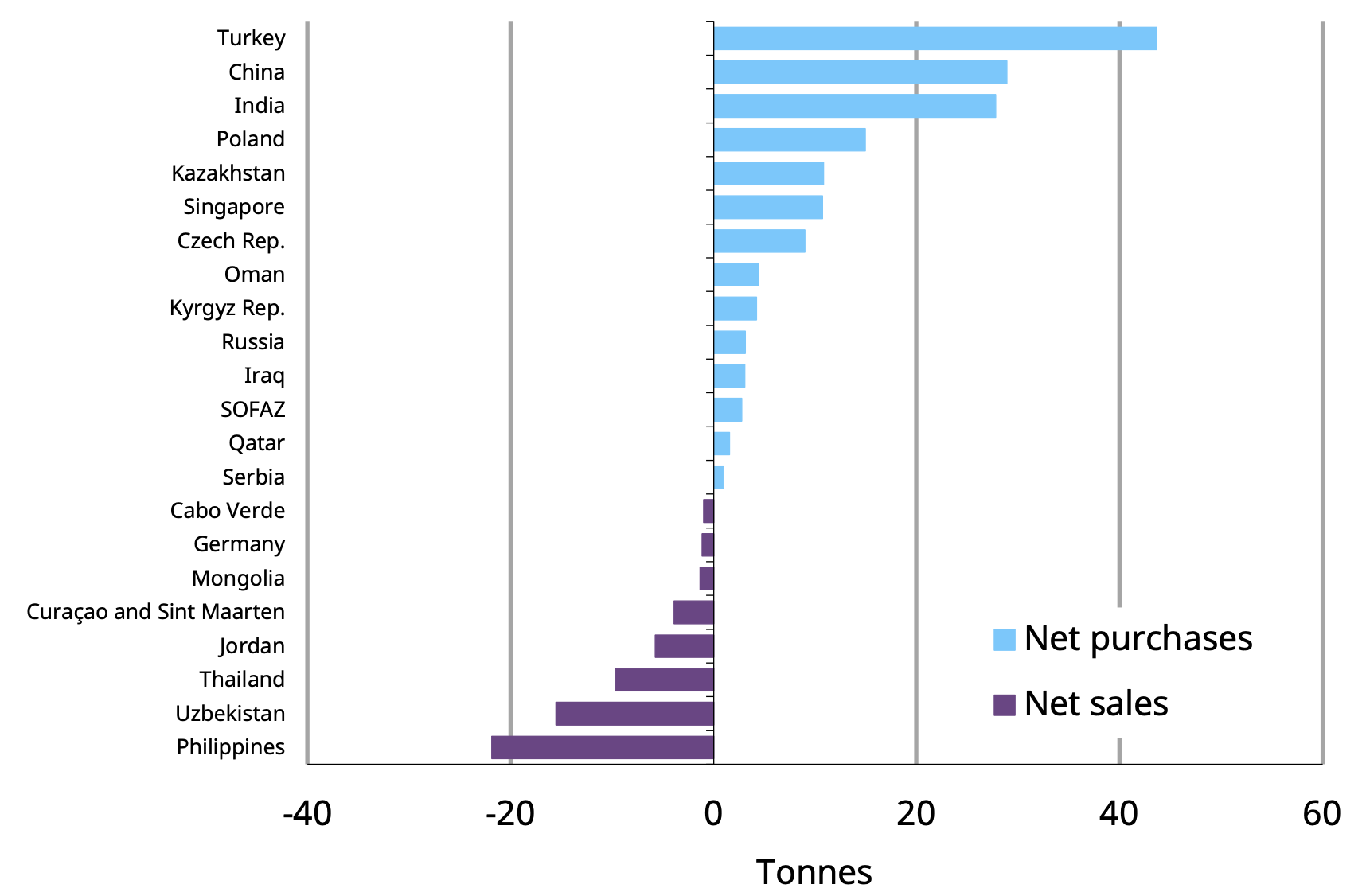
*Data to May 2024 where available. Totals may not sum due to rounding. Excludes SOFAZ which only reports quarterly data.
Note: By country and YTD charts include changes of a tonne or more only. Source: IMF IFS, respective central banks, World Gold Council
Central Bank Gold Statistics: June 2024
Krishan Gopaul
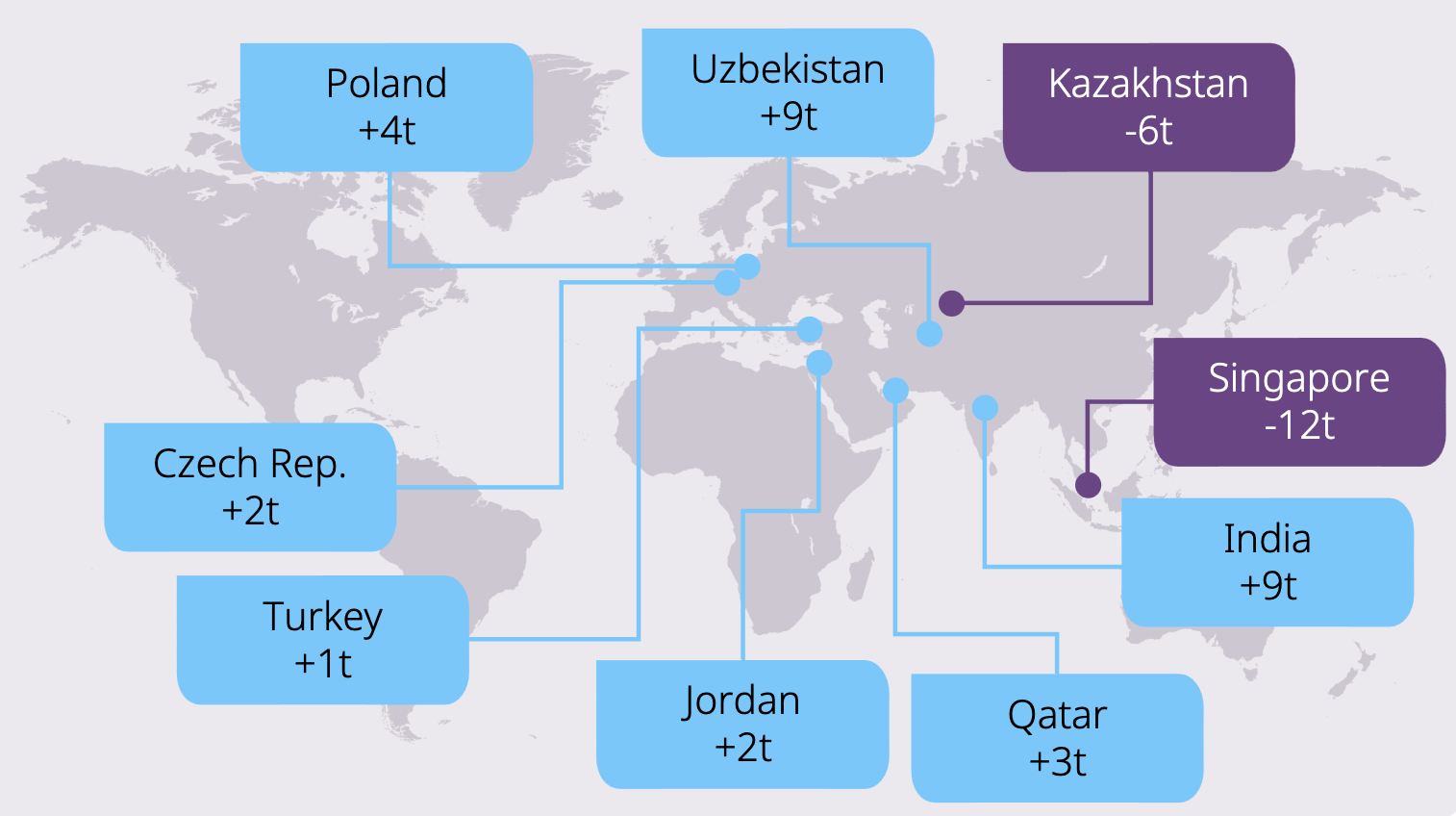
Senior Analyst, EMEA World Gold CouncilCentral banks reported 12t of net buying in June via the IMF and other public data sources. Demand moderated during the month: monthly gross purchases of 31t were offset by gross sales of 18t.*
June highlights
31tGross purchases |
18tGross sales |
-7%m/m net change |
36t12-month av |
June changes by country
Activity was once again led by emerging market central banks. The Central Bank of Uzbekistan and the Reserve Bank of India both added 9t to their gold reserves during the month. The Monetary Authority of Singapore was the largest seller (-12t) in June.
Year-to-date changes by country
Buying strength continues in 2024, although gross purchases and sales are lower compared to the same period last year. Emerging market banks are the main driving force for both purchases and sales.
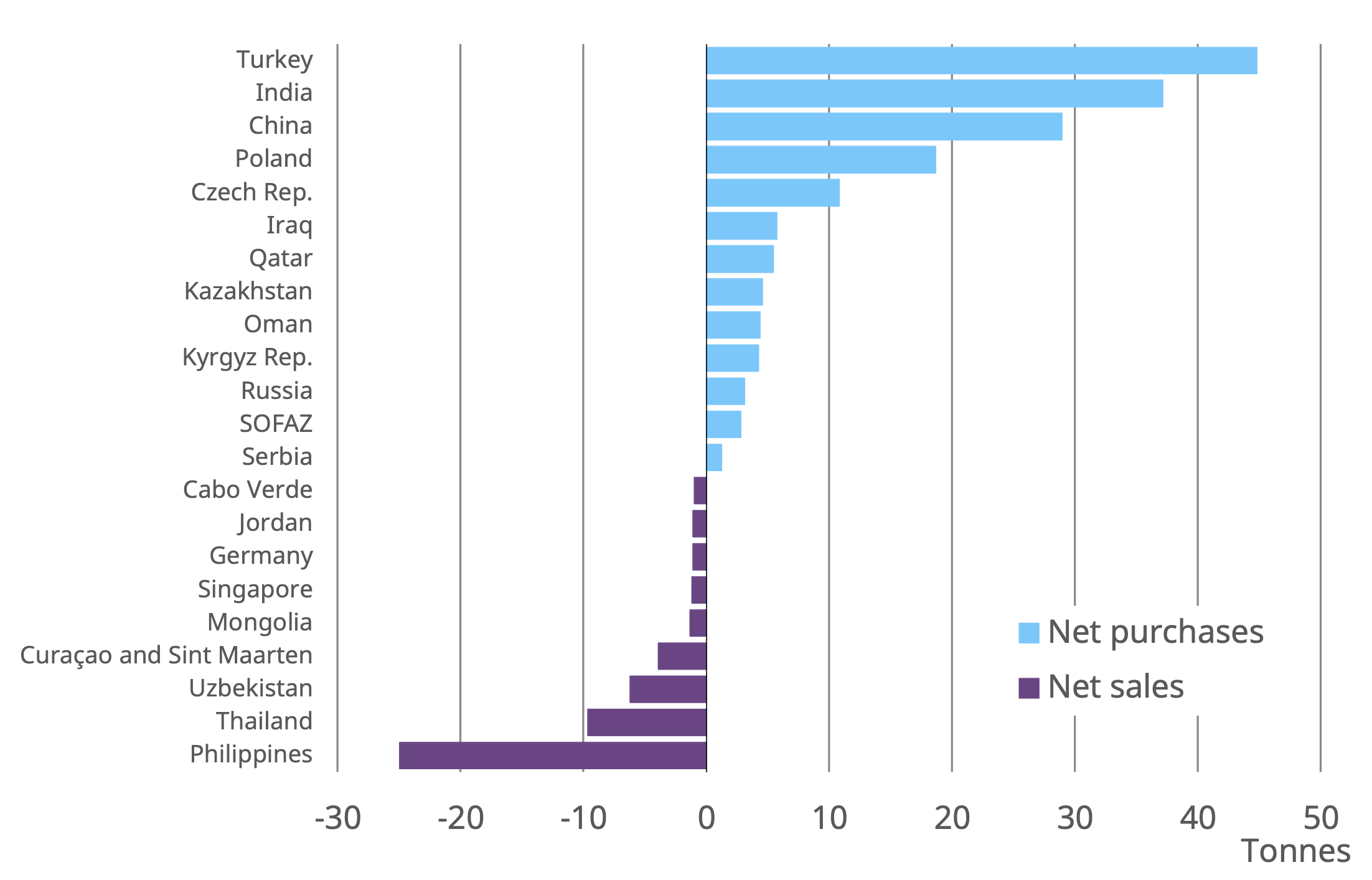
*Data to June 2024 where available. Totals may not sum due to rounding. Excludes the State Oil Fund of Azerbaijan (SOFAZ), which only reports quarterly data. Note: By country and YTD charts include changes of a tonne or more only. Source: IMF IFS, respective central banks, World Gold Council
md
Central Bank Gold Statistics: July 2024
Krishan Gopaul
Senior Analyst, EMEA World Gold CouncilCentral bank gold demand strengthened in July despite price rise
- Reported net purchases by central banks more than doubled to 37t in July
- The National Bank of Poland was the leading buyer in the month, followed by the Central Bank of Uzbekistan and the Reserve Bank of India (RBI)
- We expect central bank demand for gold to continue in the coming months.
Central banks have shown an ongoing commitment to accumulating gold in recent months. While the overall level of reported demand has cooled as the gold price has continued to rally to new record highs, it has nonetheless remained positive. This commitment continued in July, as global central banks are reported – via the IMF and publicly available data – to have added a net 37t to official reserves. This represents a 206% m/m increase and the highest monthly total since January (45t).
Central bank gold demand picked up in July
Monthly central bank gold demand in tonnes*
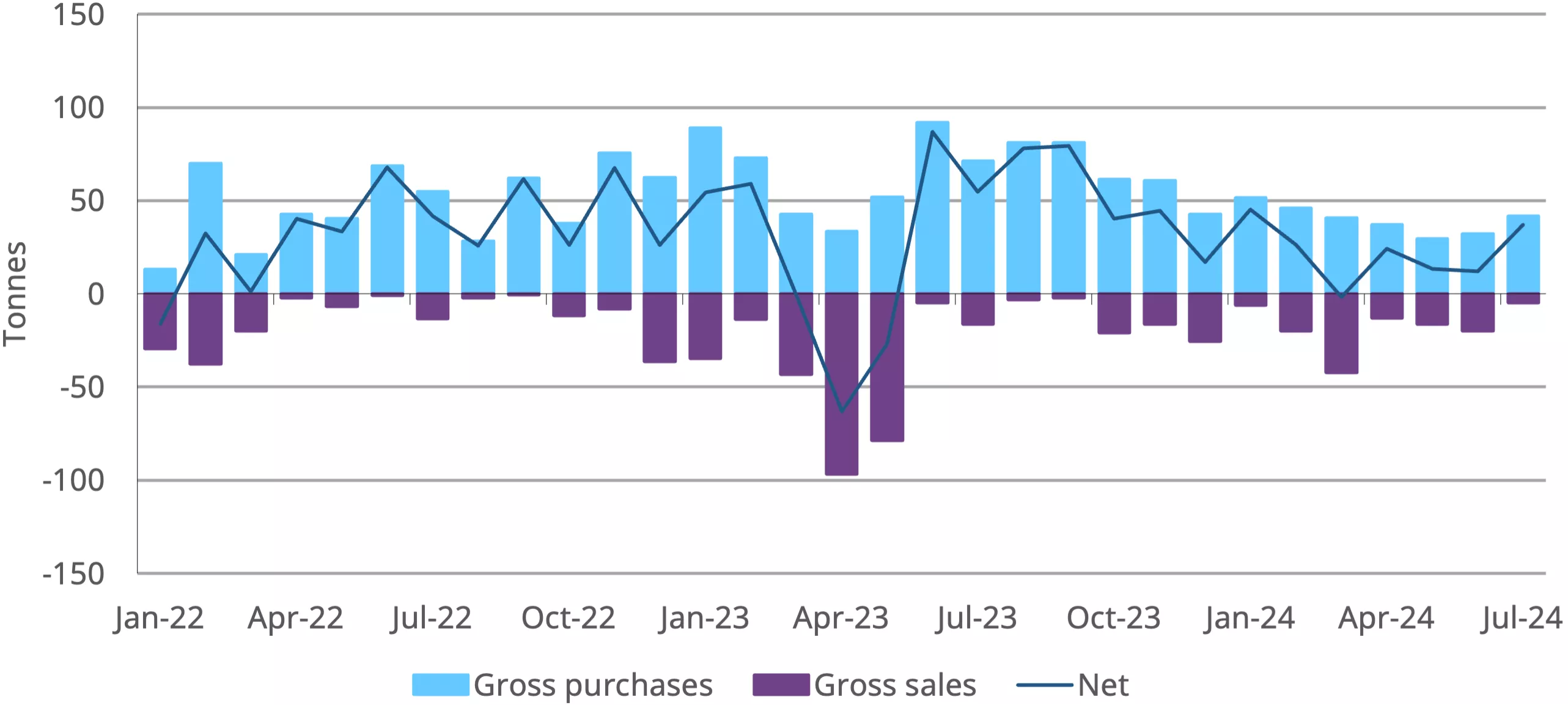
*Data as of 31 July 2024 where available.
Source: IMF IFS, respective central banks, World Gold Council
At a country level, activity was limited to those who have been buyers and sellers of late. In total, seven central banks added gold (of a tonne or more) to their reserves in July, while only one central bank reduced its gold holdings.
- The National Bank of Poland was the largest buyer, adding a net 14t, its largest monthly increase since November 2023. This purchase lifted its gold holdings to 392t, or 15% of total reserves. Poland has been on a gold buying spree since April, accumulating 33 tonnes over the last four months
- The Central Bank of Uzbekistan bought 10 tonnes in the month – the second consecutive month of buying – bringing its gold holdings to 375t. July’s purchase has flipped the Central Bank of Uzbekistan from a net seller to a net buyer on a y-t-d basis (+3t)
- Estimates based on weekly data suggest that the Reserve Bank of India’s gold reserves rose by 5t in July, meaning the RBI has now added gold every month so far this year. Y-t-d net purchases of gold total 43t, and have lifted its gold holdings to 846 tonnes
- Central Bank of Jordan (CBJ) gold reserves rose by over 4t in July - the third consecutive month of net purchases. On a y-t-d basis, CBJ gold reserves are now up a net 3 tonnes to 74 tonnes
- Data from the Central Bank of Turkey shows that its official (central bank plus Treasury) gold reserves rose by 4t – with 14 consecutive months of net buying. Its official gold reserves amount to a new record high of 589t, eclipsing the previous record of 587t, set in February 2023
- The Qatar Central Bank lifted gold reserves by 2t. This increases its y-t-d net purchases to 8t, and total gold holdings to 109t
- The Czech National Bank (CNB) increased gold reserves by 2t during the month, lifting its total to 43t. The CNB has now added to its gold reserves for 17 consecutive months, with net purchases totalling over 31t during this period
- Based on available data at the time of publication, the Central Bank of Kazakhstan was the only net seller in July. Its gold reserves fell by 4t, reducing its gold holdings to 295t or 55% of total reserves.
One other noteworthy change relates to the State Oil Fund of Azerbaijan (SOFAZ) – the only sovereign wealth fund in our data set.1 Second quarter results show that its gold holdings rose by 10 tonnes between April and June, representing the biggest quarterly increase in gold holdings since Q2'19 (+23.7 tonnes). Total gold holdings at the end of Q2'24 were 114.9 tonnes, 13t higher than at the end of 2023.
Gold buying continues to heavily outweigh sales this year
Y-t-d central bank gold purchases/sales in tonnes*
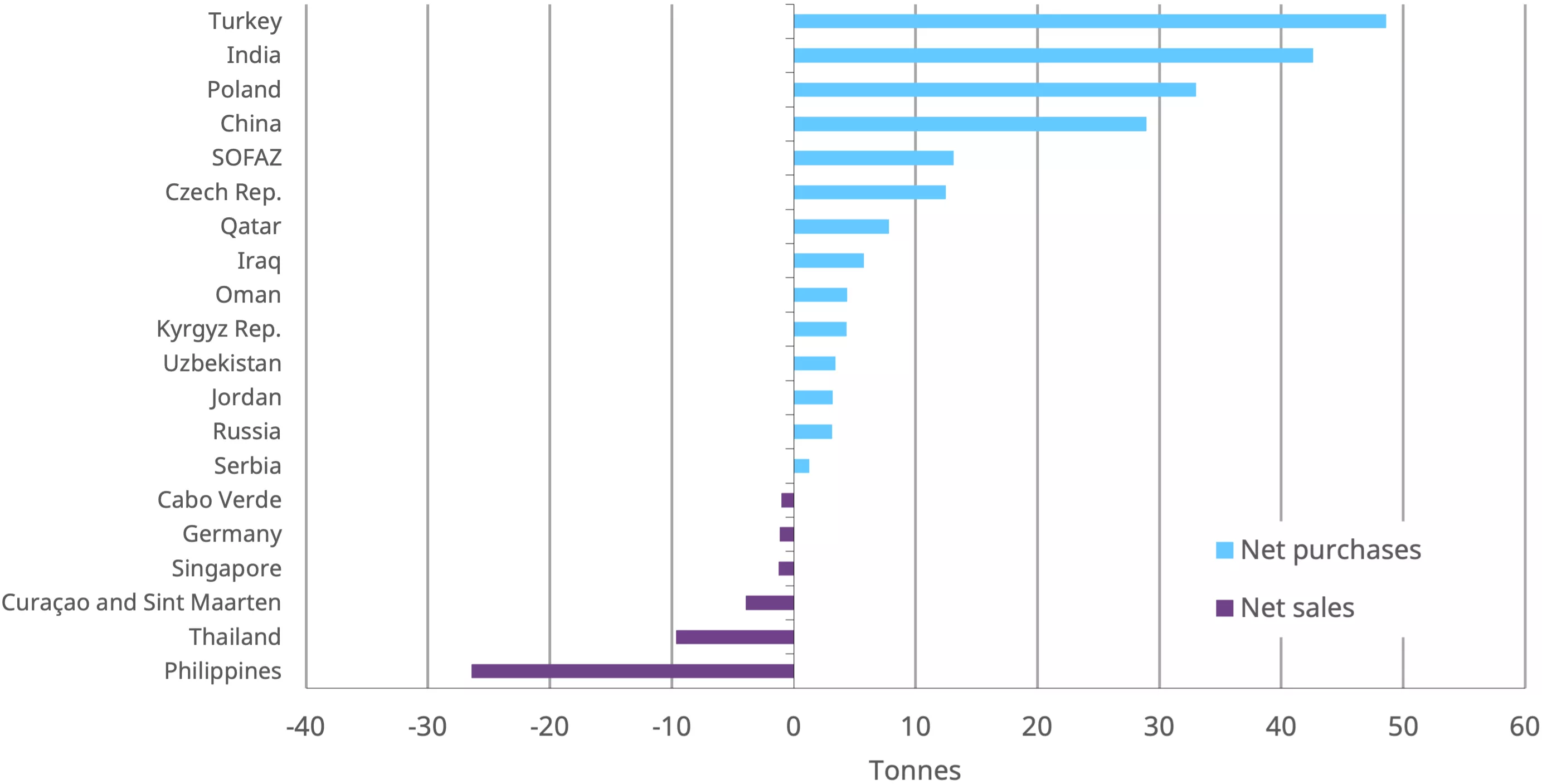
*Data as of 31 July 2024 where available.
Source: IMF IFS, respective central banks, World Gold Council
While the gold price rally is very likely having some impact on central bank gold demand this year, the longstanding trend of net buying remains intact. This reinforces the findings from our latest central bank survey, which highlights several reasons (such as gold’s role as a store of value and its performance in times of crisis) why, despite the elevated price, central banks are still keen to accumulate gold. Based on these findings, we continue to be confident in our expectation that more buying is to come.
Footnotes
1Currently, SOFAZ is the sole sovereign wealth fund in our data set as it is the only one we are aware of which publicly discloses its gold holdings.
md
Central banks report modest demand for gold in August
Marissa Salim
Senior Research Lead, APAC World Gold Council- Central banks reported net purchases of 8t in August – the lowest since March1
- The National Bank of Poland was the leading buyer in the month, followed by the Central Bank of the Republic of Turkey and the Reserve Bank of India (RBI)
- The Central Bank of Kazakhstan reduced its gold holdings by 5t in August.
Central banks have continued to accumulate gold in August with reported net purchases of 8t. While overall demand has tapered from the early 2024 highs, accumulation of gold reserves remains positive, with activity concentrated in emerging market (EM) central banks. August net purchases were the lowest since March when central banks reported a net sale of 2t; it was also well below the 12-month average of 33t.
On a y-t-d basis EM central banks account for 70% of total reported net purchases with Turkey making up 25% of overall central bank buying thus far.
Central bank demand eases in August*
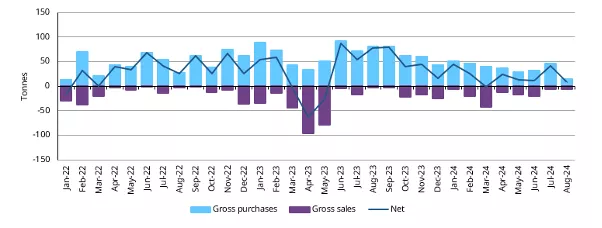
*Data to 27 September 2024 where available. Chart includes only purchases/sales of 0.5t or more as reported directly by central banks or via the IMF.
Source: IMF IFS, respective central banks, World Gold Council
At a country level, just four central banks added net gold (of a tonne or more) to their reserves in August.
- The National Bank of Poland was the largest buyer, adding a net 6t and lifting its gold holdings to 398t. Poland has continued its net purchase trajectory over the past five months, adding 39t over this period
- The Central Bank of the Republic of Turkey added 3t to its gold reserves in August, its fifteenth consecutive month of net purchases. On a y-t-d basis Turkey is the largest net purchaser, adding 52t of gold or about 35% of its total reserves
- The Reserve Bank of India accumulated 3t of gold, its eighth consecutive month of net buying. This makes the RBI the second highest net purchaser of gold on a y-t-d basis, with net purchases of 45t
- The Czech National Bank (CNB) added 2t of gold in August, its eighteenth consecutive month of net buying. The CNB has accumulated 33t of gold over this period, lifting its total gold reserves to 45t
- The Central Bank of Kazakhstan reduced its gold reserves by 5t in the month. This fourth consecutive month of net sales brings its gold holdings to 290t or about 55% of total reserves. Kazakhstan is now a net seller y-t-d, with gold holdings reduced by 5t.
Y-t-d central bank net purchases and sales*
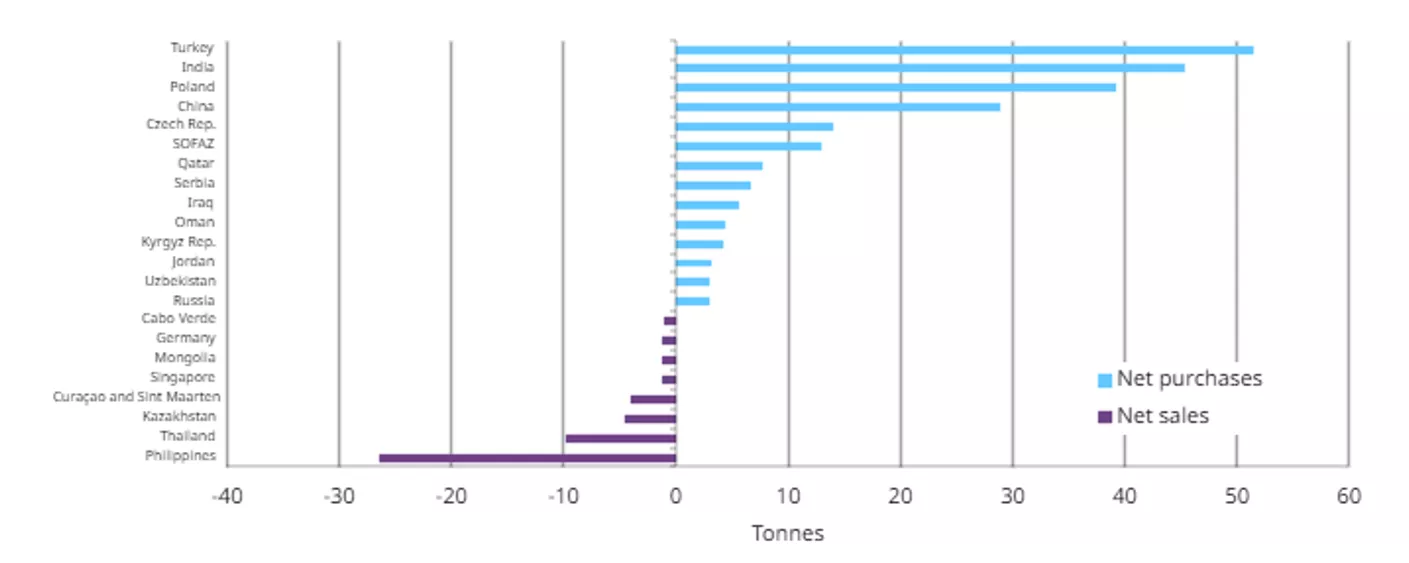
*Data to 27 September 2024 where available. Chart includes only purchases/sales of 0.5t or more as reported directly by central banks or via the IMF.
Source: IMF IFS, respective central banks, World Gold Council
Reported central bank activity in August was markedly slower. While gold’s price performance is not a top strategic driver for central banks purchase, its consistent upward trend could have influenced the deceleration. However, it is worth noting that sales have not increased which may signal a likely wait and see approach rather than a change in trend. Specially, since all other key drivers of central bank decision making, such as the need for effective diversifiers and gold’s performance in time of risk remain in place. In all, our expectation remains positive for the rest of the year but, as we previously discussed, will likely be below last year’s total.
Stay tuned for our upcoming Q3 Gold Demand Trends, scheduled at the end of October, which combines a more comprehensive set of data to estimate central bank activity.
Footnotes
1Our monthly report is limited to direct central bank reports and data provided to the IMF.
md
theme-purple surface surface--primary surface--light surface--default
Central bank gold statistics September 2024
Krishan Gopaul
Senior Analyst, EMEA World Gold Council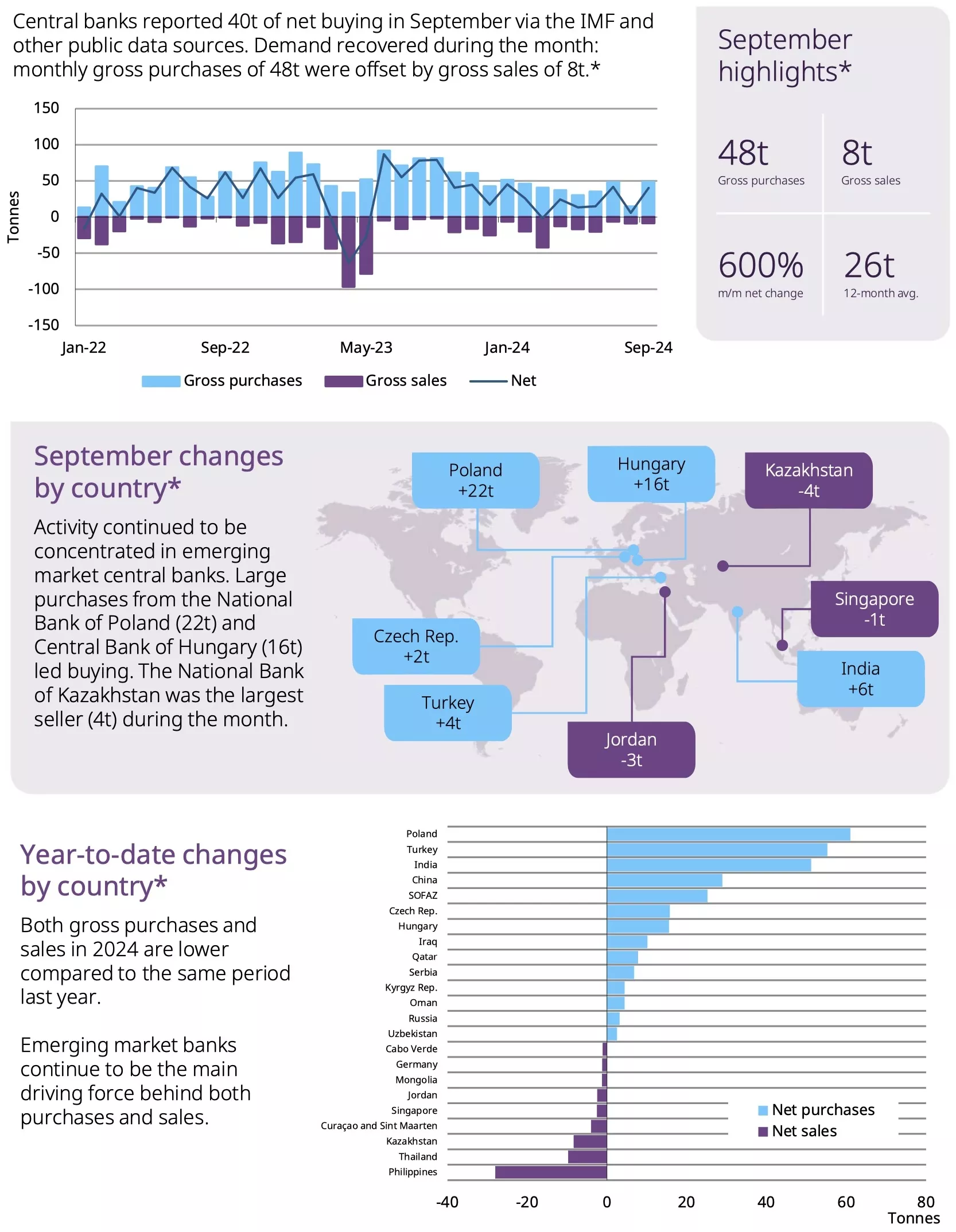
*Data to September 2024 where available. Totals may not sum due to rounding. Excludes the State Oil Fund of Azerbaijan (SOFAZ), which only reports quarterly data. Note: By country and y-t-d charts include changes of a tonne or more only.
Source: IMF IFS, respective central banks, World Gold Council
Disclaimer
Copyright and other rights
© 2024 World Gold Council. All rights reserved. World Gold Council and the Circle device are trademarks of the World Gold Council or its affiliates.
Any references to LBMA Gold Price are used with the permission of ICE Benchmark Administration Limited and have been provided for informational purposes only. ICE Benchmark Administration Limited accepts no liability or responsibility for the accuracy of the prices or the underlying product to which the prices may be referenced. All third-party content is the intellectual property of the respective third party and all rights are reserved to such party.
Reproduction or redistribution of any of this information is expressly prohibited without the prior written consent of World Gold Council or the appropriate intellectual property owners, except as specifically provided below.
Use of any statistics in this information is permitted for the purposes of review and commentary in line with fair industry practice, subject to the following pre-conditions: (i) only limited extracts may be used; and (ii) any use must be accompanied by a citation to World Gold Council and, where appropriate, to Metals Focus, Refinitiv GFMS, or other identified third party, as their source.
World Gold Council does not guarantee the accuracy or completeness of any information and does not accept responsibility for any losses or damages arising directly or indirectly from the use of this information.
This information is not a recommendation or an offer for the purchase or sale of gold or any products, services, or securities.
This information contains forward-looking statements which are based on current expectations and are subject to change. Forward-looking statements involve a number of risks and uncertainties. There is no assurance that any forward-looking statements will be achieved.
Information regarding QaurumSM and the Gold Valuation Framework
Note that the resulting performance of various investment outcomes that can generated through use of Qaurum, the Gold Valuation Framework and other information are hypothetical in nature, may not reflect actual investment results and are not guarantees of future results. Neither WGC nor Oxford Economics provides any warranty or guarantee regarding the functionality of the tool, including without limitation any projections, estimates or calculations.
md
Central Bank Gold Statistics: October 2024
Marissa Salim
Senior Research Lead, APAC World Gold CouncilPublished 4 December 2024, updated 17 December 2024.
Central bank gold buying ramps up in October
Turkey, India and Poland lead net buying y-t-d
- Central banks reported 47t of net purchases this month – the highest amount recorded y-t-d1
- The Central Bank of Turkey led the field, adding 17t of gold to its reserves, followed by India and Poland – 14t and 8t respectively
- The National Bank of Kazakhstan recorded its first monthly net buying (4t) after five consecutive months of reducing gold holdings
- Based on currently available IMF data, reported net sales were negligible this month.
The October tally almost doubled that of the 12-month average with the Central Bank of Turkey leading both y-t-d purchases and those reported during the month. Turky added 17t in October, bringing its total gold purchases to 72t y-t-d. Emerging market central banks continued to dominate the market with Poland and India adding 68t and 64t y-t-d to their gold reserves respectively. These three central banks alone account for 70% of total global net purchases reported this year.
Highest monthly net buying for 2024 recorded in October
Monthly reported central bank activity, tonnes*
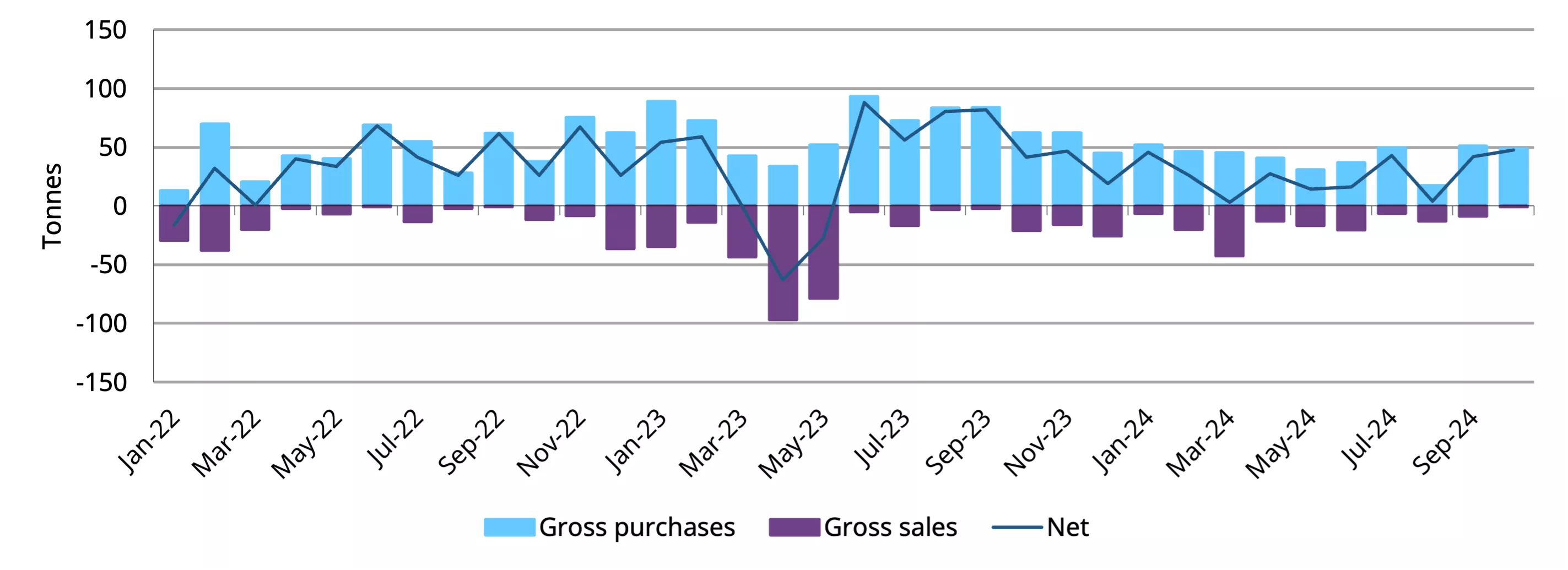
*Data to 31 October 2024 where available. Note: chart includes only purchases/sales of 0.5t or more.
Source: IMF IFS, respective central banks, World Gold Council
Other than Turkey, several central banks reported net increases (of a tonne or more) to their gold reserves in October.
- The Reserve Bank of India added 14t – the highest reported monthly figure since October 2021. On a y-t-d basis India has added 64t, representing a four-fold increase on its 2023 activity.
- The National Bank of Poland recorded net buying of 8t during the month, its seventh consecutive month of net buying. On a y-t-d basis, Poland added 69t, making up 17% of its total reserves. The NBP's annual report2 highlights its commitment to accumulating gold, with the central bank targeting a 20% allocation as a percentage of its total official reserve assets
- The National Bank of Kazakhstan added 5t of gold to its reserves after five months of net selling. However, Kazakhstan remains a net seller y-t-d, down 4t in 2024
- The Czech National Bank (CNB) added 2t of gold, making October its 20th consecutive month of net buying. The CNB has accumulated 37t of gold over this period, lifting its total gold reserves to 49t
- Kyrgyzstan added 2t of gold to its reserves, bringing its y-t-d purchases close to 6t and making October the highest reported monthly net buying on record since September 2023
- Data made available by the Bank of Ghana shows that its gold reserves now amount to 28t. The country’s gold reserves have increased steadily since May 2023, when they stood at just under 9t. Ghana added a further 1t during the month.
Y-t-d central bank net purchases and sales*
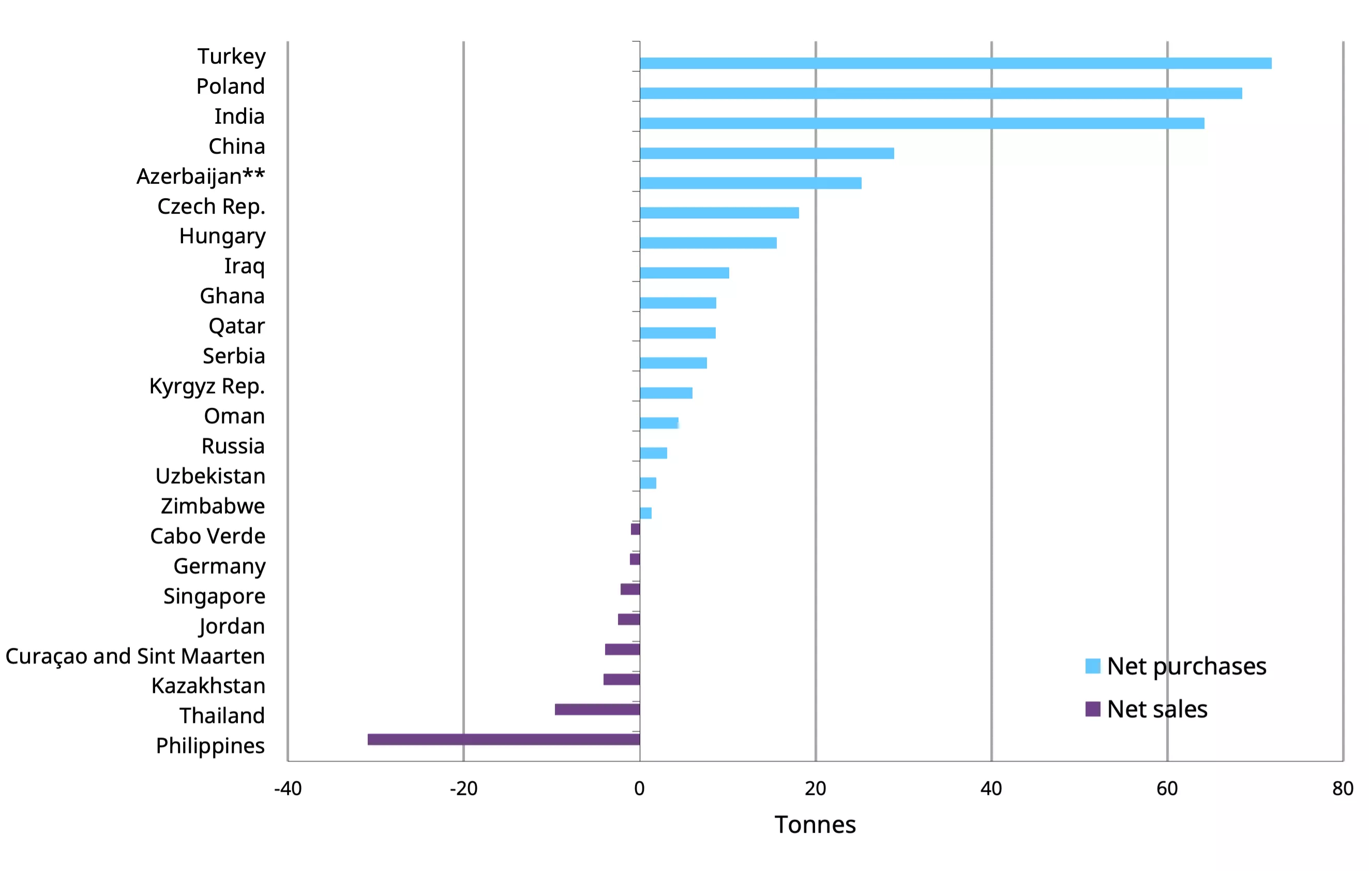
*Data to 31 October 2024 where available. Note: chart includes only purchases/sales of 0.5t or more.
Source: IMF IFS, respective central banks, World Gold Council
Central bank demand remains robust, with y-t-d (reported and unreported) buying reaching 694t by Q3 2024 – comparable to levels seen in 2022. While rising gold prices appear to have inhibited some buying and prompted tactical sales over recent months, October's rebound in reported activity signals continued interest from central banks to accumulate gold within their reserve portfolios. This reaffirms the role gold plays as a strategic asset for central banks to manage risks and diversify reserves.
Footnotes
1Based on reported monthly data from the International Monetary Fund (IMF). This blog was updated on 17 December 2024 to reflect the correct increase in Reserve Bank of India gold reserves (in tonnage terms) in November and year-to-date.
Disclaimer
Copyright and other rights
© 2024 World Gold Council. All rights reserved. World Gold Council and the Circle device are trademarks of the World Gold Council or its affiliates.
Any references to LBMA Gold Price are used with the permission of ICE Benchmark Administration Limited and have been provided for informational purposes only. ICE Benchmark Administration Limited accepts no liability or responsibility for the accuracy of the prices or the underlying product to which the prices may be referenced. All third-party content is the intellectual property of the respective third party and all rights are reserved to such party.
Reproduction or redistribution of any of this information is expressly prohibited without the prior written consent of World Gold Council or the appropriate intellectual property owners, except as specifically provided below.
Use of any statistics in this information is permitted for the purposes of review and commentary in line with fair industry practice, subject to the following pre-conditions: (i) only limited extracts may be used; and (ii) any use must be accompanied by a citation to World Gold Council and, where appropriate, to Metals Focus, Refinitiv GFMS, or other identified third party, as their source.
World Gold Council does not guarantee the accuracy or completeness of any information and does not accept responsibility for any losses or damages arising directly or indirectly from the use of this information.
This information is not a recommendation or an offer for the purchase or sale of gold or any products, services, or securities.
This information contains forward-looking statements which are based on current expectations and are subject to change. Forward-looking statements involve a number of risks and uncertainties. There is no assurance that any forward-looking statements will be achieved.
Information regarding QaurumSM and the Gold Valuation Framework
Note that the resulting performance of various investment outcomes that can generated through use of Qaurum, the Gold Valuation Framework and other information are hypothetical in nature, may not reflect actual investment results and are not guarantees of future results. Neither WGC nor Oxford Economics provides any warranty or guarantee regarding the functionality of the tool, including without limitation any projections, estimates or calculations.
md
A Central Banker's Perspective: Central Bank of Ecuador's gold acquisition program
The Central Bank of Ecuador (CBE) has strengthened its gold acquisition program over the past three years.
The program has made significant progress towards formalisation and access to finance – with good terms – for small-scale and artisanal miners. This important initiative aims to promote sustainable mining practices, foster economic development, enhance financial inclusion within mining communities, and expand the country's international reserves.
The CBE's gold acquisition program is based on a strong legal framework. Relevant legislation includes the Mining Law (2013) and the approval and reforms of the Monetary and Financial Code (2014 and 2021) as well as regulations passed by the Monetary Board. These legal provisions give the CBE authority to acquire non-monetary gold from small-scale and artisanal miners, either directly or through authorised entities.1 Recent reforms have strengthened the Central Bank’s mandate and operational autonomy, reinforcing its strategic role in Ecuador's small-scale and artisanal mining sector (ASGM).
Underpinning the acquisition program is a structured governance framework in which six relevant CBE divisions play key roles:
- The Monetary Board approves regulations and ensures that the gold acquisition program at the Bank is implemented appropriately
- The General Manager develops regulatory proposals for the Monetary Board and guarantees their correct implementation
- The Investments and Financial Services Manager prepares technical input for regulatory proposals and supervises the implementation of the program
- The Gold Commercialisation Deputy Manager operates the program on a daily basis and implements regulations approved by the Monetary Board
- The Operational Risk Deputy Manager authorises small-scale and artisanal miners as non-monetary gold suppliers for the CBE in accordance with a rigorous selection process. It also calculates the discount rate for domestic gold purchases from authorised suppliers
- The Compliance Deputy Manager conducts the due diligence process for small-scale and artisanal miners at the authorisation stage. It also undertakes frequent investigations into CBE’s authorised suppliers in order to share relevant information with other public institutions.
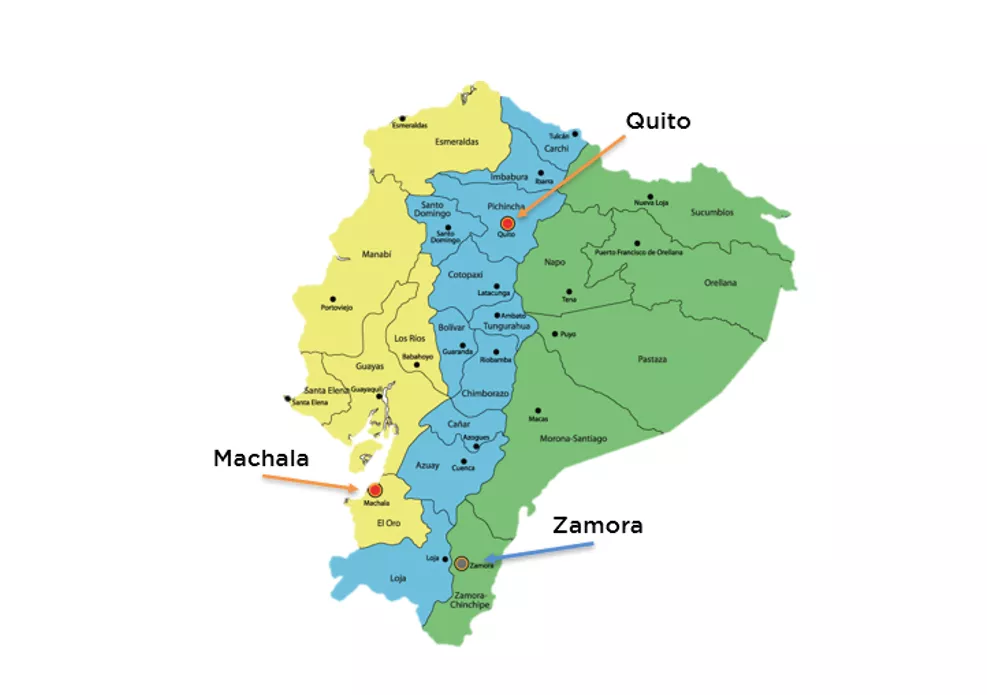
The Central Bank of Ecuador has strategically located gold acquisition offices in the capital, Quito, and Machala and with a further office in Zamora – due to open in Q2’25. These offices operate as hubs that facilitate accessibility and gold commercialisation, improve operational workflows, reduce costs for miners and foster formalisation in local mining communities.2
Gold acquisition office locations
Source: Central Bank of Ecuador
The Central Bank’s gold commercialisation program focuses on eight strategic goals:
- To promote good environmental practices in the minerals supply chain (environmentally friendly mining)
- To ensure adequate due diligence to prevent illegal activities
- To support the formalisation of small-scale mining operations through the CBE’s gold acquisition program
- To promote a fair price policy for artisanal and small-scale miners
- To promote financial inclusion in the mining sector with the support of BanEcuador (public bank) through facilitating access to banking services and commercial loans
- To foster the economic development of mining communities
- To increase Ecuador’s international reserves
- To strengthen dollarisation by boosting the Central Bank’s liquid assets.
The gold acquisition program is underpinned by five key elements.
- Small-scale and artisanal miners who participate in the program enjoy concession agreements, which ensure ownership and legal certainty for each party involved
- The CBE upholds the highest environmental standards, prioritising sustainable mining practices that minimise ecological impact
- The CBE program is characterised by due diligence practices that verify the legitimacy and compliance of participating miners
- The formalisation of small-scale and artisanal mining operations is actively promoted in order to foster transparency and accountability in the sector
- Access to finance is simplified in order that miners are empowered with the resources they need to sustain and expand their operations responsibly.
In addition, the Central Bank stipulates that all authorised miners must comply with the following six requirements if they are to participate in its gold acquisition program:
- Miners must present a document from the Ministry of Energy and Mines that formalises their operations in the ASGM sector
- They must obtain an environmental licence from the Ministry of Environment, demonstrating their commitment to sustainable practices
- They must prove that they do not have outstanding tax liabilities with the Internal Revenue Service (SRI)
- They must not have outstanding debts with public institutions
- They must hold a Compliance Certificate from Ecuador’s Financial Unit that guarantees they are not involved in illicit activities such as money laundering or financing terrorism (ML/FT); the CBE also carries out due diligence investigations in this regard
- They are required to hold an active bank account at a local financial institution in order to allow transparent and traceable transactions.
One of the program’s strengths is its due diligence process. This rigorous process not only helps to strengthen participants' operations but also mitigates risks associated with illicit activities, thereby enhancing the credibility of Ecuador’s ASGM sector. Staff from the CBE conduct field visits to identify each authorised supplier’s mining facility and assess production levels, ensuring transparency and accountability. These visits follow the due diligence practices set-out by the London Bullion Market Association (LBMA) and add integrity and credibility to the program.
The CBE’s gold acquisition program takes the following steps when buying non-monetary assets from the ASGM sector:
- Willingness to sell: The authorised small-scale or artisanal miner sends an email to the Gold Commercialisation Deputy Manager, stating their willingness to sell non-monetary gold
- CBE due diligence process: The Compliance Deputy Manager checks ML/FT databases and exchanges information with public institutions regarding the miner
- Quality control: The staff of the Gold Commercialisation Deputy Manager’s office verify the composition of the doré bars with three different methods to determine its purity degree
- Agreement: Both the CBE and the authorised miner sign a sales agreement detailing the transaction
- Sale: The miner issues an invoice, which is validated by the CBE
- Payment: The CBE pays electronically, directly into the miner’s bank account.
Since the beginning of the gold acquisition program in 2013, this initiative has allowed the CBE to increase Ecuador’s international reserves by US$534.3m. During this administration, in the past three years, the Central Bank of Ecuador has successfully refined 4.04 tonnes of non-monetary gold, equivalent to US$234.6m. In 2024 the Central Bank estimates it will buy 0.42 tonnes of non-monetary gold for an equivalent of US$31.42m. The opening of new offices in the cities of Machala and Zamora will ensure the continued growth of gold purchases as well as the strengthening of Ecuador’s international reserves and dollarisation regime.
It is important, however, to continue to build on these achievements. The CBE’s recent actions to strengthen its gold acquisition program include the Monetary Board’s approval of a new policy that aims to optimise the management of gold reserves, and ensure greater efficiency and effectiveness in resource allocation. Furthermore, the CBE has signed a cooperation agreement with the Ministry of Energy and Mines, the Ministry of Environment, and BanEcuador, showing its commitment to improving access to finance for miners and implementing best environmental practices within its gold acquisition program. The Bank’s monetary gold has facilitated access to liquidity of US$1.1bn via international organisations such as the Bank for International Settlements and the Latin American Reserve Fund.
Additionally, it is important to highlight the CBE has been an active member of the ASGM Study Group, led by the World Gold Council and comprised by several Central Banks around the world, that manage gold acquisition programmes as part of their functions. This Study Group has supported and guided its participants to take strategic actions that will improve our programmes and efforts in the ASGM sector. This initiative has also facilitated to exchange valuable experiences with other members and share commitments aiming to strengthen our programmes’ institutional framework.
As a result of this joint effort, the members of the ASGM study group signed the London Principles in June 2024, which is a document that establishes the guiding features for our Domestic Purchase Programmes (DPPs). These principles aim to support all efforts for miners’ formalization, implement Environmental, Social and Governance (ESG) standards and improve the livelihoods of responsible ASGM sector. The London Principles seek to promote the following twelve aspects in our DPPs:
- Legal frameworks, resourcing and transparency
- Community wellbeing
- Mercury reduction
- Due diligence
- Progressive improvement
- Formalisation
- Incentives
- Rule of law
- Accessibility
- Access to ‘clean’ finance
- Refining purchased gold
- International cooperation.
As previously mentioned, the CBE’s gold acquisition program complies with all the Principles, this reflects our tireless work over the past three years to become a reference for similar central bank programs. Being part of this milestone reflects the commitment of the CBE to a more institutionalized approach and the well-being of mining communities.
Our DPP was recognised as Initiative of the Year at the 2023 Central Banking Awards, which noted the program’s efforts to formalise the small-scale gold mining industry, and to promote responsible mining by implementing good environmental practices and rigorous due diligence to prevent illicit activities. Furthermore, the CBE currently holds the chairmanship for the 2024-2025 ASGM Study Group, which deepen our international commitment on best practices for gold acquisition programmes managed by central banks.
Even though ASGM programs are seldom an explicit part of a central bank’s mandate, the CBE believes that its gold acquisition program stands as an example to other monetary authorities, demonstrating a positive impact on the well-being of gold mining communities and the strengthening of our country’s monetary system.
Footnotes
1Non-monetary gold is gold that the monetary authority holds that does not meet the criteria of monetary gold or which the monetary authority has chosen not to classify as monetary gold. Monetary gold is gold held by a monetary authority and is designated as an element of its foreign exchange reserves. Monetary gold includes allocated gold bullion and unallocated gold accounts with non-residents that give title to claim the delivery of gold. Gold bullion can take the form of coins, ingots or bars with a purity of at least 995 parts per 1000, Monetary gold must meet the 3 criteria of holder, function and purity
2The CBE is building a gold acquisition office in the city Zamora, and renewing the one located in Machala. Machala station is scheduled to begin operations during the second quarter of 2025, while Zamora station will begin operations during the third quarter of 2025. Machala’s current office is still in operations, but it will be replaced by a modern and high-end installments, guaranteeing operations to small-scale and artisanal miners.
Latest research
Looking for insight and analysis on gold? Our team of experts produce market-leading research and macroeconomic commentary on gold.