The digital gold market today: a niche at an inflection point
19 October, 2026

EXHIBIT 1
Digital gold is a tiny proportion of the wider market
Digital gold sits in one of the largest, most liquid asset classes in the world, with about 220,000 tonnes above ground. The gold market is worth more than $30 trillion at current prices, spanning jewellery, bars, coins, gold-backed ETFs, OTC1 and central bank reserves. The physical investment gold market is worth about $13 trillion.2
While physical gold is enduring, the ways in which people own it have changed over time: from bars and coins to paper certificates, ETFs, vaulted digital accounts and, most recently, tokens. Each innovation has lowered barriers to entry and expanded the market, often by splitting gold into smaller and more affordable units; from 400-ounce bars to one-ounce coins, to ETF shares worth just a few dollars.
Tokenisation extends that trend, offering the potential to divide ownership into even smaller fractions. It also connects gold to a broader shift in the financial industry, which is that digital assets are becoming increasingly mainstream, supported by younger, digitally native investors.
For now, digital gold remains a niche product.
Its total value outstanding is about $45-$55 billion, equivalent to around 370 tonnes. This represents roughly 0.4% of physical investment gold and less than 9% of the $600 billion gold-backed ETF market. One reason is that digital gold has faced structural challenges which have constrained adoption.
This report’s scope
For the purposes of this report, digital gold encompasses two product categories (Exhibit 2):
Tokenised gold: A digital token that gives investors ownership of a specific quantity of physical gold held in secure custody. Each token corresponds to a fixed quantity of gold and the token price tracks the gold price.
Vaulted digital gold (digital gold certificate): An app- or platform-based account enabling investors to own physical gold held in secure custody by a third party.
Physically-backed gold ETFs, leveraged products, and gold-backed stablecoins are excluded from the definition.
Of the two digital gold products considered here, vaulted digital gold is the more established, with the first products dating back to 2005 (e.g., BullionVault).3 Tokenised gold products such as Paxos Gold (PAXG) were first launched in 2019. That difference in market maturity is reflected in volumes. Vaulted digital gold accounts for about 89% of the digital gold market by value, while tokenised gold accounts for about 11%. Both product categories are highly concentrated, with a handful of providers associated with the majority of volumes.
For vaulted digital gold, participants are drawn from across the gold value chain. They include bullion dealers and vault operators, sovereign mints, refiners and banks, alongside distributors such as super-apps and independent platforms. Meanwhile, tokenised gold issuance has generally been confined to a small group of crypto-native entities. But that is changing, with interest now expanding across the value chain and to more traditional financial institutions. HSBC’s Gold Token is one example.4
EXHIBIT 2
Vaulted digital gold currently makes up 89% of digital gold
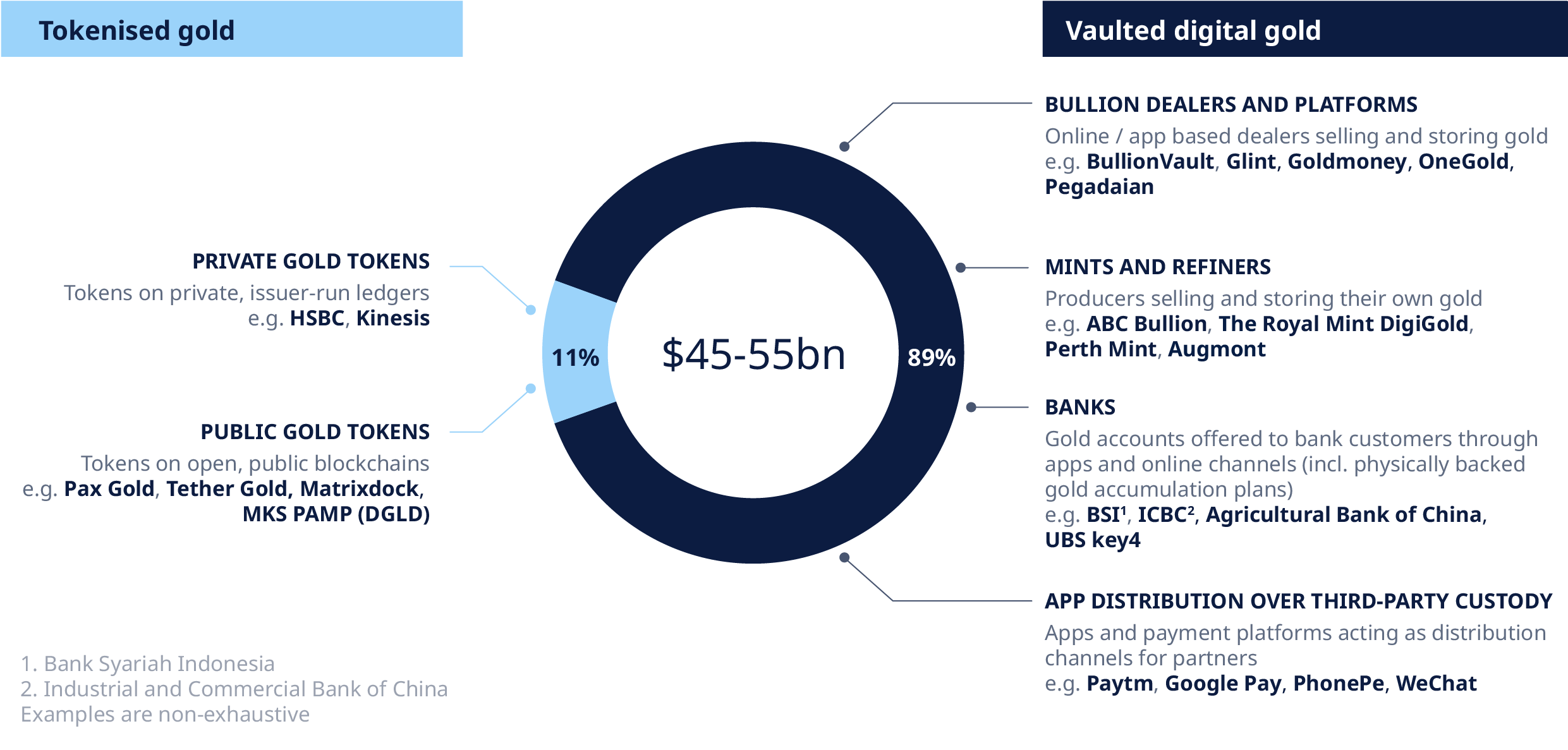
Vaulted digital gold's scale is also concentrated geographically, with more than half of it held in China, India, and Indonesia,5 a regional footprint that the tokenised gold market has yet to match.
That said, tokenised gold has been the primary source of recent activity, having seen fivefold expansion since late 2024 (2.8x increase in underlying volumes), from $1.2 billion to $6 billion. The growth has been led by Tether Gold (XAUT) and Paxos Gold, which today represent more than 90% of the public tokenised6 gold market. Trading activity has also expanded, with combined daily volumes across the two largest tokens up by approximately 45% over the past year.6 Rising transaction volumes point to growing product utility (more detail in Section 3) and represent an opportunity for value capture across the value chain.