03 - The future of digital gold and what is needed to achieve it
3.1 What a mature digital gold market could look like
There is an opportunity to extend gold’s enduring role into digital financial infrastructure, which would enable it to operate seamlessly in modern markets while preserving the attributes that have underpinned its relevance for centuries. In a mature digital end state, gold would be fully fungible, pervasively accessible, moveable, and useable across financial systems. Ownership of gold, whether by institutions or individuals, would no longer be constrained by bar sizes, vault locations, or fragmented settlement mechanisms. Instead, gold could be held, transferred, pledged, or redeemed through trusted digital rails, with clear legal ownership, robust governance, and continuous assurance of physical backing.
Embedding trust in the infrastructure
A further evolution of this vision is the embedding of trust directly into a connected digital operating system. While gold's credibility has traditionally relied on legal frameworks, audits, and institutional oversight, modern infrastructure enables continuous reconciliation and automated controls to be built into the system itself.
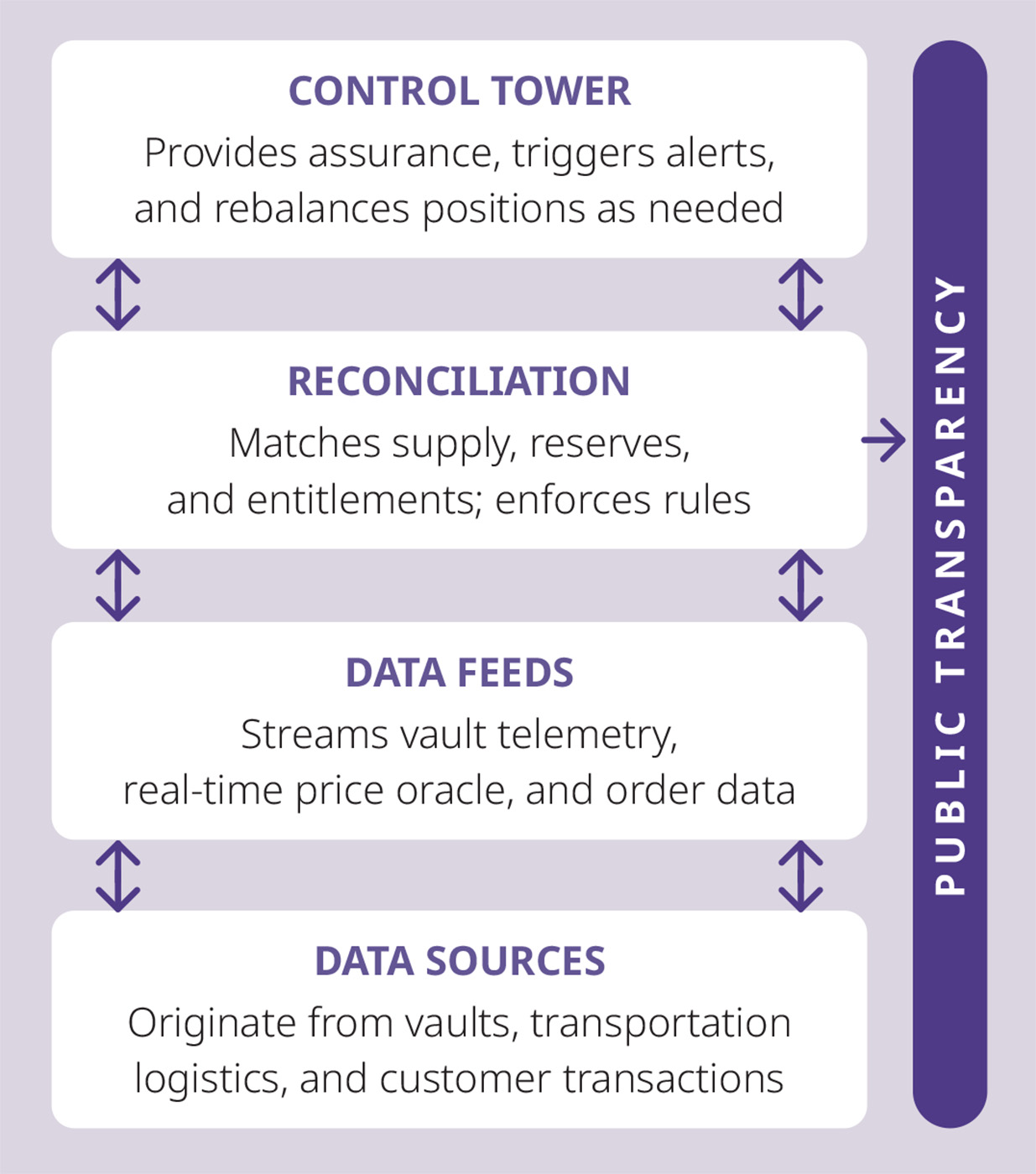
Vault holdings, token issuance records, and entitlements could be synchronised through data feeds, with independent oracle services bridging physical custody and digital records. Reconciliation engines would compare reserves and outstanding units with defined tolerance thresholds, while smart contracts enforce issuance and redemption limits and trigger alerts if discrepancies arise (Exhibit E). In this model, trust would be supported by systems that continuously align physical gold, digital balances, and legal ownership.
In practice, this could allow individuals to hold allocated, vaulted gold with redemption optionality, while also enabling gold to be used digitally, for example to make payments, transfer value across borders, or access short-term liquidity without selling the underlying asset. For market participants, it could simplify settlement and reduce operational friction through trusted digital processes, while avoiding the need for bespoke integrations or bilateral arrangements.
Importantly, this vision does not depend on a single digital product or technology. It is based on shared practices and shared infrastructure, on top of which diverse products could emerge. It would allow retail investors to access gold through familiar digital experiences which offer fractional ownership and liquidity, and issuers to deploy gold within clearing, collateral, and settlement frameworks with the same confidence they expect from other assets.
This vision of shared digital infrastructure would reduce frictions between physical and digital forms of gold and strengthen gold’s relevance in an increasingly digital financial system. It would not change what gold is, but it would enable it to more fully participate in the financial system.
3.2 What it will take to realise this vision
While some digital gold products and issuers have succeeded in isolation, digital gold as a category has reached only a fraction of gold’s broader potential. This reflects structural challenges, including fragmented infrastructure, high complexity, and inconsistent standards, rather than shortcomings by individual players (as discussed in "Challenges for the digital global market").
As digital‑native financial infrastructure increasingly becomes the norm, assets that are fungible and easily integrated are more likely to be adopted for trading, settlement, and collateral use. Without proactive coordination from the industry, there is a risk that gold will be slower to integrate, remaining a niche digital instrument rather than a broadly applicable component of the digital financial ecosystem.
In this context, articulating a clear vision for digital gold serves a broader purpose: it creates an opportunity for the industry to raise the bar across the ecosystem. This vision can act as a source of inspiration for market participants to strengthen practices that enhance trust, clarity, and transparency in digital gold markets.
As a practical step towards realising this vision, the World Gold Council is creating and operating a platform that will provide access to a shared and trusted market infrastructure, Gold as a Service. This will be developed together with the industry, with input from potential issuers, vault operators, bullion banks, regulators, and technology partners.
While issuers remain free to build and operate digital gold products independently, Gold as a Service is proposed to enable innovation and scale while preserving gold’s defining attributes of trust, integrity, and reliability.