Goldhub Research Investment Commentary Latest issue Investment Commentary Read the latest report Gold Market Commentary: The return of transitory Gold ended April flat, as a return of risk appetite weighed on gold, but a weaker US dollar and ETF inflows led by Europe provided support. Short term headwinds could sustain some gold weakness as it searches for a catalyst to regain the structural uptrend. 7 May, 2026 Gold Demand Trends: India Focus Q1 2026 India’s gold demand rose 10% y/y to 151t in Q1, while nearly doubling in value to a record INR 2,275bn (US$25bn). Growth was led by investment demand, up 54% y/y to 82t, with bar and coin demand nearly matching jewellery consumption and ETFs hitting record highs. Jewellery volumes fell 19% y/y, but spending rose 47%. Investment demand is set to remain supportive, while jewellery demand may stay under pressure from inflation and economic headwinds. 29 April, 2026 Gold Demand Trends: US Focus Q1 2026 US gold demand softened in Q1 2026 as a sharp reversal in ETF flows outweighed resilience across other segments. Physically backed US gold ETFs recorded sizeable monthly outflows in March, erasing inflows accumulated earlier in the quarter amid risk‑off conditions, elevated positioning and higher opportunity costs. Bar and coin investment provided a partial offset as retail interest remained resilient, while jewellery demand fell to a record quarterly low on affordability pressures. Despite near‑term volatility, ongoing geopolitical tensions, policy‑rate uncertainty and broader macroeconomic risks continue to support the longer‑term investment case for gold in the US. 29 April, 2026 Gold in Shari’ah investments: Hajj fund perspective Around 240 million Muslims in Southeast Asia aspire to perform the annual Hajj pilgrimage. Serving this community, Hajj savings funds carry a dual mandate: safeguard pilgrims’ deposits and generate returns that preserve purchasing power over what can be decades-long waiting periods. This report dives into the case for gold as a strategic, Shari’ah-compliant asset class within Hajj fund portfolios. 23 April, 2026 You asked, we answered: Has gold's performance structurally changed? Gold’s volatility has markedly increased in 2026; however, similar episodes have occurred in periods of risk with volatility usually normalising within a few months. Bid-ask spreads have also notably risen since 2024; however, barring unusually high spikes in off market hours, the gold market still offers sizable liquidity through record trading volumes and two-way market activity. Amid a visible increase in the bond-equity correlation, gold remains a valuable strategic asset and portfolio diversifier even when accounting for its higher volatility environment. 16 April, 2026 Gold Market Commentary: Anatomy of a fall March was the weakest month for gold since June 2013, a move driven by deleveraging and liquidity dynamics, not fundamentals. Looking ahead, there are some green shoots for gold to re-establish its positive trend but short-term risks remain. 8 April, 2026 Why gold in 2026? Is gold still a strategic asset for Japanese investors? Following an epic 2025, gold’s volatility has risen notably in 2026. This has prompted a key concern among investors: is gold still a strategic asset for Japanese portfolios? Our analysis shows that with various challenges facing Japanese investors in 2026, such as sticky inflationary pressure, rising bond-equity correlation and geopolitical uncertainties, gold remains a strategic asset and improves local portfolio performance. 26 March, 2026 Why gold in 2026? Australia's macro shifts and the case for gold Australia’s economy continues to grow but resurgent inflation and the Reserve Bank of Australia (RBA)’s decision to resume tightening in February 2026 – diverging from some of its peers – raises questions around portfolio allocations. Australia's unique geopolitical positioning, with its fortunes tied to increasingly affluent trade partners within the Indo-Pacific while being strategically aligned with the US, has created an asymmetry that makes portfolio diversification crucial. Against this backdrop, gold’s role in Australian portfolios warrants renewed attention. For Australian investors, a strategic allocation to gold offers both a macro hedge and a portfolio diversifier at a time when uncertainty takes centre stage. 25 March, 2026 Prev Page 4 of 69 Next Latest research Looking for insight and analysis on gold? Our team of experts produce market-leading research and macroeconomic commentary on gold.
Gold Market Commentary: The return of transitory Gold ended April flat, as a return of risk appetite weighed on gold, but a weaker US dollar and ETF inflows led by Europe provided support. Short term headwinds could sustain some gold weakness as it searches for a catalyst to regain the structural uptrend. 7 May, 2026
Gold Demand Trends: India Focus Q1 2026 India’s gold demand rose 10% y/y to 151t in Q1, while nearly doubling in value to a record INR 2,275bn (US$25bn). Growth was led by investment demand, up 54% y/y to 82t, with bar and coin demand nearly matching jewellery consumption and ETFs hitting record highs. Jewellery volumes fell 19% y/y, but spending rose 47%. Investment demand is set to remain supportive, while jewellery demand may stay under pressure from inflation and economic headwinds. 29 April, 2026
Gold Demand Trends: US Focus Q1 2026 US gold demand softened in Q1 2026 as a sharp reversal in ETF flows outweighed resilience across other segments. Physically backed US gold ETFs recorded sizeable monthly outflows in March, erasing inflows accumulated earlier in the quarter amid risk‑off conditions, elevated positioning and higher opportunity costs. Bar and coin investment provided a partial offset as retail interest remained resilient, while jewellery demand fell to a record quarterly low on affordability pressures. Despite near‑term volatility, ongoing geopolitical tensions, policy‑rate uncertainty and broader macroeconomic risks continue to support the longer‑term investment case for gold in the US. 29 April, 2026
Gold in Shari’ah investments: Hajj fund perspective Around 240 million Muslims in Southeast Asia aspire to perform the annual Hajj pilgrimage. Serving this community, Hajj savings funds carry a dual mandate: safeguard pilgrims’ deposits and generate returns that preserve purchasing power over what can be decades-long waiting periods. This report dives into the case for gold as a strategic, Shari’ah-compliant asset class within Hajj fund portfolios. 23 April, 2026
You asked, we answered: Has gold's performance structurally changed? Gold’s volatility has markedly increased in 2026; however, similar episodes have occurred in periods of risk with volatility usually normalising within a few months. Bid-ask spreads have also notably risen since 2024; however, barring unusually high spikes in off market hours, the gold market still offers sizable liquidity through record trading volumes and two-way market activity. Amid a visible increase in the bond-equity correlation, gold remains a valuable strategic asset and portfolio diversifier even when accounting for its higher volatility environment. 16 April, 2026
Gold Market Commentary: Anatomy of a fall March was the weakest month for gold since June 2013, a move driven by deleveraging and liquidity dynamics, not fundamentals. Looking ahead, there are some green shoots for gold to re-establish its positive trend but short-term risks remain. 8 April, 2026
Why gold in 2026? Is gold still a strategic asset for Japanese investors? Following an epic 2025, gold’s volatility has risen notably in 2026. This has prompted a key concern among investors: is gold still a strategic asset for Japanese portfolios? Our analysis shows that with various challenges facing Japanese investors in 2026, such as sticky inflationary pressure, rising bond-equity correlation and geopolitical uncertainties, gold remains a strategic asset and improves local portfolio performance. 26 March, 2026
Why gold in 2026? Australia's macro shifts and the case for gold Australia’s economy continues to grow but resurgent inflation and the Reserve Bank of Australia (RBA)’s decision to resume tightening in February 2026 – diverging from some of its peers – raises questions around portfolio allocations. Australia's unique geopolitical positioning, with its fortunes tied to increasingly affluent trade partners within the Indo-Pacific while being strategically aligned with the US, has created an asymmetry that makes portfolio diversification crucial. Against this backdrop, gold’s role in Australian portfolios warrants renewed attention. For Australian investors, a strategic allocation to gold offers both a macro hedge and a portfolio diversifier at a time when uncertainty takes centre stage. 25 March, 2026
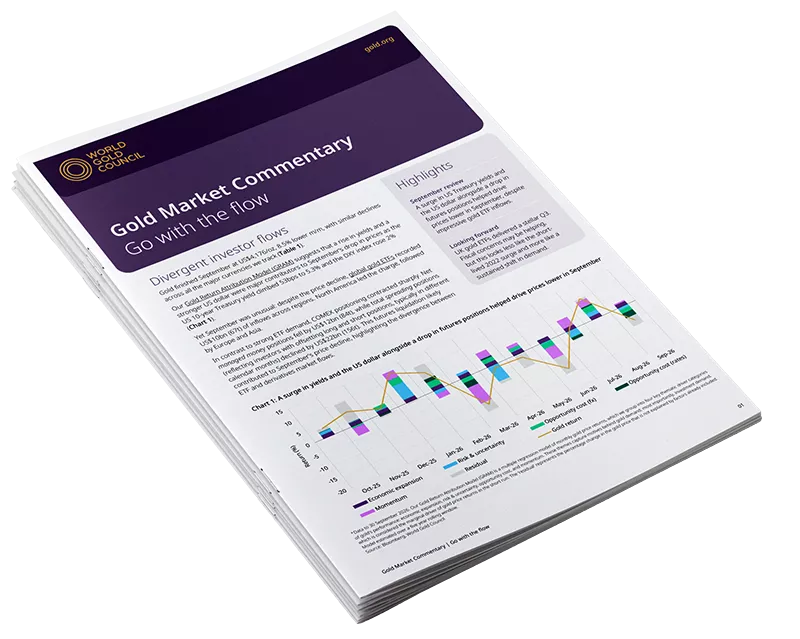

Gold Market Commentary: The return of transitory
Gold ended April flat, as a return of risk appetite weighed on gold, but a weaker US dollar and ETF inflows led by Europe provided support. Short term headwinds could sustain some gold weakness as it searches for a catalyst to regain the structural uptrend.
Gold Demand Trends: India Focus Q1 2026
India’s gold demand rose 10% y/y to 151t in Q1, while nearly doubling in value to a record INR 2,275bn (US$25bn). Growth was led by investment demand, up 54% y/y to 82t, with bar and coin demand nearly matching jewellery consumption and ETFs hitting record highs. Jewellery volumes fell 19% y/y, but spending rose 47%. Investment demand is set to remain supportive, while jewellery demand may stay under pressure from inflation and economic headwinds.
Gold Demand Trends: US Focus Q1 2026
US gold demand softened in Q1 2026 as a sharp reversal in ETF flows outweighed resilience across other segments. Physically backed US gold ETFs recorded sizeable monthly outflows in March, erasing inflows accumulated earlier in the quarter amid risk‑off conditions, elevated positioning and higher opportunity costs. Bar and coin investment provided a partial offset as retail interest remained resilient, while jewellery demand fell to a record quarterly low on affordability pressures. Despite near‑term volatility, ongoing geopolitical tensions, policy‑rate uncertainty and broader macroeconomic risks continue to support the longer‑term investment case for gold in the US.
Gold in Shari’ah investments: Hajj fund perspective
Around 240 million Muslims in Southeast Asia aspire to perform the annual Hajj pilgrimage. Serving this community, Hajj savings funds carry a dual mandate: safeguard pilgrims’ deposits and generate returns that preserve purchasing power over what can be decades-long waiting periods. This report dives into the case for gold as a strategic, Shari’ah-compliant asset class within Hajj fund portfolios.
You asked, we answered: Has gold's performance structurally changed?
Gold Market Commentary: Anatomy of a fall
March was the weakest month for gold since June 2013, a move driven by deleveraging and liquidity dynamics, not fundamentals. Looking ahead, there are some green shoots for gold to re-establish its positive trend but short-term risks remain.
Why gold in 2026? Is gold still a strategic asset for Japanese investors?
Why gold in 2026? Australia's macro shifts and the case for gold
Australia’s economy continues to grow but resurgent inflation and the Reserve Bank of Australia (RBA)’s decision to resume tightening in February 2026 – diverging from some of its peers – raises questions around portfolio allocations. Australia's unique geopolitical positioning, with its fortunes tied to increasingly affluent trade partners within the Indo-Pacific while being strategically aligned with the US, has created an asymmetry that makes portfolio diversification crucial. Against this backdrop, gold’s role in Australian portfolios warrants renewed attention. For Australian investors, a strategic allocation to gold offers both a macro hedge and a portfolio diversifier at a time when uncertainty takes centre stage.