Central Bank Gold Statistics: Central banks continue summer spree in August
6 October, 2026
Global central banks remain on pace with gold accumulation this August, with reported net buying totalling 39t (Chart 1). Large, consistent buyers of gold in 2026 showed continued activity in the month, with China taking the lead, followed by Uzbekistan and Poland. On a y-t-d basis, central banks have reported total purchases of 170t.
Chart 1: Central banks remain positive in August with net buying of 39t
Monthly reported central bank activity, tonnes*
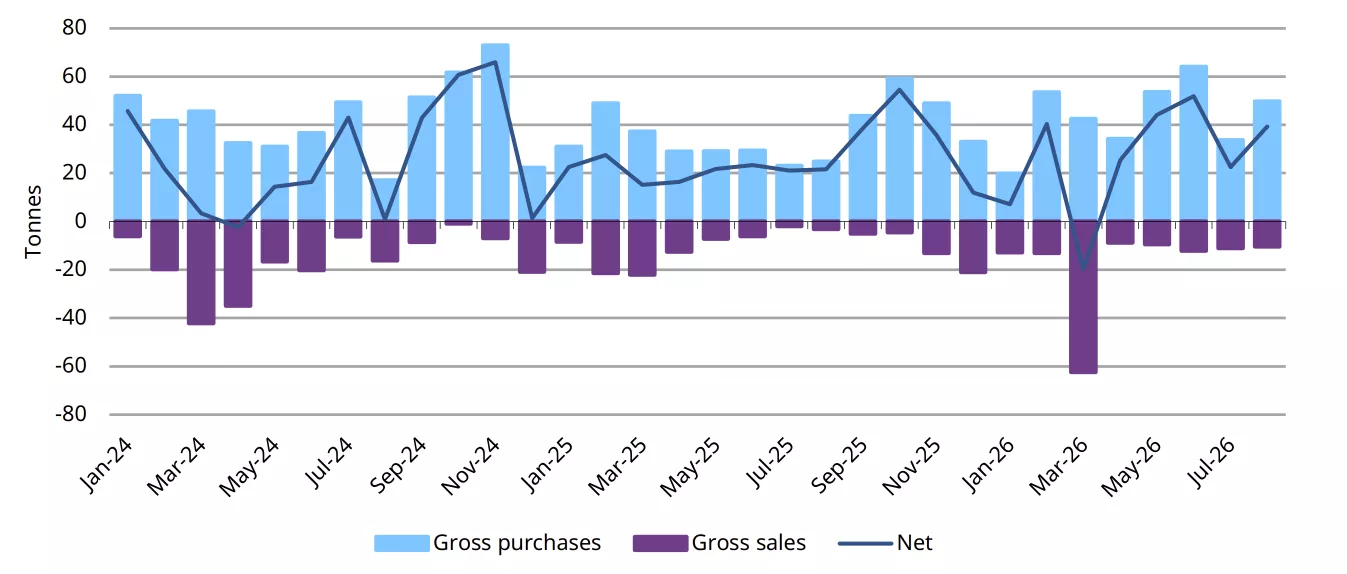
*Data to 31 August 2026, where available.
Source: IMF, respective central banks, World Gold Council
Putting August’s total in broader context, analysis of reported central-bank gold purchases between 2016 and 2025 suggest modest seasonal variation, although differences across years remain substantial (Chart 2). Heightened economic or geopolitical uncertainty may play a role, but further analysis is needed to identify any strong and persistent underlying drivers.
Chart 2: Purchasing activity has tended to be strongest in June and September-October
Average net reported activity by month, 2016-2025
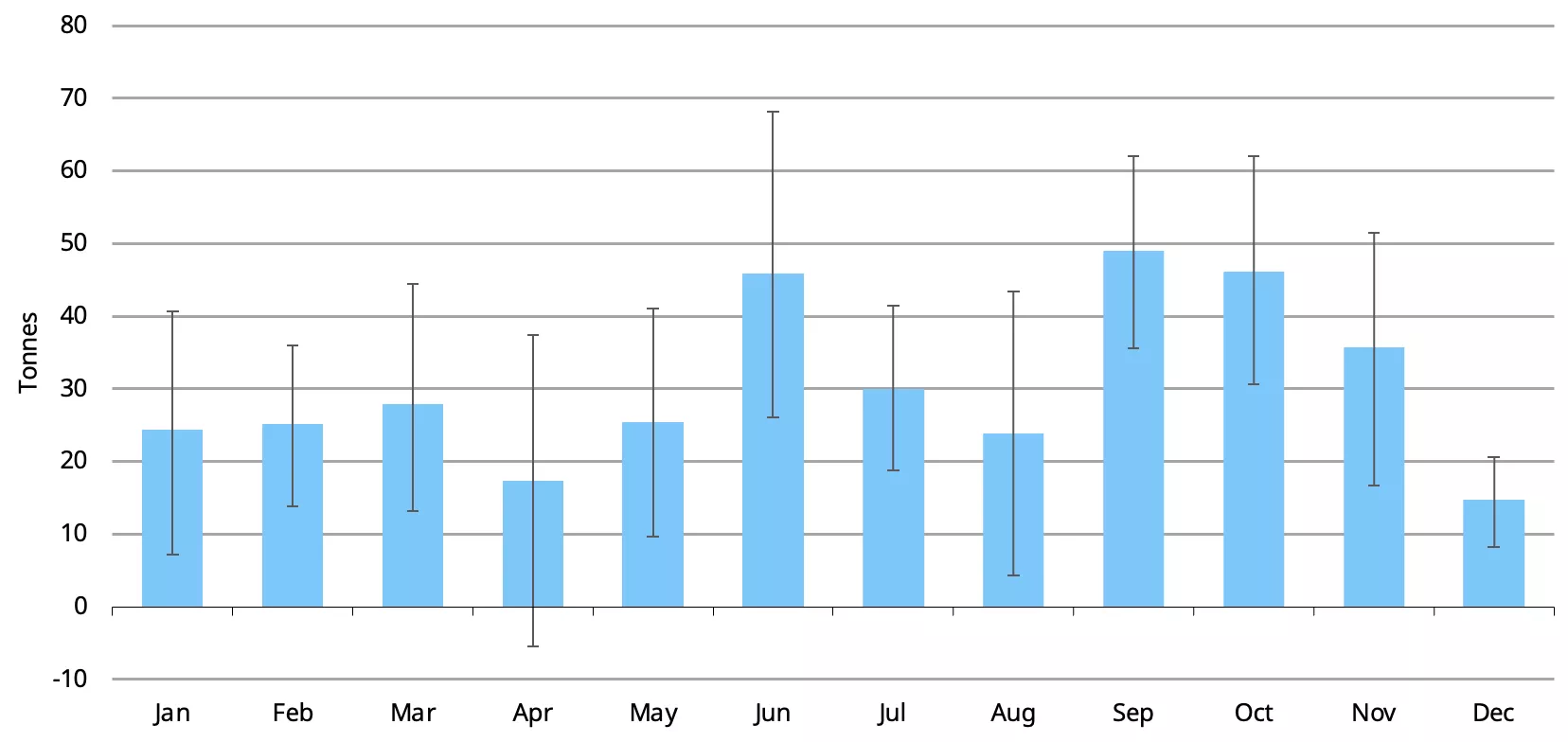
Note: Monthly averages are calculated from reported central bank gold purchases between 2016 and 2025. Error bars show 95% bootstrap confidence intervals derived from 5,000 resamples of each month's observations. The bootstrap approach makes no assumption of normality and is designed to better capture uncertainty in the presence of outliers and asymmetric distributions.
Source: IMF, respective central banks, World Gold Council
The composition of August’s buying is as notable as the headline total: demand was again led by familiar participants pursuing multi-year accumulation programmes. This suggests that central bank activity continues to reflect longer-term reserve objectives, while monthly fluctuations are more likely to capture differences in implementation, market conditions and country-specific liquidity requirements.
Significant reported activity in August and y-t-d:
- The National Bank of Poland continued its gold accumulation streak, with 8t purchased in August. Poland still tops the scoreboard when it comes to y-t-d gold purchases, buying 98t so far this year but we do see China catching up. The country has accumulated 648t of gold with its target of 700t getting closer in sight.
- In its 22nd consecutive month of buying The People’s Bank of China added 20t to its gold reserves in August. China has reported adding 80t to its gold reserves y-t-d, second only to Poland. China’s official gold reserves now stand at 9% of total reserves, or around 2,387t.
- The Central Bank of Uzbekistan bought 8t this month, with its y-t-d gold purchases close to 50t. Uzbekistan’s gold now stands at 90% of total reserves, or about 439t.
- The National Bank of Kazakhstan bought 7t in August, with its y-t-d gold purchases close to 36t. Kazakhstan’s gold now stands at 79% of total reserves, or about 377t.
- A consistent buyer of gold for the past 42 consecutive months, the Czech National Bank also bought 2t of gold in August. The central bank has bought 14t y-t-d, bringing its gold holdings to 7% of its total reserves, or 86t.
- The Central Bank of the Republic of Turkey bought 3t this month, after three past consecutive months of net sales. Y-t-d, Turkey reported net sales of 82t, with majority of its sales happening in Q1 2026. Other central banks in the market this month include Bolivia and Ghana having bought ~1t each respectively.
- The Central Bank of Russia continued its net sales in August, offloading another 6t of gold. Russia has sold 56t of gold y-t-d, with its total gold holdings now at 2,271t.
- The Central Bank of Jordan also posted sales in August, offloading 3t this month. Y-t-d, Jordan has bought 2t so far this year, lifting its gold holdings to 75t, approximately 37% of its total reserves.
Chart 3: Year-to-date central bank gold activity
Reported central bank net purchases and sales, tonnes*
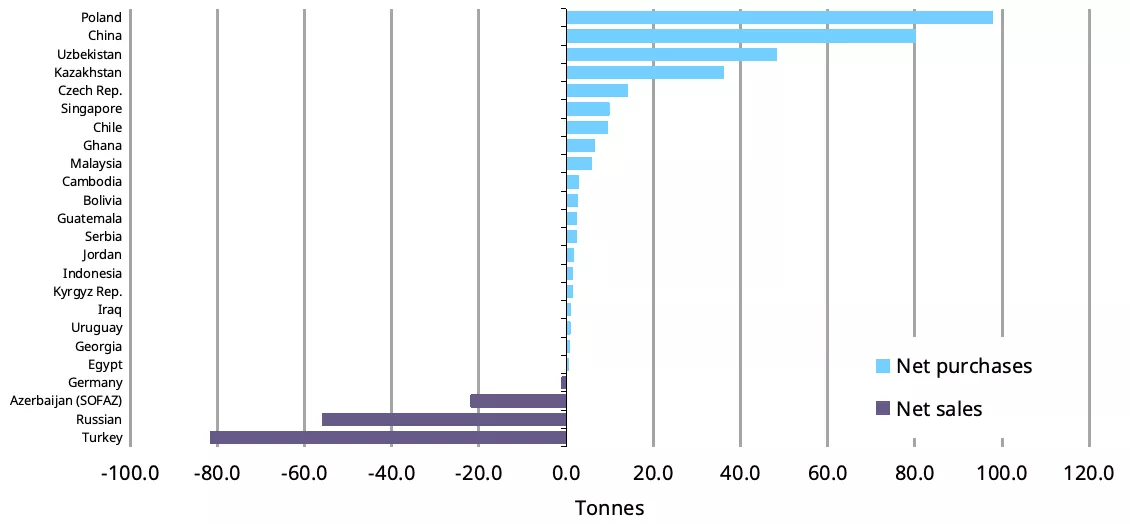
*Data to 31 August 2026, where available.
Note: The Bulgarian National Bank's transfer of 2t to the European Central Bank as part of its adoption of the euro is excluded from the chart. Azerbaijan (SOFAZ) represents the gold reserves of the State Oil Fund of Azerbaijan (SOFAZ).
Source: IMF, respective central banks, World Gold Council
Central banks take on fresh approach to gold
In our recently published You asked, we answered: Why are central banks moving their gold reserves, we delved into developments within the central banking world, particularly how they take on a more active view on the management of their gold holdings. On September 2nd, the De Nederlandsche Bank (DNB) announced the transfer of 86t of gold from New York and Ottawa to London with the aim of improving the liquidity and tradability of its gold reserves. As noted in the blog, several central banks have also been reported to repatriate or relocate their gold over the past several years. In 2025, the Banque de France also conducted a similar operation in updating the tradability of their gold holdings.1
Disclaimer
Important information and disclaimers
© 2026 World Gold Council. All rights reserved. World Gold Council and the Circle device are trademarks of the World Gold Council or its affiliates.
All references to LBMA Gold Price are used with the permission of ICE Benchmark Administration Limited and have been provided for informational purposes only. ICE Benchmark Administration Limited accepts no liability or responsibility for the accuracy of the prices or the underlying product to which the prices may be referenced. Other content is the intellectual property of the respective third party and all rights are reserved to them.
Reproduction or redistribution of any of this information is expressly prohibited without the prior written consent of World Gold Council or the appropriate copyright owners, except as specifically provided below. Information and statistics are copyright © and/or other intellectual property of the World Gold Council or its affiliates or third-party providers identified herein. All rights of the respective owners are reserved.
The use of the statistics in this information is permitted for the purposes of review and commentary (including media commentary) in line with fair industry practice, subject to the following two pre-conditions: (i) only limited extracts of data or analysis be used; and (ii) any and all use of these statistics is accompanied by a citation to World Gold Council and, where appropriate, to Metals Focus or other identified copyright owners as their source. World Gold Council is affiliated with Metals Focus.
The World Gold Council and its affiliates do not guarantee the accuracy or completeness of any information nor accept responsibility for any losses or damages arising directly or indirectly from the use of this information.
This information is for educational purposes only and by receiving this information, you agree with its intended purpose. Nothing contained herein is intended to constitute a recommendation, investment advice, or offer for the purchase or sale of gold, any gold-related products or services or any other products, services, securities or financial instruments (collectively, “Services”). This information does not take into account any investment objectives, financial situation or particular needs of any particular person.
Diversification does not guarantee any investment returns and does not eliminate the risk of loss. Past performance is not necessarily indicative of future results. The resulting performance of any investment outcomes that can be generated through allocation to gold are hypothetical in nature, may not reflect actual investment results and are not guarantees of future results. The World Gold Council and its affiliates do not guarantee or warranty any calculations and models used in any hypothetical portfolios or any outcomes resulting from any such use. Investors should discuss their individual circumstances with their appropriate investment professionals before making any decision regarding any Services or investments.
This information may contain forward-looking statements, such as statements which use the words “believes”, “expects”, “may”, or “suggests”, or similar terminology, which are based on current expectations and are subject to change. Forward-looking statements involve a number of risks and uncertainties. There can be no assurance that any forward-looking statements will be achieved. World Gold Council and its affiliates assume no responsibility for updating any forward-looking statements.
Information regarding the LBMA Gold Price
The LBMA Gold Price is used by the World Gold Council with permission under license by ICE Benchmark Administration Limited and is subject to the restrictions set forth here (www.gold.org/terms-and-conditions).
Information regarding QaurumSM and the Gold Valuation Framework
Note that the resulting performance of various investment outcomes that can be generated through use of Qaurum, the Gold Valuation Framework and other information are hypothetical in nature, may not reflect actual investment results and are not guarantees of future results. Neither World Gold Council (including its affiliates) nor Oxford Economics provides any warranty or guarantee regarding the functionality of the tool, including without limitation any projections, estimates or calculations.
Information from ICRA Analytics Limited
All information obtained from ICRA Analytics Limited contained in this document is subject to the disclaimer set forth here (www.icraanalytics.com/terms-of-use/disclaimer).