Gold's Role in an AI-Driven Economy: Direct and Indirect Effects
23 November, 2026
In my recent conversations with investors, few topics have come up as frequently as AI.
AI has become a major source of US growth, with a handful of companies driving much of the expansion in recent years.1 With a force this large reshaping the economy, it is no surprise that investors are asking what AI means for gold. And there is a direct link: the metal sits inside the chips and data centres powering the AI buildout. But AI’s indirect effects on energy costs, inflation, real rates and geopolitics I believe will carry far more weight for the gold market, because they feed into the drivers that move the gold price.2
The direct link between gold and AI is real but small in the context of the overall market. Gold is used as a component in the high-end chips, memory, connectors and networking equipment inside AI data centres, because few materials can match its conductivity and resistance to corrosion. Some of my WGC colleagues recently examined the current demand situation in the electronics sector, which they describe as a “tug-of-war”. AI demand is pulling gold usage higher, while high prices are pushing manufacturers to thin out or replace gold wherever they can. Technology demand for gold totalled 323 tonnes in 2025, virtually unchanged from 2024 and making up only around 6-7% of annual gold demand.3 Newer applications may add a modest source of demand over time, but not enough to singlehandedly move the gold price.
AI’s larger effects on gold will likely come through indirect channels. The technology is already beginning to reshape capital allocation, economic growth, and the ways in which people work, save and build wealth. Each of these shifts has implications for the macroeconomic and financial forces that influence gold. To understand these effects more systematically, the remainder of this analysis focuses on four key areas where the technology could ultimately influence gold demand and market dynamics.
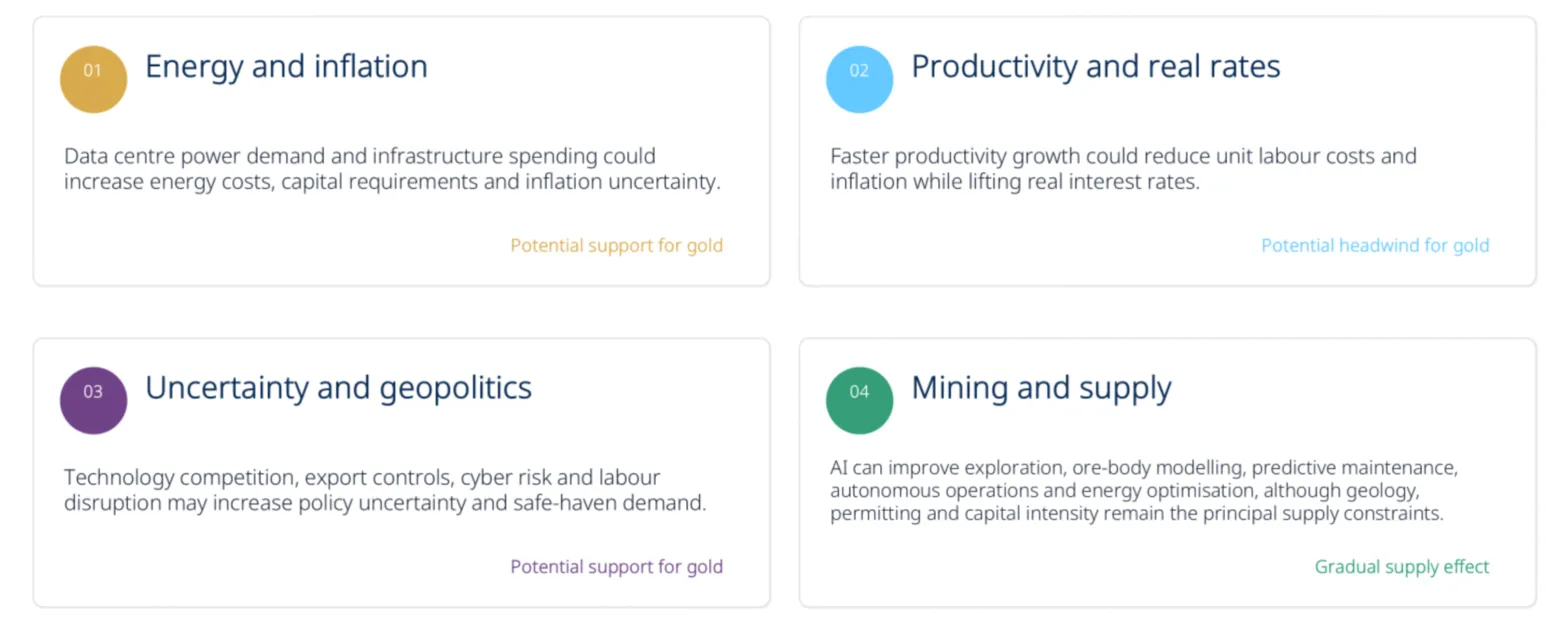
The first is energy and inflation. The AI buildout requires enormous amounts of power and physical infrastructure, and that demand is inflationary in the near term. Higher electricity costs feed into consumer prices, and heavy capital spending competes for the same resources as the rest of the economy. This kind of persistent inflation uncertainty has historically been supportive of gold in its role as an inflation hedge.
The second is the impact of AI on productivity and rates, and it runs in the opposite direction. Productivity gains from AI implementation could accelerate growth, resulting in lower unit labour costs and easing inflation. Real interest rates would likely rise in that scenario, creating a headwind for gold.
The third is uncertainty and geopolitics. Whether economies embrace AI or not is now a political question as well as a technological one. Export controls and US-China competition over advanced chips add to that uncertainty, and periods of uncertainty have historically drawn both central banks and households toward gold. For central banks, this environment strengthens the case for diversifying reserves into a neutral asset with no counterparty risk, a trend that was firmly in place before AI entered the picture. For households, particularly in emerging markets, AI raises questions about the future of work and savings. This uncertainty results in an instinct to preserve wealth; a role gold has long filled for many.
The fourth, mining and supply, may play out more gradually. Mining companies already apply AI to exploration targeting, ore-body modelling, predictive maintenance and autonomous operation.4 Over time, AI-driven advancements could lower costs and modestly lift future supply. Still, geology, permitting and capital intensity will continue to constrain how much new gold reaches the market, regardless of any such advancements. We see this as a potential headwind, albeit modest, to gold demand.
These forces are not all moving in the same direction. Energy and inflation, uncertainty and geopolitics can be supportive, while productivity, real rates and changes in mining and supply can work against them. The reality is that it is very difficult to know which of these forces will dominate at any particular moment. AI looks inflationary today and may prove disinflationary later. Politics could slow the buildout in one economy and speed it up in another.
What we can say is that these effects can reach markets quickly. In the days following the US midterm elections, AI-linked equities underwent a sharp repricing. The shift to divided government was only part of the story. Voters in dozens of local jurisdictions approved restrictions on new data centre development, and markets questioned whether AI spending can deliver the growth it promises.5 The advancement of tighter AI regulations will likely create a supportive backdrop for gold, but the signals are still developing.
Figure 1: The larger AI effect on gold is likely to be indirect
AI changes the macroeconomics and geopolitical environment in which gold trades
Source: World Gold Council
Looking ahead, I expect AI to remain one of the defining forces in the economic environment in which gold trades. The signals worth watching in the gold market have not changed: real yields, the direction of the US dollar, investment flows and central bank purchases. And each of these areas links directly to the forces we’ve outlined above. What AI will change is how those signals move, and most critically how often the market will need to rethink its assumptions.
Footnotes
1The Fed | The AI Buildout and the Economy: Publicly Available Data to Assess AI’s Impact | 17 July, 2026
2World Gold Council | Gold’s long-term expected return (GLTER) | 17 October, 2024
3World Gold Council | You asked, we answered: The AI boom and gold | 24 September, 2026
4Forbes | Using AI to Enhance Operational Excellence in Mining and Metals | 03 November, 2026
5iShares | AI stocks after the 2026 midterms: What changed? | 11 November, 2026
Disclaimer
Important information and disclaimers
© 2026 World Gold Council. All rights reserved. World Gold Council and the Circle device are trademarks of the World Gold Council or its affiliates.
All references to LBMA Gold Price are used with the permission of ICE Benchmark Administration Limited and have been provided for informational purposes only. ICE Benchmark Administration Limited accepts no liability or responsibility for the accuracy of the prices or the underlying product to which the prices may be referenced. Other content is the intellectual property of the respective third party and all rights are reserved to them.
Reproduction or redistribution of any of this information is expressly prohibited without the prior written consent of World Gold Council or the appropriate copyright owners, except as specifically provided below. Information and statistics are copyright © and/or other intellectual property of the World Gold Council or its affiliates or third-party providers identified herein. All rights of the respective owners are reserved.
The use of the statistics in this information is permitted for the purposes of review and commentary (including media commentary) in line with fair industry practice, subject to the following two pre-conditions: (i) only limited extracts of data or analysis be used; and (ii) any and all use of these statistics is accompanied by a citation to World Gold Council and, where appropriate, to Metals Focus or other identified copyright owners as their source. World Gold Council is affiliated with Metals Focus.
The World Gold Council and its affiliates do not guarantee the accuracy or completeness of any information nor accept responsibility for any losses or damages arising directly or indirectly from the use of this information.
This information is for educational purposes only and by receiving this information, you agree with its intended purpose. Nothing contained herein is intended to constitute a recommendation, investment advice, or offer for the purchase or sale of gold, any gold-related products or services or any other products, services, securities or financial instruments (collectively, “Services”). This information does not take into account any investment objectives, financial situation or particular needs of any particular person.
Diversification does not guarantee any investment returns and does not eliminate the risk of loss. Past performance is not necessarily indicative of future results. The resulting performance of any investment outcomes that can be generated through allocation to gold are hypothetical in nature, may not reflect actual investment results and are not guarantees of future results. The World Gold Council and its affiliates do not guarantee or warranty any calculations and models used in any hypothetical portfolios or any outcomes resulting from any such use. Investors should discuss their individual circumstances with their appropriate investment professionals before making any decision regarding any Services or investments.
This information may contain forward-looking statements, such as statements which use the words “believes”, “expects”, “may”, or “suggests”, or similar terminology, which are based on current expectations and are subject to change. Forward-looking statements involve a number of risks and uncertainties. There can be no assurance that any forward-looking statements will be achieved. World Gold Council and its affiliates assume no responsibility for updating any forward-looking statements.
Information regarding the LBMA Gold Price
The LBMA Gold Price is used by the World Gold Council with permission under license by ICE Benchmark Administration Limited and is subject to the restrictions set forth here (www.gold.org/terms-and-conditions).
Information regarding QaurumSM and the Gold Valuation Framework
Note that the resulting performance of various investment outcomes that can be generated through use of Qaurum, the Gold Valuation Framework and other information are hypothetical in nature, may not reflect actual investment results and are not guarantees of future results. Neither World Gold Council (including its affiliates) nor Oxford Economics provides any warranty or guarantee regarding the functionality of the tool, including without limitation any projections, estimates or calculations.
Information from ICRA Analytics Limited
All information obtained from ICRA Analytics Limited contained in this document is subject to the disclaimer set forth here (www.icraanalytics.com/terms-of-use/disclaimer).