You asked, we answered: The AI boom and gold
24 September, 2026
Gold is used for much more than creating jewellery and forming bars and coins; it is widely used in the technology sector, a relatively small but important component of demand that is often overlooked. In 2025, industrial demand for gold used in electronics, dentistry and other areas totalled 323t, virtually unchanged from 2024.
The growth of AI in recent years has had a considerable and widely reported impact on the electronics sector as a whole, and we regularly receive queries from analysts and institutional investors about how this might affect gold. This blog addresses some of the most frequently asked questions.
A brief history of gold in electronics
As the chart below illustrates, the electronics sector consumes approximately 80% of the gold used in industrial applications. This relationship between gold and electronics stretches back almost a century, but really took off during the 1960s and 70s as semiconductors began to enter mainstream consumer and commercial markets. Engineers recognised that gold possessed a unique combination of properties that no other material could match: an excellent conductor of electricity and highly resistant to corrosion and oxidation, it can be formed into extremely thin wires, films and coatings without losing performance characteristics.
These attributes made gold particularly attractive for high-reliability applications, including early computers, telecommunications equipment, defence systems and spacecraft. In the years that followed, as electronic devices became smaller, faster and more complex, gold’s unique chemical and physical properties became ever more critical, cementing it as a necessity in an ever-growing range of applications, ensuring the functionality and reliability of modern microprocessors, memory chips, connectors, sensors and networking infrastructure.
Chart 1: Electronics accounts for the vast majority of gold used in industrial applications
Annual technology demand for gold by sector, tonnes
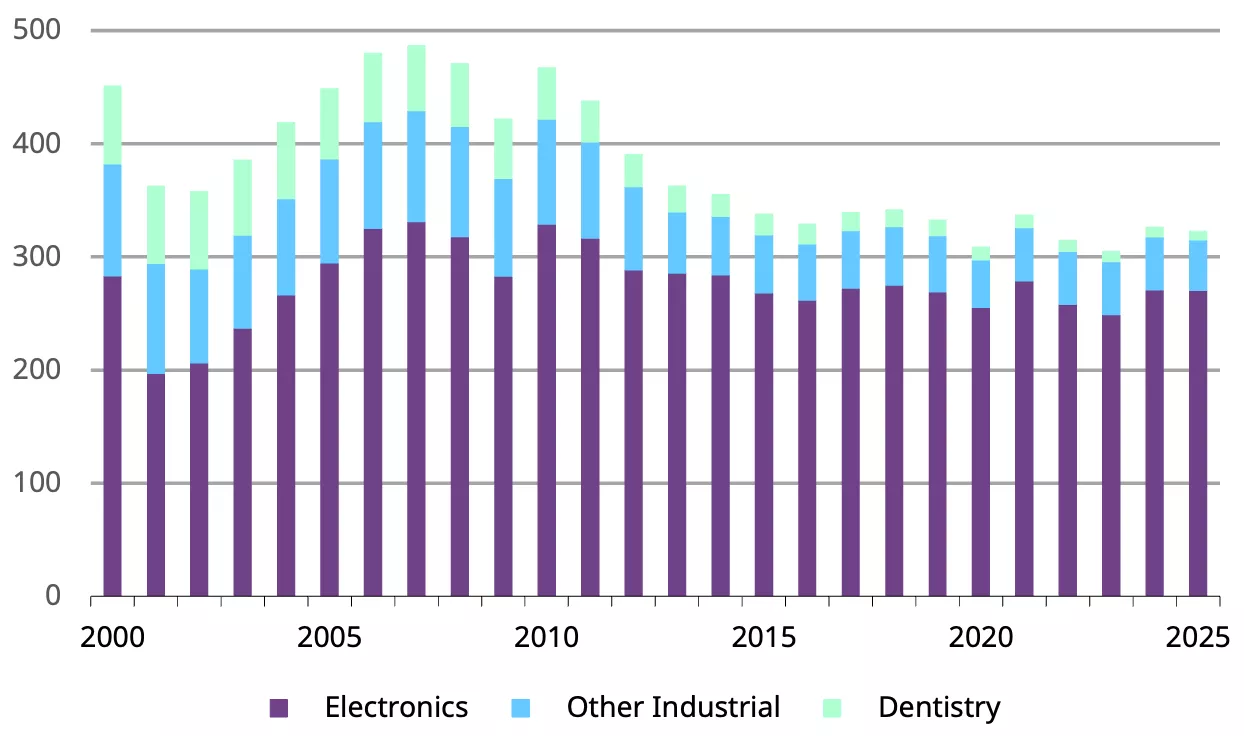
Source: Metals Focus, Refinitiv GFMS, World Gold Council
Today, gold is found in high-end chips that power the devices on which we all rely. Our cell phones, laptops, vehicles, smart watches and various other gadgets all contain the metal, as do vast data centres and other installations that manage our data and interactions online. Gold is, quite literally, all around us.
As AI continues to grow at pace, attention has increasingly turned to the role gold plays in the sector. Here, we answer some of the most frequently asked questions.
Has the AI boom fuelled demand for gold?
The answer is complex. As we have already noted, 2025 annual demand for gold in technology was virtually unchanged from 2024 at 323t. Given the rapid growth in demand for AI chips during this period we might have expected a corresponding increase in gold demand, but this was not the case. There are a number of factors at play here, all worth consideration:
- The high price continues to pressure manufacturers to reduce, or completely eliminate, the use of gold in their devices
- Miniaturisation also plays a role: technological advances produce ever-smaller chips that need less, or in some cases, no gold
- Conversely, the global clamour for AI chips has undoubtedly spurred recent demand for gold.
We view the current demand situation in the electronics sector very much as a tug-of-war, with cost pressures and technical advances on one side and AI demand on the other. At the moment, the two sides appear evenly matched.
Are there specific new areas of demand within the electronics sector?
An emerging area that could support future gold demand is that of co-packaged optics (CPO). With the growing complexity of AI models comes a dramatic increase in data transfer between processors and memory systems. Traditional electronic connections are starting to encounter limitations in delivering the requirements of next-generation AI data centres. CPO can better meet these needs if it can enhance bandwidth, reduce data transmission bottlenecks and improve energy efficiency by close integration between optical communication components and the processor itself. Gold plays several important roles within these systems. Beyond traditional wires and coatings it is also used in some optical and photonic components, thanks to its durability and excellent electrical performance, as well as in high-frequency electrodes within the chip architecture. Although CPO is at an early adoption stage, many of the industry's largest semiconductor and networking companies, such as Nvidia, are investing heavily in its development. If the technology achieves widespread deployment across hyperscale AI infrastructure it could represent a small but potentially meaningful new source of demand for gold within the sector.
Is gold replaceable in the AI/electronics sector?
Manufacturers will always try to minimise, or in some cases altogether remove, the use of high-cost materials. Recent years have seen considerable “thrifting” in the quantity of gold used in some applications – for example, the development of thinner bonding wires and coatings. There have also been instances, particularly in lower-end applications, where gold has been completely removed. However, we believe high-end and safety critical devices will continue to require gold. Many chips and devices used in AI applications are extremely complex and costly; manufacturers seek the best materials to ensure longevity and reliability, and this almost always involves gold. Another factor worth noting is that “easy” gold-thrifting happened many years ago, meaning that most coatings and wires are already at – or very close to – their technical minimum thickness.
Beyond AI related technologies, which other industrial fields rely on gold as an indispensable material?
Gold is used in a wide range of industries beyond electronics, such as aerospace, chemical catalysis and optical applications. Gold is also widely used in healthcare technologies, albeit generally in very small quantities. While these applications don’t have a significant impact on overall gold demand, they are important in terms of gold’s utility in modern society. Healthcare applications are an excellent example: billions of diagnostic tests are manufactured on an annual basis, the vast majority of which rely on tiny particles of gold to provide rapid and accurate diagnosis of diseases like malaria, sepsis and HIV/AIDs. These tests can be used in locations with limited infrastructure, making reliable medical diagnostics possible in communities around the world.
The bottom line? Gold's role in technology may be easy to overlook, but it is quietly indispensable. The electronics sector is subject to cost pressures and thrifting that pulls gold usage down, while the AI boom pushes it up — a genuine tug-of-war with no clear winner just yet. But beyond the headlines, gold continues to earn its place in applications that demand the very best: high-end chips, safety-critical devices and tests that diagnose disease in the world's most remote communities. It may be a small slice of overall demand, but where reliability matters, gold is hard to replace.
Disclaimer
Important information and disclaimers
© 2026 World Gold Council. All rights reserved. World Gold Council and the Circle device are trademarks of the World Gold Council or its affiliates.
All references to LBMA Gold Price are used with the permission of ICE Benchmark Administration Limited and have been provided for informational purposes only. ICE Benchmark Administration Limited accepts no liability or responsibility for the accuracy of the prices or the underlying product to which the prices may be referenced. Other content is the intellectual property of the respective third party and all rights are reserved to them.
Reproduction or redistribution of any of this information is expressly prohibited without the prior written consent of World Gold Council or the appropriate copyright owners, except as specifically provided below. Information and statistics are copyright © and/or other intellectual property of the World Gold Council or its affiliates or third-party providers identified herein. All rights of the respective owners are reserved.
The use of the statistics in this information is permitted for the purposes of review and commentary (including media commentary) in line with fair industry practice, subject to the following two pre-conditions: (i) only limited extracts of data or analysis be used; and (ii) any and all use of these statistics is accompanied by a citation to World Gold Council and, where appropriate, to Metals Focus or other identified copyright owners as their source. World Gold Council is affiliated with Metals Focus.
The World Gold Council and its affiliates do not guarantee the accuracy or completeness of any information nor accept responsibility for any losses or damages arising directly or indirectly from the use of this information.
This information is for educational purposes only and by receiving this information, you agree with its intended purpose. Nothing contained herein is intended to constitute a recommendation, investment advice, or offer for the purchase or sale of gold, any gold-related products or services or any other products, services, securities or financial instruments (collectively, “Services”). This information does not take into account any investment objectives, financial situation or particular needs of any particular person.
Diversification does not guarantee any investment returns and does not eliminate the risk of loss. Past performance is not necessarily indicative of future results. The resulting performance of any investment outcomes that can be generated through allocation to gold are hypothetical in nature, may not reflect actual investment results and are not guarantees of future results. The World Gold Council and its affiliates do not guarantee or warranty any calculations and models used in any hypothetical portfolios or any outcomes resulting from any such use. Investors should discuss their individual circumstances with their appropriate investment professionals before making any decision regarding any Services or investments.
This information may contain forward-looking statements, such as statements which use the words “believes”, “expects”, “may”, or “suggests”, or similar terminology, which are based on current expectations and are subject to change. Forward-looking statements involve a number of risks and uncertainties. There can be no assurance that any forward-looking statements will be achieved. World Gold Council and its affiliates assume no responsibility for updating any forward-looking statements.
Information regarding the LBMA Gold Price
The LBMA Gold Price is used by the World Gold Council with permission under license by ICE Benchmark Administration Limited and is subject to the restrictions set forth here (www.gold.org/terms-and-conditions).
Information regarding QaurumSM and the Gold Valuation Framework
Note that the resulting performance of various investment outcomes that can be generated through use of Qaurum, the Gold Valuation Framework and other information are hypothetical in nature, may not reflect actual investment results and are not guarantees of future results. Neither World Gold Council (including its affiliates) nor Oxford Economics provides any warranty or guarantee regarding the functionality of the tool, including without limitation any projections, estimates or calculations.
Information from ICRA Analytics Limited
All information obtained from ICRA Analytics Limited contained in this document is subject to the disclaimer set forth here (www.icraanalytics.com/terms-of-use/disclaimer).