Artisanal and small-scale gold mining: a vital source of gold supply
26 August, 2026
Highlights
- Artisanal and small-scale gold mining is a significant – and growing – part of the global gold market, but one that is difficult to measure and often takes place outside of legal frameworks
- The World Gold Council, in partnership with Metals Focus, seeks to improve estimation of global ASGM supply in order to deepen understanding of global gold market dynamics
- This is part of our broader efforts to reduce illicit flows and bring legitimate ASGM into the formal gold supply chain.
ASGM: improving our understanding
Artisanal and small-scale gold mining (ASGM) is an increasingly relevant part of the gold market. It is estimated to account for around one fifth of annual gold production and to support the livelihoods of some 20 million people across Africa, Latin America and Asia-Pacific.1 Yet because activity is often dispersed, informal and difficult to track, ASGM has long been one of the hardest segments of the supply chain to measure with confidence.
To help close that gap, the World Gold Council has been working with independent precious metals consultancy, Metals Focus – who provide much of the supply-side analysis that underpins our quarterly Gold Demand Trends report – to strengthen the assessment of ASGM supply worldwide. Complementing this, we are working with a partner to develop an expanded model of ASGM estimation that leverages open-source intelligence, geospatial analysis, and big data analytics. More robust data helps drive action, and is key to designing impactful formalisation schemes.
A growing share of global supply
ASGM is far from a niche activity. Its contribution to global mine supply has risen steadily over the past decade. Several factors have contributed to this increase, including higher gold prices, limited alternative employment in many producing regions, greater access to equipment and expertise, and growing demand from some refiners. The pace of expansion has, in some cases, been eye-watering: in Peru, for example, ASGM output has grown by more than 160% over the past ten years, to reach 100t in 2025.
Chart 1: Gold from ASGM sources has increased steadily for the last five years
Annual gold mine production from large-scale and artisanal and small-scale mines, in tonnes
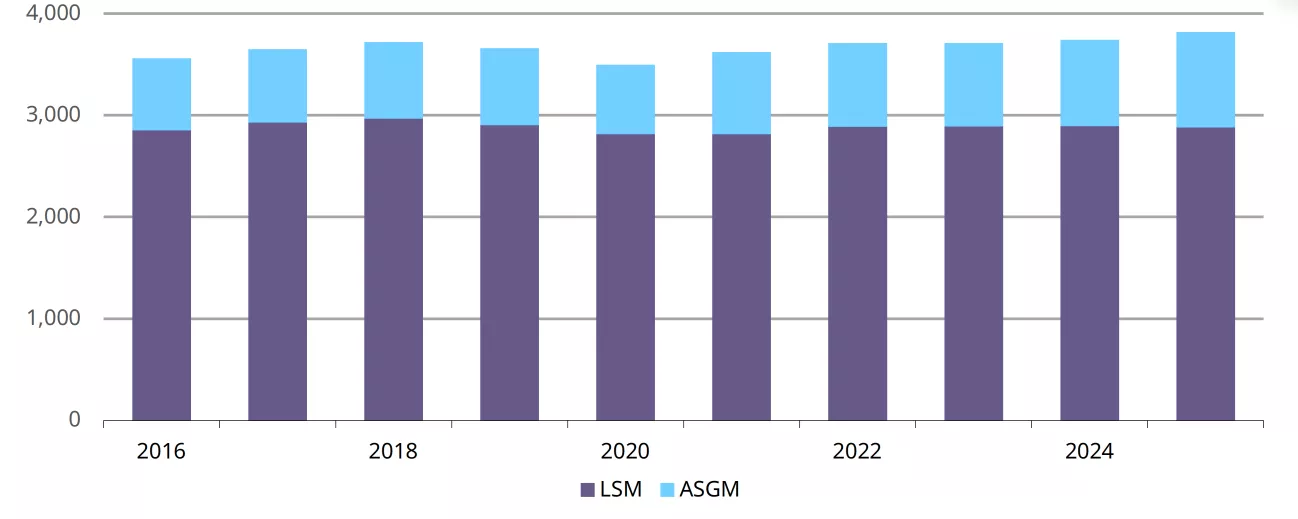
Source: Metals Focus, World Gold Council
Local roots, global significance
Individual markets show how local economic, geographic and regulatory conditions shape the sector's development.
Peru has a mature sector, with more than 300,000 operators working across three very different regions – coastal foothills, Andean highlands and Amazon rainforest – alongside large, long-established plants and a distinctive model that allows gold to be sourced from miners that are still working through the process of formalisation. Ecuador, by contrast, is in transition: here rapid mechanisation is pushing artisanal operations to reclassify as small-scale and output is growing faster than the number of producers. The ASGM sector in Mauritania emerged only in the 2010s and has expanded quickly since; a market still building its structures almost from scratch. And in Tanzania, Africa's fourth-largest gold producer, more than a million artisanal miners operate in parallel with major large-scale mining.
The common thread is a sector whose significance to global supply is growing, even as much of it continues to operate outside formal frameworks.
Why better data matters
Measuring ASGM is inherently difficult. Production is spread across many thousands of small operations, much of it beyond formal reporting systems, so estimates naturally evolve as new information comes to light. Better information helps build a clearer view of the true scale of production, and of how gold moves through the market.
The results of improved ASGM measurement are visible in recent editions of Gold Demand Trends. Our work with Metals Focus has led them to revise historical estimates of global mine production upwards, reflecting a more complete picture of artisanal output.
From measurement to understanding
Improving visibility into, and measurement of, ASGM is about more than simply filling a data gap. It will build a deeper understanding of a highly diverse global sector. Conditions vary widely from one producing country to the next, and a clearer, more consistent evidence base will help make sense of how the sector is evolving and where growth is concentrated.
Reliable data also supports the wider conversation around responsible sourcing and traceability, while technologies that verify the origin of gold offer a further route to greater transparency over time.
Looking ahead
The World Gold Council’s work on ASGM is broad, and includes catalysing the introduction of centralised processing plants, the deployment of origin verification technology, and working with buyers to ensure responsible ASGM production has an opportunity to enter formal markets.
As ASGM accounts for a meaningful and growing share of global gold production, better understanding of this sector will only become more important. Better data provides the essential foundation for informed decisions. Through our ongoing work with Metals Focus and others, we are helping to build that understanding…and with it a more transparent and complete view of global gold supply.
Disclaimer
Important information and disclaimers
© 2026 World Gold Council. All rights reserved. World Gold Council and the Circle device are trademarks of the World Gold Council or its affiliates.
All references to LBMA Gold Price are used with the permission of ICE Benchmark Administration Limited and have been provided for informational purposes only. ICE Benchmark Administration Limited accepts no liability or responsibility for the accuracy of the prices or the underlying product to which the prices may be referenced. Other content is the intellectual property of the respective third party and all rights are reserved to them.
Reproduction or redistribution of any of this information is expressly prohibited without the prior written consent of World Gold Council or the appropriate copyright owners, except as specifically provided below. Information and statistics are copyright © and/or other intellectual property of the World Gold Council or its affiliates or third-party providers identified herein. All rights of the respective owners are reserved.
The use of the statistics in this information is permitted for the purposes of review and commentary (including media commentary) in line with fair industry practice, subject to the following two pre-conditions: (i) only limited extracts of data or analysis be used; and (ii) any and all use of these statistics is accompanied by a citation to World Gold Council and, where appropriate, to Metals Focus or other identified copyright owners as their source. World Gold Council is affiliated with Metals Focus.
The World Gold Council and its affiliates do not guarantee the accuracy or completeness of any information nor accept responsibility for any losses or damages arising directly or indirectly from the use of this information.
This information is for educational purposes only and by receiving this information, you agree with its intended purpose. Nothing contained herein is intended to constitute a recommendation, investment advice, or offer for the purchase or sale of gold, any gold-related products or services or any other products, services, securities or financial instruments (collectively, “Services”). This information does not take into account any investment objectives, financial situation or particular needs of any particular person.
Diversification does not guarantee any investment returns and does not eliminate the risk of loss. Past performance is not necessarily indicative of future results. The resulting performance of any investment outcomes that can be generated through allocation to gold are hypothetical in nature, may not reflect actual investment results and are not guarantees of future results. The World Gold Council and its affiliates do not guarantee or warranty any calculations and models used in any hypothetical portfolios or any outcomes resulting from any such use. Investors should discuss their individual circumstances with their appropriate investment professionals before making any decision regarding any Services or investments.
This information may contain forward-looking statements, such as statements which use the words “believes”, “expects”, “may”, or “suggests”, or similar terminology, which are based on current expectations and are subject to change. Forward-looking statements involve a number of risks and uncertainties. There can be no assurance that any forward-looking statements will be achieved. World Gold Council and its affiliates assume no responsibility for updating any forward-looking statements.
Information regarding the LBMA Gold Price
The LBMA Gold Price is used by the World Gold Council with permission under license by ICE Benchmark Administration Limited and is subject to the restrictions set forth here (www.gold.org/terms-and-conditions).
Information regarding QaurumSM and the Gold Valuation Framework
Note that the resulting performance of various investment outcomes that can be generated through use of Qaurum, the Gold Valuation Framework and other information are hypothetical in nature, may not reflect actual investment results and are not guarantees of future results. Neither World Gold Council (including its affiliates) nor Oxford Economics provides any warranty or guarantee regarding the functionality of the tool, including without limitation any projections, estimates or calculations.
Information from ICRA Analytics Limited
All information obtained from ICRA Analytics Limited contained in this document is subject to the disclaimer set forth here (www.icraanalytics.com/terms-of-use/disclaimer).