Gold ETF Flows: March 2026

Eastern inflows counterbalance Western outflows

Published:

Highlights

  • Record March outflows cut global Q1 gold ETF inflows in half, led by North America.
  • Sustained Asian inflows offset heavy Western selling, preserving the broader Q1 inflow trend.
  • Gold market liquidity remained robust despite the March sell‑off, with trading volumes elevated across key segments.

March and Q1 in review

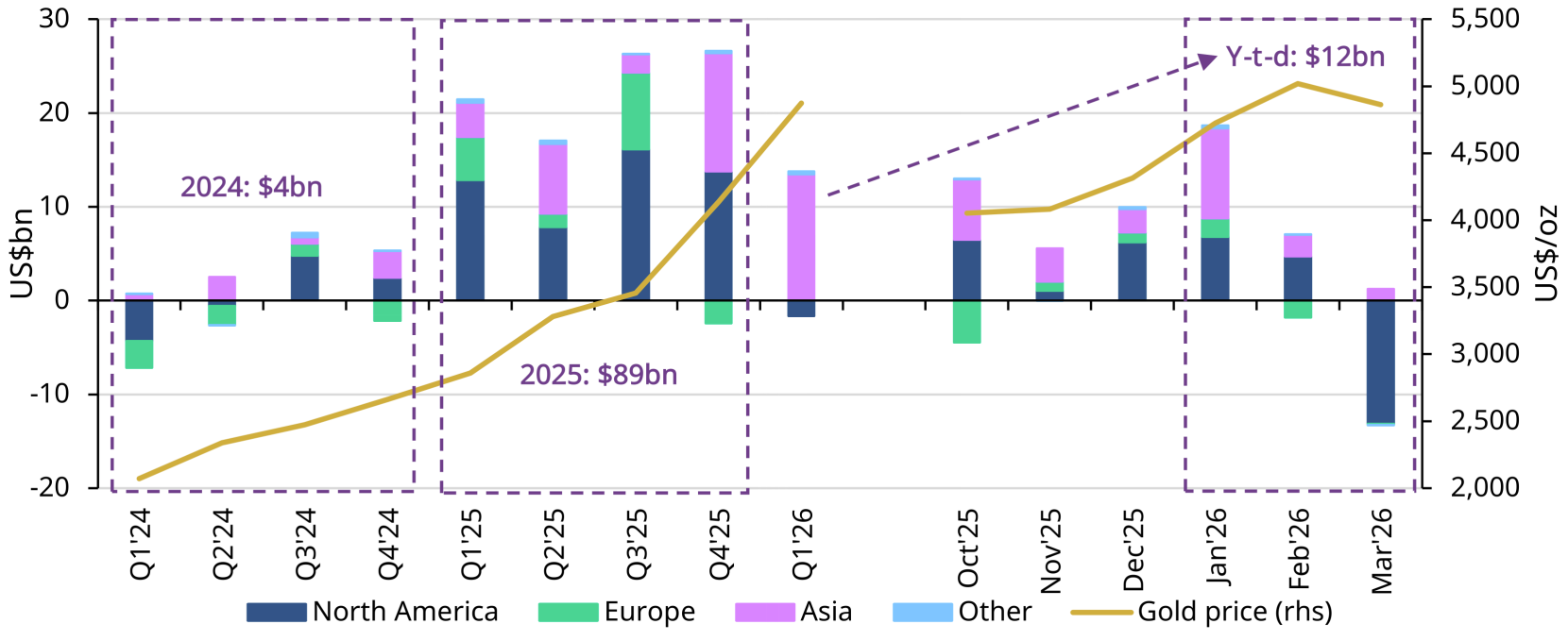
Hefty outflows of US$12bn in March, the largest monthly outflow on record, halved global inflows into physically backed gold ETFs in Q1. Prior to March, global gold ETFs were on track for their strongest quarter on record; nevertheless, the volatile start to the year still marked a seventh consecutive quarter of net inflows (Chart 1).

Holdings recorded their largest monthly decline since September 2022 in March, but still rose by 62t over Q1. Despite the pullback in the gold price, global gold ETFs ended the quarter with US$606bn in assets under management (AUM), 9% above FY25 levels. Notably, Asia posted its largest quarterly inflow on record, with positive flows in March helping to offset weakness elsewhere.

Chart 1: March interrupted, but did not derail, a seven-quarter run of inflows

Global gold ETF flows by region and average gold price*

*As of 31 March 2026. Gold price based on the quarterly and monthly average LBMA Gold Price PM in USD.
Source: Bloomberg, Company Filings, ICE Benchmark Administration, World Gold Council

Regional overview

North America recorded sizeable outflows of US$13bn in March, ending a nine-month streak of inflows. Selling pressure persisted throughout the month and marked the largest monthly outflow on record, leaving North America as the only region to post net outflows in Q1. 

Several drivers that previously supported inflows reversed course in March and became key contributors to regional weakness:

  • Broader risk‑off conditions, triggered by Operation Epic Fury2, weighed on most asset classes – except oil – and likely prompted US investors to raise liquidity by selling prior winners such as gold
  • Commodity Trading Advisors (CTAs) entered mid-March with elevated long positioning and appear to have amplified the downside price momentum, forcing weaker hands to capitulate3
  • Opportunity costs rose as the US dollar and interest rates moved higher, while rate expectations shifted materially from potential cuts in 2026 to rates now expected to remain unchanged through September 20274, adding uncertainty and weighing on gold demand. 

As noted last month, North America has experienced only two other periods with at least nine consecutive months of inflows – during the Global Financial Crisis (GFC) and the COVID‑19 pandemic. In both cases, the streaks were followed by sharp reversals. Notably, the fourth-, fifth- and sixth‑largest monthly outflows on record all occurred during the COVID‑19 period, between November 2020 and March 2021.

Even so, flows recovered quickly, with the region adding US$8bn over the subsequent 12 months. A similar pattern followed the GFC, when the end of the inflow streak was followed by US$16bn of net inflows over the next year, including inflows in nine of those months.

European funds saw US$154mn of outflows in March, reducing the region’s Q1 inflows to US$27mn. Germany, Italy and France led monthly selling. Flows closely tracked gold price movements: sizable outflows dominated the second half of March as prices fell, while modest inflows re‑emerged toward month‑end alongside a price rebound.

At the same time, inflation concerns linked to geopolitical tensions in the Middle East led the European Central Bank to hold rates steady in March while signalling a willingness to hike should inflation accelerate.5 Rising inflationary pressures and a more hawkish policy stance pushed regional yields higher, increasing local investors’ opportunity costs of holding gold. Meanwhile, the euro’s depreciation against the dollar exacerbated losses in FX‑hedged products, particularly in Switzerland, further weighing on regional flows.

Asian gold ETFs added US$2bn in March, marking a seventh consecutive month of inflows and lifting Q1 inflows to US$14bn, the strongest quarter on record. China led monthly additions, driven by heightened safe‑haven demand amid geopolitical risks, falling local equity markets, and a weaker currency. China also accounted for the bulk of regional inflows in Q1 (US$8bn). 

Elsewhere, dip‑buying activity supported inflows across the region. Indian investors continued to increase gold ETF allocations as well6, adding US$177mn in March and bringing Q1 inflows to US$3bn.

Funds in other regions recorded modest outflows of US$27mn – trimming Q1 inflows to US$285mn – largely driven by Australia. Despite heightened gold price volatility, Australian and South African holdings remained relatively resilient, with only minimal outflows during the month.


Gold ETF flows

Data as of

Demand captures changes in global/regional gold holdings; fund flows capture the net amount of money (in USD) that comes in or out of gold ETFs globally/regionally. See methodology note.

Gold market activity rose

Global gold market trading volumes7 rebounded in March, averaging US$525bn, 11% higher m/m. Despite the sharp price pullback during the month, liquidity remained ample across all market segments. Over‑the‑counter (OTC) trading activity rose 13% to US$272bn per day, well above the 2025 average of US$180bn. Exchange volumes also increased, up 10% to US$238bn per day, with activity rising on COMEX while volumes on the Shanghai Futures Exchange moderated. Meanwhile, despite a 10% m/m decline, global gold ETF liquidity remained robust at US$15bn per day, more than double the 2025 average.

In tonnage terms, trading activity painted a similar picture. OTC volumes rose 17% to 1,749t, while trading in exchanges increased 14% to 1,530t per day. Global gold ETF trading volumes recorded a 13% m/m decline, but overall market liquidity remained deep and resilient.

Positioning data showed a modest reduction in total COMEX net longs, which fell 1% over the month to 500t.8 Intra-month managed money positions declined sharply, shedding 40t during the third week of March, coinciding with the steep price correction. At the same time, non‑reportable positions, often associated with retail activity, also contributed to the sell‑off, recording a cumulative net reduction of 18t over the first three weeks of the month.

Chart 2: Gold volumes rebound in March amid gold’s price correction

Average daily trading volumes by segment*
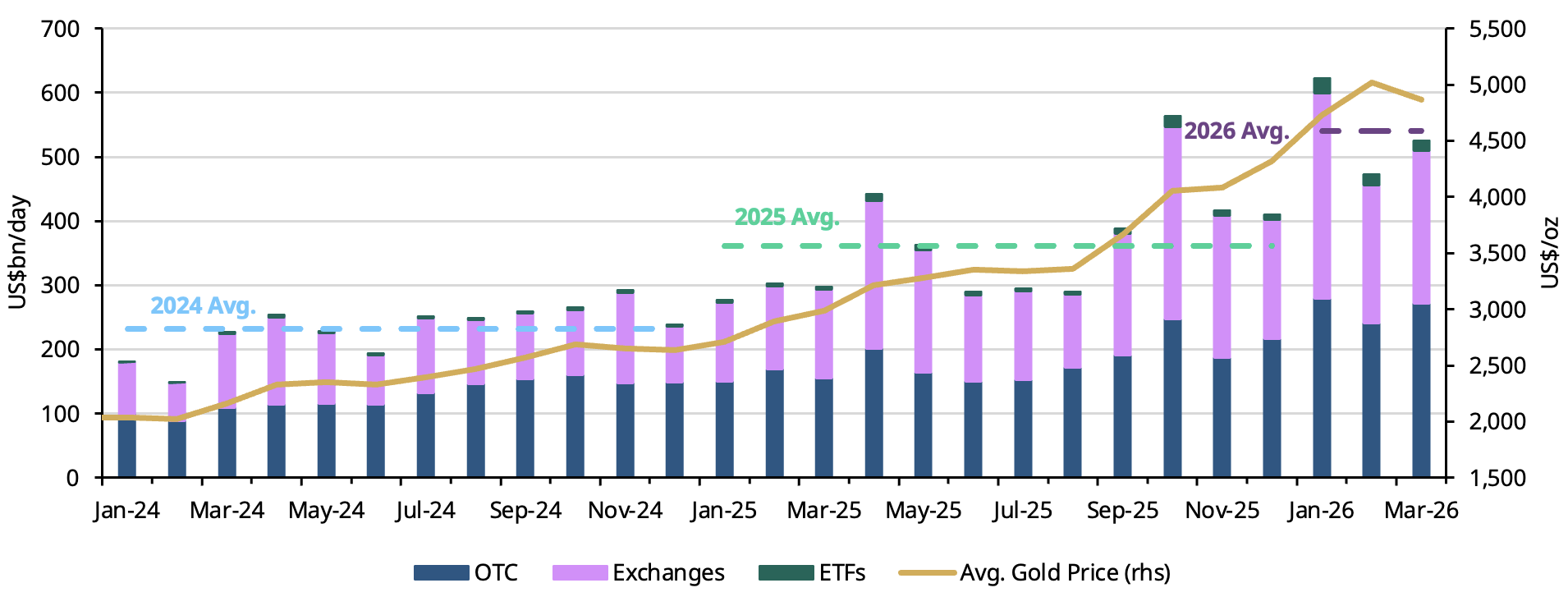
chart 2

*Data as of 31 March 2026. Gold price based on the monthly average LBMA PM Gold Price USD.
For more information on trading volumes please visit our Trading Volumes page on Goldhub: Gold Trading Volume | Gold Daily Volume | World Gold Council.
Source: Bloomberg, Nasdaq, COMEX, ICE Benchmark Administration, Shanghai Gold Exchange, Shanghai Futures Exchange, ETF providers, Multi Commodity Exchange of India, Dubai Gold & Commodities Exchange, Japan Exchange Group, Thailand Futures Exchange, Borsa Istanbul, Bursa Malaysia, Korea Exchange, World Gold Council

Footnotes

  1. We define gold ETFs as regulated securities that hold gold in physical form. These include open-ended funds traded on regulated exchanges and other regulated products such as closed-end funds and mutual funds. A complete list is included in the gold ETF section of Goldhub.com.

  2. U.S. military operation (Operation Epic Fury) launched February 28, 2026, against Iranian targets | US Central Command.

  3. Gold Market Commentary | World Gold Council | 8 April 2026.

  4. FedWatch - CME Group | Rate expectations as of 5 April 2026.

  5. Monetary policy decisions | European Central Bank | 19 March 2026.

  6. India launched an additional fund in March, bringing the total number of Indian gold ETFs to 26. For a full list of gold ETFs that we track, please visit: Gold ETF: Stock, Holdings and Flows. 

  7. Due to LBMA trading volume data availability, our full trading volume dataset dates back to 2019.

  8. Based on CFTC positioning report as of 31 March 2026. 

Disclaimer [+]Disclaimer [-]