Gold in Pension Funds: Case studies
1 October, 2026
Executive summary
Gold has received increased attention from some pension funds as they reassess portfolio construction against a backdrop of geopolitical tensions, inflation shocks and a less reliable equity-bond correlation.
Although discussion of gold allocations can sometimes be presented in theoretical terms, this note cites a number of pension funds globally that already allocate to gold. For those that do, the rationale is not typically framed as a simple directional view on the gold price. Rather, they consider gold in the context of broader portfolio challenges and objectives, including funded status, diversification in periods of market stress, inflation risk, liquidity, and the potential to affect risk-adjusted returns at the total portfolio level.
This note presents selected pension fund case studies describing how gold has been implemented in practice. The aim is not to suggest that all pension funds should hold the same allocation, nor that gold serves the same role in every portfolio. Instead, the case studies illustrate how pension funds have integrated gold in different ways, depending on governance structure, risk budget, funding position and investment philosophy.
Why do pension funds invest in gold?
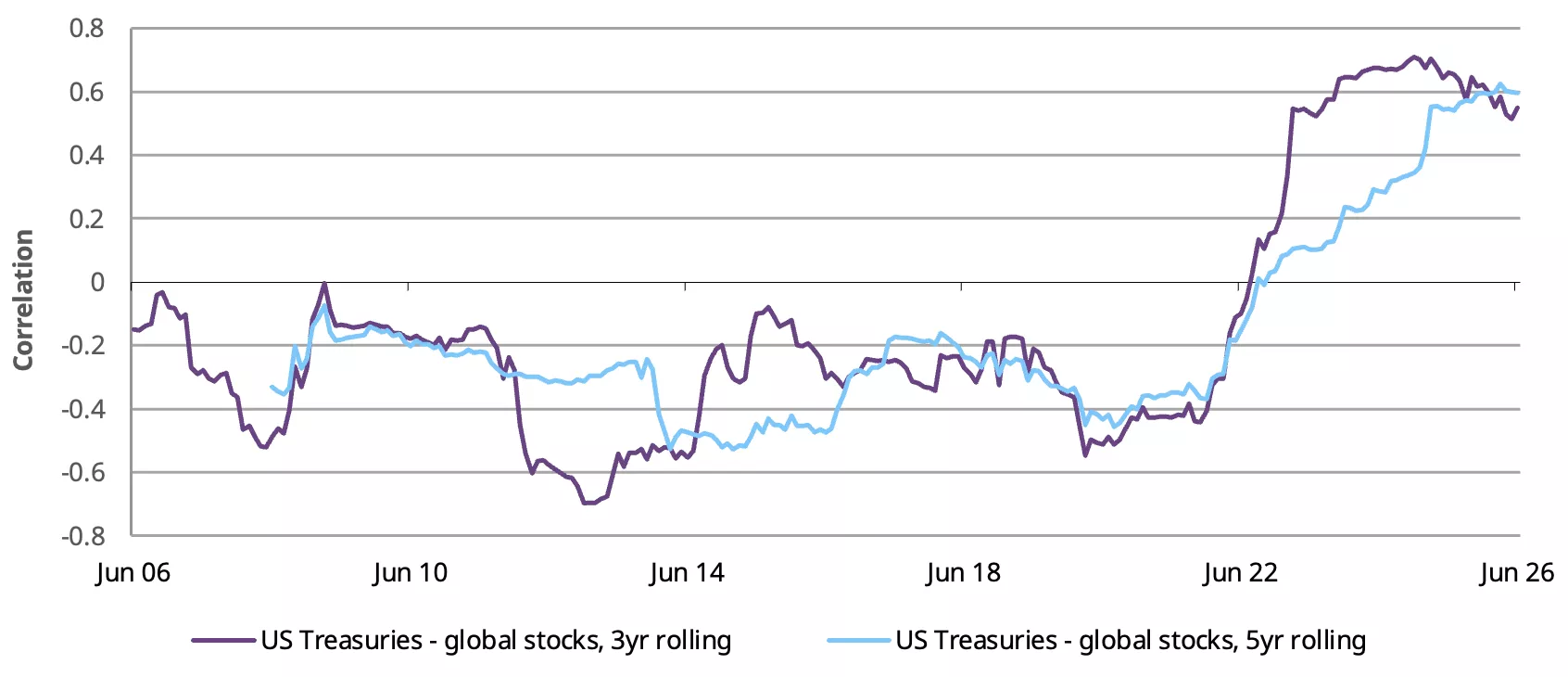
Faced with ongoing geopolitical risks and an uncertain economic backdrop, effective diversification and risk mitigation remain important considerations for pension fund investors. High quality government bonds have long fulfilled the traditional role of a diversifier in investment portfolios, offering protection during periods when risk assets have come under pressure. In recent years, however, the correlation between bonds and equities has increased significantly, raising questions about how investors should approach diversification and portfolio construction (Charts 1 & 2).
Charts 1 & 2: Gold, a more consistent diversifier
Chart 1: US Treasuries remain positively correlated to equities since the switch in ‘22
3yr and 5yr rolling correlation*
*Monthly data from 30 June 2006 to 30 June 2026.
Source: Bloomberg, World Gold Council
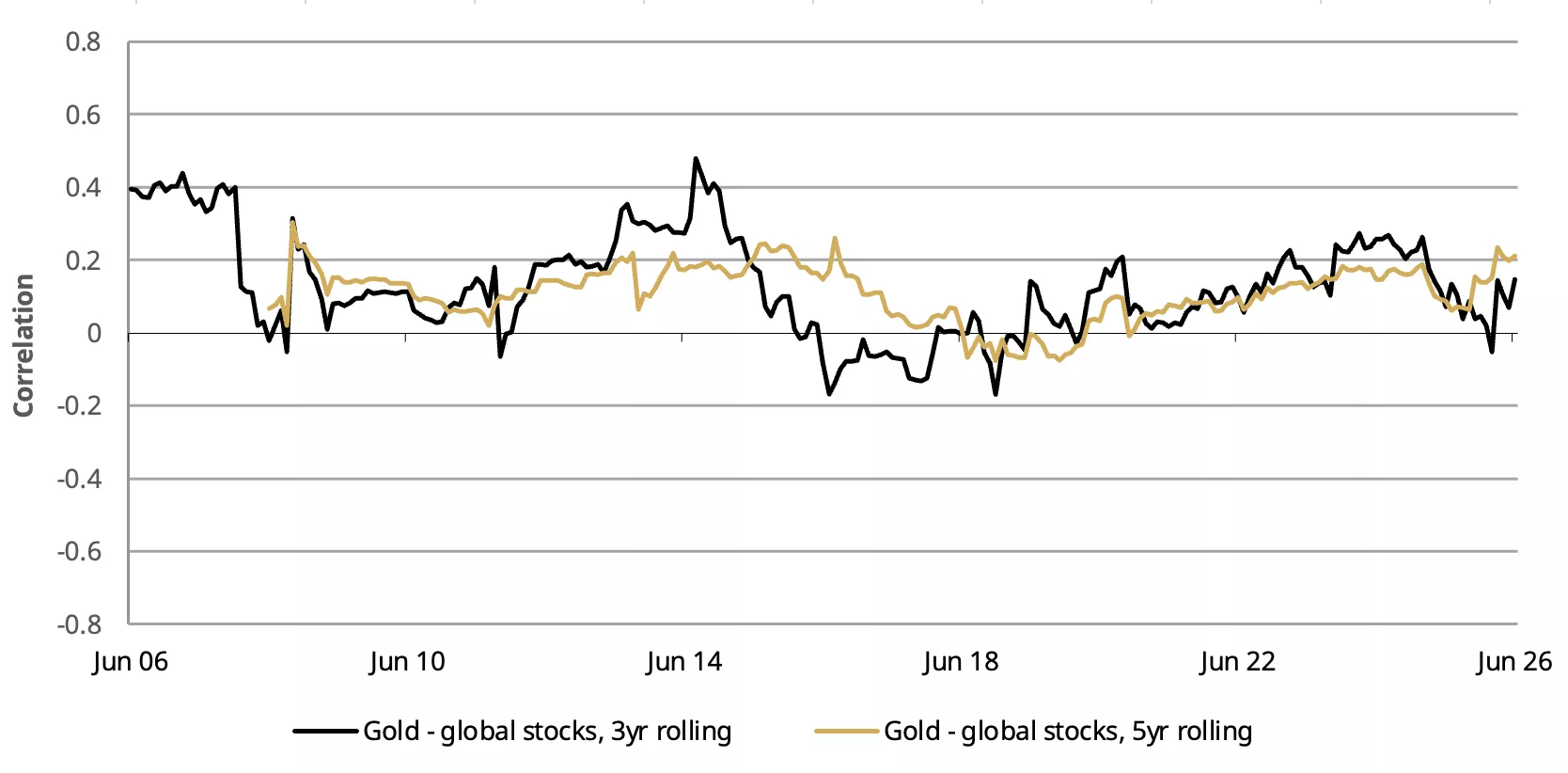
Chart 2: Gold’s correlation profile continues to be more stable
3yr and 5yr rolling correlation*
*Monthly data from 30 June 2006 to 30 June 2026.
Source: Bloomberg, World Gold Council
Assets that may be of value across a range of macroeconomic environments – rather than government bonds alone – have therefore drawn increased attention. Gold is one asset that certain pension funds consider alongside equities and bonds in broad-based portfolios. As a liquid asset with historically low-to-negative correlation to equities during periods of market stress (Chart 3), gold has exhibited correlation patterns that support diversification.
Chart 3: Gold becomes more negatively correlated with stocks in extreme market selloffs
Correlation between gold, US Treasuries and US stocks in various environments of stocks’ performance*
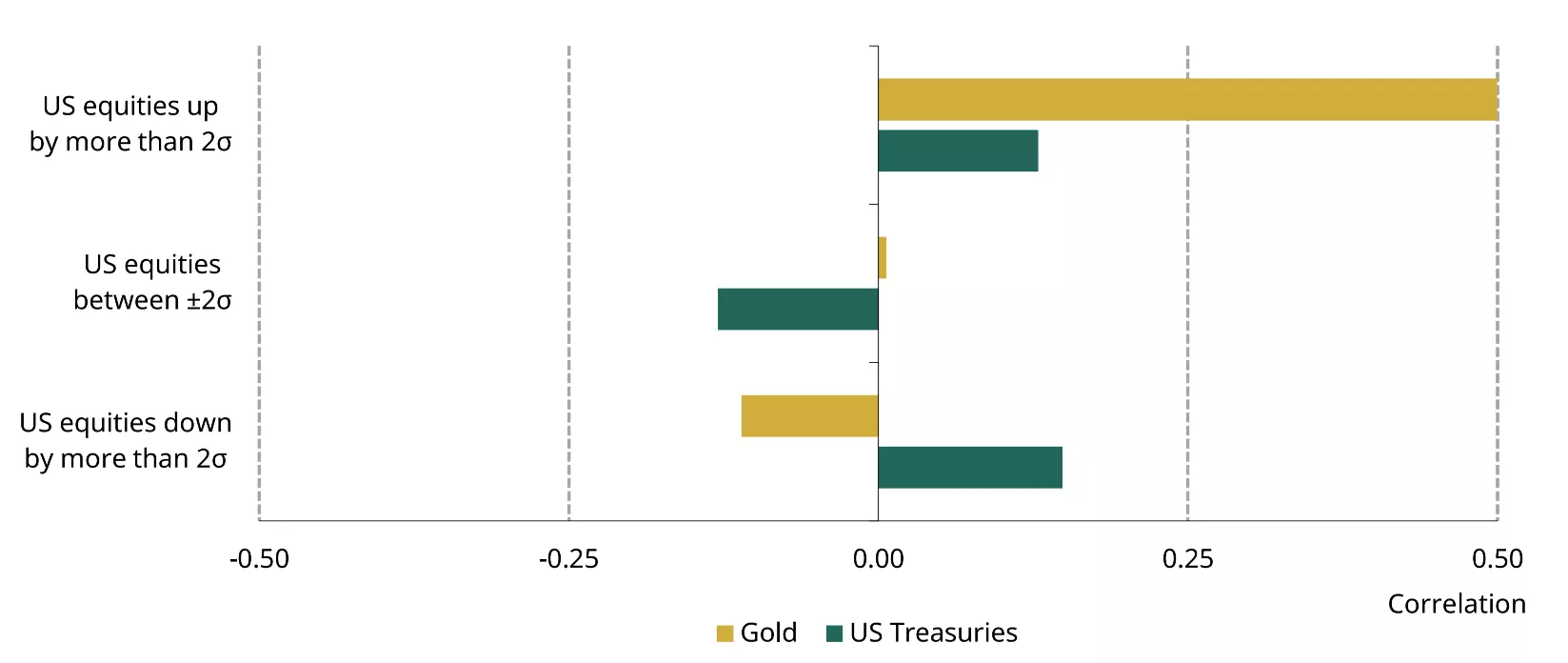
*As of 30 June 2026. Correlations based on weekly returns in US dollars for ‘stocks’: S&P 500 Index; ‘US Treasuries’: Bloomberg Barclays US Treasury Index, and ‘gold’: LBMA Gold Price PM since January 1994 due to availability of US Treasury data. The top bar corresponds to the respective correlations when the S&P 500 weekly returns rise by more than two standard deviations. The middle bar corresponds to the respective correlations when the S&P 500 weekly returns are between two standard deviations (or ‘σ’), while the bottom bar corresponds to the respective correlation when the S&P 500 weekly returns fall by more than two standard deviations. The standard deviation for the S&P 500 is calculated using weekly returns over the full period.
Source: Bloomberg, ICE Benchmark Administration, World Gold Council
Gold also enters consideration for some pension fund managers as they reassess portfolio resilience in a world shaped by inflation volatility and shocks. Gold is often discussed as a potential inflation hedge, although the extent to which it performs that role can depend on the period examined and the measure used.
Chart 4: Gold historically rallies in periods of high inflation
Gold nominal and real returns in US dollars as a function of annual inflation*
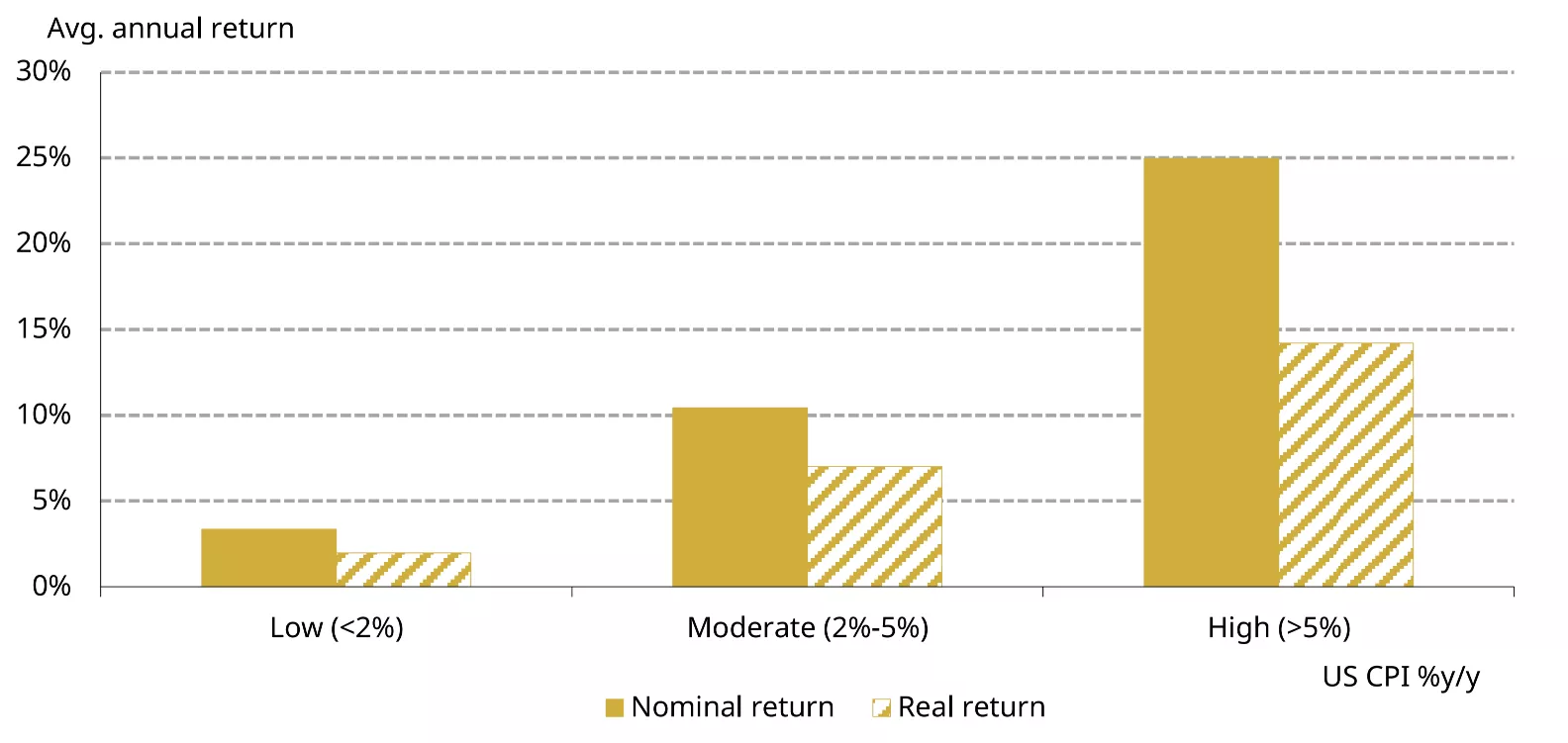
*As of 30 June 2026. Based on y/y changes in US dollars for ‘gold’: LBMA Gold Price PM, and ‘inflation’: US CPI since January 1971. Over that period there have been 13 instances of low inflation, 30 of moderate inflation and 11 of high inflation.
Source: Bloomberg, ICE Benchmark Administration, World Gold Council
Case studies
Pensioenfonds PDN (The Netherlands)
Pensioenfonds PDN (€7.7bn in assets) is managed by DPS – an integral service provider dedicated to pension funds.1
According to DPS, the investment in gold – which began in October 2020 and concluded with a final purchase in April 2021 in order to reach a 5% target – followed an asset and liability management study in 2020 in which diversification benefits and the potential to reduce portfolio risk were identified. DPS stated that the study also indicated lower expected portfolio risk without a reduction in expected return.
The study was undertaken during a period in which nominal interest rates on German government bonds had fallen to negative levels, including at longer maturities. According to DPS this raised questions about the role of such investments in the portfolio. The study also identified inflation as a concern in light of policy responses to the pandemic, including rising debt levels and money supply.
Against that backdrop, the Pensioenfonds PDN board funded an investment in a physical allocation to gold by a 10% reduction in the fund’s exposure to government bonds: half of the proceeds were allocated to gold and the remainder to equities, real estate and infrastructure.
Fairfax County Employee Retirement Systems (US)
With some US$6.2bn in assets, the Fairfax County Retirement Systems follow a risk-balanced investment approach to achieving their return objectives. In other words, the funds seek to broadly diversify risk exposure within their investment portfolios in order to deliver as smooth a return pattern as possible through the course of the business and economic cycle. Accordingly, the three Fairfax County Retirement Systems, in general, have less exposure to equities than traditional “60/40 balanced” funds and peers, in favour of greater exposure to other diversifying asset classes.
Through capital-efficient portfolio construction techniques, the funds’ asset allocation policy commonly exceeds 100 percent. Within that portfolio structure, the gold allocation (3%), which is part of the real asset exposure, is unfunded and attained through futures, allowing the remainder of the portfolio to stay invested in growth assets in pursuit of the required return.2
According to the funds, the investment in gold – initiated in 2020 – was undertaken in response to the pandemic and the associated monetary stimulus, which heightened concerns about inflation. The funds continues to describe the gold allocation as serving an inflation-hedging role, but also describes gold’s negative correlation to risk assets during periods of stress as providing additional diversification within the portfolio.
Now Pensions Master Trust (UK)
With more than 2.5 million members and over £8 billion in assets under management, Now: Pensions Master Trust made its first investment into gold in April 2021.
The fund’s investment philosophy is underpinned by three ‘Rs’ that they believe are important to their members: return, risk, and real-world impact.
To meet their criteria for return and risk they manage a portfolio that is heavily invested in growth-oriented assets while retaining diversification for adverse market environments. In that context, the investment in gold is described as providing diversification relative to a portfolio that is predominantly invested in listed equities and fixed income.
At around 2% of total assets, the investment in gold is accessed through futures within the alternatives sleeve of the Now Pensions growth fund. Overall, the fund indicates that it has 10% in alternatives, including gold, industrial metals, carbon credits and high yield.
NGS Super (Australia)
NGS Super was established in 1988 and has grown to become a leading industry super fund for education and community-based professionals.
NGS states that its priority is building resilient portfolios that can navigate different market environments, such as heightened volatility and equity downturns. And to mitigate downside risk, it employs a multi-asset strategy that balances equities with defensive exposures such as government bonds, alternative assets and gold.
NGS has maintained an allocation to gold (currently 3%) since June 2020 as gold has historically performed well during periods of market uncertainty but also during periods of inflation and currency debasement.
Conclusion
These case studies vary by region, size and implementation methodology. They show that pension funds incorporate gold in different ways: as a dedicated strategic allocation, within an inflation-sensitive or real-assets bucket, or through futures-based implementation.
These case studies are not intended to suggest a single preferred allocation size or implementation approach. Rather, they explain why gold can be viewed as a pension-friendly asset and illustrate how certain pension funds have allocated to gold based on their own portfolio objectives, governance frameworks and investment approaches.
Disclaimer
Important information and disclaimers
© 2026 World Gold Council. All rights reserved. World Gold Council and the Circle device are trademarks of the World Gold Council or its affiliates.
All references to LBMA Gold Price are used with the permission of ICE Benchmark Administration Limited and have been provided for informational purposes only. ICE Benchmark Administration Limited accepts no liability or responsibility for the accuracy of the prices or the underlying product to which the prices may be referenced. Other content is the intellectual property of the respective third party and all rights are reserved to them.
Reproduction or redistribution of any of this information is expressly prohibited without the prior written consent of World Gold Council or the appropriate copyright owners, except as specifically provided below. Information and statistics are copyright © and/or other intellectual property of the World Gold Council or its affiliates or third-party providers identified herein. All rights of the respective owners are reserved.
The use of the statistics in this information is permitted for the purposes of review and commentary (including media commentary) in line with fair industry practice, subject to the following two pre-conditions: (i) only limited extracts of data or analysis be used; and (ii) any and all use of these statistics is accompanied by a citation to World Gold Council and, where appropriate, to Metals Focus or other identified copyright owners as their source. World Gold Council is affiliated with Metals Focus.
The World Gold Council and its affiliates do not guarantee the accuracy or completeness of any information nor accept responsibility for any losses or damages arising directly or indirectly from the use of this information.
This information is for educational purposes only and by receiving this information, you agree with its intended purpose. Nothing contained herein is intended to constitute a recommendation, investment advice, or offer for the purchase or sale of gold, any gold-related products or services or any other products, services, securities or financial instruments (collectively, “Services”). This information does not take into account any investment objectives, financial situation or particular needs of any particular person.
Diversification does not guarantee any investment returns and does not eliminate the risk of loss. Past performance is not necessarily indicative of future results. The resulting performance of any investment outcomes that can be generated through allocation to gold are hypothetical in nature, may not reflect actual investment results and are not guarantees of future results. The World Gold Council and its affiliates do not guarantee or warranty any calculations and models used in any hypothetical portfolios or any outcomes resulting from any such use. Investors should discuss their individual circumstances with their appropriate investment professionals before making any decision regarding any Services or investments.
This information may contain forward-looking statements, such as statements which use the words “believes”, “expects”, “may”, or “suggests”, or similar terminology, which are based on current expectations and are subject to change. Forward-looking statements involve a number of risks and uncertainties. There can be no assurance that any forward-looking statements will be achieved. World Gold Council and its affiliates assume no responsibility for updating any forward-looking statements.
Information regarding the LBMA Gold Price
The LBMA Gold Price is used by the World Gold Council with permission under license by ICE Benchmark Administration Limited and is subject to the restrictions set forth here (www.gold.org/terms-and-conditions).
Information regarding QaurumSM and the Gold Valuation Framework
Note that the resulting performance of various investment outcomes that can be generated through use of Qaurum, the Gold Valuation Framework and other information are hypothetical in nature, may not reflect actual investment results and are not guarantees of future results. Neither World Gold Council (including its affiliates) nor Oxford Economics provides any warranty or guarantee regarding the functionality of the tool, including without limitation any projections, estimates or calculations.
Information from ICRA Analytics Limited
All information obtained from ICRA Analytics Limited contained in this document is subject to the disclaimer set forth here (www.icraanalytics.com/terms-of-use/disclaimer).