Gold ETFs and similar*

Data XLSXReport PDF

Published 6th September 2018

*A detailed explanation can be found in the notes section at the bottom of this page.

Monthly flows


Source: Bloomberg; Company Filings; ICE Benchmark Administration; World Gold Council

Outflows in gold-backed ETFs continued despite marginal growth in Europe and Asia

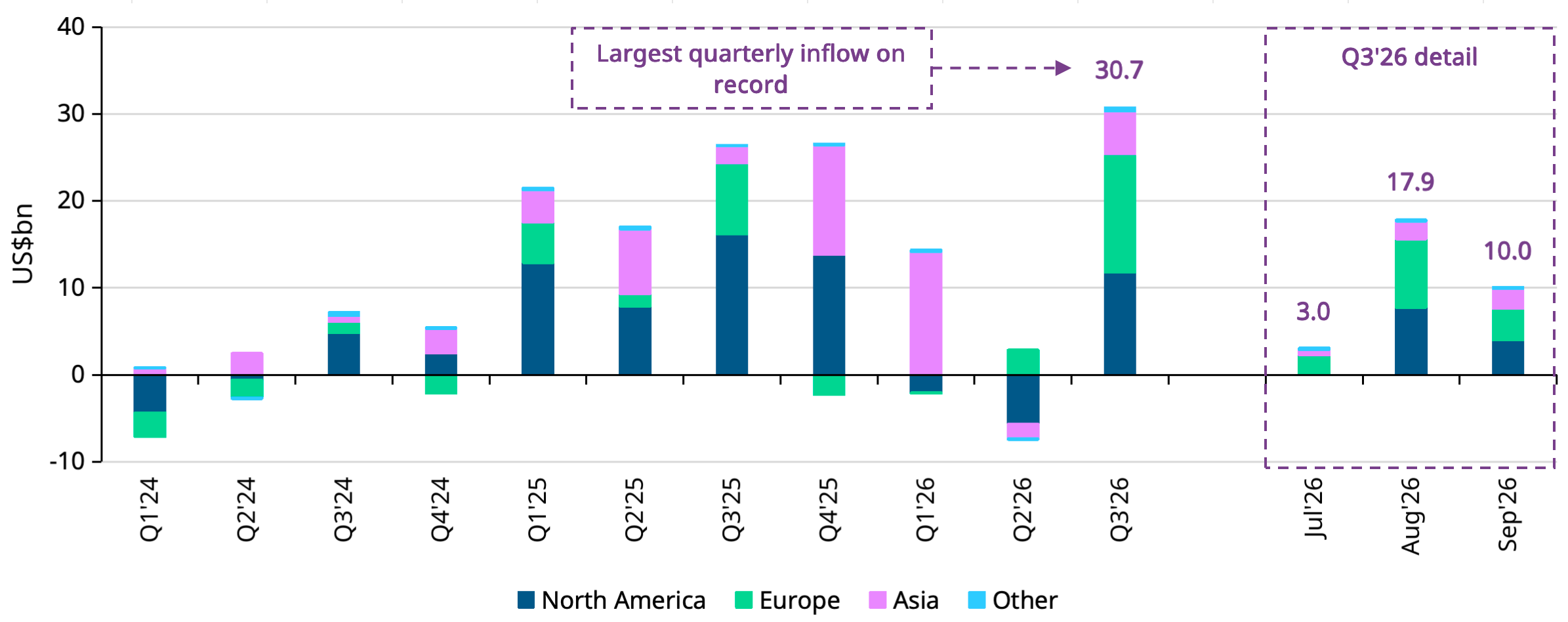
Holdings in global gold-backed ETFs and similar products fell by 40t to 2,353t in August – the third consecutive month – pushing assets under management (US$ AUM) down 3% relative to July.

Funds listed in China saw net gains as investors hedged trade risks and currency weakness. Flows in Europe were mostly flat. Global outflows were led by North American funds, which lost US$1.65bn, driven by a combination of momentum – as the US dollar gold price fell by more than 2% for the month – and a risk-on appetite by US investors in the face of an expanding economy. Funds in South Africa and Turkey suffered losses as the rand and lira depreciated sharply. In Turkey, anecdotal evidence suggests that investors have been using gold as a source of liquidity, and we believe South African investors may have acted similarly.

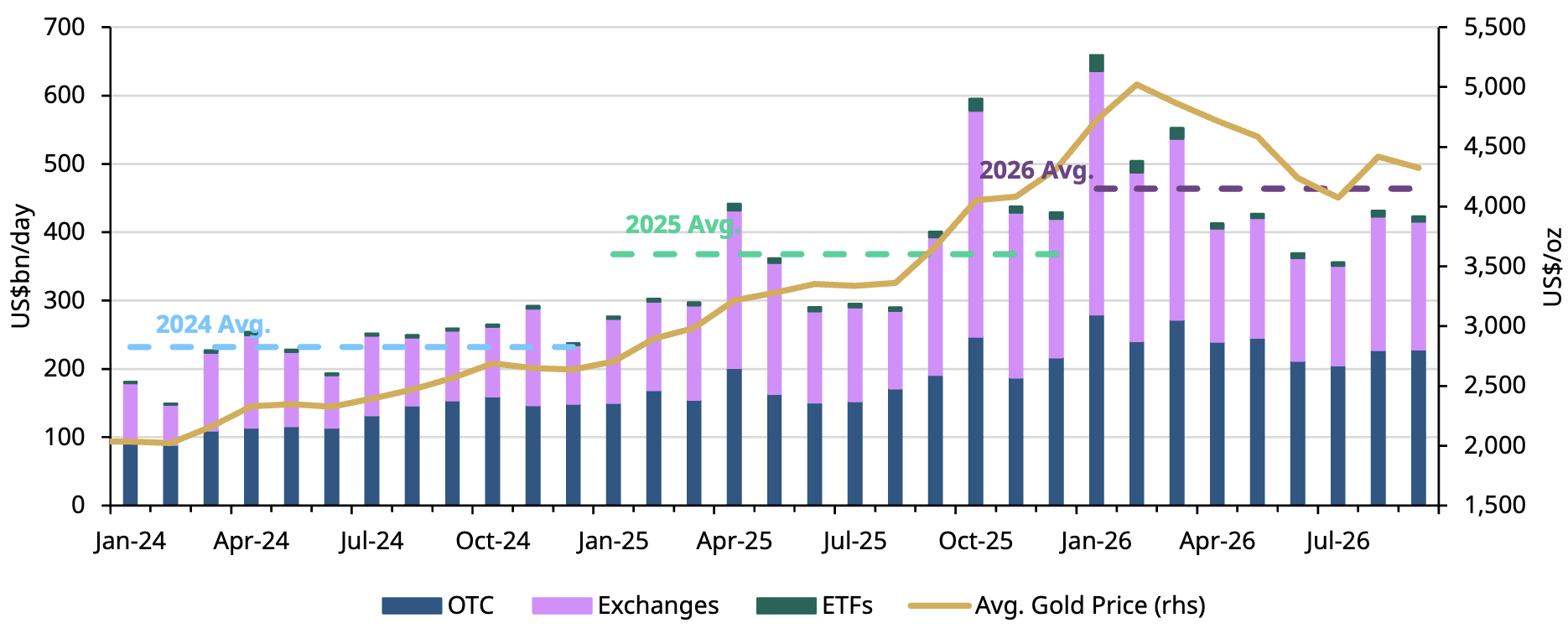
Recent reports of COMEX futures show extreme short positioning as gold’s pullback generated additional selling pressure from money managers. Money managers’ net longs have not been this negative since data became available in 2006, and non-commercial non-reporting net longs turned negative earlier this month for the first time since 2001. But such negative positioning has historically preceded rallies in the price of gold, as we discussed in detail in our recent note Gold recoils amid selloff but may rebound.


‘Global Inflows’ refers to the sum of changes of all funds that saw a net increase in ounces held over a given period (eg, month, quarter, etc.). Conversely, ‘global outflows’ aggregates changes from funds that saw ounces decline over the same period. See further notes and definitions at the bottom of this page.
Source: Bloomberg; Company Filings; World Gold Council

Regional flows

Growth in China and Europe could not offset North American net outflows

  • North American funds saw outflows of 44t (US$1.65bn, 3.6% AUM)
  • Holdings in European funds grew by 4t (US$167mn, 0.4%)
  • Funds listed in Asia increased by 2t (US$24mn, 0.7%)
  • Other regions saw a reduction in holdings of 2t (US$50mn, 3.9%)

Top 10 flows


Changes in tonnes for some of the funds are not directly measured but estimated. This may result in a change in the direction between tonnes and flows when these are small due to variations in FX between the timing of the fund's NAV and gold price benchmark.
Source: Bloomberg; Company Filings; World Gold Council

Bottom 10 flows


Changes in tonnes for some of the funds are not directly measured but estimated. This may result in a change in the direction between tonnes and flows when these are small due to variations in FX between the timing of the fund's NAV and gold price benchmark.
Source: Bloomberg; Company Filings; World gold Council

Individual flows

GLD® led global outflows but there was growth in other funds across the region

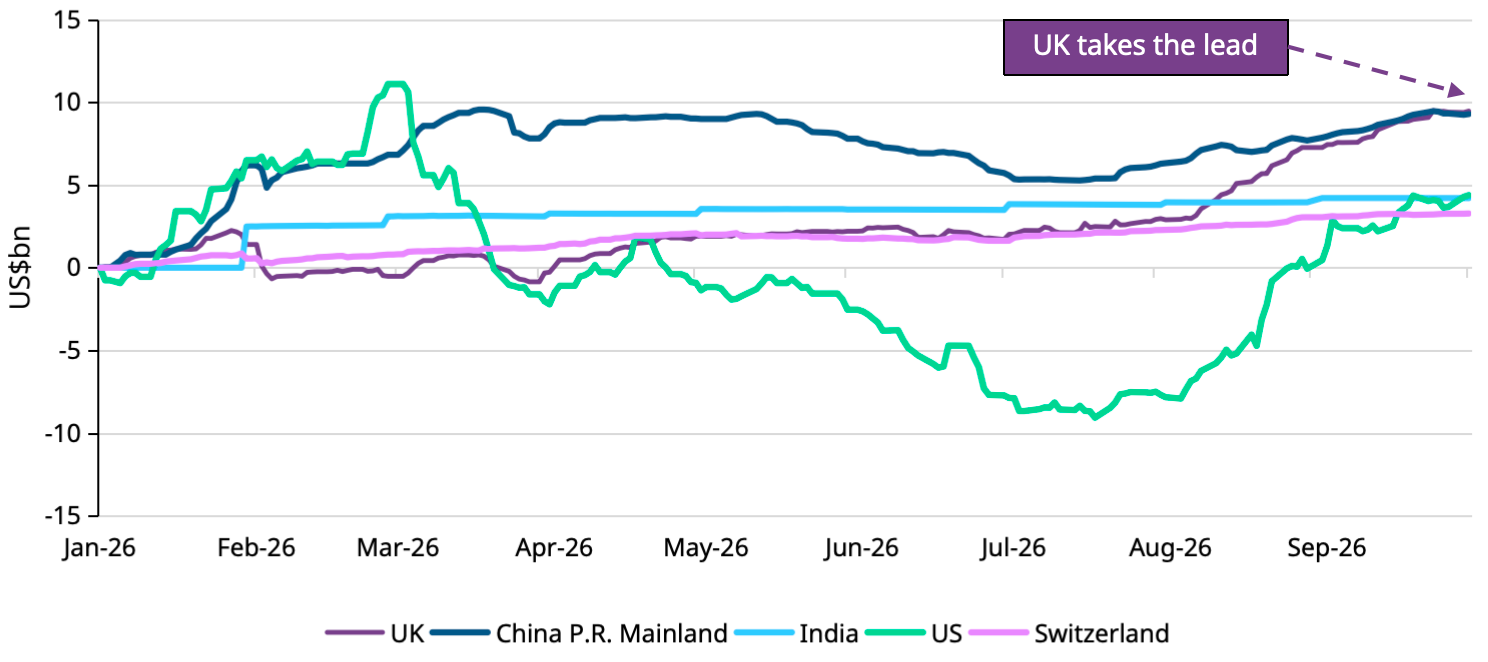
  • SPDR® Gold Shares (GLD®) continues to have significant outflows US$1.7bn or 6% of assets
  • In China, Bosera Gold led inflows globally, adding 5t (US$191mn, 19%); also in China, Huaan Yifu lost 4t (US$166mn, 22%)
  • Xtrackers in Germany and ETF Physical Gold in the UK grew by 3t and 2t, respectively
  • South Africa’s NewGold lost 6% of assets as the rand fell approximately 12% vs the US dollar
  • Turkey’s largest gold-backed ETF, Istanbul Gold, lost 6% of its assets in the face of significant currency volatility: the Turkish lira fell more than 33% during the month

Year-to-date flows

Global flows are now negative despite growth in Europe and Asia

  • A stronger US dollar over the past two quarters and a declining US dollar gold price have weighed on ETF holdings; global AUM is lower on the year by 18.5t (US$530mn, 0.6%)
  • European funds continue to lead the way, adding US$2.3bn (5.7% AUM) to their holdings
  • Asian funds have seen an impressive percentage increase, growing by 9.1% y-t-d
  • North American flows have been negative for four straight months, as the price of gold fell, with US$2.8bn (6.1% AUM) coming out during the year

Fund flows


Source: Bloomberg; Company Filings; ICE Benchmark Administration; World Gold Council

Assets Under Management


Source: Bloomberg; Company Filings; ICE Benchmark Administration; World Gold Council

Notes, definitions and methodology

Notes

Gold-backed ETFs and similar products account for a significant part of the gold market, with institutional and individual investors using them to implement many of their investment strategies. The data on this page tracks gold held in physical form by open-ended ETFs and other products such as close-end funds, and mutual funds. Most funds included in this list are fully backed by physical gold. While a few funds allow other holdings such as cash or derivatives, we only monitor those investing at least 90% through physical gold and appropriately adjust their reported assets to estimate physical holdings only. Similarly, the data only estimates the corresponding gold holdings of ETFs that include other precious metals For funds that include physical holdings of multiple precious metals, the data estimates only the corresponding gold holdings contained within them. A complete list of the gold-backed ETFs and similar products we track is included in the Data XLSX download above.

Definitions

Flows represent net creations or redemptions of shares of open-ended ETFs, or changes to the physical gold holdings that back shares of closed-end funds or similar products over a given period. ETF flows in tonnes measure demand for gold during a given period and generate the quarterly demand estimates reported in Gold Demand Trends. ETF flows in US dollars estimate the monetary value of gold demand for a given period, taking into account daily fluctuations in the price of gold.

Holdings correspond to the total assets under management (AUM) of gold-backed ETFs and similar products, measured in either tonnes or US dollars. Where tonnage holdings are not directly reported, we calculate these by dividing the US dollar value of AUM by the LBMA Gold Price per tonne – where one tonne is equivalent to 32,150.7466 Troy ounces.

Methodology

Download (pdf)

The file above describes in detail the methodology used to compute gold-backed ETF holdings and flows.

Disclaimer

This information is provided solely for general information and educational purposes. It is not, and should not be construed as, an offer to buy or sell, or as a solicitation of an offer to buy or sell, gold, any gold related products or any other products, securities or investments. It does not, and should not be construed as acting to, sponsor, advocate, endorse or promote gold, any gold related products or any other products, securities or investments.

This information does not purport to make any recommendations or provide any investment or other advice with respect to the purchase, sale or other disposition of gold, any gold related products or any other products, securities or investments, including without limitation, any advice to the effect that any gold related transaction is appropriate for any investment objective or financial situation of a prospective investor. A decision to invest in gold, any gold related products or any other products, securities or investments should not be made in reliance on any of this information. Before making any investment decision, prospective investors should seek advice from their financial advisers, take into account their individual financial needs and circumstances and carefully consider the risks associated with such investment decision.

While the accuracy of any information communicated herewith has been checked, neither the World Gold Council nor any of its affiliates can guarantee such accuracy. In no event will the World Gold Council or any of its affiliates be liable for any decision made or action taken in reliance on such information or for any consequential, special, punitive, incidental, indirect or similar damages arising from, related to or connected with such information, even if notified of the possibility of such damages.