|
|
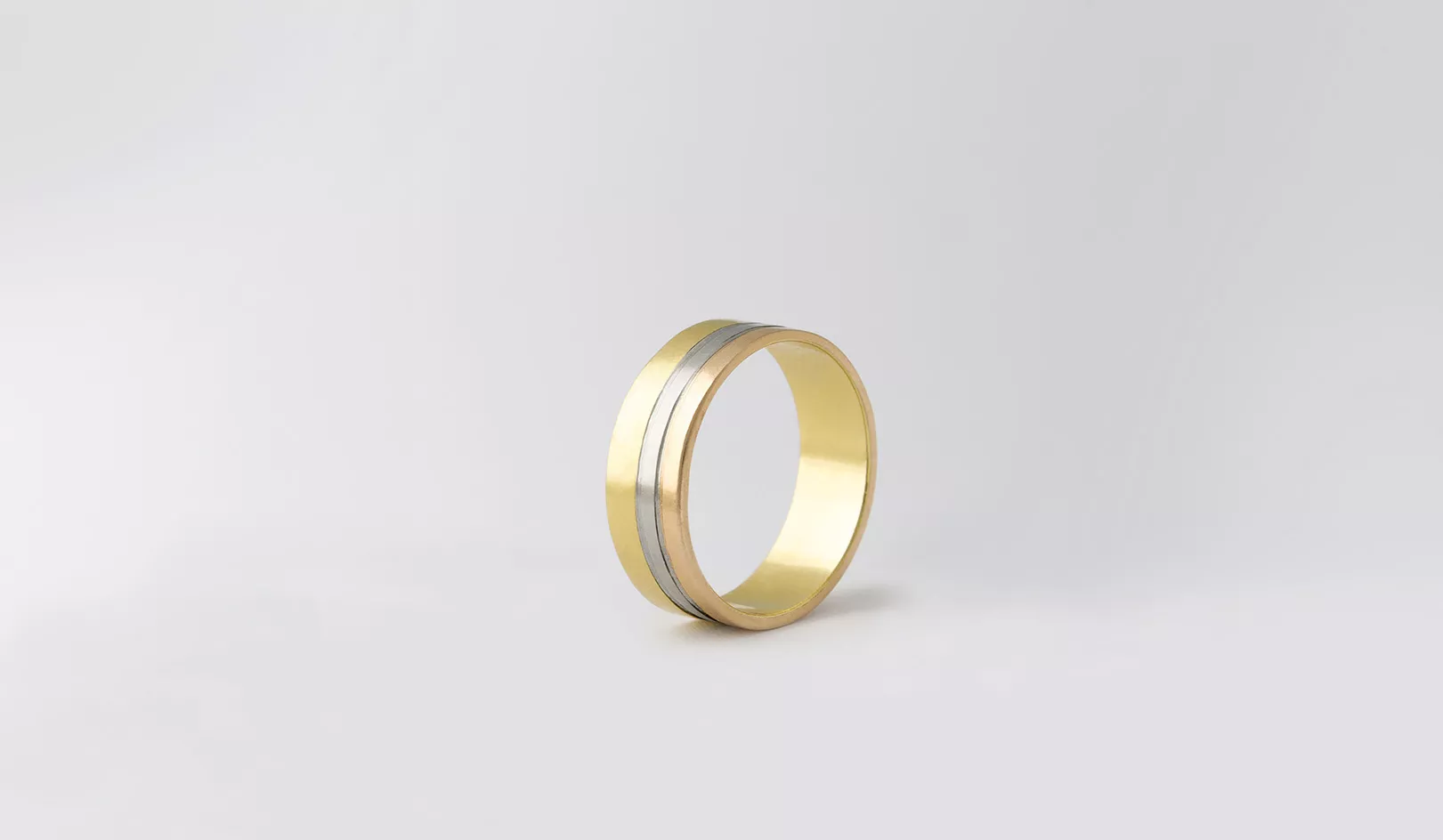
Gold Jewellery Alloys
Pure
(24 carat) gold is a deep yellow colour (an orange shade of
yellow) and is soft and very malleable. The coloured carat gold
alloys range in gold content from 8 to 22 carats (33.3% - 91.6%
gold) and can be obtained in a range of colour shades: green
(actually a green shade of yellow), pale yellow, yellow, deep
yellow, pink/rose and red. There are also white golds and even
unusual coloured golds such as 'purple gold'. They all have
different mechanical properties such as strength, hardness and
malleability (ductility) and some alloys can be heat treated
to maximise strength and hardness. There are gold alloys that
are optimised for different manufacturing routes such as lost
wax (investment) casting and stamping.
How can colour be varied and why do different gold alloys (an alloy is a mixture of two or more pure metals) have different mechanical and other properties? To answer these questions in depth requires a good technical knowledge of metallurgy. However, it is possible to give some simplified answers. The Coloured Carat GoldsAlmost all conventional, coloured carat golds are based on gold-silver-copper alloys, often with minor alloying additions. All three metals have the same crystal structure (face centred cubic, FCC) and so are compatible with each other over a large range of compositions. Typical minor additions include deoxidisers such as zinc and silicon, grain refiners such as iridium and cobalt and possibly metals such as nickel to strengthen the alloy. Larger zinc additions (about 1-2%) can improve melt fluidity and hence 'castability' in lost wax casting, as can silicon, resulting in better filling of the mould and better reproduction of surface detail. Even larger zinc additions (up to 10%) can improve malleability of certain carat golds, particularly 14 carat and lower, used for making jewellery by stamping from sheet. Additions of low melting point metals such as zinc, tin, cadmium and indium lower melting ranges and hence are used to make carat gold solders. ColourGold is yellow and copper is red, the only two coloured pure
metals. All other metals are white or grey in colour. The
addition of a red colour to yellow, as every school child
knows, makes the yellow pinker and eventually red. The addition
of a white makes the yellow colour paler and eventually white.
This principle of mixing colours is the same in carat golds.
Adding copper to gold makes it redder and adding silver, zinc
and any other metal makes gold paler. Thus, we can understand
that lower carat golds, because we can add more alloying metals,
can have a wider range of colours than the higher carat golds.
PropertiesAlloying additions affect other physical properties as seen in the next table: Physical Properties of Typical Gold Alloys
As caratage reduces, the melting range and alloy density are lowered. But at any given caratage (gold content), the actual values vary according to the relative silver and copper contents. As well as affecting physical properties, alloying additions to gold generally increase the strength and hardness, with some reduction in malleability / ductility. The silver atom is slightly larger than that of gold, so alloying gold with silver gives a moderate improvement in strength and hardness. The copper atom is significantly smaller than that of gold and so it has a greater effect on strengthening gold than silver, as it distorts the gold crystal lattice more. Thus reducing caratage from 24 carats through 22 ct and 21 ct down to 18 carat gold results in stronger and harder alloys, as can be seen in Table 3. Beyond 18 ct down to 10, 9 and 8 carats does not have much further effect. Mechanical Properties of Typical Gold Alloys
Table 3.2: Mechanical Properties of 18 Carat Golds
c.w. = cold worked However, copper-containing carat golds in the range of 8-18 carats can be hardened even further because of their metallurgy. Hard second phases can be precipitated out in the solid state as they cool below about 400°C, making the carat gold less ductile. Because of this, such alloys must be quenched in water after annealing to retain the single phase, ductile state if further working is required. This can be seen in the next table, Table 4.1 Effect of Cooling Rate on 18 Carat Golds after Annealing at 650°C
Special low temperature (ageing) heat treatments (typically 3-4 hours at 280 -300°C) can later be employed to give substantial hardening to such annealed and quenched alloys. This is known as age-hardening. In 18 ct red golds, the hardness can be doubled, as shown in Table 4.2! Effect of Heat Treatment on 18 Carat Alloys
As all goldsmiths know, working a metal makes it harder and stronger, as we can see in the previous tables, but if it is overworked, it will eventually fracture. So, they know that worked carat golds must be annealed to restore the soft ductile condition. Typical annealing temperatures for carat golds are given in the following table:
White goldsApart from copper, all other alloying metals to gold will tend to whiten the colour and so it is possible to make carat golds that are white in colour. White golds for jewellery were developed in the 1920's as a substitute for platinum. Additions of any white metal to gold will tend to bleach it's colour. In practice, nickel and palladium (and platinum) are strong 'bleachers ' of gold ; silver and zinc are moderate bleachers and all others are moderate to weak in effect. This has given rise to 2 basic classes of white golds - the Nickel whites and the Palladium whites. At the 9 carat (37.5% gold) level, a gold-silver alloy is quite white, ductile although soft and is used for jewellery purposes. White golds are available up to 21 carat. There is no legal definition of what constitutes a 'white' colour in golds and hence trade description of white gold may not mean 'detergent white'. Many commercial white golds are not a good white colour. Nickel white goldsNickel alloying additions form hard and strong white golds up to 18 carat. They are difficult to work and suffer from socalled 'firecracking'. Most commercial alloys are based on gold-nickel-silver-zinc alloys with copper often added to improve malleability. This copper addition, of course, affects colour, and so such white gold alloys are not a good white colour - more a slight yellow/ brown tint, particularly if nickel content is also low. As a consequence, such white gold jewellery is normally electroplated with rhodium (a platinum metal) which is tarnish resistant and imparts a good white colour. Unfortunately, many people, the female population especially, are allergic to nickel in contact with the skin and this gives rise to a red skin rash or irritation. The European Union countries have enacted legislation valid from the 20th January 2000 that limits nickel release from jewellery. Thus, in Europe, nickel white golds are being phased out and being replaced by palladium white golds. The USA is taking a more relaxed approach, requiring jewellery to be labelled as nickel-containing, and much jewellery in the West is now advertised as 'non-allergenic' or 'nickel-free'. [See Separate Information Sheet, "The European Directive on Nickel ." and the article in Gold Technology, No 28, Spring 2000, "Nickel gets under your skin"]. Some typical nickel white gold compositions are shown in Table 6 Typical Nickel White Golds
Palladium white goldsAdditions of about 10 -12% palladium to gold impart a good white colour. But palladium is an expensive metal, dearer than gold and it is also a heavy metal. Thus jewellery in such palladium white golds will be more expensive than identical pieces in nickel whites for 2 reasons: firstly, the cost of the palladium and secondly, the impact of density - palladium white golds are denser and so such jewellery will be heavier and also contain more gold. It is also more difficult to process as the melting temperatures are substantially higher. Many commercial palladium white golds only contain about 6-8% palladium plus silver, zinc and copper. Some may even contain some nickel [so a palladium white gold is not necessarily nickel-free]. These may also have less than a good white colour and so may also be rhodium plated. Palladium white golds tend to be softer and more ductile compared to nickel whites and so will not wear as well. They are available in all caratages up to 21 carat. It is not possible to have a 22 ct white gold, for example. Some typical compositions are given in Table7. Typical Palladium Alloys
Pd- palladium; Ag- silver; Cu - copper; Zn - zinc, Ni - nickel. [In wt %]
Alternative white golds In the European Union especially, there is a demand for cheaper alternatives to white golds than the palladium whites which are nickel-free. Many new alloys are coming to market, most of which rely on manganese additions as the main whitener. Some are palladium-free and others are low palladium alloys. Chromium and iron are also be used as whiteners. They tend to be hard and more difficult to process. Many of these alloys are not a good white colour, requiring rhodium plating, and many suffer cracking problems and tarnishing. |
||||||||||||||||||||||||||||||||||||||||||||||||||||||||||||||||||||||||||||||||||||||||||||||||||||||||||||||||||||||||||||||||||||||||||||||||||||||||||||||||||||||||||||||||||||||||||||||||||||||||||||||||||||||||||||||||||||||||||||||||||||||||||||||||||||||||||||||||||||||||||||||||||||||||||||||||||||||||||||||||||||||||||||||||||||||||||||||||||||||||||||||||||||||||||||||||||||||||||||||||||||||||||||||||||||||||||||||||||||||||||||||||||||||||||||||||||||||||||||||||||||||||||||||||||||||||||||||||||||||||||||||||||||||||||||||||||